AI 时代,斯坦福的学生在学什么?AI Writes the Code. So What Are Stanford Students Learning?
A web original — first published here on October 1, 2026.本文 2026.10.01 首发于本站。
目录Contents
- 01 The scarce thing has moved
- 02 The catalog: 70% untouched, new courses stacked on top
- 03 Assessment: after homework stopped being trustworthy
- 04 Teaching is short of people, research is short of compute
- 05 The control group: the same tools are a perk at business school
- 06 The case against
- 07 What it means for you
- 08 Final thoughts
AI 让学写代码变得便宜,难的变成了证明一个学生真的会写。这件事只有一半能交给机器,另一半要老师、考场和时间。
AI 时代,名校还有没有用,争论一直没停过。
所以本着好奇心,我和身边在美国读 CS 和 MBA 的朋友聊了聊,又去看了 AI 的核心地区湾区,翻了斯坦福和伯克利的课表,看看作为世界最顶级大学的学生,他们在学什么。
斯坦福有一条一百多年的规矩:考试不设监考。1921 年订下的荣誉守则写明,老师不得采取不寻常或不合理的措施防止作弊,监考也算在里面,诚信由学生自己负责。2026 年 4 月 23 日,斯坦福教授会全票通过,允许在现场考试里设监考,本科生议会和研究生会随后也投了赞成票,今年秋季学期开始执行。
作弊、没人举报,这些是斯坦福的老问题,AI 把它推过了临界点。数学系教授 Brian Conrad 的说法是,AI 是所有大学都要面对的难题,精灵已经放出瓶子,收不回去了。CS 系副教授 Keith Winstein 说:因为 AI,他现在看得到监考的好处,但教室排不排得开,是个很现实的难题。
CS 系的入门课动得更早。CS106B 加了助教一对一的当面考核,计划推广到 CS106A;期中期末的现场考试权重加大,带回家的作业权重降下来。CS106B 自己的数据是,作业里用 AI 的学生,考试成绩更差。到了高年级的毕业设计课 CS194 和 CS210,AI 又明确允许用。前面收,后面放。
在 AI 一天能写出上千行代码的 2026 年,地球上最好的 CS 院系之一,把学生叫回教室,让他坐下来,当着助教的面证明自己会。是不是挺有意思的。
学校是不是在抵抗 AI,我不知道。把伯克利、MIT、CMU 的秋季课表和入门课政策也拿来对照,四家管得最严的都在考核那一环:一份作业交上来,还能不能证明学生自己会。9 月 13 日有一篇斯坦福课表的文章,结论是斯坦福在训练学生留下两种证据:证明你自己会,证明你能和 AI 一起做更大的事。
我又看了十七家商学院。结果是这两种证据四家 CS 系都在教,但只肯为第一种背书;把第二种拿出来当卖点的,是隔壁的商学院。
01 稀缺的东西换了位置
过去二十年,这些系花钱最多的地方,是把一个不会写代码的人教到会,找到好工作。课程、助教、作业、项目、office hours,这一整套东西是围着这件事建起来的,而且这东西确实难,所以一个好的 CS 系值钱,一个好的 PhD 薪资高,毕业就被大厂抢走。
AI 出现以后,学生学习写代码容易多了。AI 24 小时在线,同一个问题问 20 遍也不会嫌烦。UIUC 的 CS 124 干脆把 Claude Code 写进大纲当教材,让学生自费买,一个月 20 美元。学生找人讲懂一个概念、拿到第一轮反馈的成本,这两年塌了下去。学校那一头的课程、老师和助教,成本未必跟着降。
对学校而言,难的是另一件事:学生交上来一份能跑的代码,老师怎么知道他的学生是真的会,还是工具会?
斯坦福和伯克利的办法一样,把人叫回教室。听上去很土,但这几家 CS 神校都在往这个方向走。
问题是这个办法依赖人力:印卷子要人,监考要人,阅卷也要人,一场口试要一个老师坐在那儿听一个学生讲二十分钟。AI 能替老师问完第一轮,但学生要是说我答得对、是你判错了,还得有个人坐下来听。筛查的成本降了,判断和背书的成本没降,两样都从同一笔预算里出。
今年这四家反常的动作大半指向这个缺口,作弊、班级规模、荣誉制度也各解释得了一部分。
02 课表:70%没动,新的叠了上去
那篇文章只数了斯坦福。
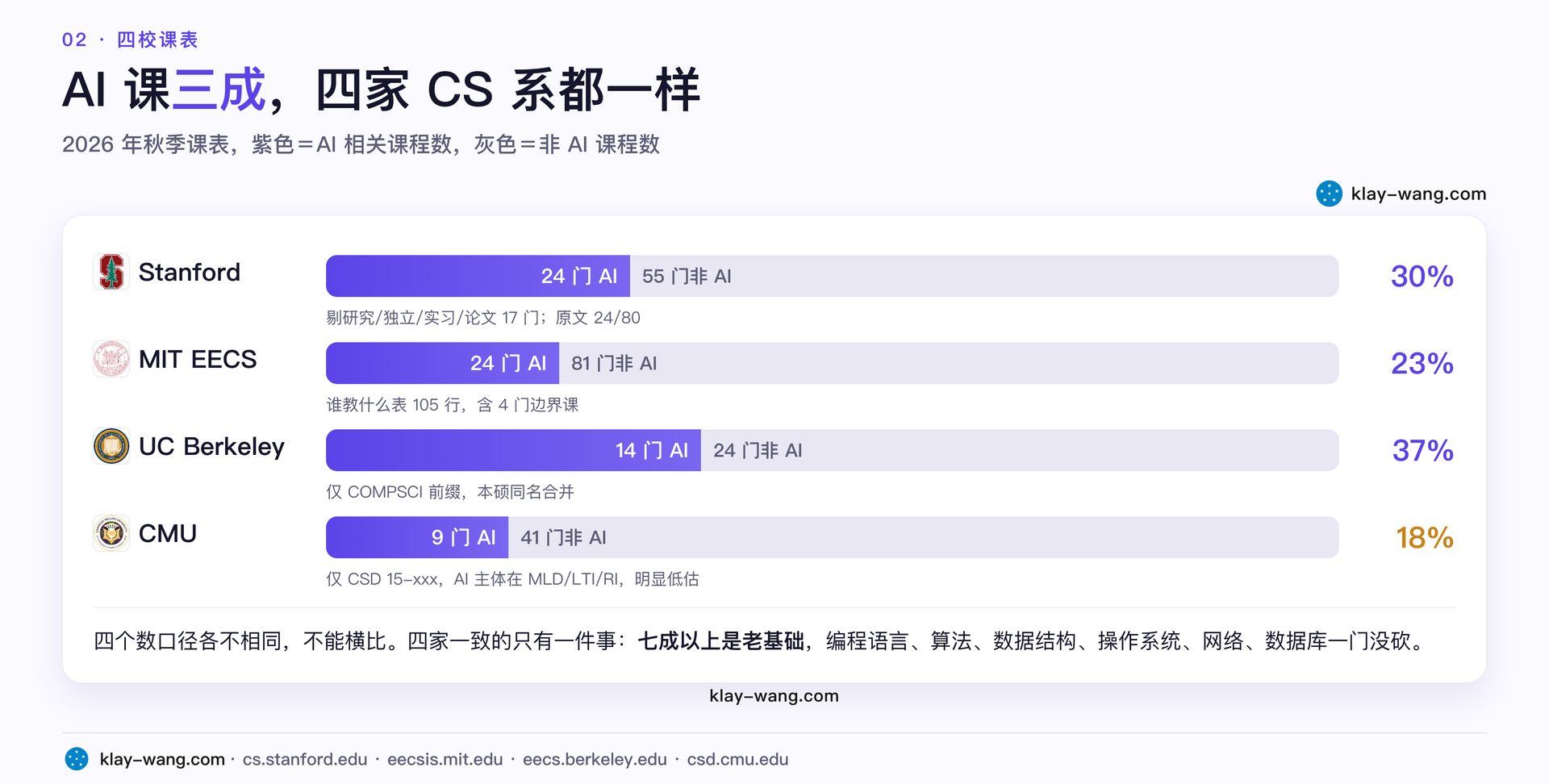
这四个百分比不能横着比:AI 课怎么算、研究课号怎么剔,没有公认的标准,换一套口径就能差好几门。CMU 的 18% 尤其低估了,它的 AI 课主体在机器学习系、语言技术研究所和机器人所,根本不在这张表里。
四家的基础课一门没少,加起来仍占 70% 以上。斯坦福秋季课表上,CS103、CS106A、CS106B、CS107 这些骨干课都在。变的有两处:老课改了内部,新课叠了上来。
老课的例子是伯克利的 CS 61A,全校最大的编程入门课。2026 年秋季改版,加了一个两周的 agent 单元,期末项目要用 coding agent 做一个大型软件;其余的基础内容一样没少,大纲写着绝大部分课业仍要学生手写出正确的程序。平时作业不许让 Copilot 或 ChatGPT 替你写代码,期末又必须用 agent,同一门课,前面不许用,后面强制用。
入门课的人也没少。CS 61A 的报名从 2025 年秋的 1269 涨到 2026 年秋的 1469,同一时期,全美四年制本科 CS 在读人数同比降了 8.4%。
新课这边,分两条线,本科教大家怎么用 agent,研究生教怎么造 agent。
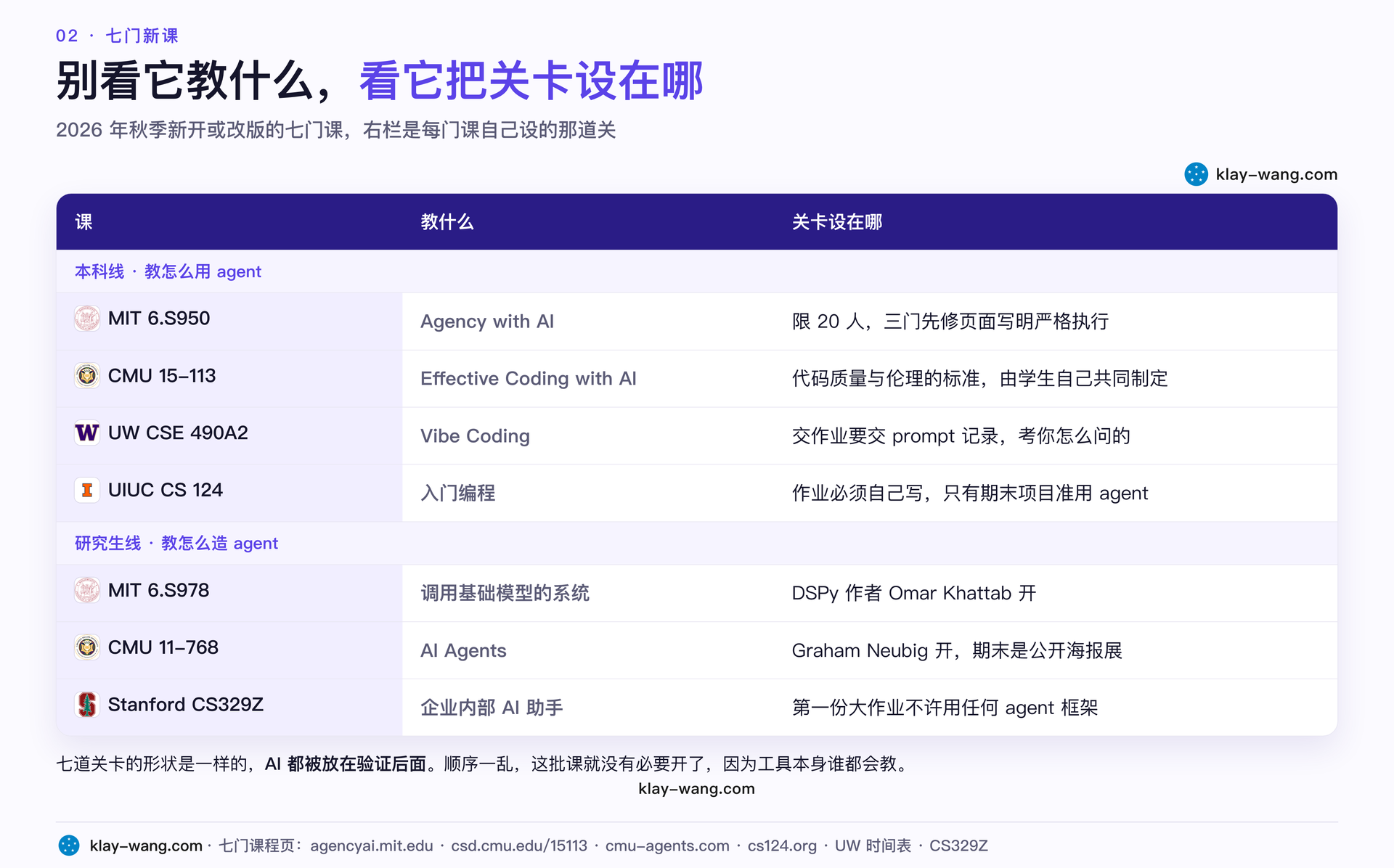
七道关卡的形状是一样的:都先设门槛,再放 AI 进来。CS329Z 不许用框架,CS 124 只有期末准用 agent,6.S950 三门先修卡死,CS 61A 的大纲把顺序写死。说白了,这批课教的是你得先会到什么程度,才轮到 AI 接手。顺序一乱,这些课就没有了开的理由。
学校里还在讨论什么时候允许用 AI,公司里工作的方式已经完全不同了。Karpathy 当年在斯坦福教过 CS231n,今年 3 月他在 No Priors 播客上说:2025 年 12 月前后,他自己写代码和交给 agent 的比例从八二开变成了二八开,基本没再亲手敲过一行代码。Notion 那边,现在所有的 pull request 都是 agent 写的,但每一个仍然要人审。写可以交给机器,审还得人来,要审得动,自己得会写。
03 考核:作业失去可信度之后
教学这块,今年动得不算多,考法变得最多。四家入门课的政策大体上分为三类。
第一类:全禁止。MIT 6.101 连让 AI 解释概念都不行,大纲把 conceptual help 也写进了禁区。CMU 15-122 要求学生关掉编辑器里的 AI 扩展,普林斯顿 COS 126、康奈尔 CS 1110、佐治亚理工 CS 1331 也在这一派。
第二类:可以用,但你得能当面讲清楚。CMU 15-112 的大纲:AI 可以用,甚至鼓励用,但拿分的唯一途径是你完全理解,能对老师或助教讲明白,最后一句是:You cannot pass the course if you over-rely on AI. It's that simple. MIT 6.100A 只准把 AI 当导师用,哈佛 CS50 只准用自家的小黄鸭机器人 CS50 Duck。斯坦福 CS106B 的助教一对一当面考核,考的也是这个。
第三类:平时作业禁,期末项目强制用 agent,就是伯克利 CS 61A。既禁又用,大纲排了三道防线:作业的全过程用一个叫 Provenance 的编辑器扩展录下来,随作业一起交;交完由一个叫 Preceptor 的 AI 当面追问,答不上来的可以改约真人;四次考试,三次改回纸笔。于是伯克利现在是用一个 AI 盘问你有没有偷用另一个 AI。它等于承认了一件别家不肯承认的事,禁令已经拦不住学生用 AI,只能让他用完之后还答得上来。
这三类做法,差别很大一部分在学校肯为此投多少人力。全禁止,出台政策最容易,但执行起来有难度;要求当面讲清楚,就得有人坐在那儿听;第三类看上去最费人,那就几样一起上。四校的助教编制和师生比,暂时没有找到可比的公开数字,所以只能按做法来推算。
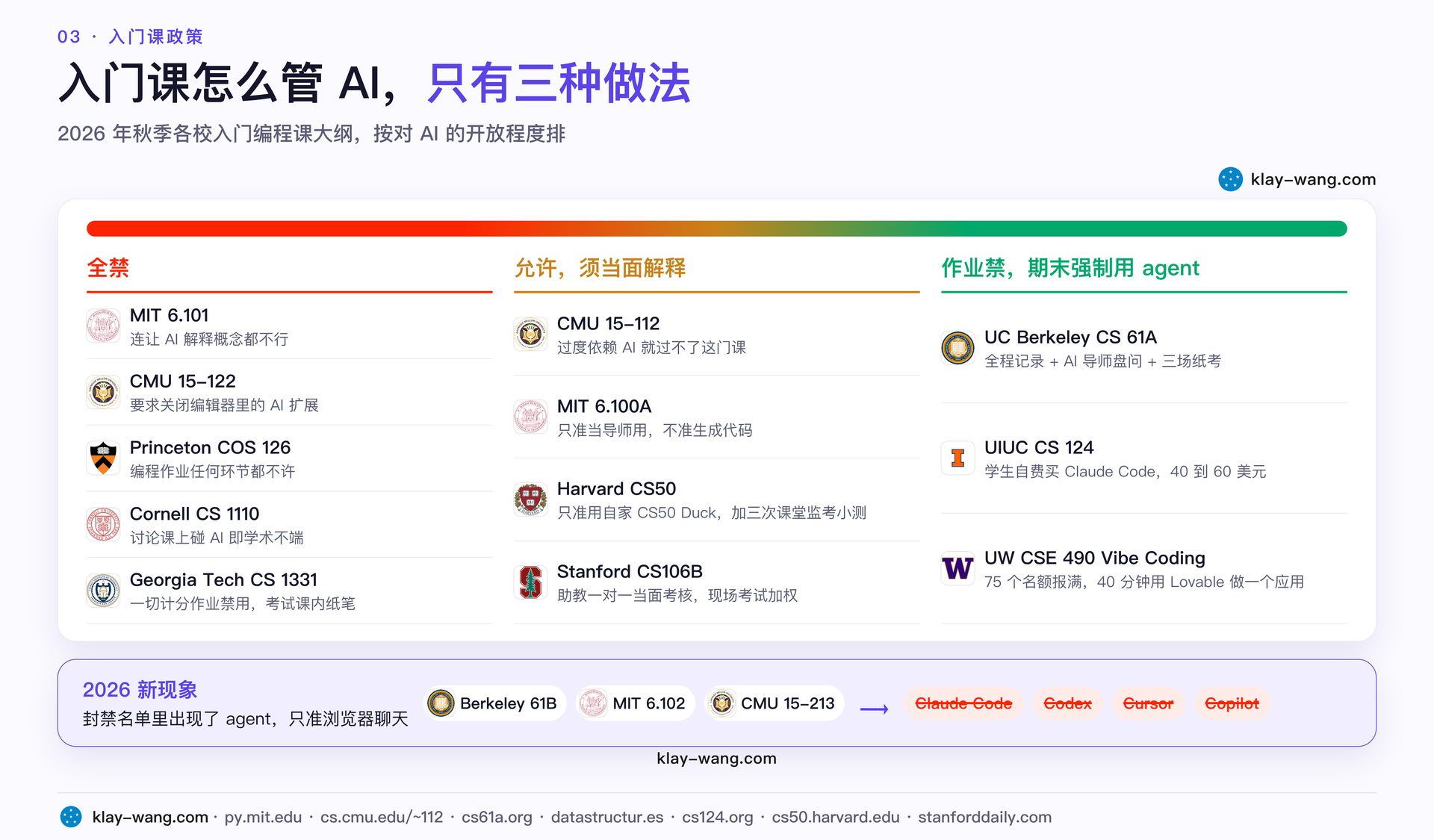
封禁名单上今年还多了 agent。伯克利 CS 61B 数据结构的政策写明,任何大模型工具都不许读取、分析或接触你的代码库,点名封了 Claude Code、Codex、GitHub Copilot、Cursor。MIT 6.102 和 CMU 15-213 措辞不同,意思一样。从打孔卡到编译器,从 Stack Overflow 到 agent,写代码的工具换了好几茬,四家顶级 CS 系要的那个证据一直没变:你得自己会。
招聘这边,已经有不少公司在面试里允许用 AI。Karat 2026 年 1 月调查了美国、印度、中国 400 位工程负责人,美国有 38% 的公司允许候选人在技术面试里用 AI,中国是 68%。David Singleton,曾经做过 Stripe CTO,2026 年 3 月在 Latent Space 播客上讲他的新公司 Dreamer 怎么招工程师:第一轮先手写代码,确认基本功在;之后让候选人用 Codex 或 Claude Code 把一个完整的产品做出来,看他怎么指挥 agent。这跟斯坦福和伯克利的排法几乎一样,先手写,最后再放开用。
学校在考场上管 agent,公司在面试里放 AI,可两边都要先看一眼,工具拿开以后,这个人脑子里还剩什么。
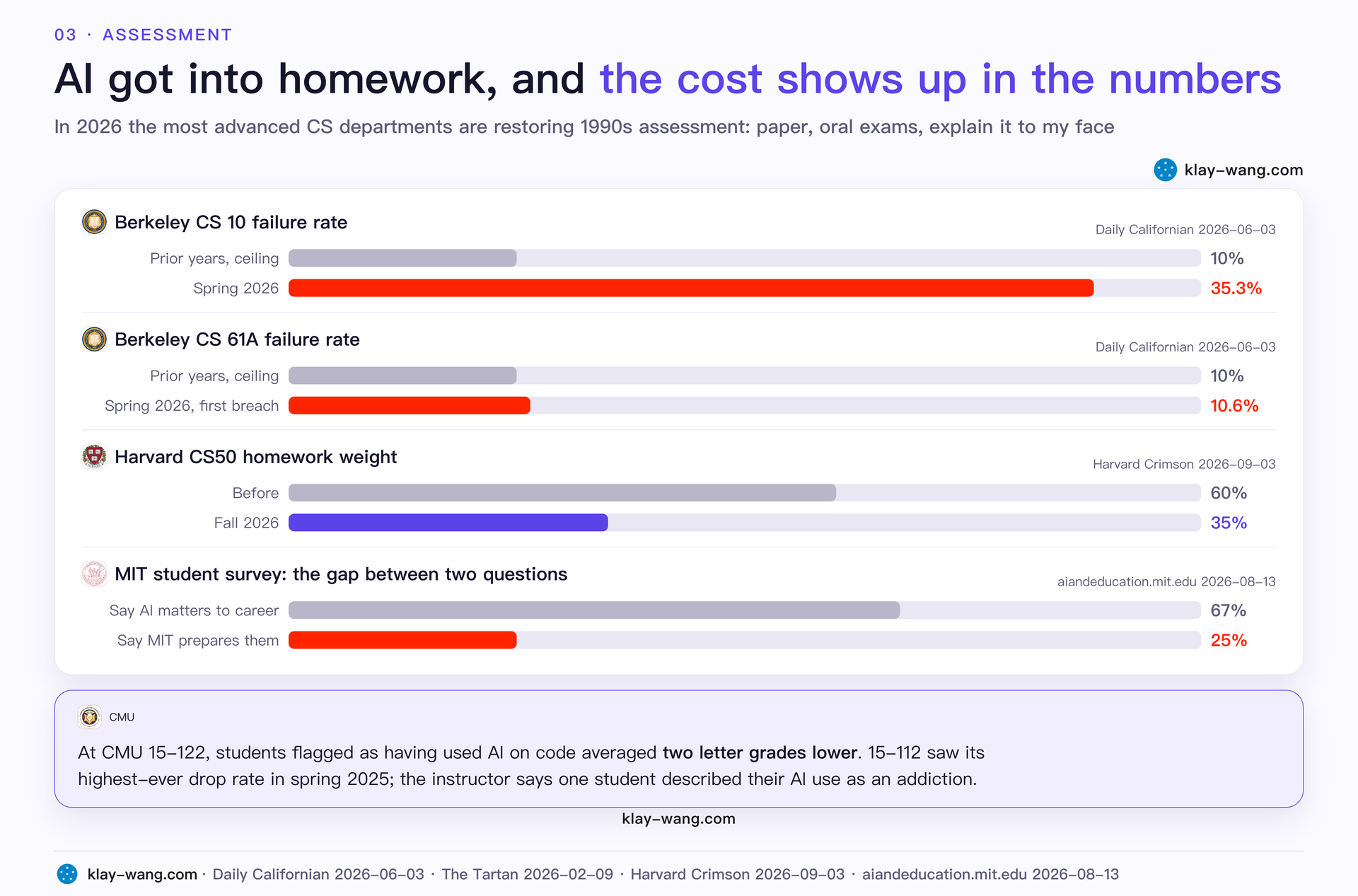
代价已经出现在数字上。伯克利 2026 年春季,CS 10 挂科率 35.3%,往年不超过 10%,教这门课的 Dan Garcia 对校报说,近 30 个学生在带回家的考试里用大语言模型作弊被抓。CMU 15-112 在 2025 年春季退课人数创了纪录,有学生来求助时,把自己用 AI 的状态形容成上瘾。
哈佛和斯坦福碰到的是同一件事:AI 答疑上线以后,真人答疑没人来了。CS50 于是加了三次课堂监考小测,作业权重从 60% 降到 35%,再加 10 分钟跟助教的当面谈话;斯坦福入门课的答疑时间,来的人也在变少。MIT 则在 2026 年 8 月发了校级报告,建议全校改用口试、作品集和课内对话这类考核。
公开记录里的多数动作,都是问题出现以后才启动的,所以这轮考核改革感觉更多是在止损,还谈不上哪一派教育理念赢了。
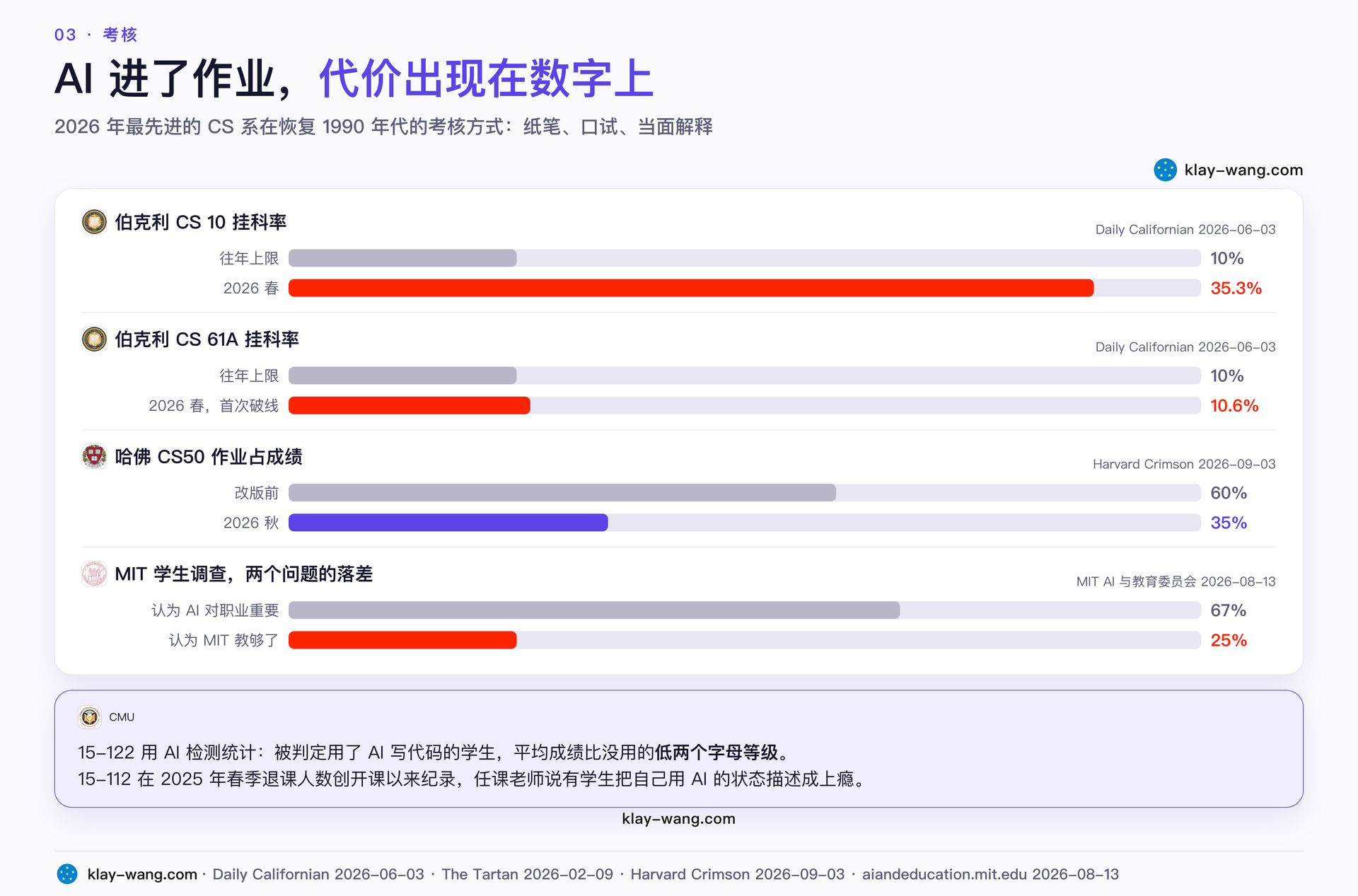
规则是学校在改,改的过程中挨罚、拿不到学位、养成坏习惯的,是刚好在这几年读书的学生。
04 教学缺人,研究缺算力
同样是把学生叫回考场,斯坦福和伯克利付出的代价完全不同。
斯坦福有钱,2025 财年的捐赠基金是 408 亿美元,它的难处是 Winstein 说的教室排不开。伯克利是公立学校,CS 专业的毕业人数,2024-25 学年 1029 人,2026-27 学年预计约 350 人,少了三分之二,这里面有多少人转去了 EECS、数据科学或别的专业,伯克利没公布。系主任 Jelani Nelson 2026 年 4 月对校报说,收缩跟学生需求没有关系,是教学成本太高;同一时期,入门课 CS 61A 的报名还在涨。
教学成本太高,听着像托词。但 2025 到 2026 财年,加州的预算给 UC 系统砍了 2.71 亿美元;2025 年 3 月 UC 全系统冻结招聘,伯克利 4 月 11 日开始执行。终身教职的薪酬砍不动,学校最容易动的是两样:不给终身教职的岗位,和招多少学生。
伯克利扩充计算与数据科学,只能高度依赖募捐。身边 Berkeley 的朋友,不止一次和我说他们几乎周周收到学校的募捐邮件。Gateway 新楼由 2020 年一笔 2.52 亿美元的匿名捐赠启动,后来三笔合计大概 7500 万美元继续支持建设,其中一笔新设了两个计算机教职。
上一节那些新考核只会让这个口子更大。一份作业可以批量打分,一次十分钟的当面追问只能一个一个来。两所学校卡住的地方不一样:斯坦福缺的是教室和执行,伯克利这边,已经把教学成本,传导到了招生名额上。
对大学来说,AI 同时抬高了两种稀缺:教学这头要人来验证,研究这头要钱和算力去追前沿。
研究经费这边,也多了不少不确定性。斯坦福 2025 财年的资助研究收入是 23 亿美元,超过七成来自联邦政府:一个面临换届、总改主意的“出资方”。不过这笔钱跟本科教学分开记账,只有间接成本回收那一块能流进学校的通用资金,对教学的影响不是一条直线。
除了钱,还有算力,算力,算力,重要的事说三遍。斯坦福自己的 AI Index 2026 年报告统计,2025 年值得关注的 AI 模型超过 90% 出自业界。多伦多大学教授、AI 制药公司 Xaira 的首席 AI 科学家 Bo Wang 说,学生进实验室,问的第一个问题往往是:你们有多少张 GPU?业界那头,Google 负责 AI 基础设施的 Amin Vahdat 面对的是另一种日常:一个 10 万张加速卡的集群,看配置,可能每小时都有东西坏掉,他们考核自己的指标叫 goodput,算的是在不停出故障的情况下,真正交付了多少有用的计算。不得不感慨:有钱真好。
十万卡规模的运维,在高校的大学实验室很难原样复刻,课堂只能教原理,给不了同等规模的现场体验。但学界也没闲着。斯坦福教授 Stefano Ermon 的实验室做出过扩散模型的早期工作,DPO 也是从他组里一个轮转项目起步的,他 2026 年 9 月在 No Priors 播客上说:难处是资源永远不够,但好处是敢下反共识的赌注。新方向学校还出得来,但最烧算力的规模化实验,越来越集中在业界。
05 对照组:同一批工具,在商学院是福利
同样的工具,走进另一栋楼,待遇完全反过来。
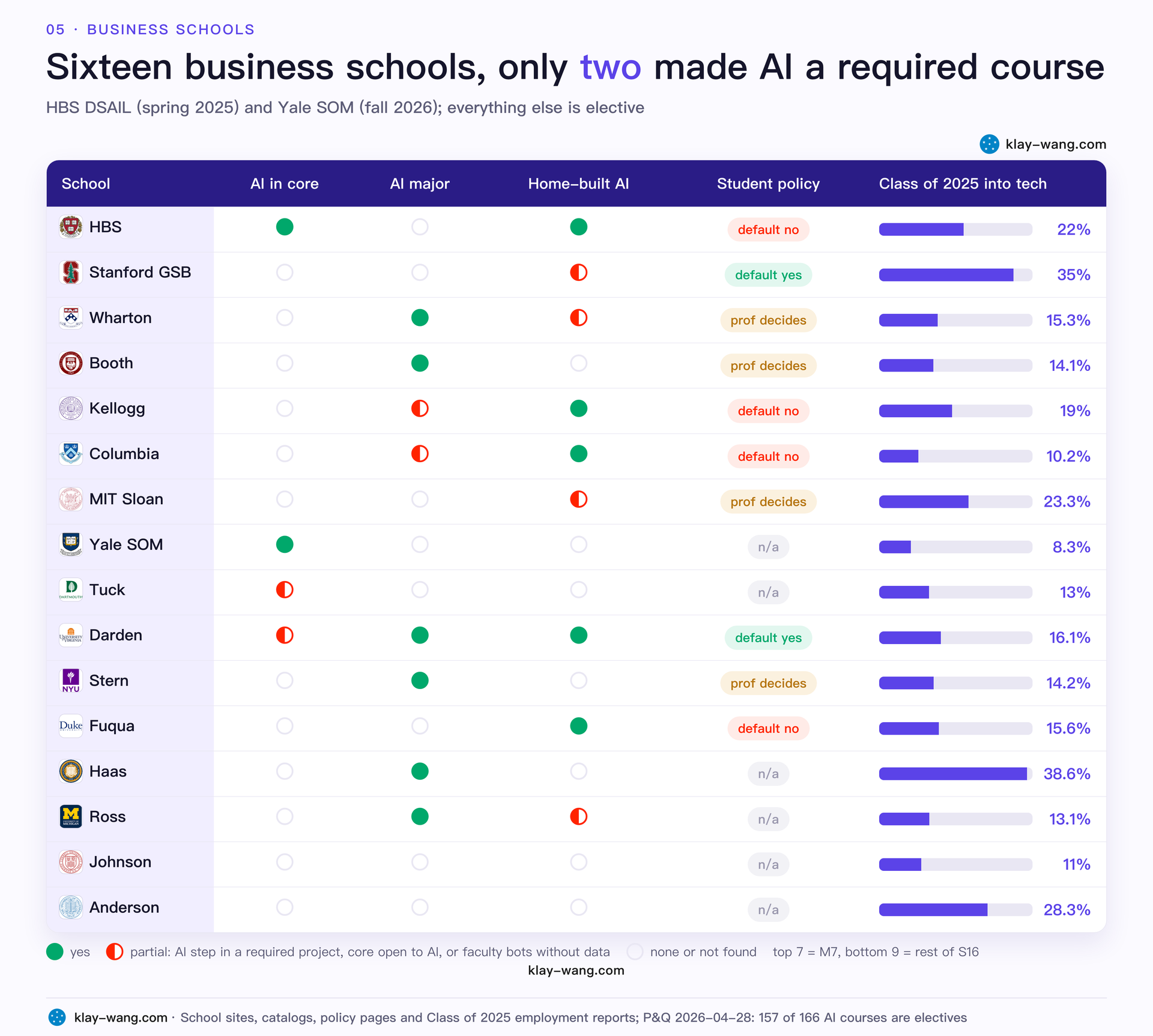
这十七家商学院里,能查到 AI 课程动作的有十六家,CMU Tepper 查不到。剩下的 16 家也俗称 S16,北美最好的商学院。单独开一门 AI 必修课的只有两家,哈佛和耶鲁;Tuck、Darden、哥大是把 AI 塞进了已有的必修环节。Poets and Quants 2026 年 4 月数过 20 家商学院的 191 门 AI 课,能归类的 166 门里,157 门是选修。这些都是学校对外发布的动作,课上到底怎么讲,从外面看不到。
哈佛(HBS)的必修课叫 Data Science and AI for Leaders,2025 年春季首开,930 名学生。课上配了一个不用写代码、用自然语言做数据分析的工具 Julius,100% 的学生用过,一个学期发了 12.67 万条消息。主讲 Karim Lakhani 说:If the 20th century was defined by the MBA wielding Excel, this century will be defined by MBAs working hand-in-hand with AI agents. 同一年,一些 CS 课程在禁 agent 碰代码库,HBS 在把 MBA 定义成跟 agent 手拉手的人。
沃顿 2025 年秋季开了 M7 第一个正式的 AI 专业,学术政策原文写着,学校给学生提供 ChatGPT、Codex、Claude、Claude Code。伯克利 CS 61B 封禁名单上的工具,沃顿当福利发。
斯坦福自己的商学院 GSB 没有必修,AI 选修开了 30 门,M7 里最多。它的学生 AI 政策也是七家里最松的,2026 年 8 月 31 日更新的版本写着:老师不得禁止学生在带回家的作业和考试里用 AI,只能决定课堂内能不能用。同一所学校,CS 系在把学生叫回考场,商学院规定老师不准禁 AI。
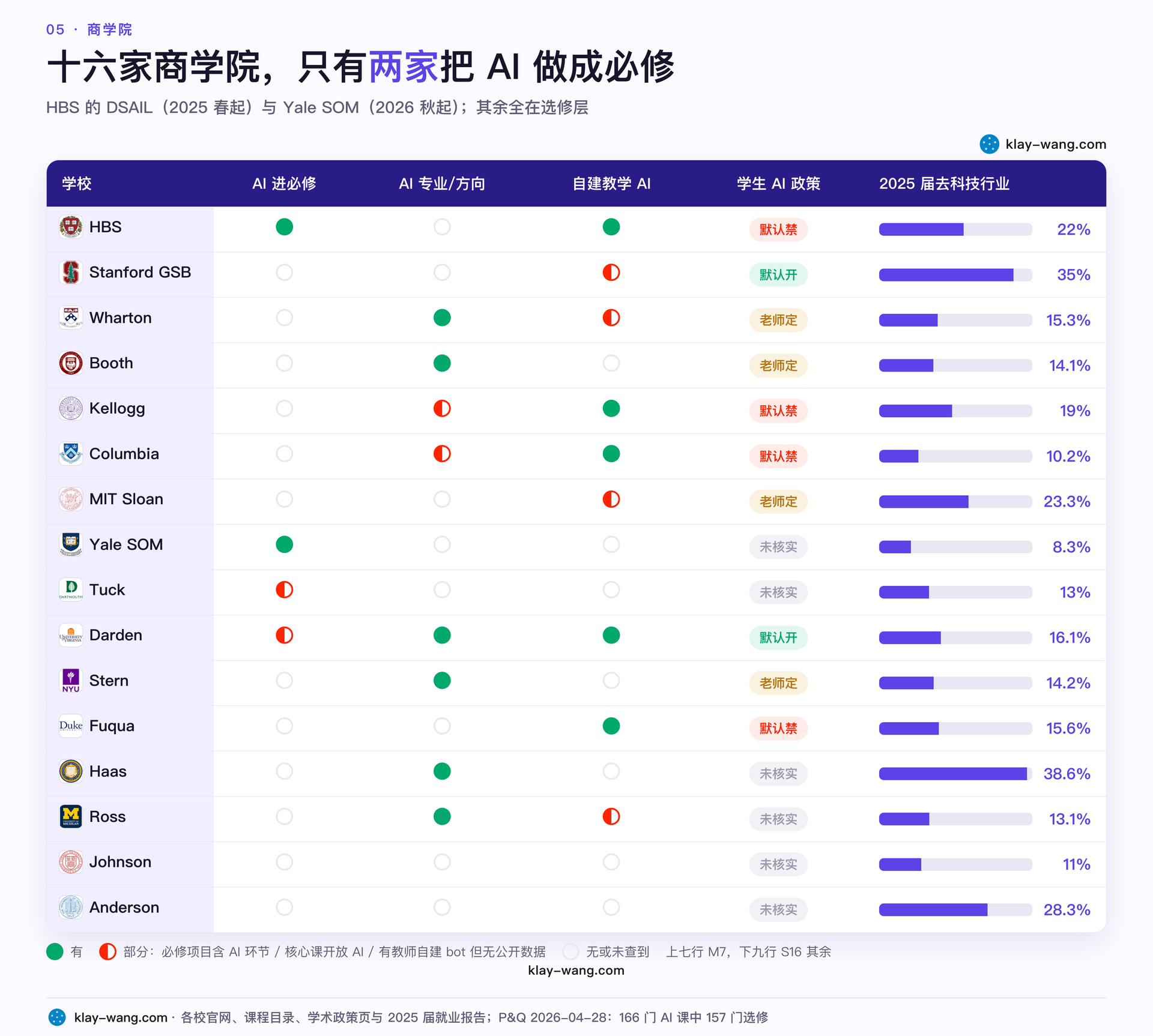
两边的账也完全反过来。CS 系每加一道验证,就得多排一个人的时间。商学院多开一个企业版账号,是一笔谈得下来就发得出去的采购,比多排一场口试容易规模化得多,所以也证明不了什么。一套纸笔加口试加过程记录的办法,要老师、要考场、要年年掏得出的那笔钱,别的学校想抄,得先有这些。
商学院和 CS 两边态度差这么远,我觉得主要是兜的错误成本不一样。工程上放过去的一个错会跑进生产系统,所以 CS 系要先确认你在工具失灵的时候接得住。管理教育要你定义问题、配资源、拍板,AI 在这里更像一把分析工具,放手用的代价没那么直接。
所以两张学位,难的地方不一样。CS 学位难,难在学校排得出多少考核和名额;MBA 这边,本质上卖的还是名字和人脉。
06 反面论证
有几个人的说法能直接动摇上面这套东西。
第一个来自商学院内部。哥大的教授 Daniel Guetta 在校内研讨会上说,编程给你的是一种结构化的思考方式,而 vibe coding 的问题是把孩子和洗澡水一起倒掉了。
第二个是一个实验数据,沃顿的 Hamsa Bastani 做过一个实验,土耳其近 1000 名高中生,用无护栏 GPT 练习的那组成绩涨了 48%,随后不用 AI 的考试,下降了 17%;而用有护栏的 GPT 导师练习的那组,考试跟对照组持平。两边都能拿它当论据:没护栏的组一离开 AI 就掉分,说明要看出真本事,得在不用 AI 的时候考;有护栏(只给提示,不给答案)的组跟对照组持平,至少说明在这次实验里,AI 导师没有削弱学生离开 AI 以后的考试表现。但它只测了教,没测 AI 能不能替老师做第一轮追问。如果能,前面说的验证没法大规模交给机器,就要改。
学生层面,也有人在反对。斯坦福商学院的学生 2025 年 7 月公开批评自己的学校,说 AI 在让 MBA 贬值,你在学的是给 ChatGPT 写提示词,编程一行没学,好几门课的考试平均分是 99。平均分 99 不能证明学生没学到东西,但说明成绩已经很难承担筛选的功能,学位的区分度会更多落到学校的名字上。
07 对于个体意味着什么?
AI 进入大学后,钱的流向也在变。AI 公司拿走了新增的订阅费,学校付出的是:监考、口试和追问的人力成本,学费买到的东西里,学生获得讲解和第一轮反馈越来越便宜,学校提供可信的验证和背书越来越贵,雇主拿到证书,面试时还要再验证一遍。
如果你现在在读 CS,或者家里有孩子要去读,光看课表,肯定是不够了。更该关注的是这门课怎么考,有没有闭卷,有没有口试,老师会不会看你的过程记录。学费买到的,就是离开 AI 以后,你还能拿什么证明自己会。高阶课能不能碰到真实的代码库、真实的公司、真实的客户,比课名里有没有 AI 两个字重要得多。
如果你是老板,在招工程师。简历上的项目正在快速贬值,一个漂亮的 GitHub 仓库,可能一个下午就能做出来。所以面试会越来越像答辩,让人解释为什么这么取舍,追一个他没写过的 bug,改一段陌生的代码,说清楚哪部分是工具做的。斯坦福和伯克利现在花人力做的就是这件事,在学校的时候考一遍,你面试时,再考一遍。
如果在选学校,开了多少门 AI 课说明不了什么东西,要看它考得有多严。口试比例、课内考核占比、入门课容量、这所学校有没有钱多请老师,这四样,是我判断一张学位三年后还值多少钱时会看的东西。
08 写在最后
斯坦福守了 105 年不监考,今年秋天开始可以监考了;伯克利把考试改回纸笔;CMU 改了作业形态,MIT 停在一份校级建议。同一批被 CS 系封禁的工具,在商学院是发给学生的福利。验证只有一半能交给机器,学生一旦不服要人来判,还得占掉一个老师的时间。
未来,AI 对高校的影响,我还是会先看斯坦福:监考会扩到多少门课,CS106B 的当面考核,会不会如期进入 CS106A。再看看伯克利 CS 毕业人数 2027-28 学年能不能止跌,靠什么止跌,募捐、涨学费,还是降验证标准。
斯坦福还有一样别的学校学不来的东西。前沿既然搬去了公司,斯坦福的办法是把公司的人请进教室。课表里 AI 课占三成,别的学校照着开就是;难复制的,是 CS153 那份讲者名单。
这门课叫 Frontier Systems,2026 年春季开,不在上面那张秋季课表里。两位主讲 Anjney Midha 和 Michael Abbott 来自同一家公司 AMP PBC,一个在 a16z 待过,一个在 Kleiner Perkins 待过。官网在册 26 组讲者,按行当排下来,是一张 AI 产业链的横截面:
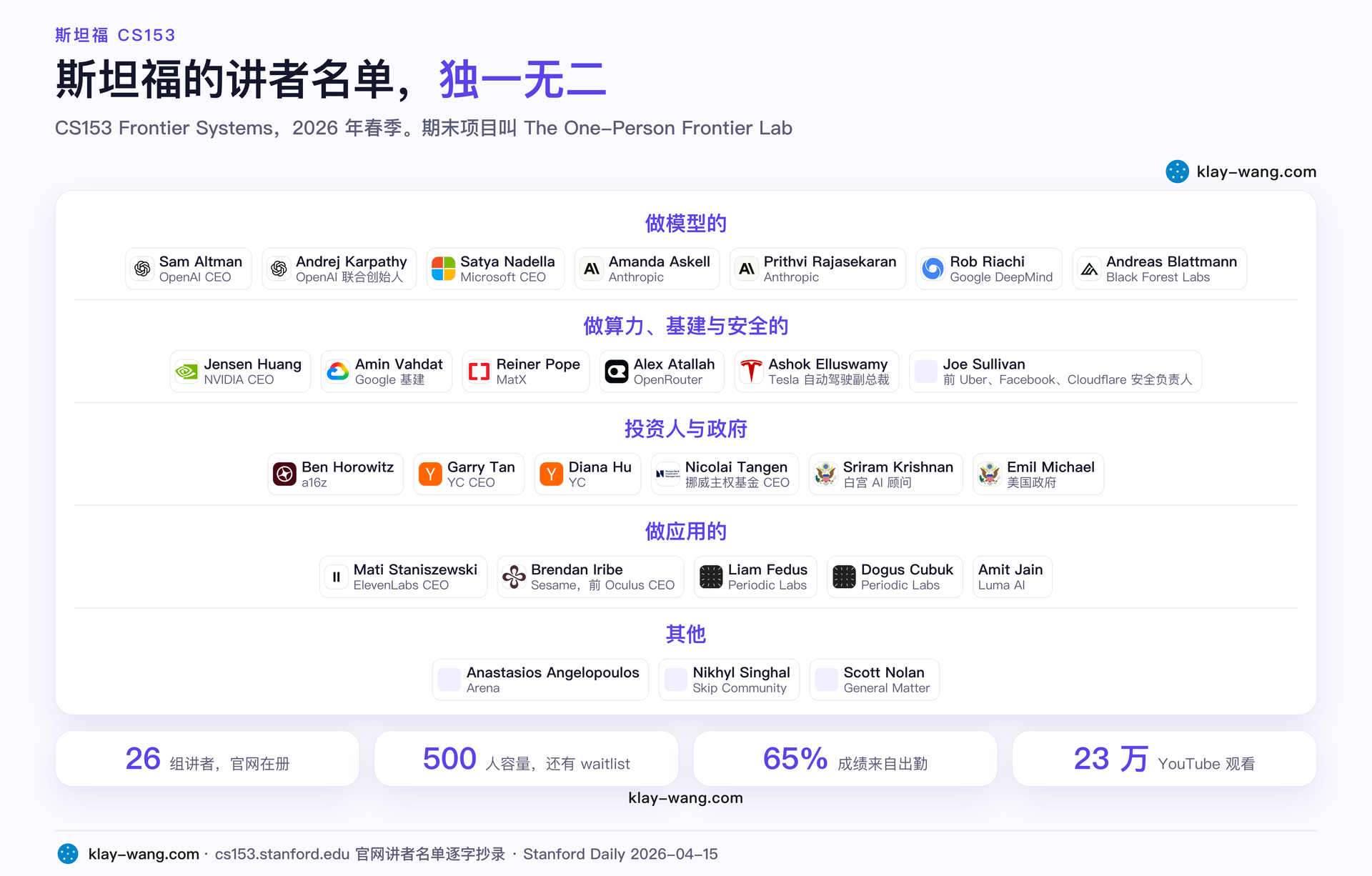
一周两次课,评分 65% 看出勤、35% 看期末项目。500 人的容量仍然排着 waitlist,开场那节课的视频在 YouTube 上已经超过 23 万次观看。名单上也有微软、挪威主权基金和美国政府这些不在本地的,湾区解释不了整份名单,但它确实把其中相当一部分人到场的成本压到了很低。课表能抄,这个课程阵容和湾区的半径,谁也抄不走。
这门课的期末项目叫 The One-Person Frontier Lab,问的是一个人加上合适的工具,十周里能扩到多大。这道题我今年自己答过:几个 agent 一起跑,到第七个左右,团队没乱,我先乱了。有一天上游数据跟往常对不上,我分不清是源头变了、接口坏了,还是自己的程序有 bug。代码可以让工具写,认出哪里不对的那一下,只能自己来。斯坦福把学生叫回考场,当着助教的面证明自己会,练的就是这一下。
可学校证明完了,市场认不认?雇主和投资人花钱买的,到底是哪一种证明?答案可能两种都不是。下篇写市场那一头。
出处(含课程与校方原页、媒体报道和行业报告)
斯坦福考核:Stanford Daily 2026-03-07《A new wave of education: From undergraduates to Ph.D.s, how is AI shifting classroom policies?》、2026-04-24《Faculty Senate authorizes exam proctoring》、2026-05-20《Stanford to begin exam proctoring following pilot program》;Academic Integrity Working Group 2025-26 学年监考试点说明(CS103 课程站)。 课表:cs.stanford.edu 秋季课表;eecsis.mit.edu 谁教什么表;www2.eecs.berkeley.edu 秋季课表;csd.cmu.edu 秋季课程列表。 新课:agencyai.mit.edu(6.S950);mit-oasys.github.io/ai-engineering(6.S978);cmu-agents.com(11-768);csd.cmu.edu/course/15113/f26 与 www.cs.cmu.edu/\~113(15-113);cs153.stanford.edu;Stanford Daily 2026-04-15;UW 秋季时间表与 cse490A2 公开仓库;www.cs124.org/syllabus(UIUC)。 政策原文:py.mit.edu/fall26/info/ai(6.101);www.cs.cmu.edu/\~112/syllabus.html;www.cs.cmu.edu/\~15122/syllabus.shtml;cs61a.org/fa26/syllabus 与 cs61a.org/cs194-fa26;fa26.datastructur.es/policies(61B);web.mit.edu/6.102/www/sp26;www.cs.cmu.edu/\~213/academicintegrity.html;cs50.harvard.edu/college/2026/fall/syllabus。 考核与代价:Daily Californian 2026-06-03 与 2026-04-16;The Tartan 2026-02-09;Harvard Crimson 2026-09-03;aiandeducation.mit.edu/report(2026-08-13)。 财务:加州立法分析办公室《The 2026-27 Budget: University of California》;UC 招聘冻结与伯克利执行方案见 evcp.berkeley.edu,2025-03 至 2025-04;伯克利计算与数据科学学院筹款与新楼见 cdss.berkeley.edu《Gateway groundbreaking brings new opportunity for computing, data science》与 inspire.berkeley.edu《Three gifts transform computing and data science at Berkeley》;NSF NCSES《Higher Education Research and Development Survey》FY2024;facts.stanford.edu 资助研究收入与联邦占比;NACUBO-Commonfund 2025 年度捐赠基金研究(斯坦福 FY2025)。 入学:National Student Clearinghouse 2026-08-11。 商学院:Poets and Quants 2026-04-28、2026-04-22、2025-07-24;hbs.edu/news 2025-03-28;tlhub.stanford.edu 2026-08-31;news.wharton.upenn.edu 2025-04-02 与 mba-inside.wharton.upenn.edu 学术政策;business.columbia.edu/insights;mitsloanedtech.mit.edu/tools/claude;kellogg.northwestern.edu 2025-05-30;som.yale.edu 2026-05-26。 业界:karat.com 2026-01-07《AI Use in Technical Interviews》(400 位工程负责人);hai.stanford.edu 2026 AI Index 研发章;No Priors 播客 Andrej Karpathy 一期 2026-03-20、Notion Simon Last 一期 2026-03-12、Stefano Ermon 一期 2026-09-18;Latent Space 播客 David Singleton 一期 2026-03-20、Xaira Bo Wang 一期 2026-07-21;Sequoia Training Data 播客 Amin Vahdat 一期 2026-10-06。 反面论证:knowledge.wharton.upenn.edu(Bastani 实验);哥大校内研讨会报道。
AI has made learning to code cheap. The hard part now is proving a student can actually do it. Only half of that job can be handed to a machine. The other half takes teachers, exam rooms, and time.
In the age of AI, the argument over whether elite universities are still worth it has never stopped.
So, mostly out of curiosity, I talked with friends in the US who are studying CS or doing MBAs, then looked at the place at the center of the AI boom, the Bay Area. I pulled up the course catalogs at Stanford and Berkeley to see what students at the very best universities in the world are actually learning.
Stanford has a rule that is more than a hundred years old: exams are not proctored. The Honor Code, adopted in 1921, says faculty will not take unusual or unreasonable precautions to prevent cheating, and proctoring counted as one of them. Honesty was the responsibility of the students themselves. On April 23, 2026, Stanford's Faculty Senate voted unanimously to allow proctoring of in-person exams. The Undergraduate Senate and the Graduate Student Council voted in favor as well, and the change takes effect this fall.
Cheating and students who don't report it are old problems at Stanford. AI pushed them past the tipping point. Brian Conrad, a professor of mathematics, put it this way: AI is a challenge for colleges everywhere, and the genie is not going back in the bottle. Keith Winstein, an associate professor of computer science, said that because of AI he now sees the merits of proctoring, but finding enough classrooms is a serious practical problem.
The introductory CS courses had already started changing. CS106B added one-on-one, in-person assessments with TAs, with plans to bring them to CS106A. In-person midterms and finals now carry more weight, take-home assignments less. CS106B's own data showed that students who used AI on assignments did worse on exams. Then, in the senior capstones, CS194 and CS210, AI is explicitly allowed. Tight at the start, open at the end.
In 2026, a year in which AI can write a thousand lines of code a day, one of the best CS departments on the planet is calling students back into the room, sitting them down, and having them prove in front of a TA that they know how to do this. Kind of fascinating, right?
Is the school resisting AI? I don't know. I pulled Berkeley's, MIT's, and CMU's fall catalogs and intro course policies too. All four schools are strictest at the same point: assessment. When a piece of homework comes in, can it still prove the student knows how to do it? On September 13, an article about Stanford's course catalog concluded that Stanford is training students to leave behind two kinds of evidence: proof that you can do it yourself, and proof that you can do bigger things with AI.
Then I looked at seventeen business schools. All four CS departments teach both kinds of evidence, but they only vouch for the first. The ones selling the second as a feature are the business schools next door.
01 The scarce thing has moved
For the past twenty years, these departments spent most of their money on taking someone who couldn't code and teaching them to code well, well enough to land a good job. Courses, TAs, homework, projects, office hours: the whole apparatus was built around that one job. And it really was hard, which is why a good CS department was valuable, a good PhD commanded a high salary, and big tech snapped them up the day they graduated.
Since AI arrived, learning to code has gotten much easier for students. AI is online 24 hours a day, and you can ask it the same question twenty times without it getting annoyed. UIUC's CS 124 went ahead and wrote Claude Code into the syllabus as the textbook, which students buy themselves at $20 a month. For a student, the cost of getting a concept explained and getting a first round of feedback has collapsed over the last two years. On the school's side, the cost of courses, faculty, and TAs has not necessarily come down with it.
For the school, the hard problem is now a different one: when a student hands in code that runs, how does the teacher know whether the student can actually do it, or the tool can?
Stanford and Berkeley landed on the same answer: bring people back into the room. It sounds old-fashioned, but every one of these elite CS schools is heading the same way.
The problem is that this approach depends on manpower. Printing exams takes people, proctoring takes people, grading takes people, and an oral exam means one teacher sitting there listening to one student talk for twenty minutes. AI can run the first round of questions for the teacher, but if a student says I got that right and you graded it wrong, someone still has to sit down and listen. Screening got cheaper. Judgment and sign-off did not, and both come out of the same budget.
Most of the unusual moves these four schools made this year point at that gap. Cheating, class size, and honor codes each explain part of it too.
02 The catalog: 70% untouched, new courses stacked on top
That article only counted Stanford.
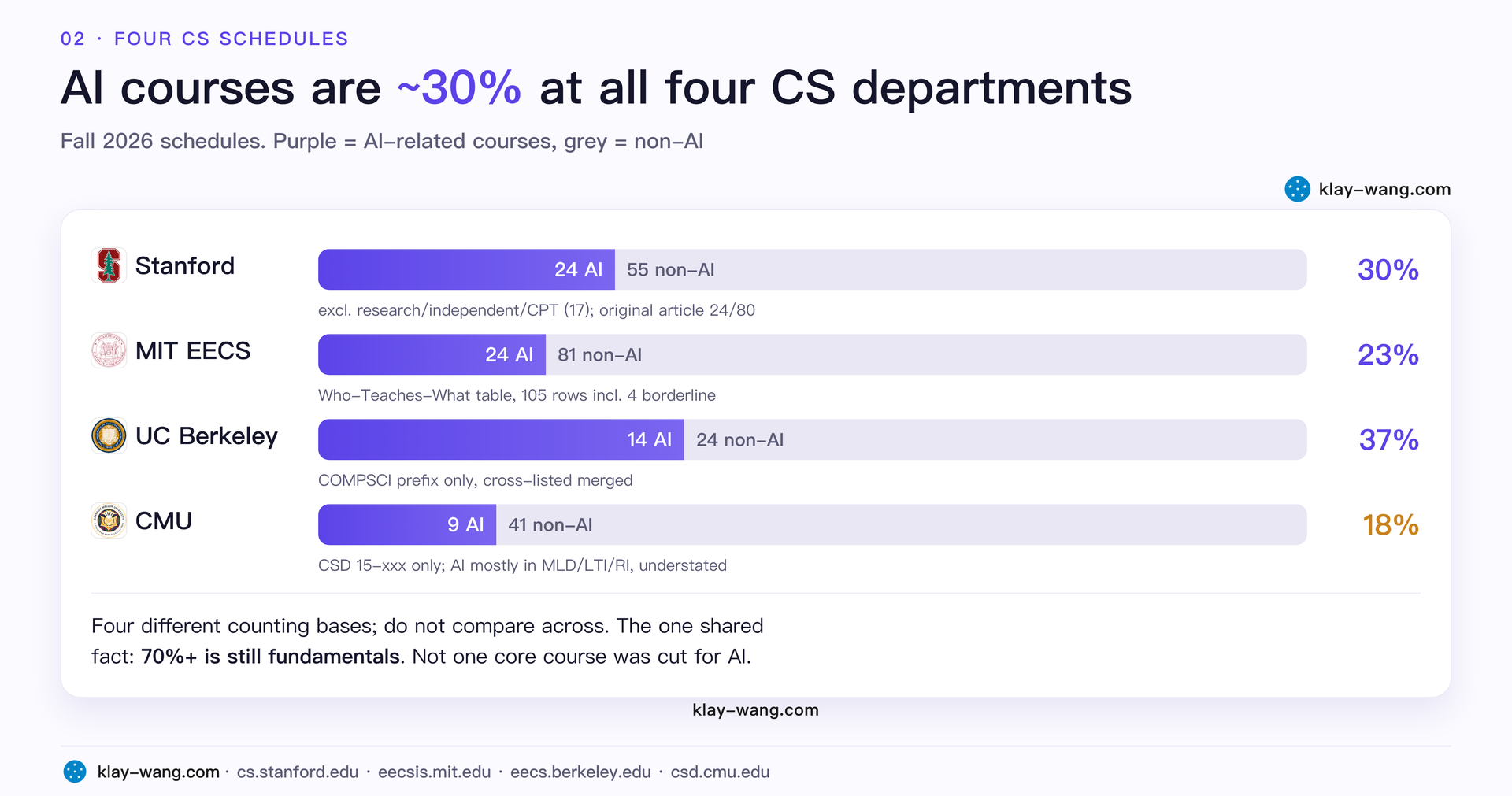
These four percentages can't be compared side by side. There is no agreed standard for what counts as an AI course or which research course numbers to drop, and a different method can move the count by several courses. CMU's 18% is especially low: most of its AI teaching lives in the Machine Learning Department, the Language Technologies Institute, and the Robotics Institute, none of which are in this table.
Not one core course disappeared at any of the four schools, and together they still make up more than 70% of the catalog. Stanford's fall schedule still has the backbone courses, CS103, CS106A, CS106B, CS107. Two things changed: old courses were reworked from the inside, and new courses were stacked on top.
The clearest example of an old course is Berkeley's CS 61A, the biggest intro programming course on campus. The Fall 2026 version adds a two-week agent unit, and the final project requires students to build a large piece of software with a coding agent. Everything else in the foundations stays, and the syllabus says most coursework still requires students to write correct programs by hand. On regular homework you may not let Copilot or ChatGPT write your code; on the final project you must use an agent. Same course: banned at the start, mandatory at the end.
The intro course isn't losing students either. CS 61A enrollment rose from 1,269 in Fall 2025 to 1,469 in Fall 2026, while nationally, enrollment in four-year undergraduate CS programs fell 8.4% year over year.
The new courses split into two tracks: undergraduates learn how to use agents, graduate students learn how to build them.
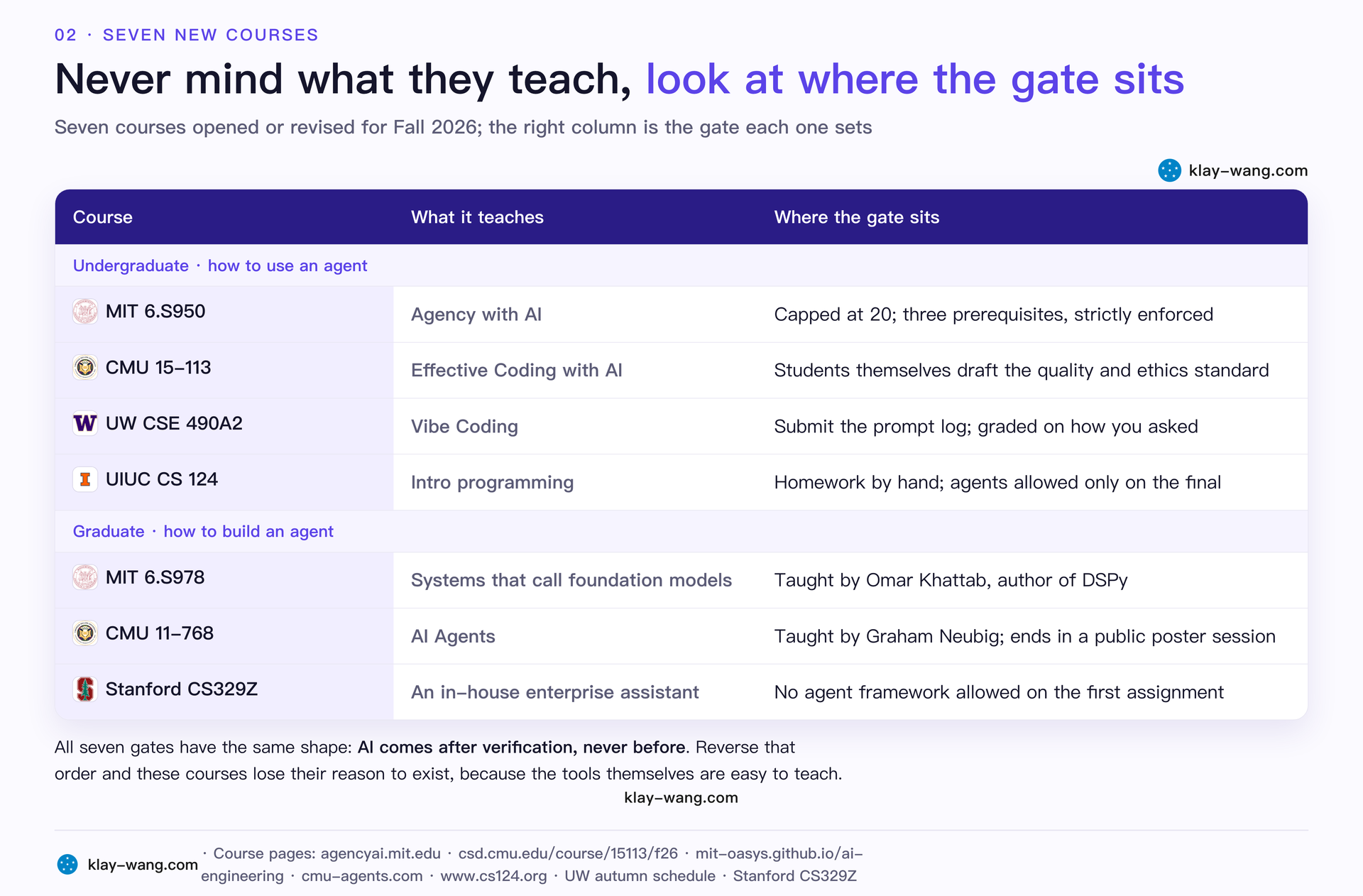
All seven gates have the same shape: set a bar first, then let AI in. CS329Z bans frameworks, CS 124 allows agents only on the final project, 6.S950 locks the door behind three prerequisites, and CS 61A writes the order into the syllabus. Put plainly, these courses teach how much you have to know before AI gets its turn. Get the order wrong and the courses lose their reason to exist.
While schools are still debating when to allow AI, work inside companies already looks completely different. Karpathy, who once taught CS231n at Stanford, said on the No Priors podcast in March 2026 that around December 2025 his split between writing code himself and handing it to agents flipped from 80/20 to 20/80, and that he has barely typed a line of code since. At Notion, every pull request is now written by an agent, and every one is still reviewed by a person. Writing can go to the machine. Review still takes a human, and to review it you have to be able to write it.
03 Assessment: after homework stopped being trustworthy
Teaching itself didn't change all that much this year. How students are tested changed the most. The intro course policies at the four schools fall roughly into three groups.
Group one: ban it outright. MIT 6.101 doesn't even let AI explain concepts; the syllabus puts conceptual help off limits too. CMU 15-122 has students turn off AI extensions in their editors. Princeton's COS 126, Cornell's CS 1110, and Georgia Tech's CS 1331 are in the same camp.
Group two: you can use it, but you have to be able to explain your work in person. The CMU 15-112 syllabus: AI is allowed, even encouraged, but the only way to earn points is to fully understand your code and be able to explain it to an instructor or TA. Its last line: You cannot pass the course if you over-rely on AI. It's that simple. MIT 6.100A allows AI only as a tutor, and Harvard's CS50 allows only its own rubber duck bot, the CS50 Duck. Stanford CS106B's one-on-one TA assessments test the same thing.
Group three: ban it on homework, require an agent on the final project. That is Berkeley's CS 61A. To ban and require at once, the syllabus sets up three lines of defense: an editor extension called Provenance records your entire process of writing an assignment and gets submitted with it; after you turn it in, an AI called Preceptor questions you about your code, and if you can't answer you can book a human instead; and of four exams, three are back on paper. So Berkeley is now using one AI to interrogate you about whether you secretly used another AI. In effect it admits something the other schools won't: a ban can no longer keep students away from AI, so the course can only make sure they can still answer for the work afterward.
A large part of the difference between these three approaches is how much manpower a school is willing to put on the job. A ban is the easiest policy to issue and the hardest to enforce. Explaining in person means someone has to sit there and listen. Group three looks like the most labor-hungry, so it runs several mechanisms at once. I haven't found comparable public figures on TA headcount or student-faculty ratios across the four schools, so this can only be inferred from how each approach works.
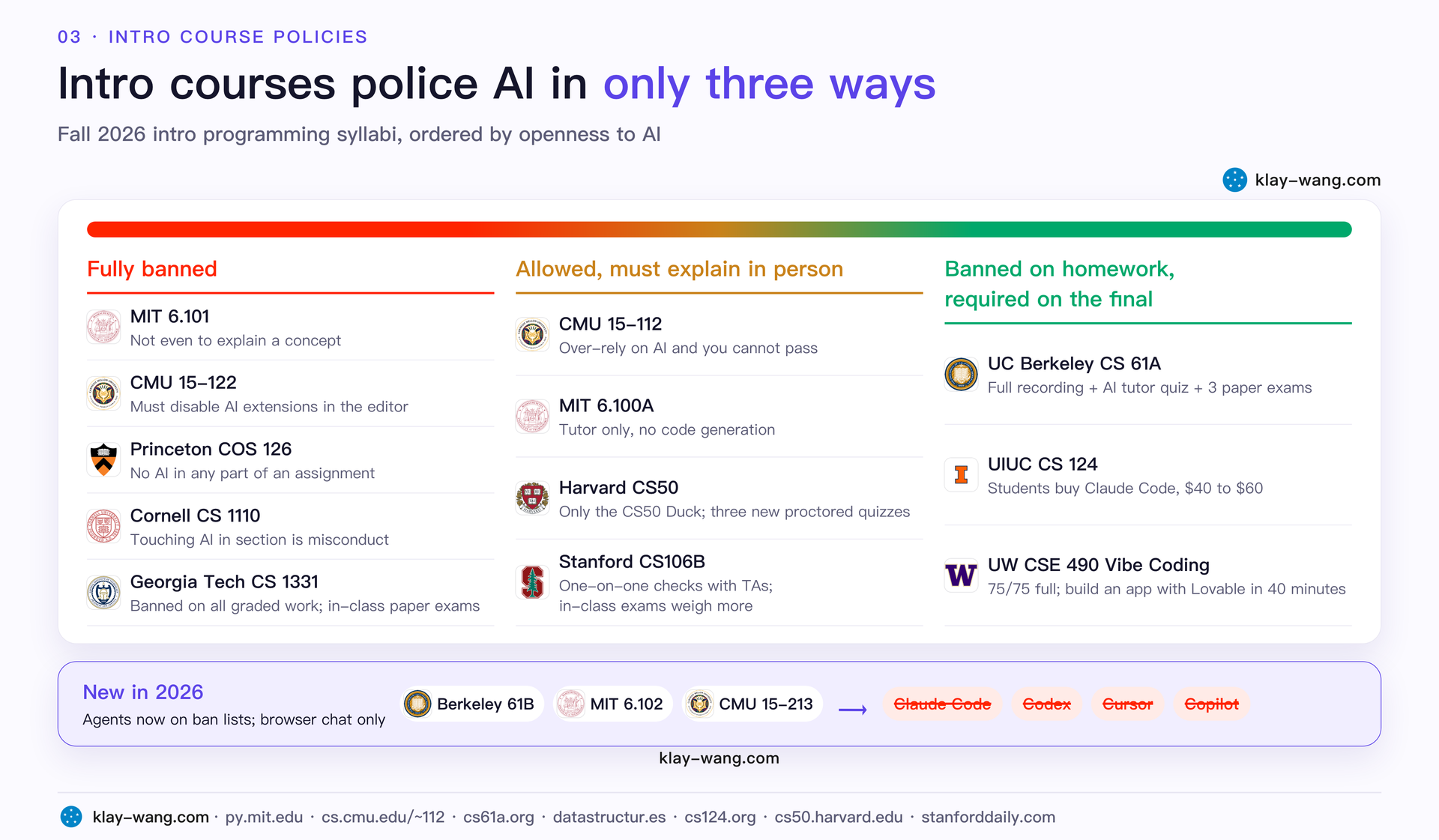
This year agents joined the banned list. Berkeley's CS 61B data structures policy says no large language model tool may read, analyze, or interface with your codebase, and it names Claude Code, Codex, GitHub Copilot, and Cursor. MIT 6.102 and CMU 15-213 word it differently and mean the same thing. From punch cards to compilers, from Stack Overflow to agents, the tools for writing code have turned over several times, and the evidence these four top CS departments want has never changed: you have to be able to do it yourself.
On the hiring side, plenty of companies already allow AI in interviews. Karat surveyed 400 engineering leaders in the US, India, and China in January 2026: 38% of US companies let candidates use AI in technical interviews, and 68% in China. David Singleton, the former CTO of Stripe, described on the Latent Space podcast in March 2026 how his new company, Dreamer, hires engineers: first a hand-coding screen to make sure the fundamentals are there, then the candidate builds a complete product with Codex or Claude Code while the team watches how they direct the agents. That is almost exactly how Stanford and Berkeley sequence it: write by hand first, open up the tools at the end.
Schools are policing agents in the exam room and companies are allowing AI in the interview, but both want one look first: with the tools taken away, what is left in this person's head?
The cost is already showing up in the numbers. In Spring 2026, Berkeley's CS 10 had a failure rate of 35.3%, against no more than 10% in earlier years; Dan Garcia, who teaches it, told the campus paper that nearly 30 students were caught using large language models to cheat on take-home exams. CMU's 15-112 had a record number of drops in Spring 2025, and one student who came for help described their AI use as an addiction.
Harvard and Stanford ran into the same thing: once AI help went live, people stopped coming to human office hours. CS50 responded by adding three proctored in-class quizzes, cutting the weight of homework from 60% to 35%, and adding a ten-minute in-person conversation with a TA. At Stanford, turnout at intro course help hours has been falling too. MIT, for its part, issued a university-wide report in August 2026 recommending oral exams, portfolios, and in-class conversations as forms of assessment.
Most of the moves on the public record started after a problem had already appeared, so this round of assessment reform feels mostly like damage control. It is too early to say any pedagogical camp has won.
The schools are the ones changing the rules. The people paying for the changes, through penalties, missed degrees, and bad habits, are the students who happen to be enrolled right now.
04 Teaching is short of people, research is short of compute
Stanford and Berkeley are both calling students back into the exam room, but the price each one pays is completely different.
Stanford is rich: its endowment was $40.8 billion in fiscal 2025, and its constraint is the one Winstein named, finding enough rooms. Berkeley is a public university. Its number of CS graduates was 1,029 in 2024-25 and is projected at about 350 in 2026-27, down by two thirds. How many of those students moved to EECS, data science, or other majors, Berkeley hasn't said. Department chair Jelani Nelson told the campus paper in April 2026 that student demand was not behind the shrinkage and that the cause was the high cost of teaching; over the same period, enrollment in the intro course CS 61A kept rising.
The cost of teaching sounds like an excuse. But for fiscal 2025-26, California's budget cut $271 million from the UC system, and in March 2025 the UC system froze hiring, which Berkeley began enforcing on April 11. Tenured faculty salaries can't really be cut, so a school can most easily move two levers: not opening tenure-track positions, and how many students it admits.
To expand computing and data science, Berkeley has had to lean heavily on fundraising. Friends of mine at Berkeley have told me more than once that they get fundraising emails from the school almost every week. The new Gateway building was launched by an anonymous $252 million gift in 2020, and three later gifts totaling about $75 million continued to fund construction, one of which also created two new computing faculty positions.
The new forms of assessment from the last section only widen the gap. Homework can be graded in batches; a ten-minute in-person follow-up has to happen one student at a time. The two schools are stuck in different places: what Stanford lacks is rooms and execution, while Berkeley has already passed the cost of teaching through to the number of students it admits.
For universities, AI has raised two kinds of scarcity at once: teaching needs people to do the verifying, and research needs money and compute to keep up with the frontier.
Research funding has also become much less certain. Stanford's sponsored research revenue was $2.3 billion in fiscal 2025, more than 70% of it from the federal government, a funder facing changes of administration and prone to changing its mind. That money is accounted for separately from undergraduate teaching, though; only indirect cost recovery flows into the university's general funds, so its effect on teaching is not a straight line.
Beyond money, there is compute. Compute, compute, compute: it bears repeating. Stanford's own 2026 AI Index reports that industry produced more than 90% of notable AI models in 2025. Bo Wang, a University of Toronto professor and chief AI scientist at the AI drug discovery company Xaira, says the first question students often ask when joining a lab is how many GPUs it has. On the industry side, Google's Amin Vahdat, who runs AI infrastructure, deals with a different daily reality: in a cluster of 100,000 accelerators, depending on the configuration, something may fail several times an hour. The metric they hold themselves to is goodput, how much useful computation actually gets delivered while things keep breaking. It is hard not to think: it must be nice to be rich.
University labs can't easily reproduce operations at the scale of 100,000 chips. A classroom can only teach the principles; it can't offer hands-on experience at that scale. Academia hasn't stood still, though. Stefano Ermon's lab at Stanford did early work on diffusion models, and DPO started as a rotation project in his group. On the No Priors podcast in September 2026 he said the hard part is that there are never enough resources, and the good part is that academia lets you make contrarian bets. New directions still come out of universities, but the most compute-hungry experiments at scale are increasingly concentrated in industry.
05 The control group: the same tools are a perk at business school
Walk the same tools into a different building and they get the opposite treatment.
Of the seventeen business schools, sixteen have visible moves on AI coursework; CMU Tepper has none we could find. The remaining sixteen are known as the S16, the top business schools in North America. Only two have a standalone required AI course, Harvard and Yale. Tuck, Darden, and Columbia have folded AI into existing required components. Poets and Quants counted 191 AI courses at 20 business schools in April 2026; of the 166 that could be classified, 157 were electives. These are all things the schools announced publicly. What actually happens in class is invisible from the outside.
Harvard Business School's required course is called Data Science and AI for Leaders. It launched in spring 2025 with 930 students. The course comes with a tool called Julius that does data analysis in plain language, no coding needed; 100% of students used it, sending 126,700 messages in a single term. The lead instructor, Karim Lakhani, said: If the 20th century was defined by the MBA wielding Excel, this century will be defined by MBAs working hand-in-hand with AI agents. In the same year, some CS courses were banning agents from codebases while HBS was defining the MBA as someone who works hand in hand with them.
In fall 2025 Wharton launched the first formal AI major in the M7. Its academic policy says the school provides students with ChatGPT, Codex, Claude, and Claude Code. The tools on Berkeley CS 61B's banned list are handed out at Wharton as a perk.
Stanford's own business school, the GSB, has no required AI course but offers 30 AI electives, the most in the M7. Its student AI policy is also the loosest of the seven. The version updated on August 31, 2026 says faculty may not prohibit students from using AI on take-home assignments and exams; they can only decide whether it is allowed in the classroom. At the same university, the CS department is calling students back into the exam room while the business school forbids faculty from banning AI.
The economics run in opposite directions too. Every extra layer of verification in a CS department means scheduling another person's time. For a business school, one more enterprise account is a purchase: once it is negotiated it can be handed out, and it scales far more easily than another oral exam, which is also why it proves nothing. A system of paper exams plus oral exams plus process records takes teachers, rooms, and money that has to be there every year. Any school that wants to copy it needs those first.
Why are business schools and CS departments so far apart? I think the main reason is the cost of the errors each one is answerable for. In engineering, a mistake that slips through ends up in a production system, so a CS department wants to be sure you can take over when the tool fails. Management education asks you to frame problems, allocate resources, and make the call. AI is more like an analytical tool there, and the cost of letting students use it freely is less direct.
So the two degrees are hard in different places. A CS degree is hard because of how much assessment and how many seats a school can staff. An MBA, at its core, still sells the name and the network.
06 The case against
A few people have arguments that cut directly against all this.
The first comes from inside a business school. Columbia professor Daniel Guetta said at an internal seminar that programming gives you a structured way of thinking, and that the trouble with vibe coding is that it throws the baby out with the bathwater.
The second is an experiment. Wharton's Hamsa Bastani ran an experiment with nearly 1,000 high school students in Turkey. The group that practiced with an unrestricted GPT scored 48% higher, then did 17% worse on a later exam without AI. The group that practiced with a GPT tutor that had guardrails performed on par with the control group. Both sides can use this. The unrestricted group fell apart without AI, which says you have to test students without AI to see what they really know. The guardrailed group, which got hints rather than answers, held even with the control group, which at least shows that in this experiment the AI tutor did not weaken how students performed once AI was taken away. But the experiment only tested teaching. It didn't test whether AI could run the first round of questioning in place of a teacher. If it can, the argument above that verification can't be handed to machines at scale would have to change.
Some students are pushing back too. In July 2025, Stanford GSB students publicly criticized their own school, saying AI is devaluing the MBA, that they were learning to write prompts for ChatGPT without writing a line of code, and that several courses had exam averages of 99. An average of 99 doesn't prove students learned nothing, but it does mean grades can hardly do the job of sorting anymore, and more of a degree's ability to set people apart will fall on the school's name.
07 What it means for you
Since AI came to campus, the money has been moving too. AI companies take the new subscription fees; what schools pay is the cost of people to proctor, run oral exams, and follow up. Within what tuition buys, getting explanations and first-round feedback keeps getting cheaper for students, while credible verification and vouching from the school keep getting more expensive. And employers who receive the diploma still test candidates again in the interview.
If you are studying CS now, or have a child who is about to, looking at the course catalog is clearly not enough anymore. Pay more attention to how the courses are assessed: are there closed-book exams, oral exams, does the instructor look at your process records? What your tuition buys is whatever you can still show to prove you know how to do this once AI is taken away. Whether advanced courses put you in front of real codebases, real companies, and real customers matters far more than whether AI appears in a course title.
If you run a company and you're hiring engineers: portfolio projects are losing value fast, and a beautiful GitHub repo might be an afternoon's work. Interviews will look more and more like a thesis defense. Have candidates explain why they made a tradeoff, chase a bug they didn't write, change an unfamiliar piece of code, and say clearly which parts the tool did. Stanford and Berkeley are spending people's time on exactly this now. Students get tested once in school, and you test them again in the interview.
If you are choosing a school, the number of AI courses tells you little. Look at how rigorously it assesses. The share of oral exams, the weight of in-class assessment, intro course capacity, and whether the school has the money to hire more teachers: these four are what I would look at to judge what a degree will be worth in three years.
08 Final thoughts
Stanford kept its unproctored exams for 105 years and can proctor them starting this fall. Berkeley moved exams back to paper. CMU changed how homework works, and MIT stopped at a university-wide recommendation. The same tools that CS departments ban by name are handed to business school students as perks. Only half of verification can go to machines; once a student disputes a result, a teacher's time is still needed.
Looking ahead, to see how AI affects universities, I will still watch Stanford first: how many courses proctoring expands to, and whether CS106B's in-person assessments make it into CS106A on schedule. Then Berkeley: whether the number of CS graduates stops falling in 2027-28, and what stops it, fundraising, higher tuition, or lower verification standards.
Stanford has one more advantage that other schools cannot easily replicate. With the frontier moving into companies, Stanford's answer is to bring the people from those companies into the classroom. AI courses make up 30% of the catalog, and any school can simply offer the same. What's hard to copy is the CS153 speaker list.
The course is called Frontier Systems. It ran in spring 2026, so it isn't in the fall catalog above. Its two lead instructors, Anjney Midha and Michael Abbott, are from the same company, AMP PBC; one spent time at a16z, the other at Kleiner Perkins. The website lists 26 speakers or speaker groups. Sorted by what they do, they form a cross-section of the AI industry:
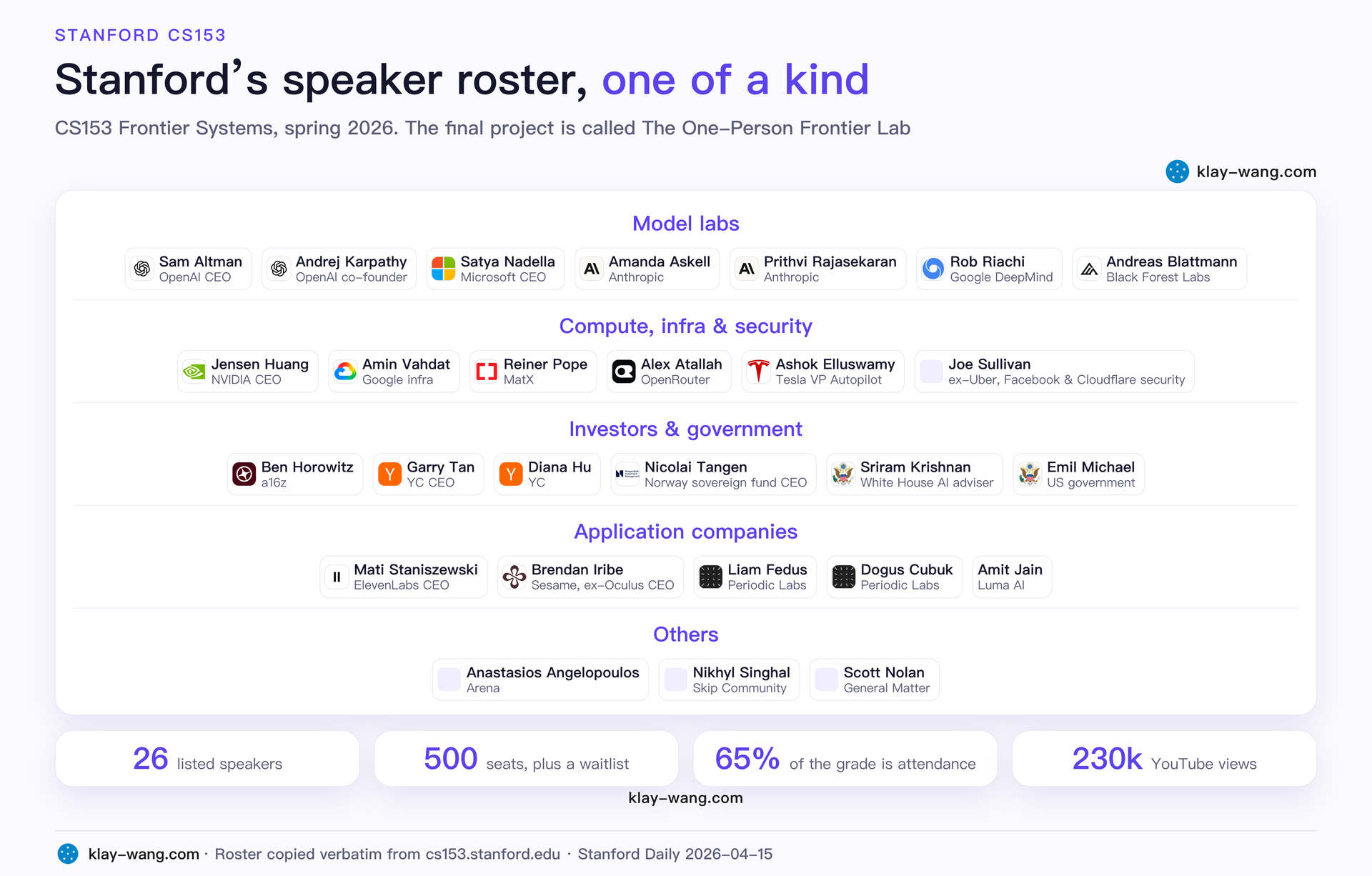
Two classes a week, graded 65% on attendance and 35% on the final project. A capacity of 500 and still a waitlist; the opening lecture alone has passed 230,000 views on YouTube. The list also includes Microsoft, Norway's sovereign wealth fund, and the US government, none of them local, so the Bay Area can't explain the whole lineup, but it does make showing up much cheaper for a good share of them. The catalog can be copied. The lineup and the radius of the Bay Area can't.
The final project is called The One-Person Frontier Lab: one person plus the right tools, and how far you can scale in ten weeks. I answered that question myself this year. With several agents running at once, somewhere around the seventh, the team didn't fall apart. I did. One day the upstream data stopped matching what it usually looked like, and I couldn't tell whether the source had changed, an interface had broken, or my own program had a bug. The tools can write the code. Noticing that something is wrong is a moment you have to handle yourself. When Stanford calls students back to the exam room to prove in front of a TA that they can do it, that moment is what they are training for.
But once the school has done its proving, will the market accept it? When employers and investors spend money, which kind of proof are they buying? The answer may be neither. Part two is about the market side.
Sources (course and university pages, press coverage, and industry reports)
Stanford assessment: Stanford Daily 2026-03-07 (A new wave of education: From undergraduates to Ph.D.s, how is AI shifting classroom policies?), 2026-04-24 (Faculty Senate authorizes exam proctoring), 2026-05-20 (Stanford to begin exam proctoring following pilot program); Academic Integrity Working Group AY 2025-26 proctoring pilot information (CS103 course site). Course catalogs: cs.stanford.edu fall schedule; eecsis.mit.edu who-teaches-what list; www2.eecs.berkeley.edu fall schedule; csd.cmu.edu fall course list. New courses: agencyai.mit.edu (6.S950); mit-oasys.github.io/ai-engineering (6.S978); cmu-agents.com (11-768); csd.cmu.edu/course/15113/f26 and www.cs.cmu.edu/\~113 (15-113); cs153.stanford.edu; Stanford Daily 2026-04-15; UW fall time schedule and the cse490A2 public repo; www.cs124.org/syllabus (UIUC). Policy texts: py.mit.edu/fall26/info/ai (6.101); www.cs.cmu.edu/\~112/syllabus.html; www.cs.cmu.edu/\~15122/syllabus.shtml; cs61a.org/fa26/syllabus and cs61a.org/cs194-fa26; fa26.datastructur.es/policies (61B); web.mit.edu/6.102/www/sp26; www.cs.cmu.edu/\~213/academicintegrity.html; cs50.harvard.edu/college/2026/fall/syllabus. Assessment and its costs: Daily Californian 2026-06-03 and 2026-04-16; The Tartan 2026-02-09; Harvard Crimson 2026-09-03; aiandeducation.mit.edu/report (2026-08-13). Finances: California Legislative Analyst's Office, The 2026-27 Budget: University of California; UC hiring freeze and Berkeley's implementation at evcp.berkeley.edu, March to April 2025; Berkeley computing and data science fundraising and the new building at cdss.berkeley.edu (Gateway groundbreaking brings new opportunity for computing, data science) and inspire.berkeley.edu (Three gifts transform computing and data science at Berkeley); NSF NCSES Higher Education Research and Development Survey FY2024; facts.stanford.edu on sponsored research revenue and the federal share; NACUBO-Commonfund Study of Endowments 2025 (Stanford FY2025). Enrollment: National Student Clearinghouse 2026-08-11. Business schools: Poets and Quants 2026-04-28, 2026-04-22, 2025-07-24; hbs.edu/news 2025-03-28; tlhub.stanford.edu 2026-08-31; news.wharton.upenn.edu 2025-04-02 and the mba-inside.wharton.upenn.edu academic policy; business.columbia.edu/insights; mitsloanedtech.mit.edu/tools/claude; kellogg.northwestern.edu 2025-05-30; som.yale.edu 2026-05-26. Industry: karat.com 2026-01-07 (AI Use in Technical Interviews, 400 engineering leaders); hai.stanford.edu 2026 AI Index, research and development chapter; No Priors podcast episodes with Andrej Karpathy (2026-03-20), Notion's Simon Last (2026-03-12), and Stefano Ermon (2026-09-18); Latent Space podcast episodes with David Singleton (2026-03-20) and Xaira's Bo Wang (2026-07-21); Sequoia Training Data podcast with Amin Vahdat (2026-10-06). The case against: knowledge.wharton.upenn.edu (Bastani experiment); coverage of a Columbia internal seminar.
Comments留言