黄仁勋保卫战The Battle for Jensen Huang
目录Contents
- The Fear-Price Index Falls to 94.7: The Near Term Eased, the Far Term Is Still Expensive
- One Man Moved a Trillion: Nvidia Added $960 Billion in a Day, and Seven of the Top Ten Came This Year
- Too Big to Move?
- One-Month Insurance Got Cheaper; One-Year Barely Moved
- Two Call Options: One Near Zero, One Doubled
- What This Means for What You Hold
- The Catch-Up Was Outside Chips; Lenders Are Still Waiting
导读|英伟达收盘涨了 31.5%,市值一天增加约 9600 亿美元,单日暴涨前十名里,七次发生在今年。市值 2 万亿美元以上的七巨头,单日涨跌超过 5% 的日子,2023 年一天都没有,今年到 8 月底已经 16 天。英伟达下个月的下跌保险比明年的贵 13 个点;跳空的行情里,止损挡不住,仓位和期限才挡得住。
恐惧的标价降到 94.7,近的松了,远的还贵
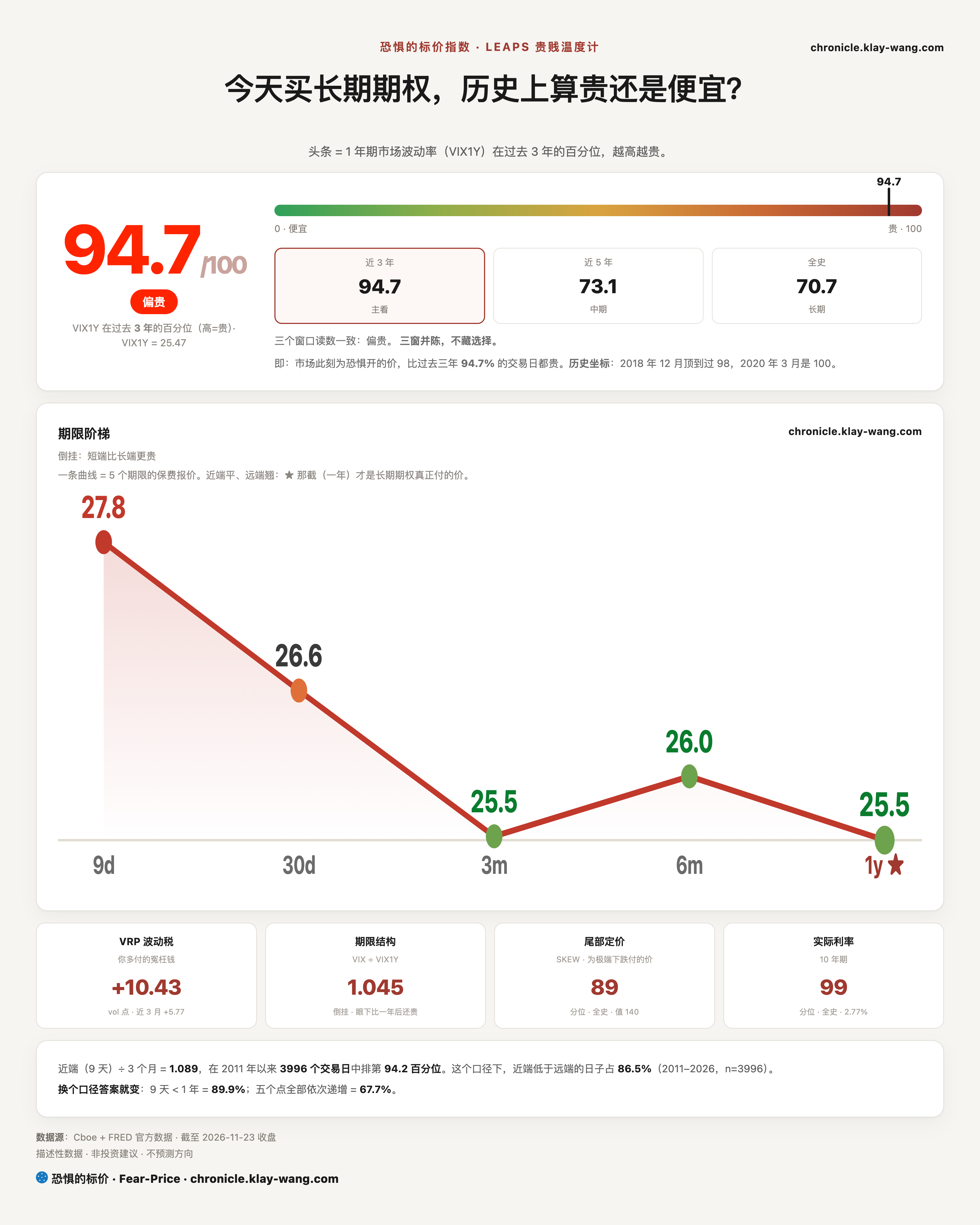
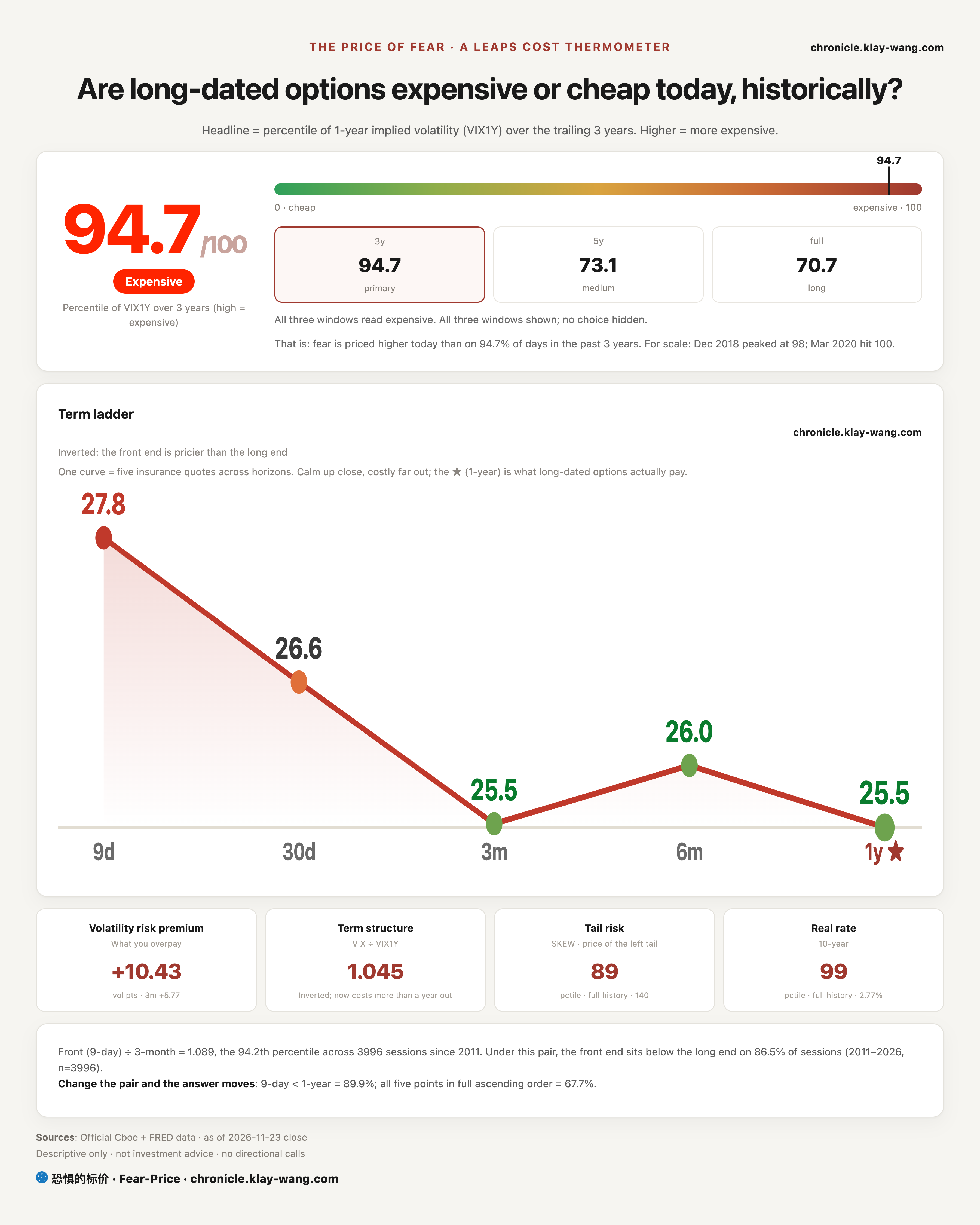
恐惧的标价指数(Fear-Price Index)· 2026-11-23 · 读数 94.7/100:一年期隐含波动率为 25.47%,处于近三年第 94.7 百分位,低于 11 月 20 日的 98.8;读数越高,历史上越贵。逐日台账与口径见 chronicle.klay-wang.com。转载注明:恐惧的标价指数 · Fear-Price。
隐含波动率可以理解成给一年后买下跌保险的保费。周一比上周五低了 2.1 个点。
老黄一己之力撬动万亿市值,英伟达一天涨回 9600 亿美元,前十里七次在今年
幸福来得太过于突然。
11 月 23 日周一盘前,英伟达董事会突然宣布恢复了黄仁勋的总裁、CEO 和董事职务!市场情绪瞬间被点燃。据华尔街日报,纳斯达克 100 期货在开盘前几分钟涨了 7%,碰到了预设的涨幅上限。收盘时,标普 500 ETF 涨了 4.7%,纳指 100 ETF 涨了 7.0%。英伟达开盘就比上周五高开 33%,最终收在 165.05 美元,全天涨了 31.5%,是 2020 年以来涨得最多的一天,市值一天增加约 9600 亿美元,上周五一天蒸发的是约 4970 亿。
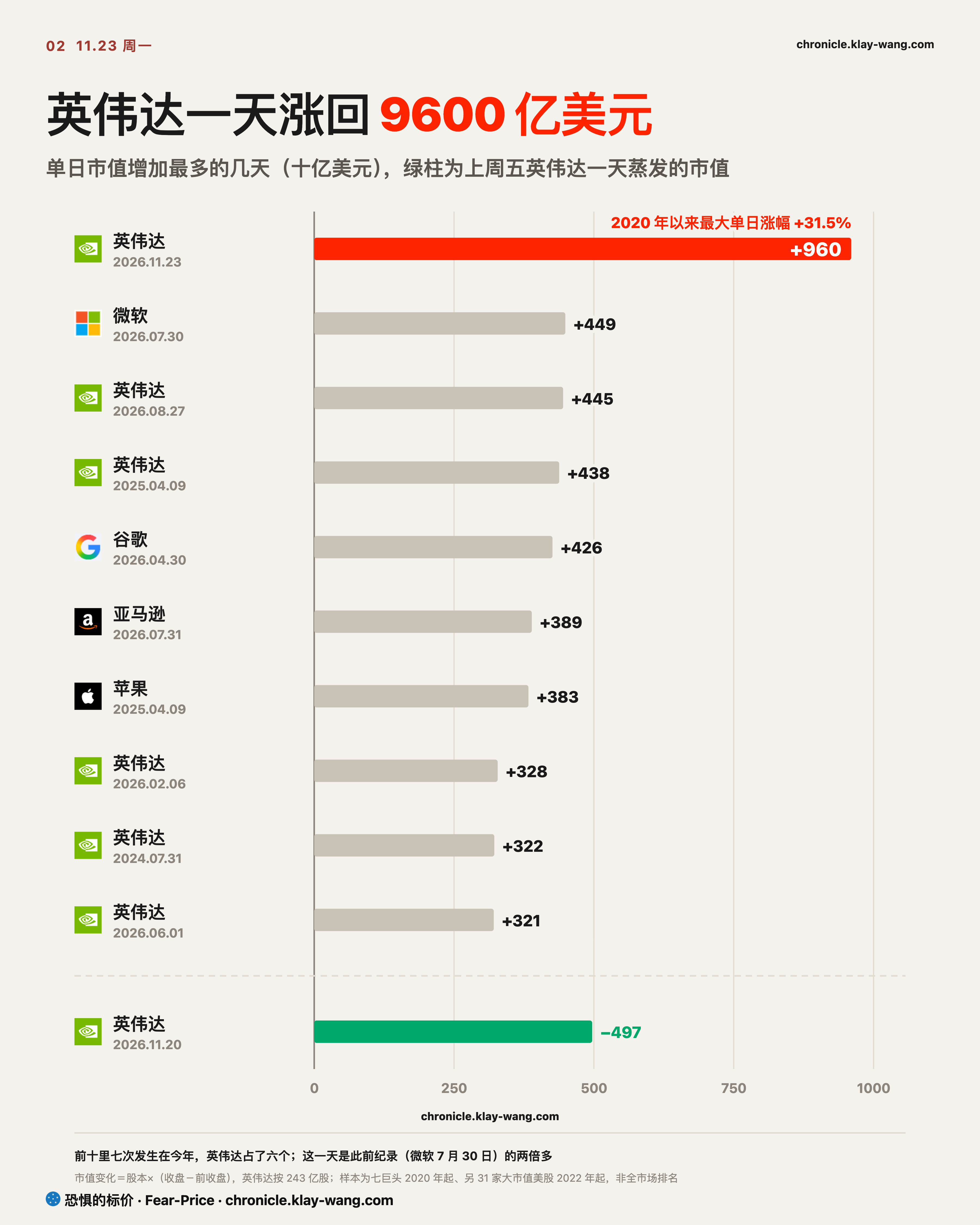
此前,单日增加最多的是微软今年 7 月 30 日的约 4490 亿美元,英伟达这一天是它的两倍多。把周一放进去排前十,英伟达占了六个,今年占了七次,2025 年两次,2024 年一次,2020 到 2023 年一次都没有。十次里只有四次在财报当天,另外六次里,两次是 2025 年 4 月 9 日关税暂停那天,一次是周一黄仁勋复职。
单日增加的市值,等于原来的市值乘以当天的涨幅。按涨幅排,七巨头 2020 年以来涨得最多的 30 天里,2020 年占了 9 天,今年只占 2 天;七巨头平均的年化波动率,2020 年是 51.5%,今年到 8 月底是 37.4%。按百分比算,今年并不比疫情那年更疯。主要的推手是体量:英伟达今年初的股价,是 2020 年初的 31 倍多。按现在的股本算,2020 年初的英伟达市值约 1450 亿美元,涨 10% 只增加约 150 亿;今年初市值约 4.6 万亿,同样涨 10%,一天就是约 4600 亿。涨幅没变,底数大了三十倍,排行榜的前几名自然都落在近两年。
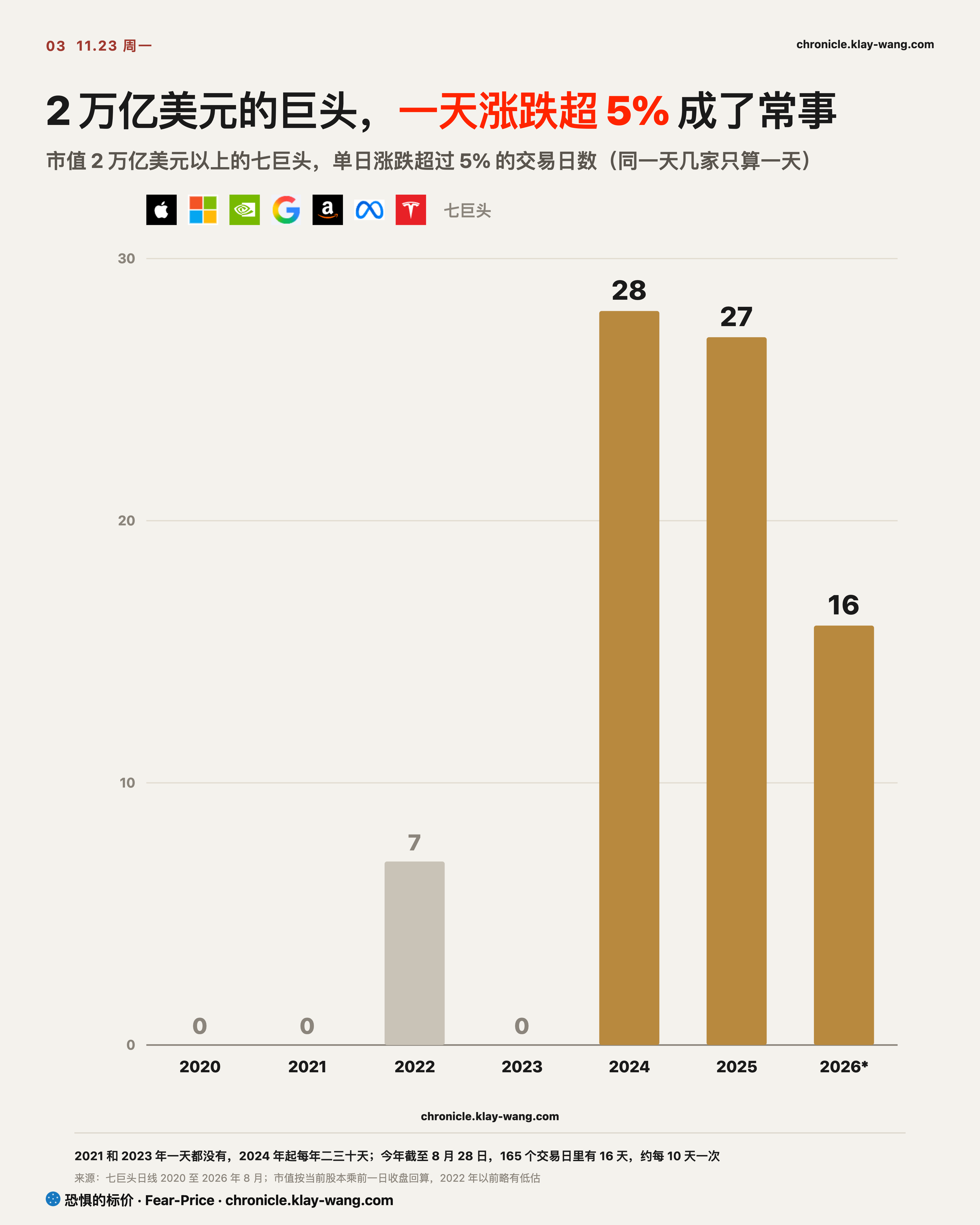
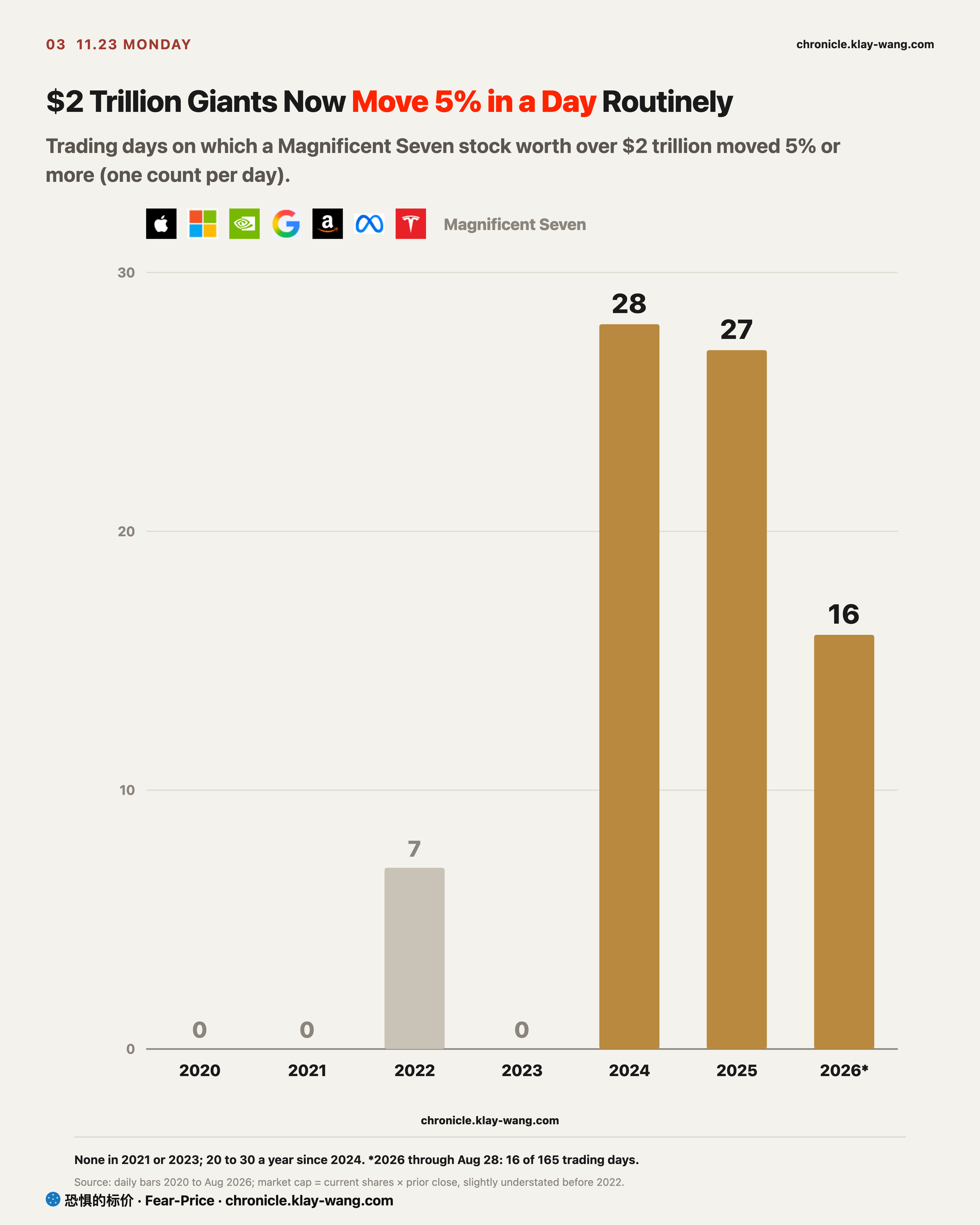
巨头也不再越大越稳,只看市值 2 万亿美元以上的七巨头,单日涨跌超过 5% 的交易日,2021 年和 2023 年一天都没有,2024 年有 28 天,2025 年 27 天,今年到 8 月底已经 16 天,平均每 10 个交易日就有一次。市值 2 万亿的公司,走起来像一只 meme 股,为什么呢?
too big to move?
一,巨头本身就是大盘。2025 年 4 月 9 日关税暂停的消息一出,标普 500 ETF 当天涨了 10.5%,英伟达涨了 18.7%,苹果涨了 15.3%,同一天双双进了前十。那天英伟达从最低到最高差了 18.2%,苹果差了 16.7%,是它们 2025 年平常一天的六倍和九倍。买指数的钱,就是买这几家巨头的,宏观消息一来,经常七家一起被买、一起被卖。对于买指数基金的人,分散没有想象中那么分散;对于机构,个股风险和指数风险在大消息那天会变成同一件事,只给个股买保护、不看指数,会算漏。chronicle.klay-wang.com/fear-price 记的是给标普 500 买一年保险的价钱,/t/NVDA 这类个股页记的是单只股票一个月保险的价钱在一年里排第几。两边一起贵起来的时候,市场押的是同一件宏观的事。
二,借来的钱多了。对冲基金向主经纪商(替它们融资、借券的大券商)借的钱,2023 年一季度是 1.75 万亿美元,今年 6 月底是 3.69 万亿,翻了一倍多,比上周五收盘时整个英伟达的市值(约 3.05 万亿)还多。按总资产除以净资产算的杠杆,从 2.07 倍升到 2.52 倍。杠杆越高,判断错了越要快速平仓。CTA,也就是跟着价格趋势加减仓的基金,涨了就加、跌了就减;波动率目标基金按最近的波动调仓位,平静时加、震荡时减。这些基金的具体仓位我们看不到,但它们的规则,都在同一个方向上放大涨跌。做市商平时是减震器,可它卖出期权之后要拿股票对冲,这就到了第三条。
三,消息变成价格,只需要一跳。周一半导体 ETF 开盘就涨了 17.2%,收盘反而只涨了 15.0%;上周五英伟达跌了 14%,谷歌 10 月 29 日财报后跌了 13%,也都是跳着下去的。隔夜的挂单把价格直接推到新位置,中间没有成交,止损单只能在跳过去之后的价格成交。
跳过去之后,还有一层放大器:当天到期的期权。英伟达周一就有当天到期的合约,我们跟踪的 12 个行权价,一天成交了约 268 万张。做市商卖出的期权多于买入的时候(净 gamma 为负),股价越往上,它越要买进股票对冲,股价越往下,它越要卖出,对冲的方向和价格同向。按行业常用的估算口径,周一开盘前,英伟达、半导体 ETF、标普 500 ETF、纳指 100 ETF 的做市商净 gamma 全是负的,上周五大跌那天也是,周五这股力量往下推,周一往上推。行权价 170 美元、当天到期的英伟达看涨期权,周一成交了约 54 万张,开盘 3.75 美元,盘中最高 6 美元,收盘只剩 0.02 美元。个股页上的上下两面墙,就是这类合约扎堆、做市商对冲最密的价位。涨的时候一起追,跌的时候一起砍,巨头跳得陡,是因为钱走得整齐划一。
一个月的保险降价了,一年的几乎没降
我们每天收盘记录 40 多只股票和 ETF 两个期限的隐含波动率。30 天的是下个月的保险价钱,反映眼前这一阵的风险;一年的是明年的保险价钱,反映市场对长期风险的看法。两个一比,就知道市场把这次当一阵风还是长期问题。周一 30 天的保险几乎全线降价,一年的只动了一点。
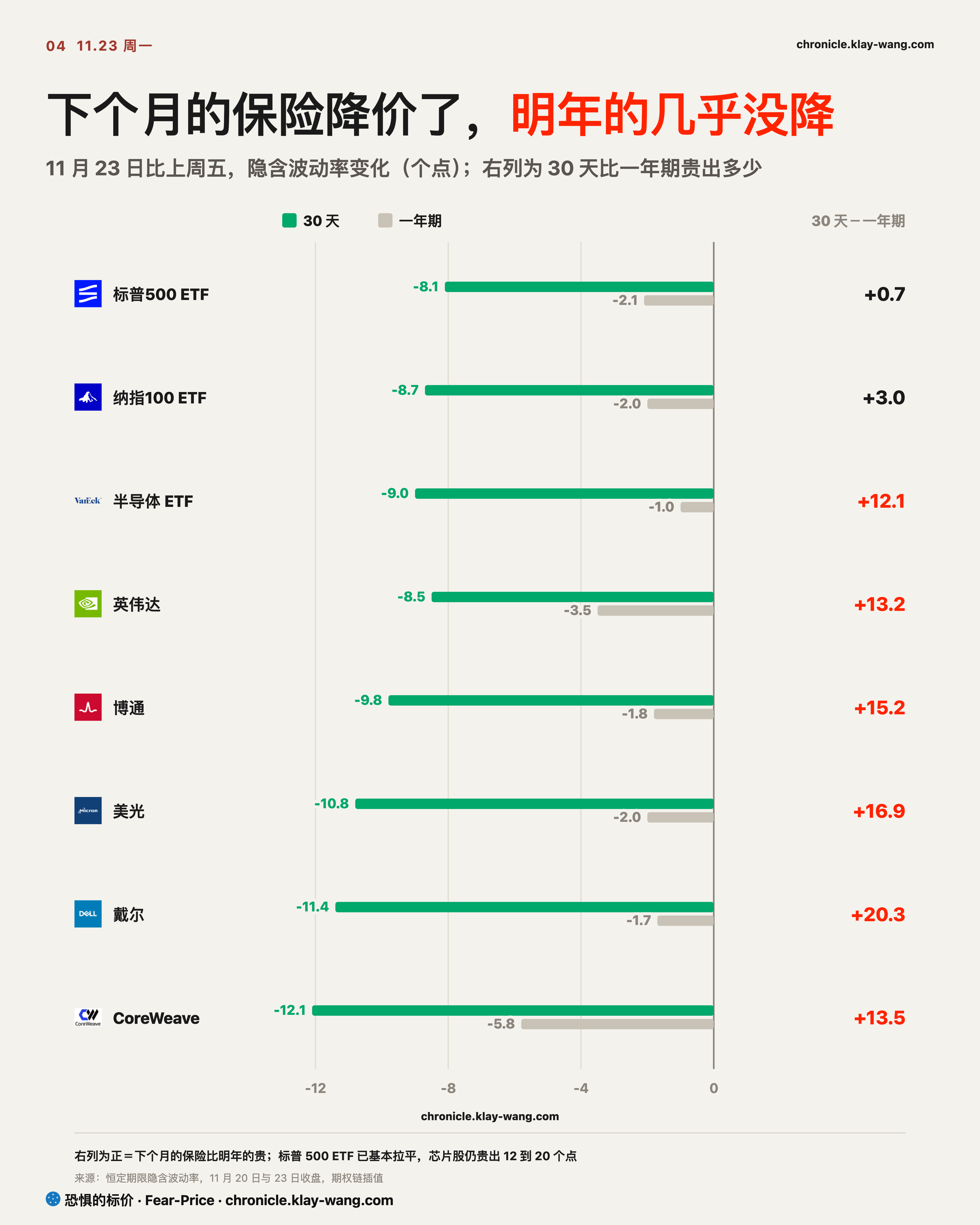
英伟达 30 天的隐含波动率从 69.4% 降到 60.9%,一年期从 51.2% 降到 47.7%。正常情况下,越远的风险越难预测,保险越贵;现在芯片股反了过来,近月的保险比远月的还贵,英伟达贵出 13 个点,半导体 ETF 贵出 12 个点。标普 500 ETF 的两头已经基本拉平,只差 0.7 个点。大盘的急性风险已经消退,芯片股的还留着,等于市场认为最大的风险就挤在接下来几周。
证监会对英伟达会计问题的审查没有结论,董事会的独立调查还在继续,华尔街承诺的 5000 亿美元融资仍未放款,这几件事都可能在下个月落地。下个月的保险,标的就是这几跳。如果这几件事迟迟没有落地,芯片股近月的保险会降回一年期以下,这个判断就是错误的。
两张看涨期权,一张归零,一张翻倍
一个券商社区里有位投资者周一复盘了自己的两笔看涨期权,我们用合约档案逐日对了一遍。
第一张是谷歌明年 1 月 15 日到期、行权价 400 美元的看涨期权,这位投资者在这张上是亏的。10 月 29 日财报后,谷歌从 324.74 美元跌到 282.58 美元;同一天,谷歌 30 天的隐含波动率从 39.5% 降到 29.7%,股价和波动溢价一起被挤掉。之后三周,谷歌的股价其实没再跌,11 月 2 日收在 278.99 美元,周一收在 282.10 美元,这张期权却从 0.52 美元跌到 0.23 美元,又少了一半多,这部分亏损是被时间吃掉的。离到期还剩 53 天,谷歌要涨 42% 才够到行权价,它每天的时间损耗,相当于自身价值的 7.5%。
第二张是英伟达 2028 年 1 月到期、行权价 180 美元的看涨期权,他是赚的:他在 13 美元附近买进,32 美元附近卖出,一天赚了一倍多。档案里它上周五收在 13.0 美元,周一收在 29.8 美元,盘中最高 34.22 美元,和他的买卖价对得上。上周五英伟达收在 125.53 美元,要涨 43% 才够到 180,和谷歌那张一样远;可它还剩 427 天,每天的时间损耗只有自身价值的 0.26%,谷歌那张是 7.5%,差了将近 30 倍。周一隐含波动率反而从 48% 降到 46%,赚到的全是股价。
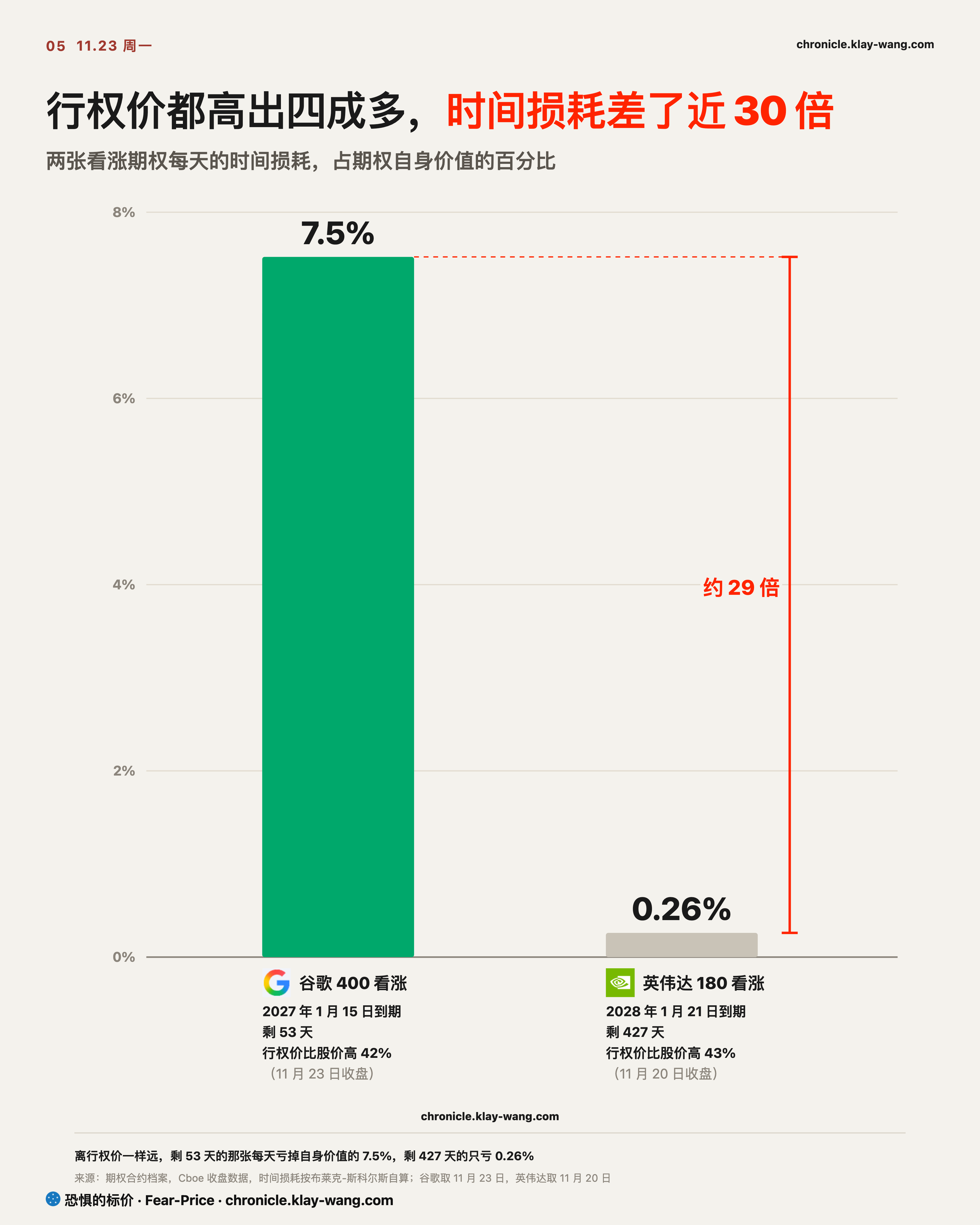
两张都押了 AI 巨头上涨,行权价都比股价高四成多,决定结果的,是还剩多少时间。剩 53 天、要涨四成的期权,需要一次奇迹;剩 400 多天的,扛得住一次财报,也接得住一次暴涨。我们长期记录 40 多只股票和 ETF 两个期限的期权信息,隐含波动率,下次开仓之前,可以先在个股页 chronicle.klay-wang.com/t/GOOGL 这类页面看一眼,一个月的保险价钱在过去一年里排第几,排得越靠前,买得越贵。
这对你手里的票意味着什么
持有的是正股的,先按跳空算仓位,再设止损。一只票一天能跳 13% 到 14%,就按跌 14% 算一遍账户扛不扛得住;扛不住,问题出在仓位,止损线救不了。
买期权的uu,要用时间换容错。到期前最后几个月,时间损耗越走越快,上面那张谷歌期权每天亏 7.5% 就是这一段。眼下芯片股一个月的保险比一年的贵 13 个点,同样的钱,期限拉长能买到更多时间。
大家都说卖方是时间的朋友,但是卖期权的uu,在高波动行情或者黑天鹅来了,两头都会被拉爆。上周五卖看跌的一天被砸穿,周一卖看涨的一天被拉穿。卖方赚的是平静的钱,用价差先把最大亏损锁住,是这种行情里的底线。卖之前,先在 chronicle.klay-wang.com/options 看当天的异动大单:有人在大笔买你正在卖的那一档,对手押的就是一次大动。
所有人都需要牢记:现金不会跳空,也没有时间损耗。跳空之后,手里有现金的人,才有选择,所以永远不要满仓。
以上只讲机制和条件,不构成投资建议。
补涨的是芯片以外,债主还在观望
开盘跳空之后,白天的买盘去了还没怎么涨的地方:罗素 2000 小盘股 ETF 收在全天区间的 89% 位置,标普 500 成分股 418 只上涨、83 只下跌。
借钱建算力的公司,CoreWeave 股票涨了 22.3%,它 2031 年到期的债券价格只涨了 3.2%,利差从 11.97 个百分点收窄到 11.05 个百分点,仍比一个月前宽 0.51 个百分点。股东涨回来了,债主还在观望。
In brief. Nvidia closed up 31.5% and added about $960 billion in market value in one day. Seven of the ten biggest one-day gains came this year. Among Magnificent Seven stocks worth over $2 trillion, days with a 5% move went from none in 2023 to 16 by the end of August this year. Next-month downside insurance on Nvidia costs 13 points more than next-year insurance. In a gap market, stops do not protect you; position size and time do.
The Fear-Price Index Falls to 94.7: The Near Term Eased, the Far Term Is Still Expensive
Fear-Price Index · November 23, 2026 · 94.7/100. One-year implied volatility was 25.47%, at the 94.7th percentile of the trailing three years, down from 98.8 on November 20; higher means historically more expensive. Daily ledger: chronicle.klay-wang.com. Credit: Fear-Price.
Think of implied volatility as the premium for insuring against a fall one year out. It was 2.1 points below Friday.
One Man Moved a Trillion: Nvidia Added $960 Billion in a Day, and Seven of the Top Ten Came This Year
The good news came all at once.
Before the open on Monday, November 23, the Nvidia board reinstated Jensen Huang as president, CEO and director. According to The Wall Street Journal, Nasdaq 100 futures rose 7% minutes before the open and hit their preset limit. At the close, the S&P 500 ETF was up 4.7% and the Nasdaq 100 ETF up 7.0%. Nvidia opened 33% above Friday, closed at $165.05, and gained 31.5% on the day, its largest one-day gain since 2020, adding about $960 billion in market value. On Friday it lost about $497 billion.
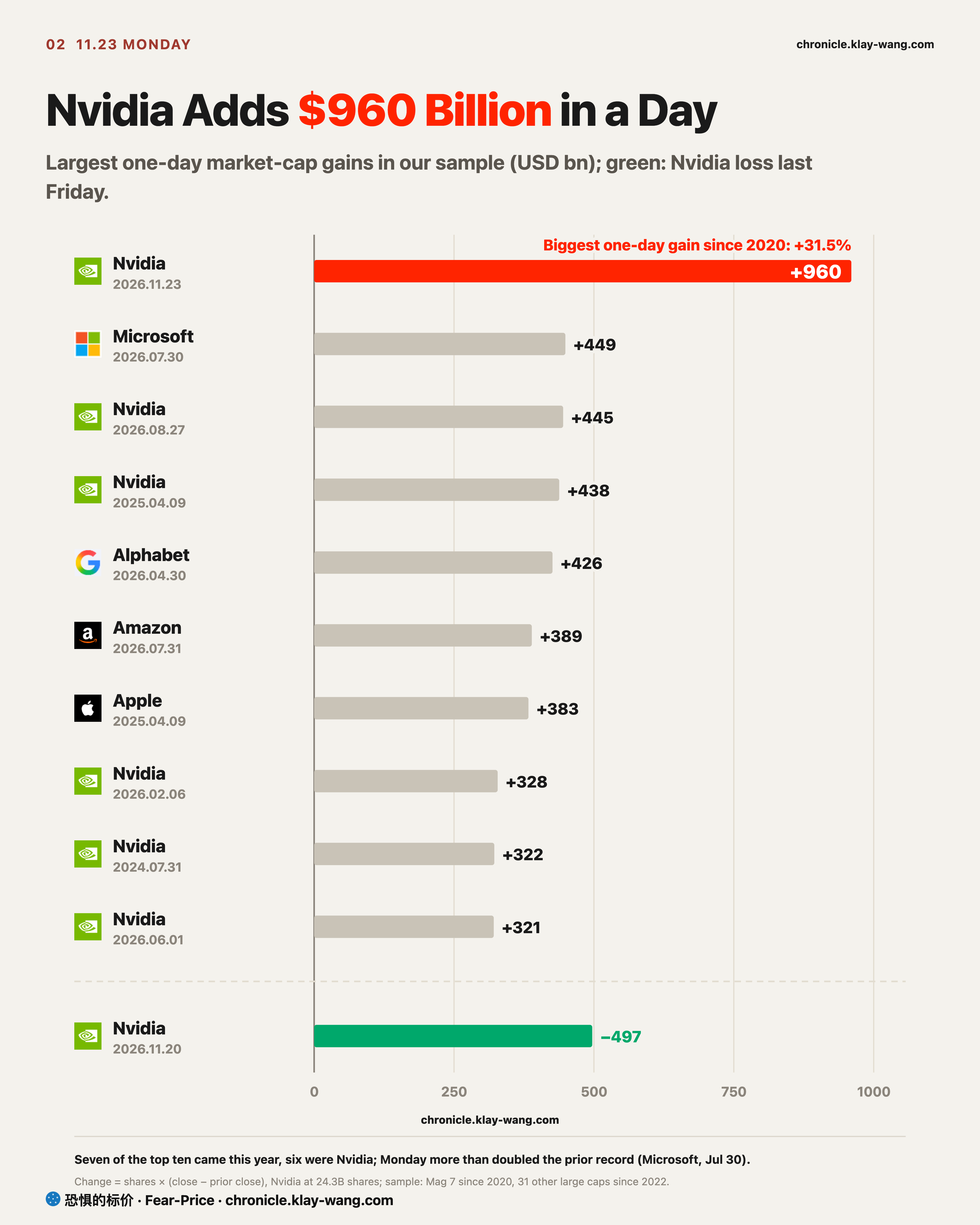
The previous one-day record was a gain of about $449 billion by Microsoft on July 30 this year; Monday more than doubled it. Put Monday in the ranking and Nvidia holds six of the top ten. Seven came this year, two in 2025, one in 2024, and none from 2020 to 2023. Only four of the ten were earnings days. Of the other six, two were April 9, 2025, when tariffs were paused, and one was the Monday reinstatement.
A one-day gain in value equals the starting market value times the percentage move of the day. Ranked by percentage, the 30 biggest up days for the seven giants since 2020 include 9 in 2020 and only 2 this year. Their average annualized volatility was 51.5% in 2020 and 37.4% this year through August. In percentage terms this year is calmer than the pandemic year. The main driver is size: the Nvidia share price at the start of this year was more than 31 times its level at the start of 2020. On the current share count, Nvidia was worth about $145 billion in early 2020, so a 10% gain added about $15 billion. At the start of this year it was worth about $4.6 trillion, and the same 10% is about $460 billion. The percentage did not change; the base grew thirtyfold, so the top of the ranking lands in the last two years.
The giants are also no longer steadier for being bigger. Among the seven when worth over $2 trillion, days with a move of 5% or more numbered zero in 2021 and 2023, 28 in 2024, 27 in 2025, and 16 this year through August, about one every 10 trading days. A $2 trillion company now trades like a meme stock. Why?
Too Big to Move?
First, the giants are the market. On April 9, 2025, when the tariff pause was announced, the S&P 500 ETF rose 10.5%. Nvidia gained 18.7% and Apple 15.3%, and both entered the top ten that day. That day the high-to-low range was 18.2% for Nvidia and 16.7% for Apple, six and nine times a typical day in 2025. Money that buys the index buys these companies, so when macro news hits, the seven are often bought and sold together. For index fund holders, diversification is thinner than it looks. For institutions, single-stock risk and index risk become one risk on big news days, and hedging single names without the index misses it. chronicle.klay-wang.com/fear-price tracks the price of one-year insurance on the S&P 500, and ticker pages such as /t/NVDA show where one-month insurance on a single stock ranks within the past year. When both get expensive together, the market is betting on the same macro event.
Second, there is more borrowed money. Hedge fund borrowing from prime brokers, the large brokers that lend them cash and securities, was $1.75 trillion in the first quarter of 2023 and $3.69 trillion at the end of June this year, more than double, and more than the entire market value of Nvidia at the Friday close (about $3.05 trillion). Leverage measured as gross assets over net assets rose from 2.07 to 2.52 times. The higher the leverage, the faster a wrong bet must be closed. CTAs, funds that follow price trends, add as prices rise and cut as they fall. Volatility-target funds size positions by recent volatility, adding in calm and cutting in turbulence. We cannot see the positions of these funds, but their rules all push in the same direction and amplify moves. Market makers are usually shock absorbers, but after they sell options they hedge with stock, which brings us to the third point.
Third, news becomes price in a single jump. On Monday the chip ETF opened up 17.2% and closed up only 15.0%. Nvidia fell 14% on Friday, and Alphabet fell 13% after earnings on October 29; both gapped down. Overnight orders move the price straight to a new level with no trades in between, so a stop order can only fill at the price after the jump.
After the jump comes another amplifier: options that expire the same day. Nvidia had same-day contracts on Monday, and the 12 strikes we track traded about 2.68 million contracts. When market makers have sold more options than they bought (negative net gamma), they must buy stock as the price rises and sell as it falls, hedging in the same direction as the price. By a common industry estimate, before the Monday open the net gamma of market makers was negative for Nvidia, the chip ETF, the S&P 500 ETF and the Nasdaq 100 ETF, as it was during the Friday drop; that force pushed down on Friday and up on Monday. The Nvidia 170 call expiring that day traded about 0.54 million contracts, opened at $3.75, reached $6 and closed at $0.02. The upper and lower walls on a ticker page are the prices where such contracts cluster and market maker hedging is densest. Everyone chases on the way up and dumps on the way down; the giants jump steeply because the money moves in lockstep.
One-Month Insurance Got Cheaper; One-Year Barely Moved
Every day at the close we record implied volatility at two terms for more than 40 stocks and ETFs. The 30-day reading is the price of insurance for next month and reflects the risk right in front of us; the one-year reading is the price for next year and reflects how the market sees long-term risk. Comparing the two shows whether the market sees a passing storm or a lasting problem. On Monday 30-day insurance got cheaper almost across the board, while one-year barely moved.
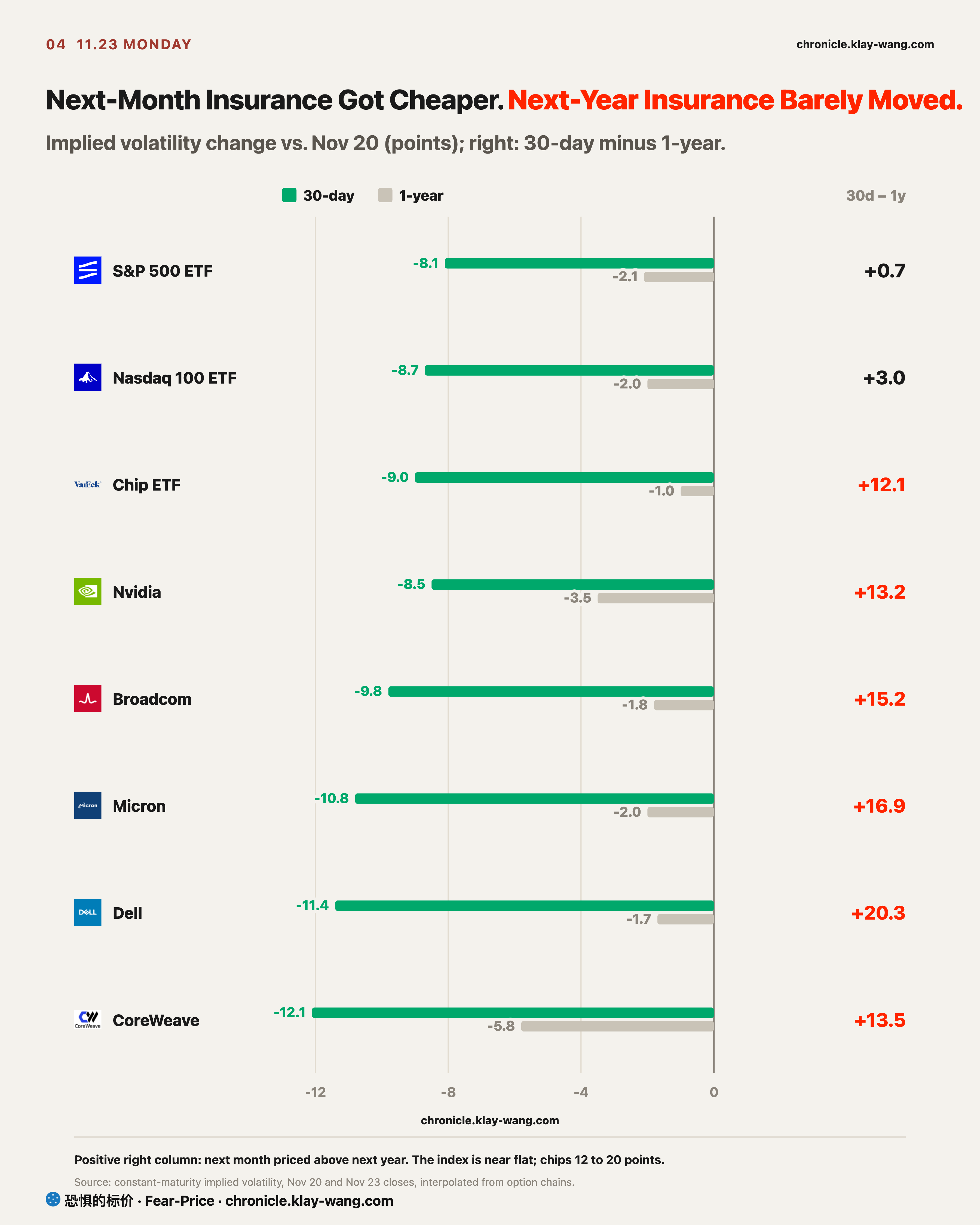
Nvidia 30-day implied volatility fell from 69.4% to 60.9% and one-year from 51.2% to 47.7%. Normally, risk further out is harder to predict, so insurance costs more; chip stocks are now the other way around, with near-month insurance priced above the far month: 13 points more for Nvidia and 12 points for the chip ETF. For the S&P 500 ETF the two are nearly level, only 0.7 points apart. Acute risk has faded for the index but is still there for chips, which amounts to the market seeing the biggest risk packed into the coming weeks.
The SEC review of the Nvidia accounting has no conclusion, the independent investigation by the board continues, and the $500 billion Wall Street pledged to mobilize has not been lent. Any of these could land next month. Insurance for next month is priced on those jumps. If these events keep failing to land, near-month insurance on chip stocks will fall back below one-year, and this call is wrong.
Two Call Options: One Near Zero, One Doubled
An investor on a broker community forum reviewed two call trades on Monday, and we checked them day by day against our contract archive.
The first is an Alphabet call expiring January 15 next year with a 400 strike, and the investor lost money on it. After earnings on October 29, Alphabet fell from $324.74 to $282.58; the same day its 30-day implied volatility fell from 39.5% to 29.7%, so the stock and the volatility premium were squeezed out together. Over the next three weeks the stock did not fall further: it closed at $278.99 on November 2 and $282.10 on Monday. The option still fell from $0.52 to $0.23, losing more than half again, and that loss was eaten by time. With 53 days left, Alphabet must rise 42% to reach the strike, and each day the option loses time value equal to 7.5% of its price.
The second is an Nvidia call expiring January 2028 with a 180 strike, and the investor made money: bought near $13, sold near $32, more than doubling in a day. In our archive it closed at $13.0 on Friday and $29.8 on Monday, with a high of $34.22, matching his trades. On Friday Nvidia closed at $125.53 and needed a 43% rise to reach 180, as far from the strike as the Alphabet option. But it had 427 days left, and its daily time decay was only 0.26% of its value, against 7.5% for the Alphabet option, nearly 30 times less. On Monday implied volatility actually fell from 48% to 46%, so the whole gain came from the stock.
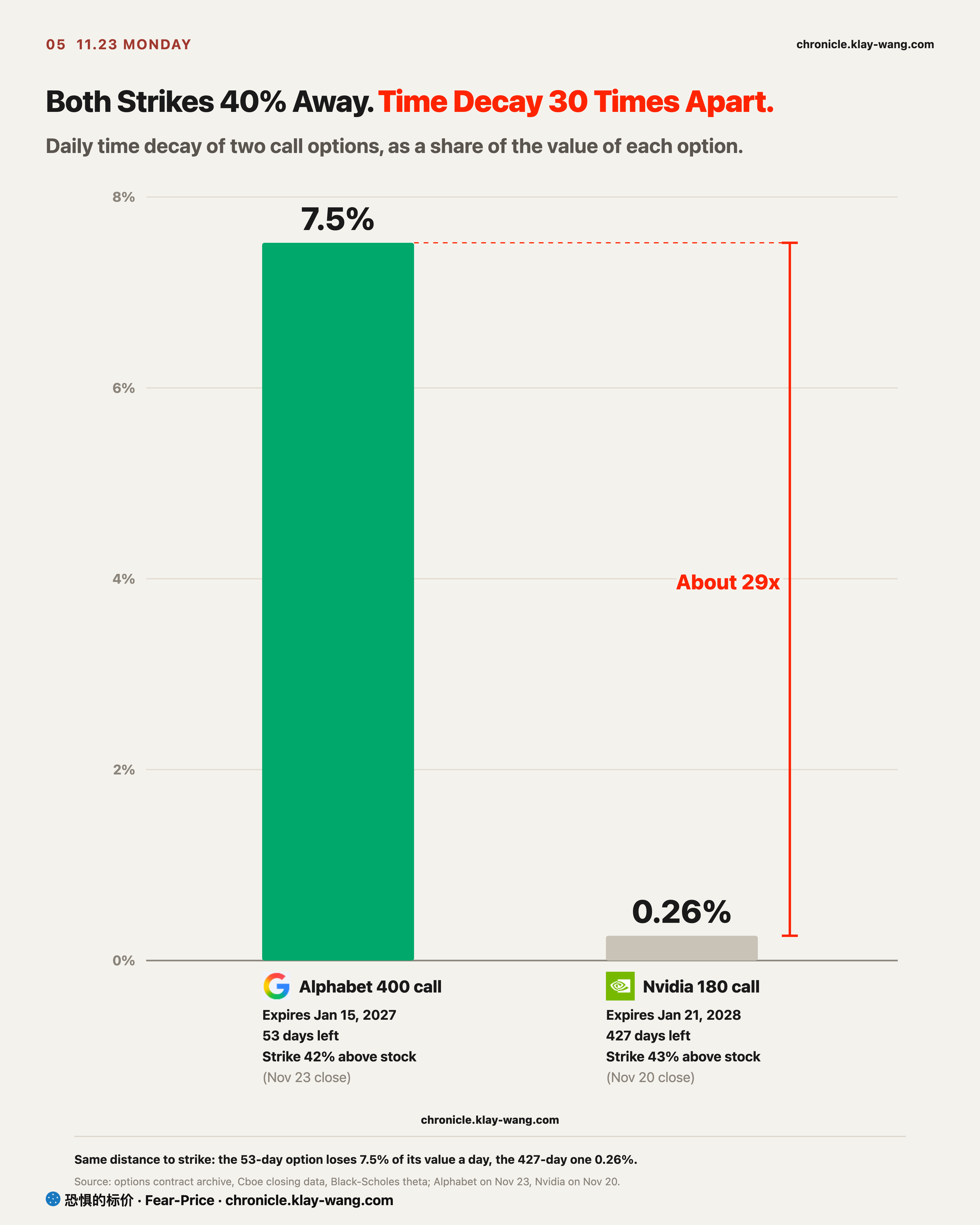
Both bet on an AI giant rising, both strikes sat more than 40% above the stock, and what decided the outcome was time. An option with 53 days that needs a 40% rise needs a miracle; one with over 400 days can survive an earnings miss and still catch a surge. We track options data, including implied volatility at two terms, for more than 40 stocks and ETFs. Before opening a position, check a ticker page such as chronicle.klay-wang.com/t/GOOGL to see where one-month insurance ranks within the past year. The higher it ranks, the more you are paying.
What This Means for What You Hold
For stockholders: size the position for a gap first, then set the stop. If a stock can jump 13% to 14% in a day, check whether the account can take a 14% fall. If it cannot, the problem is the position size, and a stop will not save it.
For option buyers: trade time for room. Time decay speeds up in the last few months before expiry, which is the stretch where the Alphabet option loses 7.5% a day. Right now one-month insurance on chip stocks costs 13 points more than one-year, so the same money buys more time further out.
For option sellers: everyone says sellers have time on their side, but in high volatility or a black swan, both sides can blow up. Put sellers were run over on Friday, call sellers on Monday. Sellers earn money from calm, and capping the maximum loss with a spread is the floor in a market like this. Before selling, check unusual large trades at chronicle.klay-wang.com/options: if someone is buying size in the strike you are selling, the other side is betting on a big move.
For everyone: cash does not gap and does not decay. After a gap, the people holding cash are the ones with choices, so never go all in.
This section describes mechanisms and conditions only and is not investment advice.
The Catch-Up Was Outside Chips; Lenders Are Still Waiting
After the opening gap, daytime buying went to what had not yet rallied: the Russell 2000 small-cap ETF closed at 89% of its daily range, and 418 S&P 500 members rose against 83 that fell.
Among companies borrowing to build computing capacity, CoreWeave stock rose 22.3%, while its 2031 bond price rose only 3.2%. The spread narrowed from 11.97 to 11.05 percentage points, still 0.51 points wider than a month ago. Shareholders came back; lenders are still waiting.
Comments留言