硅谷Fintech观察⑨|agent 把钱花错了,算谁的?没人扛得住Silicon Valley Fintech Watch ⑨ | When the Agent Spends Wrong, Who Pays? Today, Nobody Can
A web original — first published here on September 14, 2026.本文 2026.09.14 首发于本站。
目录Contents
- Before we start
- 1. Routing's next step is daring to price the outcome
- 2. Agents fail in three shapes, each harder to insure than the last
- 3. The seat map: seven positions, cut by who carries the irreversible liability
- 4. Three companies, each in its seat, each stuck on someone else
- 5. Meta put the demand side on the table, and pushed liability one step further away
- 6. How big this cell is: look at the limit, not the error rate
- 7. What this piece will not tell you
- Closing
硅谷Fintech观察系列 · 第九篇 · 本文 2026 年 9 月 14 日首发于 klay-wang.com
导读|2026 年 8 月 16 日,Bloomberg 报道 Stripe 以 70 亿美元以上买下 OpenRouter;9 月 8 日,Meta 发布个人 agent 产品 Muse,每个用户一台云端电脑,付款走 Stripe 的 Link;此前的 3 月,沃尔玛的产品负责人说,在 ChatGPT 里直接结账的转化率只有跳转官网的三分之一。三件事看着不相干,指向的是同一格:agent 替你花钱,花错了算谁的。第八篇我说地图上有三个格子没画,事后那一格最值钱。这一篇把那一格拆开:先讲为什么至今没人坐得稳,再摆一张七个位置的表,把我逐个查过的三家公司坐进去,看各自卡在谁身上,最后讲这一格的大小由什么决定。我的答案是,看额度,不看错误率。
写在前面
先交代来路。
第七篇写 Stripe 买 OpenRouter 的时候,交易还在洽谈,华尔街日报报的是 100 亿。8 月 16 日 Bloomberg 报道双方达成协议,作价 70 亿美元以上;8 月 19 日 Stripe 官方新闻室发了公告,用词是 agrees to acquire,没有披露价格。第七篇的标题和数字已经按 70 亿改过,市销率从 71 倍改成约 50 倍,判断一字未动:路由是免费的,账本不是。
这一篇往下走一步。账本之后是什么?我的观察是,支付行业二十年前也只做路由,把一笔钱送到该去的地方。后来长出来的东西比路由值钱得多:失败自动重试、一家拒了换一家、风控实时拦截、同一笔钱在几条通道之间比价。名目不同,干的是一件事,把成功率抬上去。而谁承诺成功率,失败的成本就落在谁头上。token 这条流正在把同一条路再走一遍。
然后问一个更要紧的问题:agent 的失败长什么样,为什么这么难保,以及今天有谁在赌这件事能收到钱。
后半个问题我用了两个月。从 YC 全量库和监管备案两头筛,筛出几家把出错之后谁负责这件事当成生意做的公司,逐家读白皮书、查备案、听创始人访谈,把三家做到能讲清一笔交易怎么走、谁向谁收多少钱、什么情况下判断作废。三家分别是 Ubyx、Klaimee、Catena。它们是这篇文章的实证。全部口径在文末。
一、路由的下一步,是敢按结果报价
先把 token 和任务这两个计价单位分开。
按 token 计价,你看的是每千个 token 多少钱。按任务计价,你看的是每一次把事做成多少钱。这两个数差得很远。一个 agent 要完成一件事,得先理解需求,再检索,再生成方案,再调用工具,中间失败了要重试,最后还要验证。把推理成本、重试成本、工具调用、验证、延迟和失败损失全加在一起,再除以成功的任务数,才是真实的单价。
这笔账一算清,一个流行的推论就站不住了:便宜模型越来越好用,所以路由会变成比价引擎,把每个请求发给最便宜的那个。可一个任务里便宜模型失败两次,比贵模型一次成功更贵。发给最便宜的模型,从一开始就是错的。
所以路由层真正值钱的位置,是敢对客户说这件事能做成。客户愿意为这句话付溢价,代价是失败了自己扛。支付网关就是这么活过来的:它按成功率收费,失败时客户找的是它,不是底层通道。
翻译成大白话:今天的 token 路由是个中介,告诉你哪家便宜。它的下一步是变成包工头,告诉你这活我包了,做不成算我的。中介收的是信息费,包工头收的是保费,两种钱不在一个账上。路由什么时候变成承保方?就在它第一次敢把做不成算我的写进合同的那天。
而包工头要回答的第一个问题就是:我包的活,砸了的时候长什么样?
二、agent 的错有三种,一种比一种难保
这一节是全文的承重墙。我把 agent 出错分成三种形态,分类是我自己的,不是行业共识,但每一种都有我亲手碰过的例子。
第一种:你给的委托永远写不全。
举个例子。你对 agent 说,500 美元以内订一张飞洛杉矶的机票。它完全可以给你订到:廉航,不含托运行李,到机场再补 80;凌晨两点落地;中转十四小时;不可退改。每一条你都没说过,每一条都在 500 以内。它一条指令都没违反。
你拿到的不是你要的,但它没做错。这时候找谁?拒付?你授权了。找它?它照做了。这就是那个没有主人的格子。
有人会说,那把话说全不就行了:直飞,不要中转,不要红眼,不用廉航,不要半夜落地。说全了确实有用,它把一个说不清是谁的错,变成了明确是谁的错。违约是合同能管的事。但你把话说到再全,也躲不开一件事:六条约束同时满足的票,某一天可能根本不存在。它停下来报失败,安全但没用;它放宽一条去成交,放宽哪一条是它替你选的,而你给的是一组约束,不是优先级排序。等它选完,不可退改的票已经出了。
你但凡把话说全,就不需要它了。委托的价值恰恰在于你不说全。欠定义是这门生意的前提。
第二种:话说全了,它也不照做。
这一种比第一种根本,因为规格堵不住它。
我这两个月每天用 agent 写文案、做图、跑数据管线。闸定得很清楚,规矩写在 skill 里,跑闸的命令就在手边。它照样会跳过,会忽略,会跑了闸不看返回接着提交。我经常要改好几个小时。话我说清楚了。它有幻觉,有偷懒,有明明看见红灯照样过去的时候。
这种错跟第一种的区别在于:第一种的损失被委托的边界框住了,第二种没有边界。它可以做任何事,包括你明确禁止的事。你能用规格把第一种压缩,你压缩不了第二种。
第三种:错是相关的。
保险这门生意的地基是大数定律:一万个投保人,各自独立出险,总损失可算。agent 的错天生相关。一万个 agent 实例跑同一个模型版本、同一段提示词、同一份工具定义,它们会在同一分钟犯同一个错。这不是分散得掉的风险,而再保险的功能恰恰是分散。
车险公司不怕一辆车撞了,怕的是一万辆车同时撞。agent 就是那一万辆车共用一个司机。
这一格至今没人坐得稳,三种形态各堵一个口。第一种要一个受理窗口,今天没有。第二种要一个不依赖规格的兜底机制,今天没有。第三种让愿意兜底的人不敢兜。
但第一笔真金白银的损失已经有人在扛了,只是它不叫 agent 出错,它叫欺诈。
Stripe 2026 年 5 月 27 日的 Radar 博客写了一句话:在 Stripe 网络上,AI 公司超过六分之一的注册与多账号滥用有关。多账号滥用的意思是,一个人开几十个账号,反复薅免费额度,或者把盗刷的卡分散到多个账号里拖延被发现的时间。同一篇博客说,ElevenLabs 靠这套系统每天拦掉 2,000 个滥用免费层的用户。
一个更具体的数:OpenCode 的创始人 Dax Raad 在 8 月 11 日的 X 上说,他们查出并封掉了 7,013 个欺诈账号,估算每月因此少损失约 40 万美元。更早一条帖子说,一个人操作 8,000 个账号,每月倒卖 48 万美元的 token。
为什么这一笔损失先出现在路由和平台层?因为只有那一层看得见同一个人在多少家重复开户。单个模型厂商只看得见自己那一份损失,看不见全貌。看得见全貌本身还不值钱,值钱的是看见之后敢做什么,敢扛什么。第一笔钱就是从这儿收的。
所以路由层往承保方走的第一步,是先把人对 agent 的骗兜住,agent 自己的错排在后面。骗的分布是独立的,可保。错是相关的,难保。
三、承重位表:七个位置,按谁扛不可逆责任切
第八篇那张地图按产品类型切:代理商务、代理支付、代理金融科技、代理银行。切法没错,但它回答不了这篇文章的问题。要回答花错了算谁的,得换一把刀:按一笔钱动起来之后,谁承担那个不可逆的责任来切。
这么一切,整个 agent 金融这件事就落成七个位置。我叫它承重位表,因为每一格都是整栋楼里承重的那根柱子,抽掉哪一根,上面的东西都会塌。
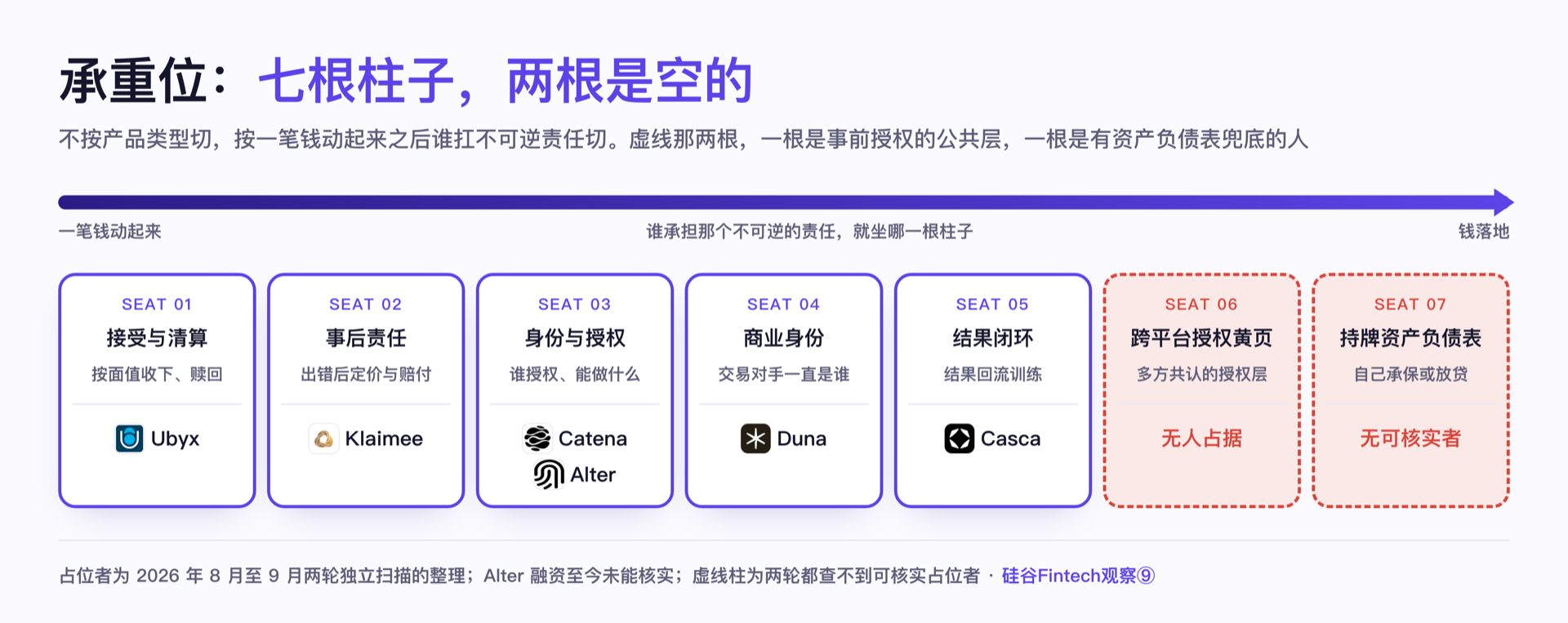
这张表要看的是空着的两格。
第六格是事前授权的公共层,就是第八篇里我说的 agent 时代的 Plaid 该长出来的地方。今天每家钱包、每家银行、每个协议各管各的授权,没有一本被多方共认的黄页。第七格解释了一件我两轮筛选都碰到的事:自称 AI 原生保险公司或 AI 放贷方的项目不少,能拿出承保实体、监管编号或州牌照的,一个都没有。声称与可核实证据之间的差距,就是这一格至今为空的原因。
而第二节讲的三种失败形态,落在表上就是第二格和第七格的事:定损失是谁的,以及谁有资产负债表去付。一个刚有人坐,一个至今空着。
四、三家公司逐个坐进去:各自卡在谁身上
坐在前三格里的三家,我逐家做到了能讲清一笔交易怎么走。先说我最后的结论,再说每家。
三家赌的是同一件事:出错之后谁负责,会从一句免责声明变成一个要花钱买的东西,而它们各自想当那个收钱的人。三家今天的处境也是同一个:都想当收费站,但路上都还没有车。差别只在一处,而这一处决定一切:让车上路这件事,各自卡在谁身上。
Ubyx 坐清算格,卡在需求侧。
先说它是什么。稳定币这条链上只有三种角色:印币的发行方,最后给客户兑付的收币银行,以及替企业把整件事外包的编排商。Ubyx 想当的是三者之间的规则和路由:银行签一次它的规则书,就能接所有发行方的币,按面值收下,实时拿到法币。它自己不印币,不收币,也不买币,只传指令。
它的模式是白皮书写的:发行方在结算银行预存资金,客户在参与银行存入稳定币,系统把请求路由到发行方,实时以法币结算,银行拿赎回手续费和汇差。平台费白皮书给的示例是 20 个基点,由收币银行付。创始人在花旗构想并主持过同一件事的机构版,这是他最硬的一条。
它的供给侧有货:公开的发行方十五家,Paxos、Ripple、Agora、Transfero、Monerium、GMO Trust、BiLira、Juno、Brale、Minteo 都在名单上。2025 年 6 月种子轮 1,000 万美元,Galaxy 领投,Coinbase Ventures、Founders Fund、VanEck 参投;2026 年 1 月 Barclays 单独入股。
它的需求侧到今天为止公开为零。创始人在 2026 年 2 月的书面问答里说公司 2025 年 10 月已上线、正在处理真实交易,但截至 2026 年 9 月,没有一家收币机构被公开点名为已上线,也没有任何清算量的数字。发行方那一侧十五家的数字,从 2025 年 6 月到 2026 年 1 月一字未变。
它卡在哪?卡在要银行改变行为,主动来签一本规则书。这件事没有日期,没人能给。它最可能死在网络效应的冷启动:价值等于接入的银行数,而第一家接入时价值为零。
Klaimee 坐事后格,卡在供给侧。
保险这行行话密。先说三个词。承保方,是最后掏钱赔的那一方,把自己的资产负债表押上去。管理型总代理,缩写 MGA,是替承保方干活但不掏钱的中间人,拿授权代为定价、核保、签单、理赔,赚佣金,真出大事故赔钱的是承保方。排除批单,是保单上写明这种情况我不赔的那张附页。传统责任险原来对 AI 造成的损失是沉默的,既没说赔也没说不赔;2026 年起改成明写不赔。那张写着不赔的纸,正是这门生意的市场。
Klaimee 做的事:先按八个风险维度测一个 agent,通过的发证书,证书后面绑一份承保方背书的赔付承诺。厂商拿这一张纸去过所有客户的采购,不用每家重谈。它卖给厂商的东西是过采购这一关,保险只是背后的支撑。它自己是 MGA,不掏钱,不用先拿牌照,承保方每年续一次约。
它 2026 年 7 月 22 日拿了 550 万美元种子轮,两个人,成立六个月。创始人最硬的一条是在 SafetyWing 走完过从总代理到自持牌的全程,保单原件能核到。
它的供给侧只有一家承保方,没有公开名字,落地在百慕大。需求侧公开为零:无客户、无保单、无理赔。
它卡在哪?卡在承保能力握在一家无名承保方手里,每年续一次约。创始人自己把这个结构比作融资:承保方是 LP,随时可以不再出资。它最可能死在承保方撤约。同路上 AIUC 早它十二个月,已经有 Beazley 的纸;先测再保这个打法,2026 年 9 月已被 AIUC 和 Armilla 追平,不再是差异点。
Catena 坐身份格,卡在监管。
Catena 的创始人是 Circle 的联合创始人 Sean Neville,做的是给 agent 开一个有身份、有规矩、留得下证据的美元账户:谁授权、能做什么、超限怎么拦、事后怎么重放。它同时在申请 OCC 的国民信托银行牌照。2026 年 5 月 20 日 A 轮 3,000 万美元,累计 4,800 万,a16z 在种子和 A 轮都在。
这一格最拥挤。Google 的 AP2、Stripe 的 ACP、Visa 的 TAP,三家巨头的协议直接压在这一格上;创业公司这边除了 Catena 还有 Alter、Nekuda、Payman AI。2026 年 8 月 6 日,做同一件事的 Sapiom 拿了 3,500 万美元 A 轮,两轮合计 5,000 万,超过 Catena 的 4,800 万,而且它的股东名单里有 Anthropic 和 Okta Ventures。一家模型提供方直接投了 agent 支付公司,这类股东 Catena 名单里没有。
它的采用数据只有一个硬数:三个开发包月下载各约 400 次。没有公开定价,外部生产客户无。
它卡在哪?卡在一张牌照。国民信托这道门今天什么样:2025 年 12 月 12 日 OCC 一次批了五家有条件批准,2026 年上半年又批了 Bridge、Protego、Foris DAX、Coinbase;但全新设立走完最终批准可开业的,到 2026 年 9 月只有 Circle 一家,2026 年 7 月 10 日获批。2026 年 7 月 Wise 被拒,8 月 Bunq 被拒,理由写得很细。门开了,但不是自动的。Catena 排在 Bridge 和 Coinbase 之后,仍在 Pending。
它最可能死在牌照拿到之后才发现牌照不值钱。信托牌照不许放贷,上限被资本金与回报率的算术锁死。而协议层的两个东家 Bridge 和 Coinbase 已经各自拿到有条件批准,排在它前面。如果它们在自己的牌照之上把带政策和证据链的 agent 账户做出来,Catena 拿到牌照那天,手上剩下的是什么?
三家并排,只能选一家,选哪家?
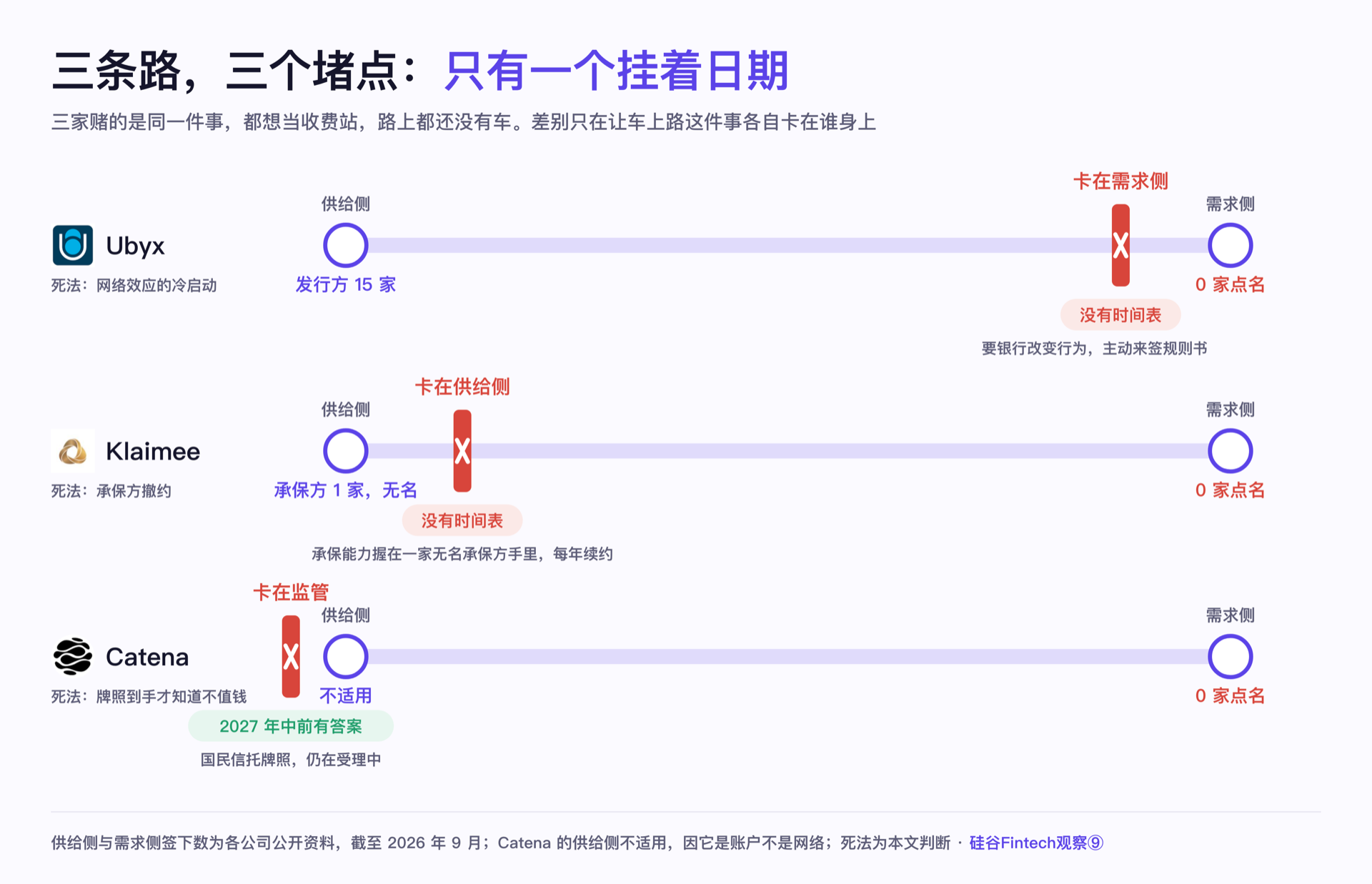
我的选择是 Catena。它今天不是三家里最好的一家,选它的理由只有一条:它的堵点是三家里唯一有既定流程、有先例、有时间表的那一个。Ubyx 需要银行改变行为,Klaimee 需要市场先出一次大事故,这两件事都可能发生,但都不由公司自己决定,也都没有日期。对一个要在有限时间里看到答案的人来说,能被验证的判断比更好听的故事值钱。
再往前走一步,把选它写成进入的条件。价格我给不出,Catena A 轮的投后估值没有公开披露,我不编一个。条件能给三个:一,OCC 的有条件批准在 2027 年中之前到手;二,在那之前至少有一家企业法务把它那套政策与证据链当成默认模板,公开点名;三,拿了模型厂商钱的 Sapiom 没有赶在它前面拿到牌。三个缺一个,都不是今天进的理由。
这个判断最可能错在哪?错在把牌照当护城河。牌照是准入,Coinbase 和 Stripe 旗下都已排在前面。Catena 的护城河只能长在另一件事上:它那套政策与证据链被企业法务当成默认模板。这件事今天没有证据。
五、Meta 把需求侧摆上了桌,顺带把责任推得更远
9 月 8 日 Meta 发布 Muse,我读了官方新闻稿和几家媒体的发布报道,把能核实的事实摆一下。
Muse 跑在一台专属的云端电脑上,Meta 的原话是 its own dedicated computer in the cloud,TechCrunch 的描述是 dedicated, secure computer with its own browser。模型叫 Muse Spark。它能替你订餐厅、买东西、发邮件、管日历,关了 app 也在跑。免费额度每周 1 亿 token,这个数出自扎克伯格的 Threads 帖子,Gizmodo 9 月 8 日引用;付费档 Power 每月 20 美元,Maximum 每月 100 美元,来自 TechCrunch。
两个细节比参数更值得看。
第一,免费档也要绑卡。TechCrunch 写得明白:Muse requires a payment card to get started。一个会替你结账的 agent,从第一天起就有你的卡号。
第二,付款走 Link by Stripe。Meta 新闻稿的原话是 Muse can checkout with Link built by Stripe,Shop Pay 后续加入。TechCrunch 补了一句:Link 带购买保护,可能减轻消费者的顾虑。翻译过来:Meta 没有自己造一个责任机制,它把 agent 的付款接到了卡轨道现成的争议系统上。第六篇我写过,谁赢 Stripe 都是收银台。Muse 是又一个实证,而且是需求侧的。
商业模式这件事,网上传得比事实快。我看到有文章说扎克伯格选了交易抽成的路线。核了一下,Motley Fool 9 月 11 日引 CNBC:Meta 首席 AI 官 Alexandr Wang 说,公司在探索从 agent 完成的购物里抽成,但尚未定方案。扎克伯格本人在 7 月的财报会上只说了一句,个人 agent 是下一波产品和收入线的基础。探索不是决定,Wang 不是扎克伯格。这个区别要写清楚。
为什么 Muse 跟责任那一格有关?看沃尔玛。
2025 年 11 月起,沃尔玛把约 20 万件商品放进了 OpenAI 的 Instant Checkout,用户在 ChatGPT 里就能下单。2026 年 3 月,沃尔玛产品与设计负责人 Daniel Danker 公开说,这些在对话里直接完成的购买,转化率只有跳转到沃尔玛官网的三分之一,他用的词是 unsatisfying。同月 OpenAI 确认在逐步下线 Instant Checkout,改由商家自己的结账流程接手。
这个数说明什么?普通人不喜欢在跟 AI 聊天的时候突然跳到一个结账页。能跑通的方向只剩一个:结账页消失,agent 在后台把钱付掉。Muse 走的就是这条路。
而这条路把责任的距离又拉长了一格。你看得见的结账页,你还能在付款前停一下。你看不见的结账,你却要为它负责。一次性虚拟卡、Link 的购买保护,业界给出的答案是把责任推回卡轨道的拒付系统。第八篇我说过卡组织真正的权力锚在争议规则上,这一格在卡轨上养活了一个品类,现在它被拿来给 agent 用。
问题是卡轨道只认两种状态:授权了,或者没授权。你说 200 以内它买了 250,这笔在网络眼里是一笔完全正常的已授权交易。没有第三种状态叫授权了但超出参数。这个格子,卡轨道也填不上。它落回承重位表的第二格和第六格:事后责任,和事前授权的公共层。
六、这一格的大小,看额度不看错误率
写到这里,一个自然的问题是:agent 的幻觉越严重,兜底这门生意是不是越大?
一半对。但关系是倒 U,往上走到一半就往下拐。
幻觉太严重,没人敢把带钱的活交给 agent。没有部署就没有敞口,没有敞口就没有保费,承保方也不敢接,因为损失是必然发生而不是概率发生。市场为零。幻觉足够轻,损失小到自己吃掉就完了,企业自留,不买。没人给键盘打错字买保险。市场也接近零。中间那一段才有生意:低到敢部署,高到扛不住。
再往下拆一层。保费大致是四样相乘:部署规模,单次敞口,事故频率,不可自留的那部分。幻觉率只进第三项,而且它同时把第一项往下压。倒 U 就是从这儿来的。
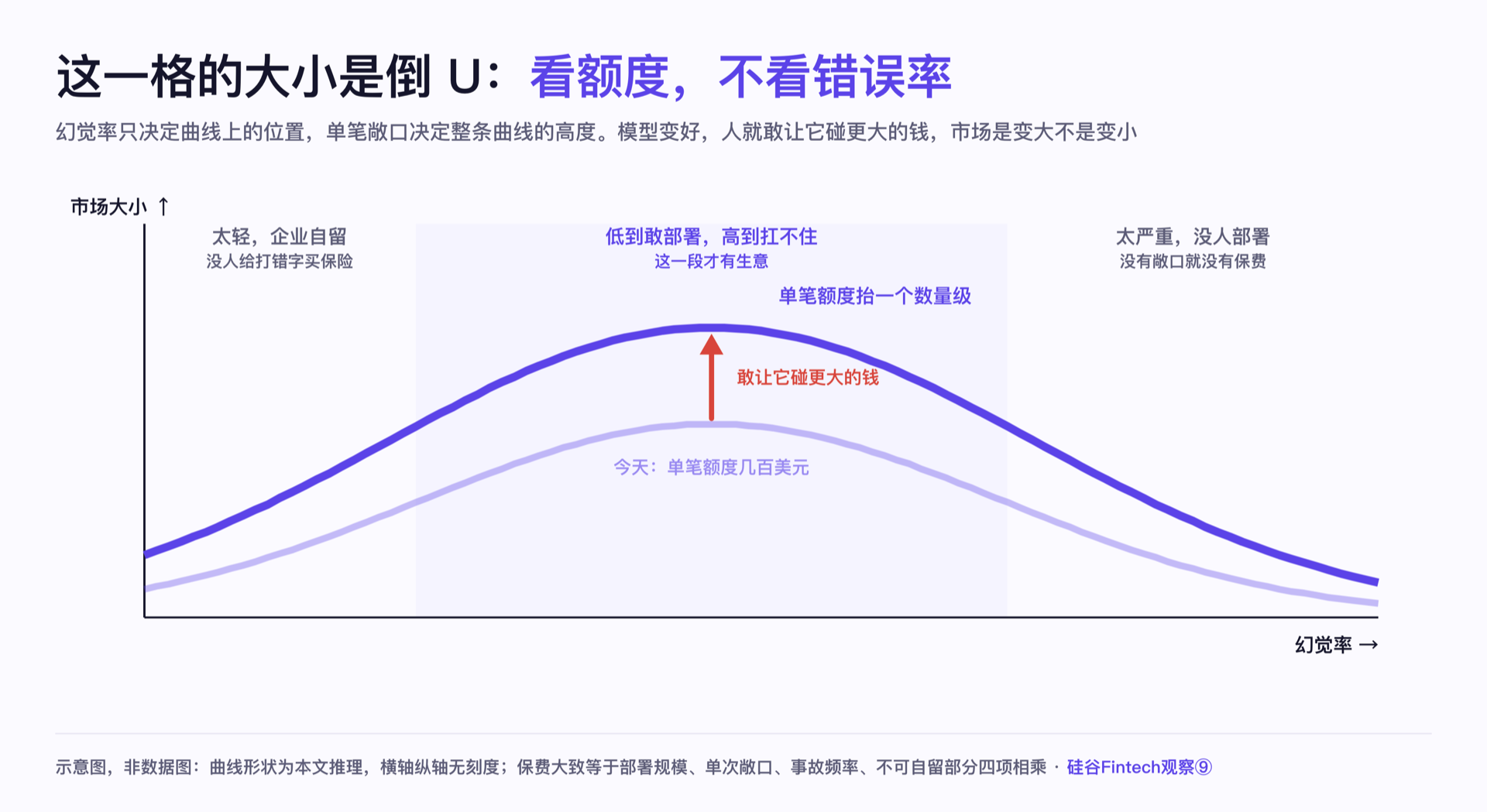
最大的杠杆是单次敞口。同样的出错概率,agent 被允许动 200 美元和被允许动 1,000 万美元,市场差五个数量级。决定这个市场大小的,是它被允许碰多大的钱。
由此有个反直觉的推论:模型变好,这个市场是变大不是变小。模型变好,人就敢让它碰更大的钱,单次敞口上一个台阶。频率下降但敞口上升,期望损失不一定降,尾部一定更肥。车险是同一个道理,车越来越安全,事故率一路降,车险市场没缩,因为车更贵、责任限额更高、诉讼更贵。
所以该跟的指标是 agent 单笔授权额度的上限,模型跑分放一边。卡组织的 agent 协议给的默认限额,各家钱包的默认限额,企业采购里给 agent 开的额度,这几个数往上抬一个数量级,这一格就跟着抬一个数量级。Muse 上线就要绑卡,是这条线上第一个消费端的数据点:Meta 愿意让它碰钱了,至于一次能碰多少,官方没说。
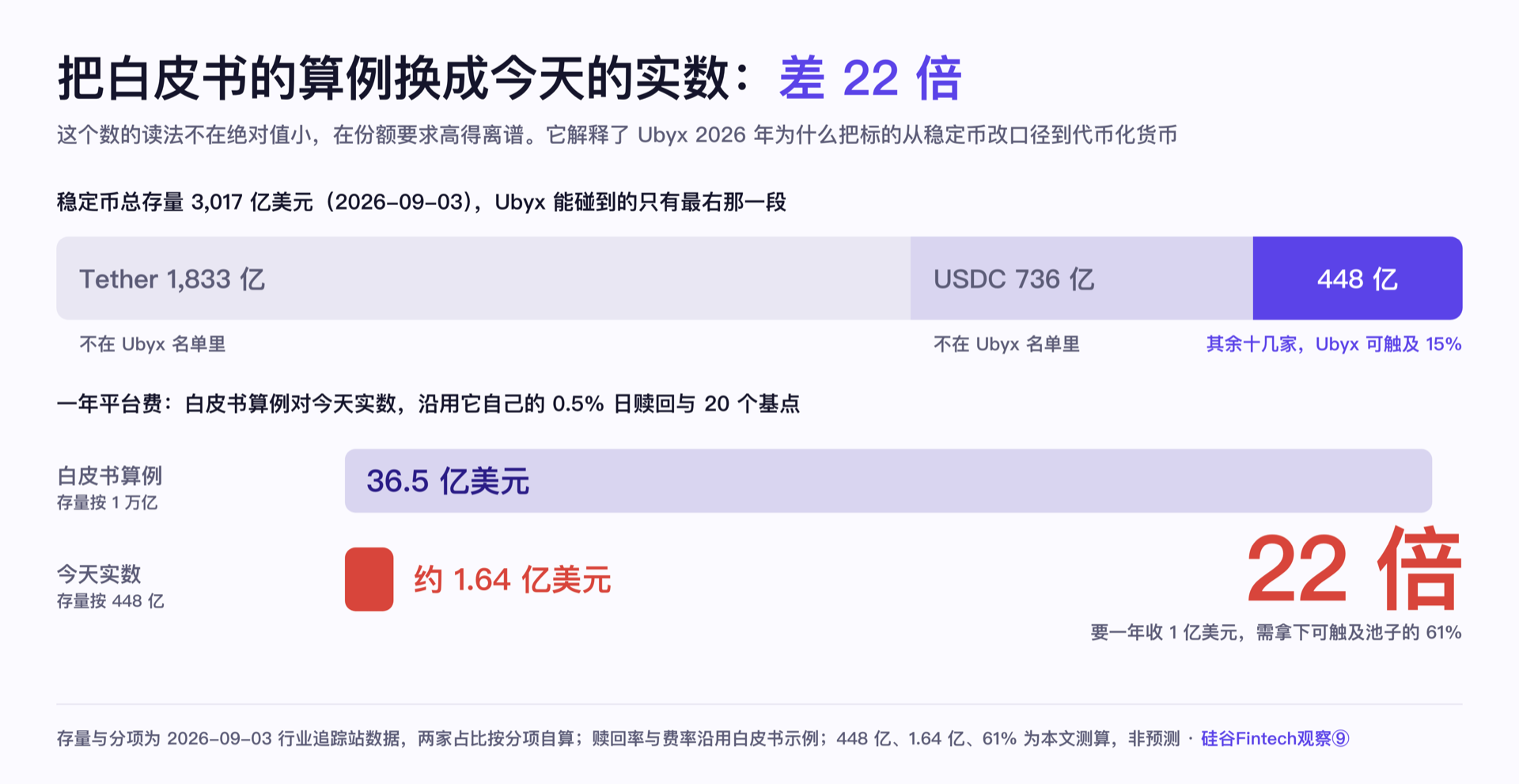
这个思路也能回头检验第四节那三家。以 Ubyx 为例,它白皮书那个 36.5 亿美元的年收入池,输入是稳定币存量 1 万亿、每天赎回 0.5%、平台费 20 个基点。存量 1 万亿是白皮书自己标了可能不反映现实的整数。换成 2026 年 9 月 3 日的实数:稳定币总存量约 3,017 亿,其中 Tether 1,833 亿、Circle 的 USDC 736 亿,两家合计约 85%,而 Ubyx 公开的十五家发行方里,这两家都不在。它今天能碰到的存量是剩下那 15%,约 448 亿。沿用白皮书自己的赎回率和费率,年赎回约 818 亿,平台费约 1.64 亿美元一年,和白皮书的 36.5 亿差 22 倍。要一年收 1 亿美元,得拿下它可触及池子的 61%。这个数的读法不在绝对值小,在份额要求高得离谱。它解释了 Ubyx 2026 年为什么把标的从稳定币改口径到代币化货币:银行存款那个池子远大于稳定币。
最后一层,也是我认为最实际的一层:验证先于承保。没人能承保一个没有损失历史的东西。这一格要先长出一层卖检查的生意,按调用或按席位收费,把错误记下来、分类、算频率;等损失数据攒够了,第二层卖赔偿的生意才有人敢做。顺序不能颠倒。而第一层的护城河,是它攒下的损失数据,不是它的检查算法。Klaimee 先测再保的结构正是这个顺序,但测这一半 2026 年 9 月已被追平,它的差异点得往后挪一格,变成谁攒到最多的损失数据。Stripe 那句六分之一,就是第一层已经开始攒数据的证据。
七、这篇文章不会告诉你的事
收口之前先自己拆台。
第一,三种失败形态的分类和七格承重位表都是我的框架,不是行业共识。它们对我这两个月的经历和筛出来的公司解释得通,对别人的场景未必。
第二,三家公司全部依据公开信息:白皮书、监管备案、融资公告、创始人的公开访谈与文章。公司未披露的内部进展无从得知。三家的融资与估值取自不同时点的公开报道,横向比较只当量级参考。
第三,沃尔玛那个三分之一是 Danker 一个人的公开表态,我没有见到沃尔玛的书面披露,也不知道样本大小和时间窗。
第四,Muse 上线一周,没有任何使用量、交易量或出错率的公开数据。第五节全是产品设计层面的推断。
第五,Ubyx 那笔账全是别人的输入值加我的算式:存量数取自行业追踪站的分项,赎回率和费率取自白皮书的示例。任何一个输入变了,结论作废。
第六,第二种失败形态的证据是我自己的使用经历,样本是一,不是统计。它足够让我相信这种错存在,不足以让我估它的频率。
第七,四项相乘那个公式是我自己拆的,没有任何一家保险公司按这个口径公开过 agent 相关的承保数据。它是思考工具,不是定价模型。
收口
把这一篇收成三句话。
第一句:路由的终点是敢按结果报价,报价那一刻它就成了承保方。Stripe 买 OpenRouter 买的是账本,账本的下一页是成功率,成功率的背面是赔付。这条路支付业走了二十年,token 不需要二十年。
第二句:七个位置里,出错之后的两格一个刚有人坐,一个至今空着,而坐进去的三家都卡在别人身上。Ubyx 等银行改行为,Klaimee 等承保方续约,Catena 等一张牌照。只有最后一个有日期。
第三句:这一格的大小看额度不看错误率。该盯的数字是 agent 一笔能花多少。模型变好,这个数会涨,市场跟着涨。
可证伪的说法:到 2027 年底,如果没有任何一家 token 路由或 agent 平台公开按任务成功计价并附带赔付条款,第一句作废。到 2027 年年中,如果 Catena 仍未获得 OCC 有条件批准,第四节的排序下调;如果 Ubyx 在此之前点名了一家真实上线的收币机构,排序翻转。到 2028 年年中,如果主流消费端 agent 的单笔默认授权额度仍停在几百美元以下,第三句里关于市场规模的判断降权,正确的解释会变成信任门槛比我想的高得多。
(本文事实口径:Stripe 收购 OpenRouter,华尔街日报 2026-07-23 前后报道洽谈作价约 100 亿美元,Bloomberg 2026-08-16 报道达成协议作价 70 亿美元以上,Stripe 官方新闻室 2026-08-19 公告 agrees to acquire 未披露作价,详见第七篇 2026-09-14 更新。Stripe Radar 博客 Expanding Stripe Radar to protect more of your business 发布于 2026-05-27,六分之一与 ElevenLabs 每天 2,000 个均为原文数字。OpenCode 的 7,013 个欺诈账号与每月约 40 万美元为 Dax Raad 2026-08-11 在 X 的原帖,8,000 个账号与每月 48 万美元为其更早一条帖子。承重位表七格及占位者为本文作者 2026 年 8 月至 9 月两轮独立扫描的整理,第一轮以 YC 全量库为起点,第二轮以监管备案与融资记录为起点;表中 Alter 的融资至今未能核实,Duna 的 CapitalG 领投 A 轮、Casca 的三家银行客户兼投资人为公开报道。Ubyx:白皮书 2025 年 3 月版为资金流七步、发行方预存、20 个基点示例费率与 36.5 亿美元算例的来源;发行方十五家名单、2025 年 6 月 1,000 万美元种子轮及投资方、2026 年 1 月 Barclays 入股均为公司公告与公开报道;创始人 2026 年 2 月书面问答称 2025 年 10 月已上线;截至 2026 年 9 月无公开点名的收币机构与清算量;稳定币存量 3,017 亿、Tether 1,833 亿、USDC 736 亿为 2026-09-03 行业追踪站分项数据,两家占比 85.2% 为按分项自算,448 亿、818 亿、1.64 亿、61% 均为本文按白皮书示例参数测算,非预测。Klaimee:2026-07-22 种子轮 550 万美元为公司公告;MGA 结构、百慕大承保方、八个风险维度、履约保证为其官网与创始人 2026 年 5 月至 7 月公开文章;承保方名称未公开;AIUC 与 Beazley 的关系为 AIUC 公开资料;先测再保被 AIUC 与 Armilla 追平为 2026 年 9 月各家公开产品页对照。Catena:2026-05-20 A 轮 3,000 万美元、累计 4,800 万、a16z 参与为公司公告;OCC 国民信托申请状态为 OCC 公开索引,截至 2026-09-07 仍为 Pending;三个开发包月下载约 400 次为公开包管理站数据;Sapiom 2026-08-06 A 轮 3,500 万、两轮合计 5,000 万、股东含 Anthropic 与 Okta Ventures 为公司公告。OCC 队列:2025-12-12 一次批准 Circle、Ripple、BitGo、Paxos、Fidelity Digital Assets 有条件批准,2026-02-12 Bridge、2026-02-13 Protego、2026-02-20 Foris DAX、2026-04-02 Coinbase 有条件批准,Circle 2026-07-10 为本轮首家全新设立的最终批准,Wise 2026-07 与 Bunq 2026-08 被拒,均为 OCC 公开决定书。Meta Muse 发布于 2026-09-08,专属云端电脑、Muse Spark、Link by Stripe 结账、Shop Pay 后续加入均出自 Meta 官方新闻稿;免费档每周 1 亿 token 出自扎克伯格 Threads 帖,经 Gizmodo 2026-09-08 引用;Power 20 美元与 Maximum 100 美元、免费档需绑卡、Link 带购买保护均出自 TechCrunch 2026-09-08。Meta 探索交易抽成为首席 AI 官 Alexandr Wang 对 CNBC 的表态,经 Motley Fool 2026-09-11 引用,尚未定方案;扎克伯格关于个人 agent 是下一波收入线基础的表述出自 2026 年 7 月财报会。沃尔玛约 20 万件商品自 2025 年 11 月进入 OpenAI Instant Checkout、对话内购买转化率为跳转官网的三分之一、OpenAI 于 2026 年 3 月逐步下线 Instant Checkout,均出自 Search Engine Land 2026-03-19 对沃尔玛产品与设计负责人 Daniel Danker 表态的报道,未见沃尔玛书面披露。机票例子、三种失败形态、承重位表、倒 U 与四项相乘公式、验证先于承保、三家排序,均为本文分析框架与判断,非引述。文中关于市场规模的表述除 Ubyx 一节的测算外均为结构判断,未给出绝对金额,理由见第八篇。)
Silicon Valley Fintech Watch series · Part Nine · First published on klay-wang.com, September 14, 2026
In brief. On August 16, 2026, Bloomberg reported that Stripe had agreed to buy OpenRouter for more than $7 billion. On September 8, Meta launched Muse, a personal agent that gives every user a dedicated computer in the cloud and checks out through Stripe's Link. Back in March, Walmart's head of product said that purchases completed inside ChatGPT converted at one third the rate of click-throughs to its own site. Three events that look unrelated point at the same cell: the agent spends on your behalf, and when it spends wrong, who pays. In Part Eight I said the map had three cells nobody had drawn, and that the after-the-fact one was worth the most. This piece opens that cell up. First, why nobody has managed to sit in it. Then a table of seven seats, with the three companies I have dug into placed in theirs, each stuck on a different party. Last, what decides how big the cell is. My answer: look at the spending limit, not the error rate.
Before we start
Where this comes from.
When Part Seven went out, the Stripe and OpenRouter deal was still in talks and the Wall Street Journal had reported $10 billion. On August 16 Bloomberg reported an agreement at more than $7 billion; on August 19 Stripe's newsroom published the announcement, worded as agrees to acquire, with no price. Part Seven has since been corrected to $7 billion in the title and throughout, the revenue multiple from 71x to about 50x, and the judgment left untouched: routing is free, the ledger is not.
This piece takes the next step. What comes after the ledger? My observation is that twenty years ago the payments industry also did nothing but route, sending a transaction to where it should go. What grew on top of routing turned out to be worth far more: automatic retries on failure, a second acquirer when the first declines, real-time fraud blocking, the same transaction priced across several rails. Different names, one job, pushing the success rate up. And whoever promises the success rate eats the cost of failure. The token flow is walking the same road again.
Then a harder question: what does agent failure look like, why is it so hard to insure, and who today is betting that this can be charged for.
The second half took me two months. I screened from two ends, the full YC library and regulatory filings, for companies that treat who pays when it goes wrong as a business. Three I worked through until I could explain how a single transaction moves, who charges whom how much, and what would void the judgment. They are Ubyx, Klaimee and Catena. They are the evidence in this piece. Every source is listed at the end.
1. Routing's next step is daring to price the outcome
Start by separating two units of account: the token and the task.
Priced per token, you look at the cost of a thousand tokens. Priced per task, you look at the cost of getting one thing done. The two numbers are far apart. To complete a task an agent has to understand the request, retrieve, draft a plan, call tools, retry when a step fails, and verify at the end. Add inference cost, retry cost, tool calls, verification, latency and the losses from failed attempts, then divide by the number of tasks that actually succeeded. That is the real unit price.
Once that sum is done, a popular inference falls apart: cheap models keep getting better, so routing becomes a price-comparison engine that sends every request to the cheapest one. But a cheap model that fails twice on a task costs more than an expensive one that succeeds once. Sending to the cheapest model was wrong from the start.
So the position in the routing layer that is worth real money is the one that dares to tell the customer this will get done. The customer pays a premium for that sentence; the price is that when it fails, the promiser eats it. That is how payment gateways survived: they charge on success rate, and when something fails, the customer comes to them, not to the underlying rail.
In plain terms: today's token router is a broker that tells you who is cheapest. Its next step is to become a general contractor who tells you I will take this job, and if it fails, that is on me. A broker collects an information fee; a contractor collects a premium. The two kinds of money do not sit in the same ledger. When does a router become an underwriter? The first day it dares to write if it fails, that is on me into a contract.
And the first question a contractor has to answer is: when a job I took goes wrong, what does that look like?
2. Agents fail in three shapes, each harder to insure than the last
This section is the load-bearing wall. I split agent failure into three shapes. The taxonomy is mine, not an industry consensus, but every shape comes with an example I have run into myself.
Shape one: the mandate you give can never be written out in full.
An example. You tell an agent: a flight to Los Angeles, under $500. It can perfectly well book you a budget carrier with no checked bag and an $80 surcharge at the airport, landing at two in the morning, a fourteen-hour layover, non-refundable. You said none of those things, and every one of them is under $500. It broke no instruction.
What you got is not what you wanted, but it did nothing wrong. Now who do you go to? Chargeback? You authorized it. The agent? It did as told. That is the cell with no owner.
Someone will say, then spell it out: nonstop, no layover, no red-eye, no budget carrier, no landing after midnight. Spelling it out does help. It turns a case where nobody can say whose fault it is into a case where it is clear. Breach of contract is something a contract can handle. But however completely you write it, one thing stays out of reach: a ticket satisfying all six constraints may simply not exist on a given day. The agent can stop and report failure, safe but useless. Or it can relax one constraint to close the deal, and which constraint it relaxes is a choice it made for you, because what you gave it was a set of constraints, not a ranking. By the time it has chosen, the non-refundable ticket is issued.
If you could write it all out, you would not need the agent. The value of delegation is precisely that you do not spell everything out. Underspecification is the premise of this business.
Shape two: you spelled it out, and it still did not comply.
This shape is more fundamental than the first, because no specification can block it.
For two months I have used agents daily to write copy, make charts and run data pipelines. The gates are defined clearly, the rules are in the skill files, the gate command is right there. It still skips steps, ignores rules, runs the gate and commits without reading the result. I regularly spend hours fixing what it did. I did make myself clear. It hallucinates, it cuts corners, it sees the red light and goes anyway.
The difference from shape one: there, the loss is bounded by the edges of the mandate; here, there are no edges. It can do anything, including what you explicitly forbade. You can compress shape one with specification. You cannot compress shape two.
Shape three: the errors are correlated.
The foundation of insurance is the law of large numbers: ten thousand policyholders, each with an independent claim, total loss computable. Agent errors are correlated by birth. Ten thousand agent instances running the same model version, the same prompt, the same tool definitions will make the same mistake in the same minute. This is not a risk that can be diversified away, and diversification is exactly what reinsurance is for.
A car insurer is not afraid of one car crashing. It is afraid of ten thousand crashing at once. Agents are ten thousand cars sharing one driver.
Nobody has managed to sit in this cell because each shape blocks a different door. The first needs a claims window, and there is none. The second needs a backstop that does not depend on specification, and there is none. The third makes anyone willing to backstop unwilling.
But the first real money in losses is already being carried by someone. It just is not called agent error. It is called fraud.
Stripe's Radar blog of May 27, 2026 has a sentence: across the Stripe network, more than one in six sign-ups at AI companies are linked to multi-account abuse. Multi-account abuse means one person opening dozens of accounts to reuse free credits repeatedly, or spreading stolen-card activity across accounts to delay detection. The same post says ElevenLabs uses the system to block 2,000 free-tier abusers a day.
A more specific number: OpenCode founder Dax Raad wrote on X on August 11 that they had found and banned 7,013 fraudulent accounts, saving an estimated $400,000 a month. An earlier post described one operator running 8,000 accounts and reselling $480,000 of tokens a month.
Why does this loss show up first at the routing and platform layer? Because only that layer can see the same person opening accounts across many providers. A single model vendor sees only its own slice of the loss, never the whole. Seeing the whole is not yet worth money on its own; what is worth money is what you dare to do, and dare to carry, once you have seen it. That is where the first fee gets collected.
So the routing layer's first step toward being an underwriter is to backstop people cheating agents, with the agent's own errors coming later. Fraud is independently distributed and insurable. Errors are correlated and hard.
3. The seat map: seven positions, cut by who carries the irreversible liability
The map in Part Eight was cut by product type: agentic commerce, agentic payments, agentic fintech, agentic banking. Nothing wrong with the cut, but it cannot answer this piece's question. To answer who pays when it spends wrong, you need a different knife: once a sum of money starts moving, who carries the responsibility that cannot be undone.
Cut that way, the whole of agent finance falls into seven positions. I call it the seat map, because each cell is a load-bearing column in the building. Pull any one and what sits above it comes down.
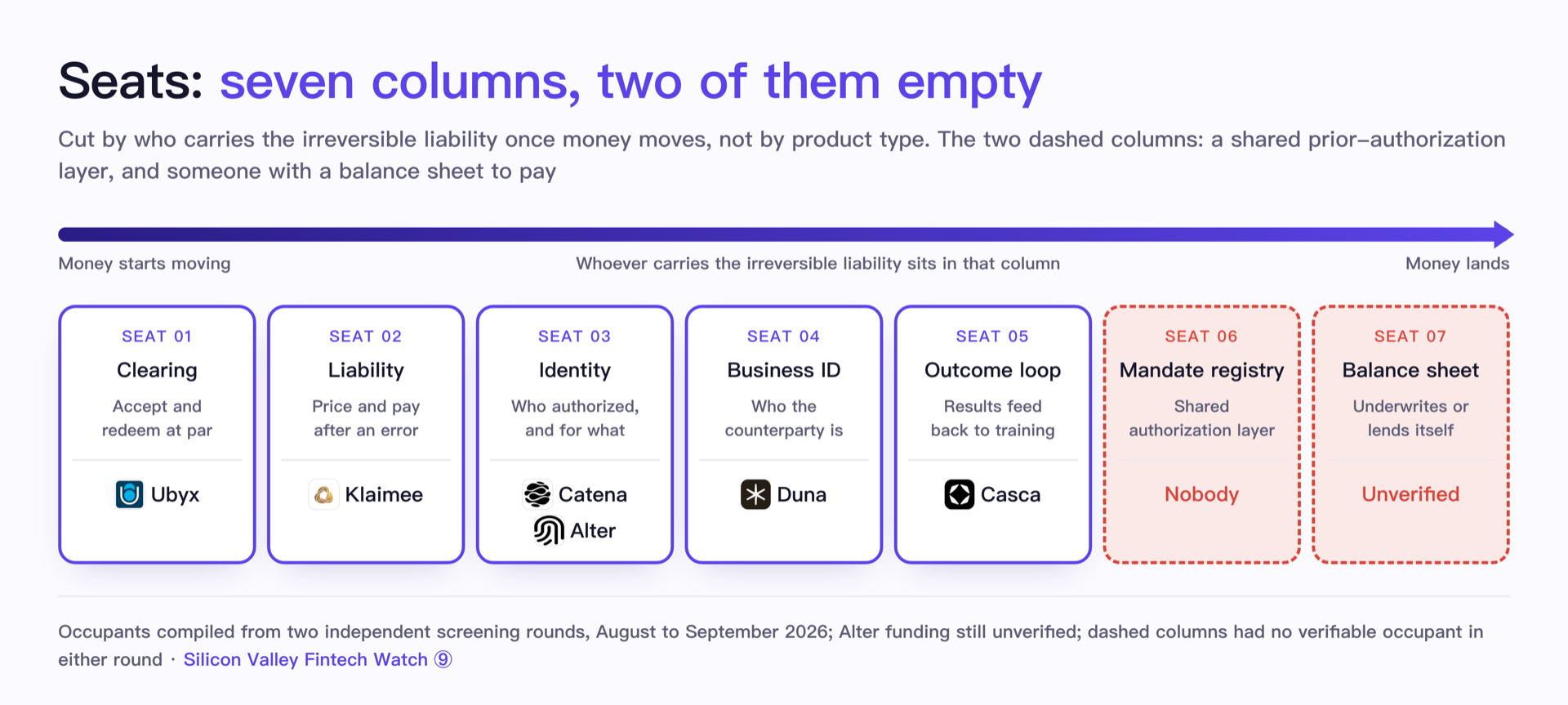
What matters in this table are the two empty cells.
The sixth is the public layer for prior authorization, the place where, as I said in Part Eight, the Plaid of the agent era should grow. Today every wallet, every bank and every protocol manages authorization on its own; there is no directory everyone recognizes. The seventh explains something I ran into in both screening rounds: plenty of projects call themselves AI-native insurers or AI-native lenders, and not one could produce an underwriting entity, a regulator's registration number or a state license. The gap between what is claimed and what can be verified is why that cell is still empty.
The three failure shapes from the previous section land on this table as the second and seventh cells: who defines the loss, and who has a balance sheet to pay it. One just got its first occupant. The other is still empty.
4. Three companies, each in its seat, each stuck on someone else
The three companies in the first three cells I have worked through until I can trace a single transaction. My conclusion first, then each one.
All three are betting on the same thing: that who is responsible after an error will go from a line in a disclaimer to something people pay money for, and each wants to be the one collecting. All three are in the same situation today: each wants to be a tollbooth, and there are no cars on the road yet. The difference is in one place, and that place decides everything: getting cars onto the road is stuck on someone, and it is a different someone for each.
Ubyx sits in clearing and is stuck on the demand side.
What it is. The stablecoin chain has only three roles: issuers who mint, banks that finally redeem for the customer, and orchestrators who take the whole job off a company's hands. Ubyx wants to be the rules and the routing among the three: a bank signs its rulebook once and can accept every issuer's coin at par, settling in fiat in real time. It does not mint, does not accept, does not buy. It only passes instructions.
The model is in the white paper: issuers pre-fund at a settlement bank, a customer deposits stablecoins at a participating bank, the system routes the request to the issuer, settlement happens in fiat in real time, and the bank earns a redemption fee plus the spread. The platform fee in the white paper's example is 20 basis points, paid by the accepting bank. The founder conceived and ran the institutional version of the same thing at Citi, which is his strongest card.
The supply side has goods: fifteen public issuers including Paxos, Ripple, Agora, Transfero, Monerium, GMO Trust, BiLira, Juno, Brale and Minteo. A $10 million seed round in June 2025 led by Galaxy, with Coinbase Ventures, Founders Fund and VanEck participating; a separate Barclays investment in January 2026.
The demand side is publicly zero. In a written Q&A in February 2026 the founder said the company went live in October 2025 and was processing real transactions, but as of September 2026 no accepting institution has been named publicly and no clearing volume disclosed. The issuer count of fifteen has not changed between June 2025 and January 2026.
Where is it stuck? On banks changing their behavior and coming to sign a rulebook. Nobody can put a date on that. Its most likely death is the cold start of a network effect: its value equals the number of banks connected, and the first bank connects to a network worth nothing.
Klaimee sits in after-the-fact liability and is stuck on the supply side.
Insurance is dense with jargon. Three terms first. The carrier is the party that finally pays a claim, putting its own balance sheet behind the policy. A managing general agent, MGA, is an intermediary that works for the carrier without putting up money: it prices, underwrites, issues and handles claims on the carrier's authority, earns commission, and when a big loss hits, the carrier pays, not the MGA. An exclusion endorsement is the page on a policy that says this we do not cover. Traditional liability policies used to be silent on losses caused by AI, neither covering nor excluding; from 2026 they say in writing that they do not. That page saying we do not cover is exactly this business's market.
What Klaimee does: test an agent across eight risk dimensions, certify the ones that pass, and attach to the certificate a payout commitment backed by a carrier. A vendor takes that one document through every customer's procurement without renegotiating each time. What it sells the vendor is getting through procurement; insurance is only the support behind it. It is itself an MGA, puts up no capital, needs no license first, and renews with its carrier annually.
It raised a $5.5 million seed on July 22, 2026, two people, six months old. The founder's strongest card is having gone the full way from MGA to holding a license at SafetyWing, with the policy documents traceable.
Its supply side is one carrier, unnamed, domiciled in Bermuda. Its demand side is publicly zero: no customers, no policies, no claims.
Where is it stuck? On underwriting capacity held by one unnamed carrier, renewed once a year. The founder herself compares the structure to fundraising: the carrier is the LP and can stop committing at any time. Its most likely death is the carrier walking away. On the same road, AIUC is twelve months ahead with paper from Beazley, and the test-then-insure play has been matched by AIUC and Armilla as of September 2026. It is no longer a differentiator.
Catena sits in identity and authorization and is stuck on the regulator.
Catena's founder is Circle co-founder Sean Neville. It builds a dollar account for agents that has an identity, rules and an evidence trail: who authorized, what it may do, how limits get enforced, how actions get replayed afterward. It is also applying for an OCC national trust bank charter. A $30 million Series A closed on May 20, 2026, $48 million cumulative, with a16z in both the seed and the A.
This is the most crowded cell. Google's AP2, Stripe's ACP and Visa's TAP, three big-company protocols, press directly on it; on the startup side there are Alter, Nekuda and Payman AI besides Catena. On August 6, 2026, Sapiom, doing the same thing, raised a $35 million Series A, $50 million across two rounds, more than Catena's $48 million, and its cap table includes Anthropic and Okta Ventures. A model provider investing directly in an agent payments company is a category of shareholder Catena does not have.
Its only hard adoption number: three developer packages at roughly 400 monthly downloads each. No public pricing, no external production customers.
Where is it stuck? On a charter. What the national trust door looks like today: on December 12, 2025 the OCC granted five conditional approvals in one batch, and in the first half of 2026 added Bridge, Protego, Foris DAX and Coinbase; but the number of de novo applicants that have completed final approval and can open is, as of September 2026, one, Circle, on July 10, 2026. Wise was refused in July 2026 and Bunq in August, with detailed reasons. The door is open, but it is not automatic. Catena is queued behind Bridge and Coinbase, still pending.
Its most likely death is getting the charter and discovering the charter is not worth much. A trust charter cannot lend, so the ceiling is locked by the arithmetic of capital and return. And the two owners of the protocol layer, Bridge and Coinbase, already hold conditional approvals ahead of it. If they build the agent account with policy and evidence trail on top of their own charters, what does Catena have in hand the day its charter arrives?
Three side by side. If you can only pick one, which?
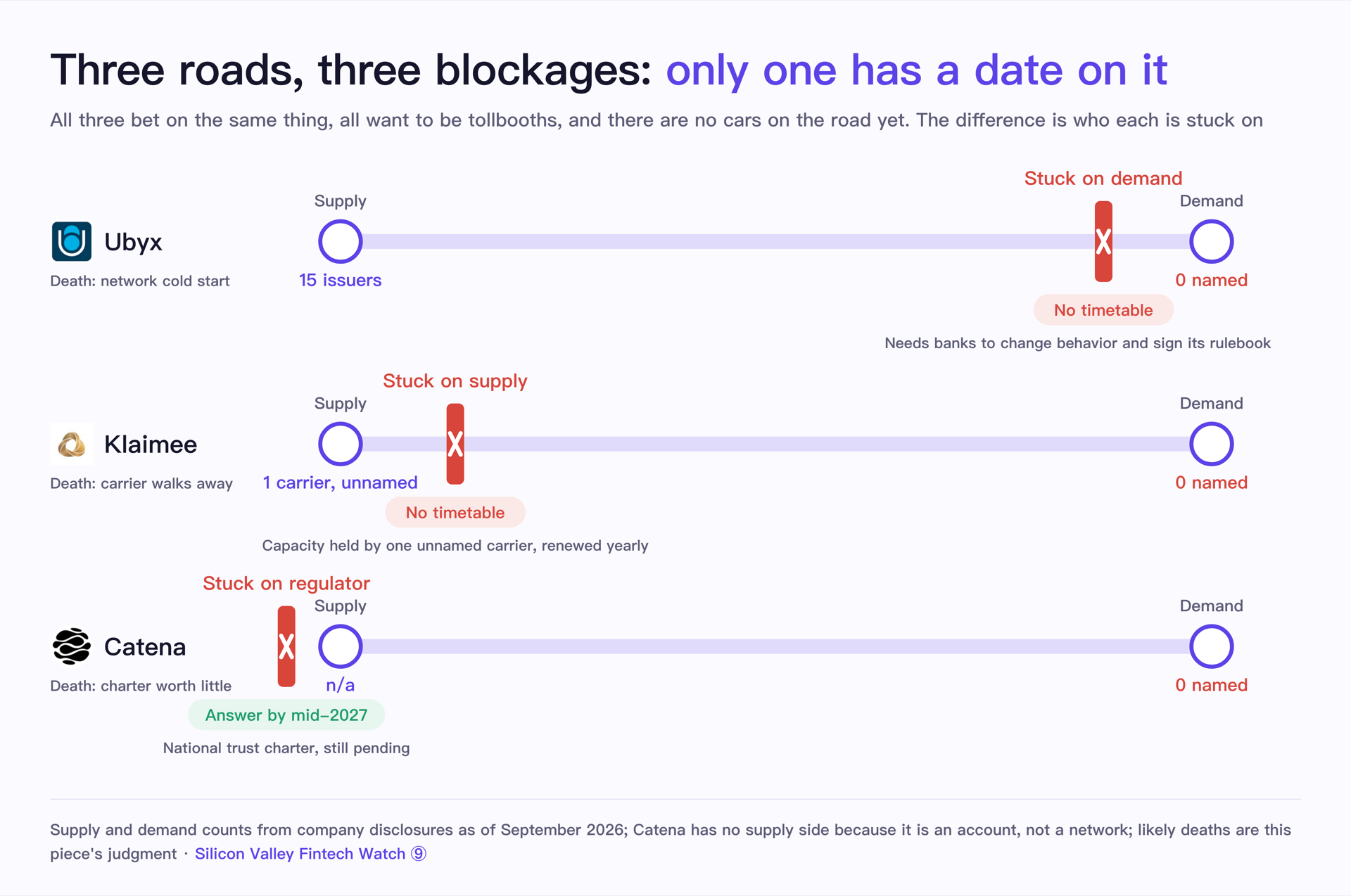
My pick is Catena. It is not the best of the three today; the only reason to pick it is that its blockage is the one with an established process, precedents and a timetable. Ubyx needs banks to change behavior; Klaimee needs the market to produce a major agent accident first. Both may happen, but neither is in the company's hands, and neither has a date. For someone who needs an answer within a finite window, a judgment that can be tested is worth more than a better story.
One step further: write the pick as conditions for entry. I cannot give a price, because Catena's post-money valuation for the A round is not public and I am not going to invent one. I can give three conditions. One, the OCC conditional approval arrives before mid-2027. Two, before then, at least one corporate legal team publicly adopts its policy and evidence trail as the default template, by name. Three, Sapiom, with model-provider money behind it, does not get a charter first. Missing any one of the three is a reason not to enter at today's price.
Where is this judgment most likely wrong? In treating the charter as a moat. A charter is admission, and Coinbase and Stripe's subsidiary are already queued ahead. Catena's moat can only grow somewhere else: corporate legal teams adopting its policy and evidence trail as the default. There is no evidence of that today.
5. Meta put the demand side on the table, and pushed liability one step further away
Meta launched Muse on September 8. I read the official newsroom post and several launch reports; here are the facts that check out.
Muse runs on a dedicated computer in the cloud, in Meta's words its own dedicated computer in the cloud, and in TechCrunch's, a dedicated, secure computer with its own browser. The model is called Muse Spark. It books restaurants, buys things, sends email and manages your calendar, and keeps running after you close the app. The free tier is 100 million tokens a week, a figure from a Threads post by Mark Zuckerberg as cited by Gizmodo on September 8; the paid tiers are Power at $20 a month and Maximum at $100, per TechCrunch.
Two details matter more than the specs.
First, the free tier requires a card. TechCrunch puts it plainly: Muse requires a payment card to get started. An agent that will check out for you has your card number from day one.
Second, payment goes through Link by Stripe. The newsroom post says Muse can checkout with Link built by Stripe, with Shop Pay to follow. TechCrunch adds that Link carries purchase protection, which may ease consumer worries. Translated: Meta did not build its own liability mechanism. It plugged the agent's payments into the existing dispute system of the card rails. In Part Six I wrote that whoever wins, Stripe is the checkout counter. Muse is one more data point, and this one is on the demand side.
On the business model, rumor has traveled faster than fact. I have seen articles saying Zuckerberg chose a transaction take rate. Checked: Motley Fool on September 11, citing CNBC, reports that Meta chief AI officer Alexandr Wang said the company is exploring taking a cut of purchases completed through the agent but has not settled on a plan. Zuckerberg himself, on the July earnings call, said only that personal agents are the foundation for the next wave of products and revenue lines. Exploring is not deciding, and Wang is not Zuckerberg. The distinction needs to be written down.
Why does Muse bear on the liability cell? Look at Walmart.
From November 2025 Walmart put roughly 200,000 products into OpenAI's Instant Checkout, so users could order inside ChatGPT. In March 2026 Walmart's head of product and design, Daniel Danker, said publicly that purchases completed inside the conversation converted at one third the rate of click-throughs to Walmart's site; his word was unsatisfying. The same month OpenAI confirmed it was phasing out Instant Checkout in favor of checkout flows run by the merchants themselves.
What does that number say? Ordinary people do not like being dropped onto a checkout page in the middle of a chat with an AI. Only one direction remains: the checkout page disappears and the agent pays in the background. That is the road Muse is on.
And that road stretches the distance to liability by one more step. A checkout page you can see is a place you can still stop before paying. A checkout you cannot see is one you are still responsible for. Single-use virtual cards and Link's purchase protection are the industry's answer: push liability back onto the chargeback system of the card rails. In Part Eight I wrote that the real power of card networks is anchored in dispute rules; that cell fed an entire category on the card rails, and now it is being reused for agents.
The problem is that card rails know only two states: authorized, or not. You said under $200 and it bought for $250, and in the network's eyes that is a perfectly normal authorized transaction. There is no third state for authorized but out of bounds. That cell, the card rails cannot fill either. It falls back onto the second and sixth seats of the map: after-the-fact liability, and the public layer for prior authorization.
6. How big this cell is: look at the limit, not the error rate
By this point a natural question: the worse agents hallucinate, the bigger the backstop business?
Half right. But the relationship is an inverted U, rising halfway and then turning down.
Hallucinate too badly and nobody hands an agent anything involving money. No deployment, no exposure, no premium; and no underwriter will touch it, because the loss is certain rather than probable. Market zero. Hallucinate lightly enough and the losses are small enough to eat; companies self-insure and do not buy. Nobody insures typos. Market near zero too. Only the middle band has a business: low enough to dare to deploy, high enough that you cannot carry it.
One layer down. Premium is roughly four things multiplied: deployment scale, exposure per transaction, incident frequency, and the share that cannot be self-retained. The hallucination rate enters only the third factor, and at the same time pushes the first one down. That is where the inverted U comes from.
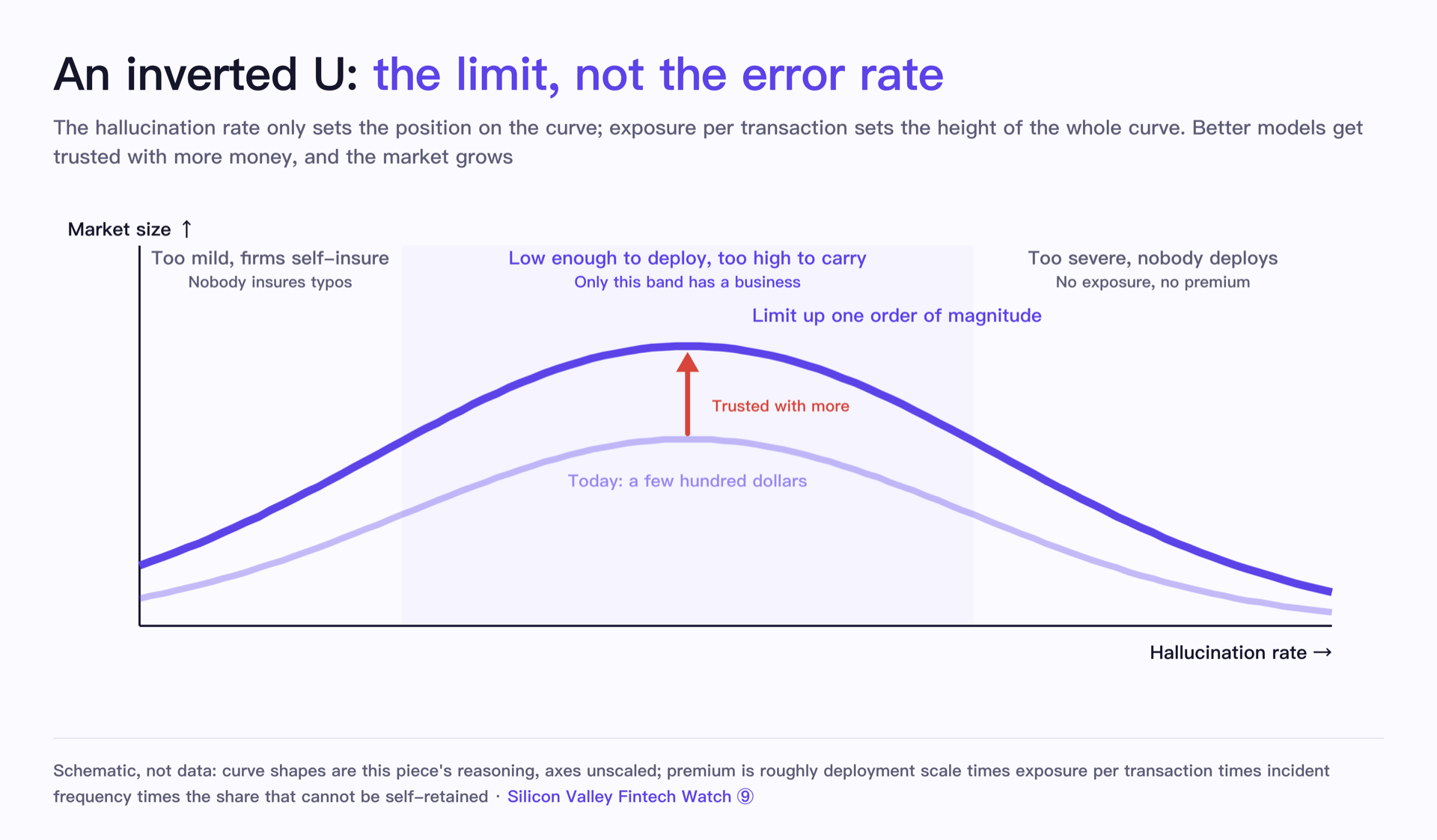
The biggest lever is exposure per transaction. At the same error rate, an agent allowed to move $200 and one allowed to move $10 million are five orders of magnitude apart as a market. What decides the size of this cell is how much money the agent is allowed to touch.
Which leads to a counterintuitive corollary: better models make this market bigger, not smaller. Better models mean people dare to let them touch more money, and exposure per transaction steps up. Frequency falls but exposure rises; expected loss does not necessarily fall, and the tail definitely gets fatter. Car insurance is the same story. Cars keep getting safer, accident rates keep falling, and the car insurance market has not shrunk, because cars cost more, liability limits are higher and litigation is dearer.
So the indicator to watch is the ceiling on an agent's per-transaction authorization, with model benchmarks set aside. The default limits in the agent protocols of the card networks, the default limits in each wallet, the budgets enterprises open for agents in procurement: lift those an order of magnitude and this cell lifts an order of magnitude with them. Muse requiring a card at launch is the first consumer-side data point on that line: Meta is willing to let it touch money at all; how much per transaction, the company has not said.
The same lens works back on the three companies in section four. Take Ubyx. The white paper's $3.65 billion annual revenue pool takes as inputs a $1 trillion stablecoin float, 0.5% daily redemption and a 20 basis point platform fee. The trillion is a figure the white paper itself flags as a round number that may not reflect reality. Swap in the actual numbers for September 3, 2026: total stablecoin float about $301.7 billion, of which Tether $183.3 billion and Circle's USDC $73.6 billion, the two together about 85%, and neither is among Ubyx's fifteen public issuers. What it can reach today is the remaining 15%, about $44.8 billion. Keep the white paper's own redemption rate and fee: annual redemptions of about $81.8 billion, platform fee of about $164 million a year, 22 times short of the white paper's $3.65 billion. To make $100 million a year it would need 61% of its reachable pool. The way to read that number is not that it is small in absolute terms but that the share it requires is absurd. It explains why Ubyx in 2026 widened its target from stablecoins to tokenized money: the pool of bank deposits is far larger than the pool of stablecoins.
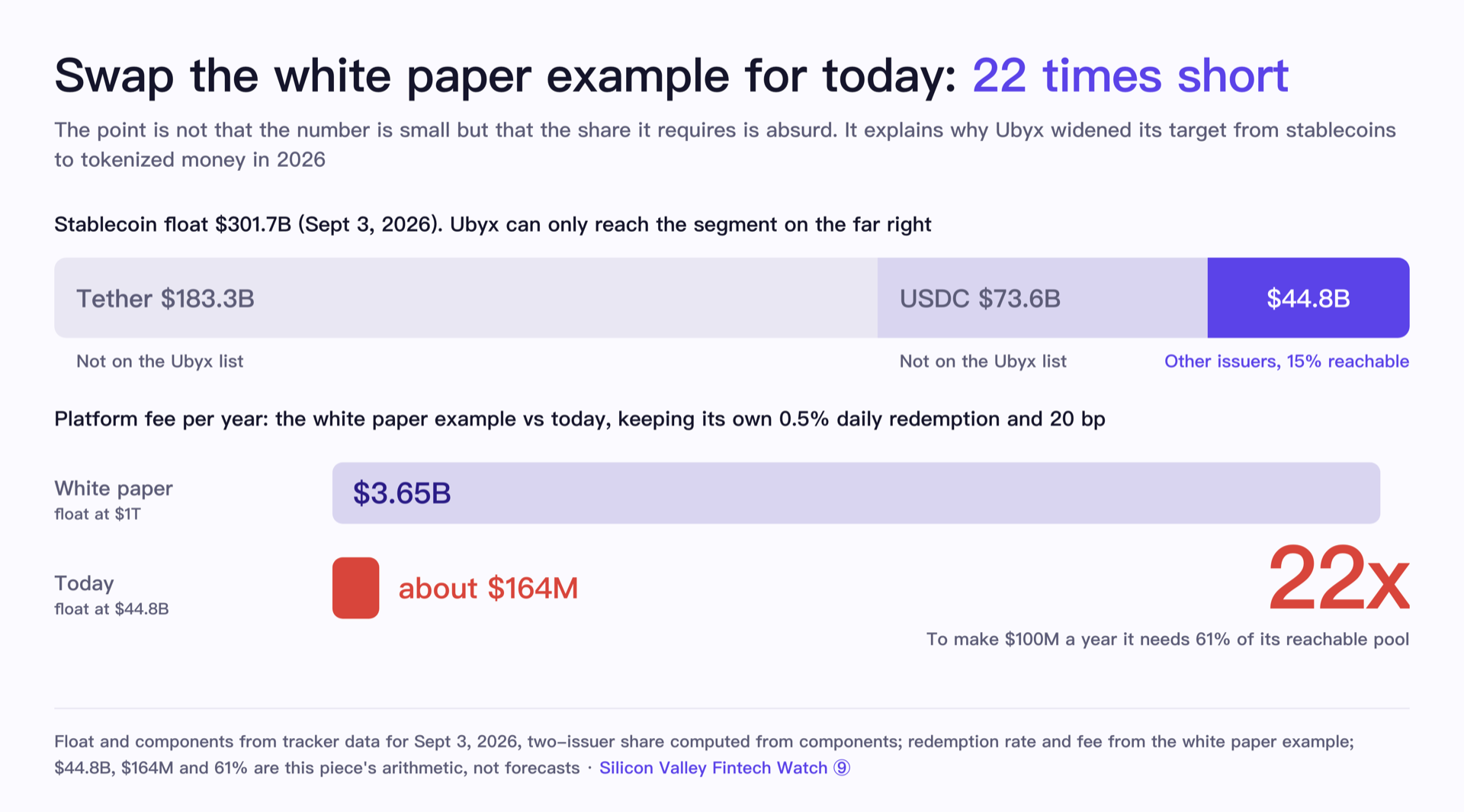
The last layer, and the one I think is most practical: verification comes before underwriting. Nobody can underwrite something with no loss history. This cell has to grow a layer that sells checking first, charged per call or per seat, recording errors, classifying them, computing frequencies; only once loss data has accumulated will anyone dare to run the second layer that sells payouts. The order cannot be reversed. And the moat of the first layer is the loss data it accumulates, not its checking algorithm. Klaimee's test-then-insure structure is exactly this order, but the testing half was matched as of September 2026, so its differentiator has to move one cell over, to whoever accumulates the most loss data. Stripe's one-in-six is evidence that the first layer has already started accumulating.
7. What this piece will not tell you
Before closing, some self-demolition.
First, the three failure shapes and the seven-seat map are both my frameworks, not industry consensus. They explain what I have seen these two months and the companies I screened; they may not fit other people's cases.
Second, everything on the three companies rests on public information: white papers, regulatory filings, funding announcements, and public interviews and writing by the founders. What the companies have not disclosed internally I cannot know. Funding and valuations come from public reports at different points in time, and side-by-side comparison is only for order of magnitude.
Third, Walmart's one third is one person's public statement. I have not seen a written Walmart disclosure, and I do not know the sample size or time window.
Fourth, Muse has been out a week and there is no public usage, transaction or error-rate data. Section five is entirely inference at the level of product design.
Fifth, the Ubyx arithmetic is other people's inputs plus my formula: the float figures come from a tracker's breakdown, the redemption rate and fee from the white paper's example. Change any input and the conclusion is void.
Sixth, the evidence for failure shape two is my own usage. The sample is one, not a statistic. It is enough to convince me the shape exists, not enough to estimate its frequency.
Seventh, the four-factor formula is my own decomposition. No insurer has published agent-related underwriting data on that basis. It is a thinking tool, not a pricing model.
Closing
Three sentences.
One: the endpoint of routing is daring to price the outcome, and the moment it does, it becomes an underwriter. Stripe bought OpenRouter for the ledger; the ledger's next page is the success rate; the flip side of the success rate is the payout. Payments took twenty years to walk that road. Tokens will not need twenty.
Two: of the seven seats, the two on the after-the-fact side have one first occupant and one still empty, and the three companies who sat down are each stuck on someone else. Ubyx waits for banks to change behavior, Klaimee for a carrier to renew, Catena for a charter. Only the last has a date.
Three: the size of this cell is decided by the limit, not the error rate. The number to watch is how much an agent may spend in one transaction. Better models push that number up, and the market follows.
The falsifiable version: by the end of 2027, if no token router or agent platform has publicly priced per completed task with payout terms attached, sentence one is void. By mid-2027, if Catena has not received OCC conditional approval, the ranking in section four moves down; if Ubyx names a real live accepting institution before then, the ranking flips. By mid-2028, if the default per-transaction authorization for mainstream consumer agents is still stuck below a few hundred dollars, the market-size judgment in sentence three is downgraded, and the correct explanation becomes that the trust threshold is far higher than I thought.
(Sourcing. Stripe's acquisition of OpenRouter: the Wall Street Journal reported talks at roughly $10 billion around July 23, 2026; Bloomberg reported an agreement at more than $7 billion on August 16, 2026; Stripe's newsroom announced the agreement on August 19, 2026, worded agrees to acquire, with no price disclosed; see the September 14, 2026 update to Part Seven. Stripe Radar blog, Expanding Stripe Radar to protect more of your business, May 27, 2026: the one-in-six and ElevenLabs 2,000 a day figures are from the original text. OpenCode's 7,013 fraudulent accounts and roughly $400,000 a month are from Dax Raad's X post of August 11, 2026; 8,000 accounts and $480,000 a month from an earlier post of his. The seven-seat map and its occupants are the author's compilation from two independent screening rounds in August and September 2026, the first starting from the full YC library, the second from regulatory filings and funding records; Alter's funding remains unverified; Duna's CapitalG-led Series A and Casca's three bank customers who are also investors are from public reports. Ubyx: the March 2025 white paper is the source for the seven-step flow, issuer pre-funding, the 20 basis point example fee and the $3.65 billion worked example; the fifteen-issuer list, the June 2025 $10 million seed and its investors, and the January 2026 Barclays investment are from company announcements and public reports; the founder's February 2026 written Q&A states an October 2025 launch; as of September 2026 no accepting institution or clearing volume has been named publicly; stablecoin float of $301.7 billion, Tether $183.3 billion and USDC $73.6 billion are tracker breakdowns for September 3, 2026, the 85.2% share is computed from the components, and $44.8 billion, $81.8 billion, $164 million and 61% are this piece's arithmetic on the white paper's example parameters, not forecasts. Klaimee: the July 22, 2026 $5.5 million seed is a company announcement; the MGA structure, Bermuda carrier, eight risk dimensions and performance guarantee are from its website and the founder's public writing between May and July 2026; the carrier's name is not public; AIUC's relationship with Beazley is from AIUC's public materials; the matching of test-then-insure by AIUC and Armilla is from a comparison of public product pages in September 2026. Catena: the May 20, 2026 $30 million Series A, $48 million cumulative and a16z participation are company announcements; the OCC national trust application status is from the OCC public index, still pending as of September 7, 2026; roughly 400 monthly downloads for three developer packages is from public package registry data; Sapiom's August 6, 2026 $35 million Series A, $50 million across two rounds, and Anthropic and Okta Ventures as shareholders are company announcements. OCC queue: conditional approvals for Circle, Ripple, BitGo, Paxos and Fidelity Digital Assets on December 12, 2025, Bridge on February 12, 2026, Protego on February 13, Foris DAX on February 20, Coinbase on April 2; Circle's July 10, 2026 final approval as the first de novo completion this cycle; Wise refused in July 2026 and Bunq in August; all from OCC public decisions. Meta Muse launched September 8, 2026; the dedicated cloud computer, Muse Spark, Link by Stripe checkout and Shop Pay to follow are from Meta's official newsroom post; the 100 million tokens a week free tier is from a Threads post by Mark Zuckerberg as cited by Gizmodo, September 8, 2026; Power at $20 and Maximum at $100, the card requirement on the free tier, and Link's purchase protection are from TechCrunch, September 8, 2026. Meta exploring a transaction cut is chief AI officer Alexandr Wang's statement to CNBC as cited by Motley Fool, September 11, 2026, with no plan settled; Zuckerberg's statement that personal agents are the foundation of the next wave of revenue lines is from the July 2026 earnings call. Walmart's roughly 200,000 products on OpenAI Instant Checkout from November 2025, in-conversation conversion at one third of click-out, and OpenAI phasing out Instant Checkout in March 2026 are from Search Engine Land's March 19, 2026 report of Walmart product and design head Daniel Danker's statement, with no written Walmart disclosure seen. The flight example, the three failure shapes, the seat map, the inverted U and four-factor formula, verification before underwriting, and the ranking of the three companies are this piece's frameworks and judgments, not quotations. All statements on market size, apart from the Ubyx arithmetic, are structural judgments with no absolute figure given, for the reasons set out in Part Eight.)
Comments留言