硅谷Fintech观察⑧|谁在为 AI Agent 建金融系统:一张两层地图,和它没画的三格Silicon Valley Fintech Watch ⑧ | Who Is Building the Financial System for AI Agents: A Two-Layer Map, and the Three Cells It Left Blank
A web original — first published here on August 27, 2026.本文 2026.08.27 首发于本站。
硅谷Fintech观察系列 · 第八篇 · 本文 2026 年 8 月 27 日首发于 klay-wang.com
导读|最近有一张 agentic finance 版图在流传:上层四格讲 agent 能用钱做什么,下层六格讲每一笔钱动起来之前系统要回答的六个问题。图不错,但一张地图的价值不在于它画了多少 logo,而在于每个 logo 背后是谁出的钱、拿的什么牌照、站的什么位置。我把图上二十多个名字挨个查了一遍融资和监管记录,查完发现三件事比地图本身值钱:巨头把协议层占满了,创业公司只活在两端;号称下一波的 agentic banking,走完牌照路径的机构只有两家;还有三个格子,整张图上根本没画。上一篇讲的是公司怎么付钱给模型,这一篇把整张桌子摆出来:钱要为 agent 重修一遍的,到底是哪几层。
写在前面
先交代这篇文章的来路和方法。
素材起点是一张在 LinkedIn 流传的图和它的文字版,标题叫 Who is building the financial system for AI agents。作者把这个市场画成两层:前层是产品与服务,agent 能用钱做什么;后层是基础设施与信任,agent 动钱之前系统要回答的六个问题。文字版开头说这个市场几年内会有三到五万亿美元。
这个数我不打算用。它没有出处,也没有计算过程,属于典型的从 AI GDP 顺推出来的大数。这个系列的老规矩是市场规模要从可收费单元往上算:多少企业客户、每客户付多少钱、抽多少基点,算不出来就不引用。所以这篇文章不谈万亿,谈的是能查证的东西:每一格里的公司融了多少钱、谁投的、拿了什么牌照、卡在什么位置。
方法很笨:图上二十多个名字,挨个查公开融资记录、监管备案和产品公告,全部口径列在文末。查证过程里改了我三个印象:原本以为协议层还有创业公司的位置,查完发现那一列的创业公司几乎都拿着巨头战投的钱;原本以为代理银行只是个愿景,查完发现它已经有正式产品线,只是持牌机构的分母小得惊人;原本以为这张图画全了,查完发现它漏掉的比画上的更值钱。这三个改动就是后面三个判断的来源。先把地图读一遍。
一、先把地图读一遍:上层花钱,下层管钱
这张图的两层结构是它最有价值的骨架,值得先原样讲清楚。
上层是产品与服务,回答 agent 能用钱做什么,分四格:代理商务(agent 发现、比价、下单),代理支付(agent 替人或企业发起并执行付款),代理金融科技(金融科技公司把现有产品开放给 agent 调用),代理银行(受监管机构本身直接把 agent 当作服务对象)。
下层是基础设施与信任,回答的是在一个 agent 动钱之前,系统必须依次过的六道门:身份,这个 agent 是谁;授权,谁给它的权力;权限,它具体能做什么;运行时,这些规则在哪里被执行;钱包,钱和签名能力放在哪里;支付轨,价值最终怎么移动。
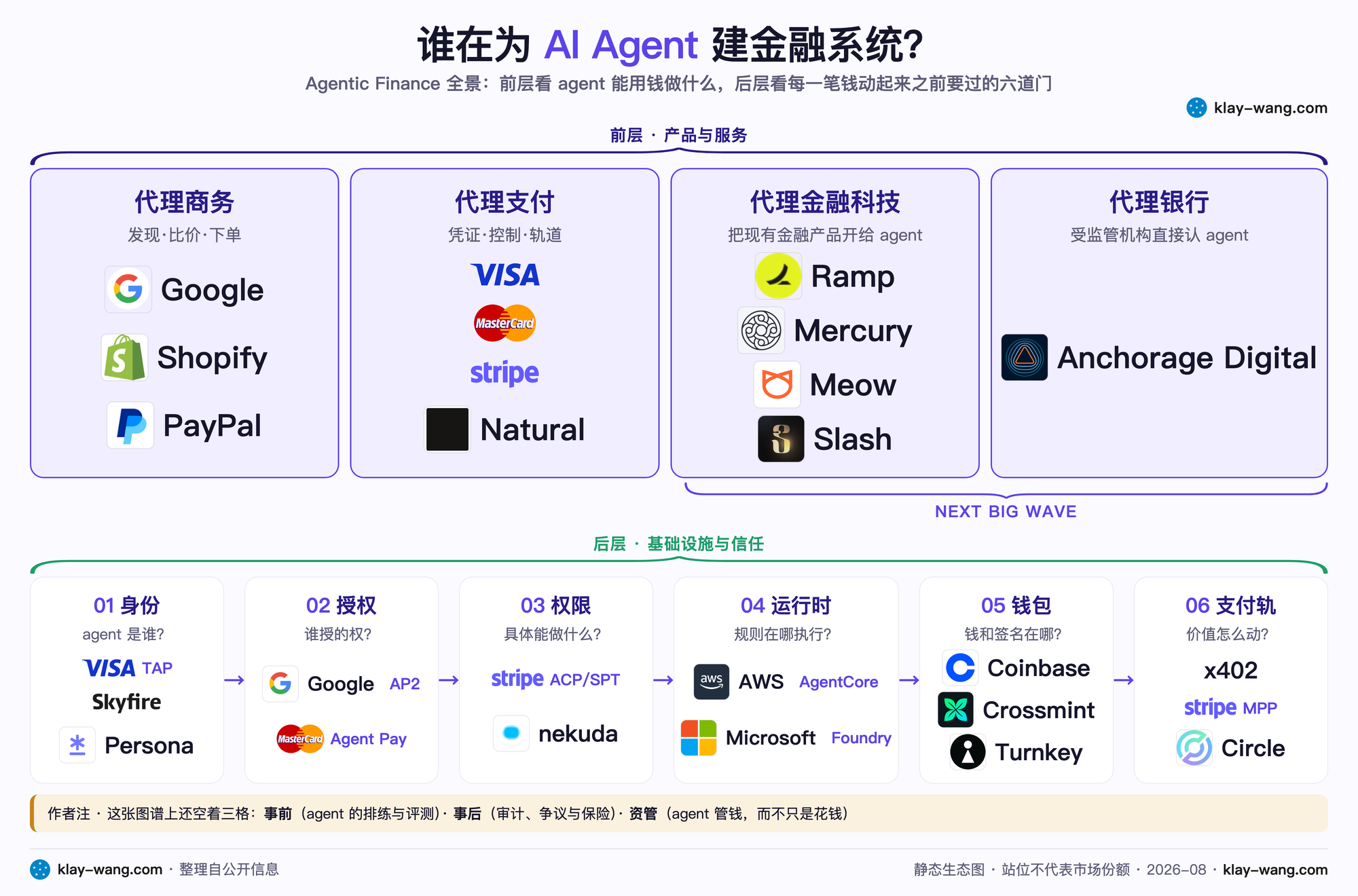
这六问的排列不是随意的,它其实是一条责任链:先确认主体,再确认委托,再确认边界,再确认执行环境,再确认资产托管,最后才轮到转账本身。传统支付体系里这六件事由银行开户流程、卡组织规则和司法体系分摊掉了,用户感觉不到。agent 把它们全部重新暴露了出来,因为传统体系的每一环都默认操作者是人:人登录、人点确认、人承担争议责任。操作者换成软件,六道门就得逐一重造。
顺带说一个容易看混的地方。流传的图片版把授权和权限合并成了一列,文字版是拆开的。拆开是对的:授权回答的是权力从哪个人或哪个企业来,权限回答的是拿到权力之后具体能花多少、买什么、对谁付。Stripe 的 ACP 和 SPT 属于后者,那是一种带范围限制的支付令牌,单笔限额、指定商户,回答的是能做什么,不是谁授的权。这个区分后面第三节还会用到。
地图读完了。接下来是这篇文章真正要做的事:逐格查证,然后说三个地图上看不出来的判断。
二、上层四格,其实是一把离受托责任的距离的梯子
把上层四格并列画在一行,容易让人以为它们是四个平行赛道。查完每一格的玩家之后,我的结论是:这四格不是并列关系,是递进关系,递进的维度是离受托责任的距离。每上一级,就离自己为客户资金担责近一步,收入的性质也跟着变一次。
第一级,代理商务:不碰钱的牌照,只碰货架。这一格的代表动作是 Shopify。它把自己的 agentic commerce 基础设施通过 UCP 和 Catalog API 开放给了开发者:UCP 是 Shopify 与 Google 共同开发的开源标准,定义 agent 怎么和商户交易;Catalog API 是它的发现层,把几百万商户的商品变成 agent 可查询的结构化数据。更值得注意的是接入方式的变化:这套东西原本需要申请审批,现在改成了自助接入,开发者注册一个 agent 档案就能调用公开端点。把审批制改成自助制,这个动作本身就是表态:Shopify 赌的是 agent 流量越多越好,它在货架层收租,不在资金层担责。Google 和 PayPal 在这一格的逻辑类似,入口和转化,不碰监管。
第二级,代理支付:轨道拥有者自己下场。Visa 在 2025 年 10 月发布了 Trusted Agent Protocol,Mastercard 在 2026 年 6 月把 Agent Pay 扩展到了机器对机器场景,Stripe 有 MPP 和 ACP/SPT。三大轨道方全部亲自下场做 agent 凭证和控制协议,一家都没有缺席,这个后面第三节细讲。这一格里更有信息量的是那个陌生名字 Natural:2025 年 8 月成立,10 月拿了 980 万美元种子轮,2026 年 7 月完成 3000 万美元 A 轮,投后估值 1.5 亿美元,由 Forerunner 创始人 Kirsten Green 领投,累计融资超过 4000 万。它的产品清单说明了创业公司在轨道层的切口在哪里:规划中的十三个产品覆盖记账、资金移动、风控合规,其中六个已上线,包括通过合作银行的资金归集安排实现 FDIC 保险的 agent 钱包,以及一种只进不出、agent 无法单独把钱转走的资金保险库。它不是要再造一张卡网,而是给 agent 造一套原生的账户与账本体系。轨道巨头做协议,创业公司做账本,这是第二级的分工现状。
第三级,代理金融科技:前端是自己的,资产负债表是别人的。这一格的四个名字,融资记录都查得到:Ramp 在 2026 年二季度完成 7.5 亿美元融资,估值 440 亿美元;Mercury 在 2026 年完成 D 轮 2 亿美元,估值 52 亿;Slash 融资 1 亿美元,估值 14 亿,新晋独角兽;Meow 累计融资约 3300 万美元,股东包括 Tiger Global、QED、Lux。它们的共同结构是:自己做软件和客户关系,底层依赖持牌银行的基础设施。而它们正在做的事印证了地图作者的判断,金融科技公司确实在把产品开放给 agent。最激进的是最小的那家:Meow 在 2026 年 4 月宣布上线它称为业内第一的 agentic 平台,让 AI agent 可以代表用户开立和管理企业银行账户。agent 开户这件事从概念变成产品公告,就发生在 2026 年 4 月。
第四级,代理银行:受监管机构本身认 agent。这是地图作者标注为很小的类别,小到什么程度,可以用一张监管名单量化。美国货币监理署对加密类机构的全国信托牌照,拿到有条件批准的有九家:Circle、Ripple、BitGo、Fidelity、Paxos、Protego、Bridge、Crypto.com、Coinbase。九家里走完最终批准的只有 Circle 一家(2026 年 7 月获批),加上 2021 年就拿到牌照、且已在实际运营的 Anchorage,走完这条牌照路径的相关机构一共两家。这就是第四级的现实分母。
但这一格在 2026 年二季度以来发生了质变:它从口号变成了产品。Anchorage 在 2026 年 5 月正式发布了名为 Agentic Banking 的平台,并与 Google Cloud 达成合作。产品逻辑值得逐句读:企业给自己的 agent 注资并设定控制,当 agent 走到交易那一步,平台先执行企业的支出政策、Know Your Agent 身份标准和实时合规检查,通过之后才在稳定币、法币轨道或代币化凭证之间完成清算。注意 Know Your Agent 这个词,它已经从行业黑话变成了一家持牌银行的产品语言。与此同时,Anchorage 还披露有最多二十家大机构在排队通过它发行稳定币。
第四级还有两个值得记录的新玩家,方向相反。一个是 Catena Labs,Circle 联合创始人 Sean Neville 创办,向 OCC 申请全国信托银行牌照,目前状态是申请被受理、尚未获批;它累计融资 4800 万美元,2026 年 5 月 20 日公告的 3000 万美元 A 轮由 a16z crypto 和 Acrew 共同领投,参投方包括 QED、General Catalyst、Coinbase Ventures 等。它赌的方向是给 agent 本身建受托账户,把授权和审计写进受监管机构的法律责任里。另一个是 Erebor,2026 年 2 月开业的全国银行,存款从 3 月末约 11 亿美元涨到 7 月末约 46 亿,2025 年 12 月以 43.5 亿美元投后估值融资 3.5 亿,Lux 领投;英国金融时报 2026 年 8 月 11 日报道它在洽谈新一轮,拟融 15 亿美元、投前估值 80 亿美元(投后约 95 亿),截至本文发稿未见成交公告。这里要做一个地图上没有的区分:Erebor 是给 AI 产业的公司开户的银行,客户是人类企业;Catena 和 Anchorage 的 Agentic Banking 想做的是让 agent 本身成为被服务对象。前者是传统银行做新客群,后者才是第四级的本义。把两者混为一谈,会把这个类别的大小估错一个量级。
梯子爬完了。总结一下每一级的收入性质:第一级收货架租金,第二级收协议和通道费,第三级赚软件订阅和利差分成,第四级收的是受托责任的钱。越往上爬,收入越像租金,门票越贵,牌照越重。这是上层四格真正的结构。
三、下层六格逐格点名:权力分布写在股东名单里
下层是这张地图信息密度最高的地方。我把六格的玩家、核心竞争力和融资记录整理成一张表,先看表,再说两个从表里长出来的观察。
| 门 | 玩家 | 核心竞争力 | 公开融资与主要投资人 | 生态位判断 |
|---|---|---|---|---|
| 01 身份 | Visa TAP | 卡网存量凭证体系 | 上市公司 | 把 agent 身份做成网络功能 |
| Skyfire | agent 钱包与身份,先发 | 2024 年 8 月种子轮 850 万美元:Circle、Gemini、Ripple、ARCA、Brevan Howard Digital、Neuberger Berman;后续 Coinbase Ventures 与 a16z CSX 追加,累计 950 万美元 | 轨道方集体下注的哨位 | |
| Persona | 年验证量逾 3 亿次的身份平台 | D 轮 2 亿美元,估值 20 亿:Founders Fund 与 Ribbit 领投 | 从 KYC 平移到 agent 身份层 | |
| 02 授权 | Google AP2 | 委托凭证协议,生态分发 | 上市公司 | 定义谁授的权 |
| Mastercard Agent Pay | 卡网授权规则延伸 | 上市公司 | 同上 | |
| 03 权限 | Stripe ACP/SPT | 范围限制支付令牌 | 员工要约口径估值 1590 亿美元 | 定义能做什么 |
| nekuda | agent 钱包加授权委托 SDK | 种子 500 万美元:Madrona 领投,Amex Ventures 与 Visa Ventures 参投 | 巨头哨位型创业公司 | |
| 04 运行时 | AWS AgentCore | 云上执行环境 | 上市公司 | 规则在云里被执行 |
| Microsoft Foundry | 同上 | 上市公司 | 同上 | |
| 05 钱包 | Coinbase Agentic Wallets | 托管与合规存量 | 上市公司 | 加密钱包能力平移 |
| Crossmint | 企业级链上钱包与通道 | 2360 万美元:Ribbit 领投,Franklin Templeton、First Round、Lightspeed Faction 参投 | 企业侧签名与资产层 | |
| Turnkey | 私钥与签名基础设施 | 累计超 6500 万美元:Bain Capital Crypto 领投 3000 万美元 B 轮,Sequoia 参投;2026 年 5 月 1250 万美元战略轮含 Circle Ventures;客户含 Stripe 旗下 Bridge、Polymarket | 签名即服务 | |
| 06 支付轨 | x402 | Coinbase 推的机器结算协议 | 上市公司 | 定义价值怎么动 |
| Stripe MPP | 机器支付协议 | 同 Stripe | 同上 | |
| Circle | 持牌稳定币发行与信托银行 | 上市公司 | 结算资产本身 |
观察一:授权与权限这两列,几乎没有创业公司。02 列是 Google 和 Mastercard,03 列是 Stripe,唯一的创业公司 nekuda 只融了 500 万美元种子轮,而它的股东名单里坐着 Amex Ventures 和 Visa Ventures。同样的模式在身份列重复:Skyfire 850 万美元的种子轮股东里有 Circle、Gemini、Ripple,后来 Coinbase Ventures 追加进来,累计 950 万美元。把这些名单放在一起读,结论很直白:协议层的创业公司,股东主要是轨道巨头的战投部门。巨头一边自己发协议,一边用小额支票在每一家可能长出替代标准的创业公司里占一个哨位。这不是财务投资的分布,这是防御性布防的分布。对创业者来说,这个信号残酷但清晰:在授权与权限层做独立公司,你的融资故事最好的归宿就是被某家轨道方买走或者吸收,独立长成平台的路径,图上找不到先例。
观察二:钱包列是全场加密浓度最高的地方,也是六格里新创公司融资最扎实的一格。(身份列的 Persona 融得更多,但它是做了七年 KYC 的存量公司改旗,不计入新创口径,下面单说。)Crossmint 的 2360 万美元由 Ribbit 领投,Franklin Templeton 参投;Turnkey 累计超过 6500 万美元,Bain Capital Crypto 领投 3000 万美元 B 轮,Sequoia 参投,Circle Ventures 在 2026 年 5 月的战略轮进入,客户名单里有 Stripe 旗下的 Bridge 和 Polymarket。原因不复杂:钱和签名放在哪里这个问题,加密行业已经用真金白银练了五年多,私钥管理、多方计算、可编程托管,这些能力恰好就是 agent 需要的资金保管形态。这是整张图上少有的、创业公司靠既有技术存量而非牌照或流量就能站住的位置。连 Anchorage 给 Agentic Banking 选的合作方 Google Cloud,合作内容里最核心的一块也是密钥管理。
观察三:存量公司已经开始改旗。这个信号跨列,出在身份列的 Persona 身上。一家做了七年 KYC 的身份验证公司,2024 年做了逾三亿次验证,2025 年 4 月融 D 轮的时候,官方新闻稿的标题把钱的用途写成了给 agentic AI 世界建验证身份层。Founders Fund 和 Ribbit 领投的这 2 亿美元,本质上是身份赛道向 agent 叙事的公开改旗。当存量公司开始用 agent 重写自己的融资故事,说明这一层的资本站队已经开始了。
四、三个判断
查证做完,地图重读过了,表也列完了。下面是我自己的三个判断,每个都给出依据和推翻条件。
判断一:下层协议格没有独立创业公司的位置,创业公司的活路在两端,受监管资产端和垂直包装端。
依据是第三节那张表的结构:授权与权限列全是巨头协议,仅有的创业公司拿的是巨头战投的钱;而钱包列的创业公司融资最扎实、客户最真实。两端的意思是:要么往下沉到受监管资产层,要么往上走做垂直包装。
这里要先自我修正一句,否则这个判断会显得太乐观。受监管资产端同样在被巨头填:第二节列的 OCC 九家有条件批准里,八家是上市公司或行业巨头,其中 Bridge 本身就是 Stripe 旗下的。所以准确的说法是,牌照这条路创业公司也在被挤,真正还没被挤掉的下沉位置只剩一小块,就是签名与托管这种靠技术存量吃饭、巨头懒得自建的活,Turnkey 和 Crossmint 站的是这一块,Catena 走的牌照路则要和八家巨头同场竞速。上行的垂直包装位置反而更宽:像 Natural 那样给 agent 造原生账本,像 Meow 那样把 agent 开户做成产品,巨头的存量组织结构反而转不动这些。中间的协议层,凭证怎么发、意图怎么表达、授权怎么传递,那是 Visa、Mastercard、Google、Stripe 的战场,它们有存量网络、有分发、有免费的动机,创业公司在这一层没有可防御的位置。
推翻条件:如果在 2028 年 2 月底之前出现一家授权或权限层的独立创业公司,完成由纯财务投资人领投的 B 轮及以上融资、且客户里有至少两家大型金融机构把它当成主协议用,这个判断作废。
判断二:agentic banking 刚从口号变成产品,这个类别的门票是牌照,而牌照的分母此刻是两家。
依据有三条。第一,Anchorage 把 Agentic Banking 做成了正式产品线,政策执行、Know Your Agent、实时合规、跨轨清算,这是持牌机构第一次把 agent 当作账户主体来设计产品。第二,监管分母查得清:OCC 相关有条件批准九家,走完最终批准的一家(Circle),加已在运营的存量一家(Anchorage),一共两家;而这两家里真正把 agent 当账户主体做产品的,目前只有 Anchorage 一家。第三,一级市场已经开始为这张门票定价:Catena 在只有申请受理、没有营收披露的阶段,累计拿到 4800 万美元,投资人名单是 a16z crypto、Acrew、QED、General Catalyst、Coinbase Ventures。这类公司的估值本质是牌照期权:赌的不是现在的现金流,是批文下来那天,受托责任变成收入的那个瞬间。
这个判断附带一个风险提示:期权可能不行权。OCC 的申请受理不等于批准,资本要求、治理条件、时间线都可能变;而如果批文迟迟不来,做同样事情的存量玩家(比如已经持牌的 Anchorage)会把窗口吃掉。把这类公司当成确定性标的的人,买的其实是监管日历。
推翻条件:到 2027 年底,如果出现三家以上没有自有牌照的机构(借合作银行或州牌照)把 agent 当作账户主体做成规模化产品并公开客户数,而持牌路径这边仍然只有一两家在做,那么门票是牌照这个说法作废,正确的说法会变成门票是合作银行关系。这条不是空设:本文第二节里的 Natural 用合作银行给 agent 钱包上了 FDIC 保险,Meow 让 agent 开企业账户,两家都没有自己的牌照。我现在的看法是它们拿不到受托责任那一层的收费权,只能赚软件的钱,但这个看法可能是错的。
判断三:这张地图上真正的空位不在图里,在图外。三个格子没画:事前、事后、资管。
事前,指 agent 动真钱之前的排练与评测。这个格子已经开始被填了:就在本文发稿前一天的 2026 年 8 月 26 日,一家叫 Arga Labs 的公司公告了 1000 万美元种子轮,General Catalyst 领投,BoxGroup、Emergence、Gradient、SV Angel 参投。它做的事情是给企业软件建全尺寸数字孪生,把 Salesforce、Workday 这类系统连权限体系带 webhook 完整克隆下来,让 agent 先在副本里把错误犯完。创始人一个来自亚马逊,一个来自 Stripe 和高盛。执行成本塌下去之后,敢不敢让 agent 碰真系统成了新的稀缺,而排练是把敢字变成流程的第一站。
事后,指审计、争议与保险,这一格还空着,而它可能是整张图上最值钱的空位。理由来自支付行业自己的历史:卡组织真正的权力从来不锚在转账速度上,锚在争议规则上,谁定义退款、谁分配责任、谁兜底损失,谁就拥有这张网络。agent 支付把不可逆的稳定币结算、可撤回的 ACH 和有成熟争议体系的卡轨混在同一个界面里,出错之后的责任分配比出错之前的授权检查难得多。图上六道门全是事前和事中的门,没有一道管事后。这格空着,可能说明真正的收租位还没人坐上去;也可能说明它压根不会长出独立玩家,因为争议与赔付本来就该由卡组织规则和法院分掉,轮不到新公司定义。这两种解释我暂时分不出来,所以下面给了可证伪条件。
资管,指 agent 管钱,而不只是花钱。整张图的六问全部围绕支出展开:买什么、付给谁、怎么结算。没有一格回答企业的闲置资金怎么被 agent 扫进货币基金、组合怎么被 agent 再平衡、赎回怎么被触发。花钱是负债端的事,管钱是资产端的事,资产端的监管栈(投顾、托管、基金)比支付栈更深,也更没有被 agent 化。这一格什么时候出现玩家,值得单独盯。
可证伪的说法:到 2027 年底,如果同类地图上仍然没有出现事后格(争议、审计或 agent 保险的专门玩家),且没有任何一家保险公司在财报口径里披露 agent 相关承保产品,那么判断三里关于事后格的这一段作废,正确的解释会是这一格本来就该由卡组织和法院分掉,不会长出独立玩家。
五、这张地图不会告诉你的事
收口之前先自己拆台。这篇文章和它依据的地图,有五个地方需要读者保持怀疑。
第一,logo 上墙不等于有量。图上大半协议是 2025 到 2026 年的公告:Google AP2 是 2025 年 9 月,Visa TAP 是 2025 年 10 月,Stripe MPP 是 2026 年 3 月,Mastercard 面向机器场景的 Agent Pay 扩展是 2026 年 6 月,全部在过去一年内。本文未见其中任何一家披露生产环境的交易量。基础设施先行解锁产品层,这个叙事的另一种读法是巨头在需求确认之前抢占标准位,公告本身就是竞争动作。企业实际的 agent 支付大量停留在生成付款草稿、人工点确认的阶段,六道门造好了没人走,也是一种可能的结局。
第二,本文的样本是别人选的,不是市场普查。这张图上每格只有两三个名字,是作者的取舍。所以某一格没有创业公司,首先意味着这张图没画它,其次才可能意味着市场上真没有。文中所有关于某一层缺谁的说法,都应该按这个口径打折读。
第三,标准战没有打完。UCP、AP2、MPP、x402、TAP,五套协议出自五个利益方,彼此有重叠有竞争。历史上支付标准的收敛通常以十年计,中途会有标准死掉。本文的逐格点名是 2026 年 8 月的切面,不是终局名单。
第四,三到五万亿的市场规模,本文一次都没有用它做论据。再说一遍:这个数没有出处。这一类大数的作用是给融资 PPT 撑腰,不是给分析撑腰。这个市场此刻可查证的收入,是 Natural 们卖给企业的产品收入、Anchorage 们的托管与受托费、以及各家 agent 钱包的交易抽成,从这里往上算,才是这个赛道的真实体量。
第五,本文自身的局限:全部依据公开信息,公司未披露的内部进展无从得知;融资与估值取自不同时点的公开报道,横向比较只当量级参考;被访谈过的成功者留下了记录,倒在种子轮之前的尝试没有留下任何痕迹,实际的死亡率必然高于可见样本。
收口
把这一篇收成三句话。
第一句:上层四格是一把监管深度的梯子,不是四个并列赛道。从货架到轨道到借牌照到自己持牌,每上一级,收入越像租金,门票越贵。判断一家 agentic fintech 公司值多少钱,先看它站在第几级,再看它有没有往上爬的路径。
第二句:下层的权力分布不用猜,写在股东名单里。协议层归巨头,谁的战投在场上,谁就在那一层布防;资产层归牌照和签名,那是创业公司靠真本事能站住的地方。看这个赛道的项目,先查投资人名单再听故事,名单比故事诚实。
第三句:真正的空位不在地图上。排练刚有人进场,追责和资管两格还空着,而支付行业的历史说,收租的位置从来不在执行那一层,在出了事谁负责那一层。下一张同类地图重画的时候,看这三格谁的名字被填进去,那大概率就是这个周期里值得记住的公司。
(本文事实口径:市场规模三到五万亿美元为流传文案的表述,无出处,本文不采信。Shopify 与 Google 共同开发的 UCP 为开源标准、Catalog API 为其发现层、接入由审批制改为自助制,来自 Shopify 官方开发者文档与 2026 春季版公告。Visa Trusted Agent Protocol 为 2025 年 10 月官方发布;Mastercard Agent Pay 首发为 2025 年 4 月,面向机器场景的 Agent Pay for Machines 扩展为 2026 年 6 月官方新闻稿;Stripe MPP、ACP/SPT 来自 Stripe 官方资料;Stripe 估值 1590 亿美元为 2026 年 2 月员工要约口径。Natural:2025 年 10 月种子轮 980 万美元(Abstract 与 Human Capital 共同领投)与 2026 年 7 月 A 轮 3000 万美元、投后 1.5 亿美元、Forerunner 的 Kirsten Green 领投、累计超 4000 万美元、产品含合作银行提供的 FDIC 保险 agent 钱包,来自 Axios、TechCrunch 与公司通稿。Ramp 7.5 亿美元融资与 440 亿美元估值、Mercury D 轮 2 亿美元与 52 亿美元估值、Slash 1 亿美元融资与 14 亿美元估值,均为 2026 年二季度公开报道口径;Meow 累计约 3300 万美元与 2026 年 4 月 agent 开户平台公告来自其官方通稿与公开报道。Anchorage Digital 的 Agentic Banking 发布、Google Cloud 合作、Know Your Agent 与政策执行描述、最多二十家机构的稳定币管道,来自其官方公告与 2026 年 5 月 CoinDesk 报道;其 2021 年 OCC 牌照为公开记录。OCC 加密类全国信托牌照有条件批准九家(Circle、Ripple、BitGo、Fidelity、Paxos、Protego、Bridge、Crypto.com、Coinbase)、最终批准仅 Circle 一家(2026 年 7 月获批),为 2026 年 8 月下旬据 OCC 公开名录整理的口径。Catena Labs:累计融资 4800 万美元,2026 年 5 月 20 日公告 3000 万美元 A 轮由 a16z crypto 与 Acrew 共同领投,参投含 Breyer、General Catalyst、QED、Oak HC/FT、Fin Capital、Coinbase Ventures、IDG,OCC 全国信托银行申请状态为受理未批准、公开申请载明不面向公众常规放贷,来自公司公告、投资方公告与 OCC 公开申请文件。Erebor:OCC 有条件批准为 2025 年 10 月、FDIC 存款保险为 2025 年 12 月、2026 年 2 月开业,存款 3 月末约 11 亿美元为监管披露、二季度末约 40.5 亿美元为 Bloomberg 系报道、7 月末约 46 亿美元为监管披露口径;2025 年 12 月 3.5 亿美元融资与 43.5 亿美元投后估值、Lux 领投为公开报道;拟融 15 亿美元、投前 80 亿美元(投后约 95 亿)的洽谈为金融时报 2026 年 8 月 11 日报道,截至发稿未见成交公告。Skyfire:2024 年 8 月种子轮 850 万美元、后续追加至累计 950 万美元与股东名单,来自 2024 年 8 月至后续公开报道。Persona:D 轮 2 亿美元、估值 20 亿美元、Founders Fund 与 Ribbit 领投、2024 年逾三亿次验证,来自 2025 年 4 月公司与媒体公告。nekuda:500 万美元种子、Madrona 领投、Amex Ventures 与 Visa Ventures 参投,来自 2025 年 5 月公司通稿。Crossmint:2360 万美元、Ribbit 领投、Franklin Templeton 等参投,来自 2025 年 3 月公司与媒体公告。Turnkey:2025 年 6 月 B 轮 3000 万美元由 Bain Capital Crypto 领投、Sequoia 参投,2026 年 5 月战略轮 1250 万美元含 Circle Ventures,累计超 6500 万美元、客户含 Bridge 与 Polymarket,来自 2025 年 6 月及后续公开报道。Arga Labs:1000 万美元种子、General Catalyst 领投、BoxGroup、Emergence、Gradient、SV Angel 参投、创始人背景,来自 2026 年 8 月 26 日 TechCrunch 报道与公司资料。文中所有生态位与判断段落为作者分析,非任何公司披露。)
Silicon Valley Fintech Watch series · Part Eight · First published on klay-wang.com, August 27, 2026
In brief. A map of the agentic finance stack has been making the rounds: four cells on top for what agents can do with money, six gates below for the questions a system must answer before any dollar moves. The frame is good. But a map is worth only as much as what sits behind each logo: who wrote the checks, who holds the charter, what position it occupies. I went through all two dozen names and checked funding and regulatory records. Three findings turned out to be worth more than the map itself. The incumbents have filled the protocol columns and startups survive only at the two ends. Agentic banking, billed as the next big wave, has exactly two institutions that have walked the charter path all the way. And three cells are missing from the map entirely. The last piece was about how companies pay the models. This one lays out the whole table: which layers of money are being rebuilt for agents.
Before we start
A note on sources and method.
The starting material is an image and its accompanying text circulating on LinkedIn, titled Who is building the financial system for AI agents. The author splits the market into two layers: a front layer of products and services covering what agents can do with money, and a back layer of infrastructure and trust covering six questions the system must answer before an agent moves money. The text opens by sizing the market at three to five trillion dollars within a few years.
I am not using that number. It carries no source and no derivation, and it is the classic top-down figure extrapolated from AI GDP. The house rule in this series is that market size gets built up from billable units: how many enterprise customers, how much each pays, how many basis points get taken. If you cannot build it up, do not cite it. So this piece does not talk trillions. It talks about what can be verified: how much each company in each cell has raised, from whom, under what charter, and where it is stuck.
The method is unglamorous. Two dozen names, each checked against public funding records, regulatory filings and product announcements, with every figure listed at the end. Three of my own impressions changed along the way. I had assumed the protocol layer still had room for startups, and found that nearly every startup in that column is funded by incumbent strategic arms. I had assumed agentic banking was still a vision, and found it already has a shipped product line, sitting on a startlingly small denominator of chartered institutions. And I had assumed the map was complete, and found that what it leaves out is worth more than what it draws. Those three revisions are where the judgments below came from. First, read the map.
1. Reading the map: the top layer spends, the bottom layer governs
The two-layer structure is the most valuable thing about this map, so it is worth restating faithfully.
The front layer is products and services, answering what agents can do with money, in four cells: agentic commerce (agents discover, compare and buy), agentic payments (agents initiate and execute payments for people or businesses), agentic fintech (fintechs expose existing products to agents), and agentic banking (the regulated institution itself is designed to serve agents directly).
The back layer is infrastructure and trust, and it is the sequence of gates a dollar passes before an agent can move it: identity, who is the agent; authorization, who gave it authority; permissions, what exactly is it allowed to do; runtime, where those rules are enforced while it operates; wallets, where funds and signing capability are held; and payment rails, how value actually moves.
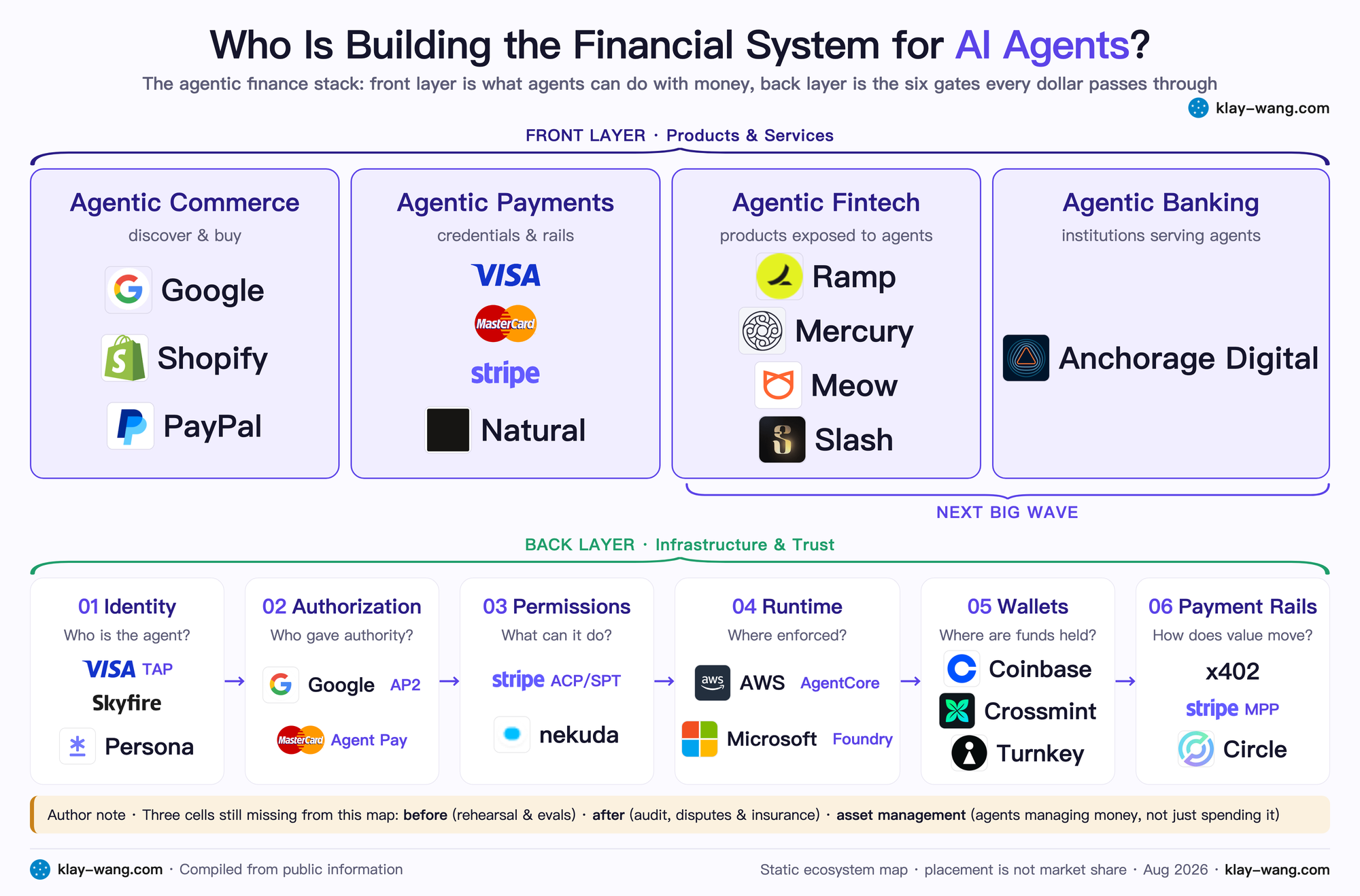
That ordering is not arbitrary. It is a chain of accountability: establish the actor, then the delegation, then the boundary, then the execution environment, then custody, and only then the transfer itself. In the existing payment system those six jobs are absorbed by bank onboarding, card network rules and the courts, and the user never sees them. Agents expose all six again, because every link in the old system assumes a human operator: a human logs in, a human clicks confirm, a human bears the dispute. Swap the operator for software and all six gates have to be rebuilt.
One thing that is easy to misread. The circulating image merges authorization and permissions into a single column; the text version keeps them apart. Apart is correct. Authorization asks which person or company the power came from. Permissions asks, once it has the power, how much it can spend, on what, and to whom. Stripe's ACP and SPT belong to the second: a scoped payment token with per-transaction limits and named merchants answers what it can do, not who authorized it. That distinction matters again in section three.
That is the map. What follows is the actual work: verify each cell, then say three things the map cannot show you.
2. The top four cells are a ladder of distance from fiduciary duty, not four parallel lanes
Drawing four cells side by side invites you to read them as four parallel races. Having checked the players in each, my conclusion is the opposite: these are not parallel, they are sequential, and the axis is distance from fiduciary duty. Each rung moves you closer to being answerable for customer money yourself, and the character of the revenue changes with it.
Rung one, agentic commerce: no license on the money, just the shelf. Shopify is the exemplar. It opened its agentic commerce infrastructure to developers through UCP and the Catalog API: UCP is an open standard developed jointly by Shopify and Google for how agents transact with merchants, and the Catalog API is its discovery layer, turning products from millions of merchants into structured, queryable data for agents. The more telling change is in access: this used to require approval, and now it is self-serve, with developers registering an agent profile and calling a public endpoint. Turning an approval process into self-serve is itself a statement of position. Shopify wants agent traffic to be as large as possible, collects rent at the shelf, and takes no liability at the money layer. Google and PayPal play the same logic in this cell: entry point and conversion, no regulatory exposure.
Rung two, agentic payments: the rail owners came down themselves. Visa published its Trusted Agent Protocol in October 2025. Mastercard extended Agent Pay to machine-to-machine scenarios in June 2026. Stripe has MPP and ACP/SPT. All three rail owners are personally building agent credentials and controls, with none sitting it out, which section three takes up in detail. The more informative name in this cell is the unfamiliar one, Natural: founded August 2025, a $9.8 million seed in October, a $30 million Series A in July 2026 at a $150 million post-money valuation led by Forerunner's Kirsten Green, more than $40 million raised in total. Its product list shows where a startup can still cut into the rail layer: thirteen planned products spanning ledgering, money movement, fraud and compliance, six of them already live, including agent wallets carrying FDIC insurance through a partner bank sweep arrangement, and vaults that take money in but never let an agent move it out alone. It is not trying to build another card network; it is building a native account and ledger system for agents. Rail incumbents write the protocols, startups write the ledger. That is the current division of labour on rung two.
Rung three, agentic fintech: the front end is yours, the balance sheet is someone else's. All four names here have verifiable records. Ramp raised $750 million in the second quarter of 2026 at a $44 billion valuation. Mercury raised a $200 million Series D at $5.2 billion. Slash raised $100 million at $1.4 billion, a new unicorn. Meow has raised roughly $33 million in total, with Tiger Global, QED and Lux on the cap table. They share one structure: they own the software and the customer relationship and depend on a chartered bank underneath. And they are doing exactly what the map's author describes. The most aggressive move came from the smallest of them: in April 2026 Meow announced what it called the industry's first agentic platform letting AI agents open and manage business bank accounts on a user's behalf. Agents opening bank accounts went from concept to product announcement in April 2026.
Rung four, agentic banking: the regulated institution recognizes the agent. The map's author calls this a very small category. How small can be quantified with a list. Among crypto-oriented applicants for a US national trust charter, the OCC has granted conditional approval to nine: Circle, Ripple, BitGo, Fidelity, Paxos, Protego, Bridge, Crypto.com and Coinbase. Of those nine, exactly one, Circle, has completed final approval, in July 2026. Add Anchorage, chartered back in 2021 and operating since, and the number of institutions that have walked this charter path all the way is two. That is the denominator for rung four.
But this cell changed character from the second quarter of 2026 onward: it went from slogan to product. Anchorage launched a platform called Agentic Banking in May 2026, in partnership with Google Cloud. The mechanics are worth reading closely. An enterprise funds and governs its own agents; when an agent reaches the point of transaction, the platform first enforces corporate spending policy, Know Your Agent identity standards and real-time compliance checks, and only then settles across stablecoins, fiat rails or tokenized credentials. Note that Know Your Agent has moved from industry jargon into the product language of a chartered bank. Anchorage has also disclosed a pipeline of up to twenty large institutions waiting to issue stablecoins through it.
Two newer names belong in this rung, pointing in opposite directions. Catena Labs, founded by Circle co-founder Sean Neville, has applied to the OCC for a national trust charter; the application has been accepted and is not approved. It has raised $48 million in total, including a $30 million Series A announced May 20, 2026, co-led by a16z crypto and Acrew with QED, General Catalyst and Coinbase Ventures among the participants. Its bet is to build custodial accounts for agents themselves, writing authorization and audit into the legal duties of a regulated institution. The other is Erebor, a national bank that opened in February 2026, with deposits growing from roughly $1.1 billion at the end of March to roughly $4.6 billion at the end of July, having raised $350 million in December 2025 at a $4.35 billion post-money valuation led by Lux; the Financial Times reported on August 11, 2026 that it was in talks to raise $1.5 billion at an $8 billion pre-money valuation (about $9.5 billion post-money), with no closing announced as of publication. Here is a distinction the map does not draw: Erebor is a bank that opens accounts for companies in the AI industry, and its customers are human enterprises; what Catena and Anchorage's Agentic Banking are building is a world where the agent itself is the party being served. The former is a traditional bank reaching a new customer segment. The latter is what rung four actually means. Conflating them will misjudge the size of this category by an order of magnitude.
That is the ladder. To summarize how revenue changes with it: rung one collects shelf rent, rung two collects protocol and network fees, rung three earns software subscriptions and a share of spread, and rung four is paid for accepting fiduciary duty. The higher you climb, the more the revenue looks like rent, the more expensive the ticket, and the heavier the charter. That is the real structure of the front layer.
3. Naming the back layer cell by cell: power is written in the cap tables
The back layer is where this map carries the most information. Here are the players, their core strengths and their funding records, followed by two observations that come out of the table.
| Gate | Players | Core strength | Disclosed funding and lead investors | Position |
|---|---|---|---|---|
| 01 Identity | Visa TAP | Incumbent credential system | Public company | Makes agent identity a network feature |
| Skyfire | Early agent wallet and identity | $8.5M seed in August 2024: Circle, Gemini, Ripple, ARCA, Brevan Howard Digital, Neuberger Berman; later top-ups from Coinbase Ventures and a16z CSX bringing the total to $9.5M | An outpost the rails collectively funded | |
| Persona | Identity platform, 300M+ verifications a year | $200M Series D at $2B, led by Founders Fund and Ribbit | KYC platform migrating into agent identity | |
| 02 Authorization | Google AP2 | Delegation protocol, distribution | Public company | Defines who granted authority |
| Mastercard Agent Pay | Card-network authorization rules extended | Public company | Same | |
| 03 Permissions | Stripe ACP/SPT | Scoped payment tokens | ~$159B valuation, employee tender basis | Defines what it may do |
| nekuda | Agent wallet plus mandate SDK | $5M seed led by Madrona, with Amex Ventures and Visa Ventures | Incumbent-funded outpost | |
| 04 Runtime | AWS AgentCore | Execution environment | Public company | Where the rules run |
| Microsoft Foundry | Same | Public company | Same | |
| 05 Wallets | Coinbase Agentic Wallets | Custody and compliance stack | Public company | Crypto custody capability ported over |
| Crossmint | Enterprise onchain wallets and rails | $23.6M led by Ribbit, with Franklin Templeton, First Round, Lightspeed Faction | Enterprise signing and asset layer | |
| Turnkey | Key management and signing infrastructure | $65M+ total; $30M Series B led by Bain Capital Crypto with Sequoia; a $12.5M strategic round in May 2026 including Circle Ventures; customers include Stripe's Bridge and Polymarket | Signing as a service | |
| 06 Payment rails | x402 | Coinbase's machine settlement protocol | Public company | Defines how value moves |
| Stripe MPP | Machine payments protocol | Same as Stripe | Same | |
| Circle | Chartered stablecoin issuer and trust bank | Public company | The settlement asset itself |
Observation one: the authorization and permissions columns contain almost no startups. Column 02 is Google and Mastercard. Column 03 is Stripe. The one startup, nekuda, has raised a $5 million seed, and its cap table contains Amex Ventures and Visa Ventures. The same pattern repeats in identity: Skyfire's $8.5 million seed includes Circle, Gemini and Ripple, with Coinbase Ventures topping up later to $9.5 million in total. Read those lists together and the conclusion is blunt: the startups in the protocol layer are funded mainly by the strategic arms of the rail incumbents. The incumbents publish their own protocols while placing small checks in every startup that might grow into a competing standard. That is not the distribution of financial investment; it is the distribution of defensive positioning. For founders the signal is harsh but clear: build an independent company in authorization or permissions and the best ending your funding story has is being bought or absorbed by a rail owner. There is no precedent on this map for growing into a standalone platform there.
Observation two: the wallet column has the highest crypto concentration on the board, and the sturdiest funding among newly formed companies across the six gates. (Persona in the identity column has raised more, but it is a seven-year-old KYC business changing flags rather than a new entrant, and it gets its own note below.) Crossmint's $23.6 million was led by Ribbit with Franklin Templeton participating. Turnkey has raised more than $65 million, with Bain Capital Crypto leading a $30 million Series B alongside Sequoia, Circle Ventures joining in a strategic round in May 2026, and Stripe's Bridge and Polymarket among its customers. The reason is not complicated. Where funds and signing keys live is a question the crypto industry has spent five years and real money on: key management, multi-party computation, programmable custody. Those are precisely the custody primitives an agent needs. This is one of the few positions on the map where a startup can stand on accumulated technology rather than a charter or a distribution channel. Even the Anchorage and Google Cloud partnership has key management at its center.
Observation three: incumbents have started changing flags. This signal runs across columns, and it shows up in Persona. The company spent seven years doing KYC and ran more than three hundred million verifications in 2024. When it raised a Series D in April 2025, it titled its own press release around building the verified identity layer for an agentic AI world. The $200 million led by Founders Fund and Ribbit is, in effect, an established identity player publicly changing flags. When incumbents start rewriting their funding stories around agents, the capital in that layer has already begun to take sides.
4. Three judgments
The verification is done, the map reread, the table built. Here are my own three judgments, each with its evidence and its falsification condition.
Judgment one: there is no independent startup position in the protocol cells of the back layer. The openings are at the two ends, the regulated asset end and the vertical packaging end.
The evidence is the structure of the table in section three: authorization and permissions are entirely incumbent protocols, and the sole startup there is funded by incumbent strategic arms, while the wallet column has the sturdiest funding and the most real customers. The two ends mean this: go down into the regulated asset layer, or go up into vertical packaging.
One self-correction is needed here, or the judgment reads too optimistically. The regulated asset end is being filled by incumbents too. Of the nine OCC conditional approvals listed in section two, eight are public companies or industry giants, and Bridge is itself a Stripe subsidiary. So the accurate version is that startups are being squeezed on the charter path as well, and the one downhill position not yet taken is the narrow one: signing and custody, work that runs on accumulated technology and that incumbents cannot be bothered to build themselves. That is where Turnkey and Crossmint stand, while Catena's charter route means racing eight giants on the same track. The uphill position is the wider one: building a native ledger for agents the way Natural does, or turning agent account opening into a product the way Meow does, work the incumbents' own org charts are too rigid to turn toward. The protocol layer in between, how credentials get issued, how intent gets expressed, how authority gets passed, is the battleground of Visa, Mastercard, Google and Stripe. They have the installed networks, the distribution and every incentive to give the protocol away for free. There is no defensible position there for a startup.
Falsification: if before the end of February 2028 an independent startup in authorization or permissions closes a Series B or later led by a purely financial investor, with at least two large financial institutions using it as their primary protocol, this judgment is void.
Judgment two: agentic banking just turned from slogan into product, the ticket to this category is a charter, and the denominator on that charter is currently two.
Three pieces of evidence. First, Anchorage has made Agentic Banking a real product line, with policy enforcement, Know Your Agent, real-time compliance and cross-rail settlement. That is the first time a chartered institution has designed a product treating the agent as the account party. Second, the regulatory denominator is checkable: nine conditional approvals from the OCC, one completed (Circle), plus one operating incumbent (Anchorage), two in total, and of those two only Anchorage is actually building products that treat the agent as the account party. Third, the private market has already begun pricing that ticket: Catena has raised $48 million while holding nothing but an accepted application and no disclosed revenue, from a16z crypto, Acrew, QED, General Catalyst and Coinbase Ventures. Valuation for companies like this is fundamentally a charter option: the bet is not on today's cash flow but on the moment the approval lands and fiduciary duty converts into revenue.
A risk note attaches to this judgment: options can expire unexercised. An accepted OCC application is not an approval, and capital requirements, governance conditions and timelines can all shift. If the approval is slow, incumbents doing the same work, Anchorage among them, will consume the window. Anyone treating these companies as a sure thing is buying a regulatory calendar.
Falsification: by the end of 2027, if three or more institutions without their own charter (working through partner banks or state licenses) have built scaled products treating the agent as the account party and disclosed customer numbers, while the chartered path still has only one or two players doing so, then the ticket is a charter claim is void and the correct version becomes the ticket is a partner bank relationship. This is not a hypothetical: Natural, in section two, uses a partner bank to put FDIC insurance behind agent wallets, and Meow lets agents open business accounts, and neither holds its own charter. My current view is that they cannot capture the fee that comes with fiduciary duty and are left selling software, but that view may be wrong.
Judgment three: the real openings are not on this map. Three cells are missing: before, after, and asset management.
Before means the rehearsal and evaluation an agent needs before it touches real money. That cell has started to fill. One day before this piece was published, on August 26, 2026, a company called Arga Labs announced a $10 million seed led by General Catalyst with BoxGroup, Emergence, Gradient and SV Angel participating. It builds full-scale digital twins of enterprise software, cloning systems like Salesforce and Workday with their permission models and webhooks intact, so agents can make their mistakes in a copy first. One founder came from Amazon, the other from Stripe and Goldman Sachs. Once execution costs collapse, the scarce thing becomes the willingness to let an agent touch a live system, and rehearsal is the first station where willingness becomes procedure.
After means audit, disputes and insurance, and that cell is still empty. It may be the most valuable empty cell on the map, and the reason comes from the payments industry's own history: the power of a card network has never been anchored in transfer speed, it is anchored in dispute rules. Whoever defines refunds, allocates liability and absorbs the loss owns the network. Agentic payments mix irreversible stablecoin settlement, revocable ACH and card rails with mature dispute regimes into one interface, and allocating responsibility after something goes wrong is far harder than checking authority before it does. All six gates on the map are before-and-during gates. Not one governs after. The empty cell may mean the real toll position is still unoccupied. It may equally mean no independent player will ever grow there, because disputes and loss allocation were always going to be split between card network rules and the courts. I cannot yet tell these two apart, which is why a falsification condition follows.
Asset management means agents managing money, not just spending it. All six questions on this map are about outflow: what to buy, whom to pay, how to settle. Not one asks how idle corporate cash gets swept by an agent into a money market fund, how a portfolio gets rebalanced by an agent, how a redemption gets triggered. Spending is a liability-side activity; managing is an asset-side one, and the asset-side regulatory stack (advisers, custodians, funds) is deeper than the payments stack and far less agent-enabled. When a player finally shows up in this cell, that is worth watching on its own.
A falsifiable version: by the end of 2027, if maps of this kind still show no after cell (a dedicated player in disputes, audit or agent insurance), and no insurer has disclosed an agent-related underwriting product in its reported figures, then the after half of judgment three is void and the right reading will be that this cell was always going to be split between the card networks and the courts.
5. What this map will not tell you
Before the close, an argument against my own piece. There are five places where this article and the map behind it deserve suspicion.
First, a logo on the board is not volume. Most of the protocols here were announced in 2025 or 2026: Google AP2 in September 2025, Visa TAP in October 2025, Stripe MPP in March 2026, and Mastercard's Agent Pay extension for machines in June 2026, all within the past year. I have found no disclosure of production transaction volume from any of them. The infrastructure-first narrative has another reading: incumbents are occupying standard positions before demand is confirmed, and the announcement is itself a competitive act. Plenty of enterprise agent payments remain at the stage of drafting a payment for a human to approve. Six gates built and nobody walking through them is a possible ending too.
Second, the sample is someone else's, not a market census. This map carries two or three names per cell, chosen by its author. So a cell with no startups in it first means the map did not draw one, and only second might mean the market has none. Every claim in this piece about who is missing from a layer should be discounted accordingly.
Third, the standards war is not over. UCP, AP2, MPP, x402 and TAP come from five different interested parties, overlapping and competing. Payment standards historically take a decade to converge, and some die on the way. This cell-by-cell naming is a cross-section of August 2026, not a final roster.
Fourth, the three-to-five-trillion market size is not used once in this piece as evidence. To repeat: that number has no source. Figures of that kind exist to prop up fundraising decks, not analysis. The verifiable revenue in this market today is what the Naturals sell to enterprises, the custody and fiduciary fees at the Anchorages, and the transaction take at the agent wallets. Build up from there and you get the real size of this sector.
Fifth, the limits of this piece itself: it relies entirely on public information and cannot see undisclosed internal progress; funding and valuation figures come from different points in time and should be read as orders of magnitude, not precise comparisons; and the survivors left records while the attempts that died before seed left none, so the real mortality rate is necessarily higher than the visible sample.
The close
Three sentences.
One: the front layer is a ladder of regulatory depth, not four parallel lanes. From shelf to rail to borrowed charter to owned charter, each rung makes the revenue more like rent, the ticket more expensive. To judge what an agentic fintech is worth, first see which rung it stands on, then whether it has a path upward.
Two: you do not have to guess where the power sits in the back layer, it is written in the cap tables. The protocol layer belongs to incumbents, and whoever's strategic arm is on the board is defending that layer. The asset layer belongs to charters and signing keys, and that is where startups can stand on genuine capability. When you look at a deal in this space, read the investor list before you listen to the story. The list is more honest than the story.
Three: the real openings are off the map. Rehearsal has just seen its first entrant, accountability and asset management are still blank, and the history of payments says the toll position has never been at the execution layer; it sits at the layer that answers who is responsible when something breaks. When the next map like this gets drawn, watch which names land in those three cells. That is probably where the companies worth remembering from this cycle will come from.
(Sourcing. The three-to-five-trillion market size is the circulating text's own figure, carries no source, and is not relied on here. Shopify's UCP, developed jointly with Google, as an open standard, the Catalog API as its discovery layer, and the shift from approval-based to self-serve access come from Shopify's developer documentation and its Spring 2026 Edition announcement. Visa's Trusted Agent Protocol was published in October 2025; Mastercard's Agent Pay first launched in April 2025 with the Agent Pay for Machines extension in June 2026; Stripe MPP and ACP/SPT from Stripe's own materials; Stripe's roughly $159 billion valuation is the February 2026 employee tender basis. Natural: $9.8 million seed in October 2025 (co-led by Abstract and Human Capital), $30 million Series A in July 2026 at $150 million post-money led by Forerunner's Kirsten Green, more than $40 million raised in total, product set including agent wallets carrying FDIC insurance through a partner bank sweep arrangement, per Axios, TechCrunch and company releases. Ramp's $750 million at $44 billion, Mercury's $200 million Series D at $5.2 billion and Slash's $100 million at $1.4 billion are second-quarter 2026 public reporting; Meow's roughly $33 million total and its April 2026 agent account-opening announcement come from company releases and public reporting. Anchorage Digital's Agentic Banking launch, the Google Cloud partnership, the Know Your Agent and policy-enforcement description and the pipeline of up to twenty institutions come from company announcements and May 2026 CoinDesk reporting; its 2021 OCC charter is a matter of public record. The OCC's nine conditional approvals for crypto-oriented national trust charters (Circle, Ripple, BitGo, Fidelity, Paxos, Protego, Bridge, Crypto.com, Coinbase) and the single completed approval, Circle, in July 2026, reflect the public OCC record as compiled in late August 2026. Catena Labs: $48 million raised in total, a $30 million Series A announced May 20, 2026, co-led by a16z crypto and Acrew with Breyer, General Catalyst, QED, Oak HC/FT, Fin Capital, Coinbase Ventures and IDG participating; its OCC national trust charter application is accepted and not approved, and the public application states it will not engage in ordinary lending to the public, per company and investor announcements and the OCC public filing. Erebor: OCC conditional approval in October 2025, FDIC deposit insurance in December 2025, opened February 2026; deposits of roughly $1.1 billion at the end of March per regulatory disclosure, roughly $4.05 billion at the end of the second quarter per Bloomberg-sourced reporting and roughly $4.6 billion at the end of July per regulatory disclosure; the $350 million raise at a $4.35 billion post-money led by Lux in December 2025 is public reporting; the talks to raise $1.5 billion at $8 billion pre-money (about $9.5 billion post-money) were reported by the Financial Times on August 11, 2026, with no closing announced as of publication. Skyfire: an $8.5 million seed in August 2024 topped up to $9.5 million in total, with its investor list, from August 2024 and subsequent public reporting. Persona: $200 million Series D at $2 billion led by Founders Fund and Ribbit, more than 300 million verifications in 2024, from April 2025 company and press announcements. nekuda: $5 million seed led by Madrona with Amex Ventures and Visa Ventures, from the May 2025 company release. Crossmint: $23.6 million led by Ribbit with Franklin Templeton and others, from March 2025 company and press announcements. Turnkey: a $30 million Series B in June 2025 led by Bain Capital Crypto with Sequoia participating, a $12.5 million strategic round in May 2026 including Circle Ventures, more than $65 million in total, customers including Bridge and Polymarket, from June 2025 and later public reporting. Arga Labs: $10 million seed led by General Catalyst with BoxGroup, Emergence, Gradient and SV Angel, and founder backgrounds, from TechCrunch reporting on August 26, 2026 and company materials. All positioning and judgment passages are the author's analysis and are not disclosures by any company.)
Comments留言