硅谷Fintech观察⑦|Stripe 的 70 亿:买的不是路由,是 AI 花钱的那个地方Silicon Valley Fintech Watch ⑦ | Stripe's $7 Billion: Not Buying Routing, Buying the Place Where AI Spends
A web original — first published here on August 8, 2026.本文 2026.08.08 首发于本站。
目录Contents
- Before we start
- 1. Get the numbers straight first
- 2. Why the model layer cannot grow a moat
- 3. But at the routing layer, other people are giving it away
- 4. Stripe is not buying routing. It is buying the checkout counter for AI spend
- 5. Three risks it created for itself
- 6. Running the YouTube comparison
- Closing
硅谷Fintech观察系列 · 第七篇
导读|Stripe 以 70 亿美元以上收购 OpenRouter,一个把请求分发给四百多个大模型的路由层,作价约是它年化收入的 50 倍,也是 Stripe 历史上最大的一笔收购。奇怪的是,同一层的产品,Vercel 收零抽成,LiteLLM 开源免费,Portkey 三个月前刚被一家安全公司买走。花 70 亿买一个别人免费送的东西,买的到底是什么?
更新于 2026-09-14|本文 8 月 8 日发出时,Stripe 与 OpenRouter 还在洽谈,华尔街日报报的作价是约 100 亿美元,标题和全文都按这个数写。8 月 16 日 Bloomberg 报道双方已达成协议,作价 70 亿美元以上,较三个月前 B 轮的 13 亿估值为 5.4 倍;8 月 19 日 Stripe 官方新闻室发布公告,用词是 agrees to acquire,未披露作价。本次把标题与全文的 100 亿改为 70 亿,市销率从 71 倍改为约 50 倍,占 Stripe 市值的比例从 6.3% 改为 4.4%,对照 YouTube 那节的派生数字同步重算,三张配图重出。判断部分一字未动。
上一篇讲的是 Agent 怎么付钱给商户,这一篇讲的是钱从另一个方向流:公司怎么付钱给模型。
写在前面
2026 年 7 月 23 日前后,华尔街日报报道 Stripe 正在与 OpenRouter 洽谈收购,作价约 100 亿美元。8 月 16 日 Bloomberg 报道双方已达成协议,作价 70 亿美元以上;8 月 19 日 Stripe 官方公告确认收购协议,未披露价格。下文按 70 亿计算。
先把状态说清楚。这是一笔已签约、尚未交割的收购。8 月 8 日本文首发时它还在洽谈,Stripe 官方新闻室没有公告;8 月 19 日公告出来了,标题是 Stripe agrees to acquire OpenRouter,用的是 agrees 而不是 completes。对比它今年 1 月那笔,Metronome 交割时的公告标题是 Stripe completes Metronome acquisition。两个词的差别就是签约和交割的差别,截至本次更新,OpenRouter 这笔还停在前一个。作价 Stripe 没说,70 亿美元以上是 Bloomberg 的口径。
OpenRouter 是什么?一句话:它接了七十来家供应商的四百多个大模型,给开发者一个统一的 API,按价格、可用性、速度把每个请求分给最合适的那家。超过五百万开发者在用它。它 2026 年 5 月刚由 Alphabet 旗下的 CapitalG 领投完成 1.13 亿美元 B 轮,估值约 13 亿。不到三个月,出价是它的 5.4 倍。
上一篇写的是 Agent 怎么付钱给商户,是收入侧。这一篇的钱往另一个方向流:公司付钱给模型厂商,是支出侧。这是 Stripe 第一次把手伸到支出侧,而这条流至今没有主人。
一、先把数字摆清楚
关于这笔交易的市销率,网上流传着好几个版本,因为 OpenRouter 的收入涨得太快,用哪个月的数字算出来差一倍。把时间线拉一下:
| 时点 | 年化收入 |
|---|---|
| 2024 年底 | 约 1900 万美元 |
| 2026 年 3 月 | 约 5000 万美元 |
| 最新口径 | 约 1.4 亿美元,较 4 月涨约三倍 |
按最新口径,70 亿对应约 50 倍市销率。这是个惊人的数字,但没有一些报道说的两百倍那么夸张,那是用几个月前的收入算的。
它怎么赚钱?很简单:你往账户里充值,它收 5.5% 的手续费;你自带模型厂商的 key,每月 2.5 万美元以内免费,超出部分按同款模型的标价收 5%。它不在 token 单价上加价,它在钱上抽成。这个区别待会儿很关键。
按 5% 反推,流过它的推理支出大约是 28 亿美元年化。作为参照,第三方对 2026 年全球企业 LLM API 支出的估算大约是 84 亿美元。两个口径不完全可比,后者只统计企业,不含大量个人开发者和小团队,所以不能直接相除。但量级上足以说明:这不是一家边缘公司,它已经站在 AI 花钱这条路的中间。
还有一个更能说明位置的数字:2026 年中,它每周处理的 token 量达到 25 万亿,六个月涨了五倍。
二、为什么模型这一层长不出护城河
要理解 Stripe 为什么盯上路由,得先理解模型层出了什么问题。
云的定价权不是来自只有三四家,是来自迁移成本极高。数据、IAM 权限体系、CI/CD、生态工具链全部长在 AWS 上之后,换到 GCP 的成本是天文数字。这是 vendor lock in,跟供给方数量少关系不大。即便有十家云厂商,只要各家 API 和生态互不兼容,锁定照样在。云的护城河等于数据引力加集成深度加迁移摩擦。
大模型现在恰恰缺这个东西。在接口这一层,换一个模型供应商的成本低到接近改一行配置。而 OpenRouter、LiteLLM 这类抽象层的商业模式,本身就是把这层残余的摩擦也磨掉。所以即便供给方真的收敛到六七家,只要接口标准化,六七家之间打的就是纯价格战,而不是云厂商那种锁死了再收租。
更关键的是,云那边没有一个开源的、免费能自建的云作为竞争基准线,而大模型这边有。Kimi、GLM、DeepSeek、Qwen、Llama 这些开源权重模型的存在,等于给整个市场钉了一个价格天花板。只要开源能力持续贴近闭源前沿,任何一家闭源厂商想收租,客户理论上随时可以自建,或者找云厂商托管开源模型跑。
这个天花板不是绝对的。自建的账只在高利用率下才划算,利用率低的时候,自建的单位成本远高于直接买 API。但它足以让闭源定价不敢离谱地高出自建成本太多。
而这不是推演,OpenRouter 自己的流量就是证据。按公开口径,中国出身的开源模型在它平台上的流量占比,从 2024 年底的不到 2%,涨到 2026 年中的周峰值 46%;同期美国模型的占比从大约 70% 掉到 30%。
这组数字值得停下来看一眼。一个把切换成本降到接近零的中立层,让全球开发者用脚投了两年票,结果是需求大规模从闭源前沿流向开源权重。这就是没有锁定的市场长什么样:谁便宜好用,钱就往哪走,昨天的领先不构成明天的定价权。
所以真正值钱的从来不是模型,是业务结合那一层的工程资产:路由决策、prompt 与后训练、评测集、成本归因。库存可以随时换供应商,但你在库存上面搭的那套供应链系统换不了。
这里要说准一点:接口层的切换成本趋近于零,应用层的不是。prompt 是对特定模型调过的,换模型要重跑评测。真正拦住你换供应商的从来不是 API,是你在这个 API 上面沉淀的东西。
三、但路由这一层,别人正在免费送
上面的逻辑说到底是:谁消灭切换成本,谁就赚模型厂商赚不到的钱。
那问题就来了:路由层自己有没有切换成本?
答案是几乎没有,而且这一层的价格战已经打起来了:
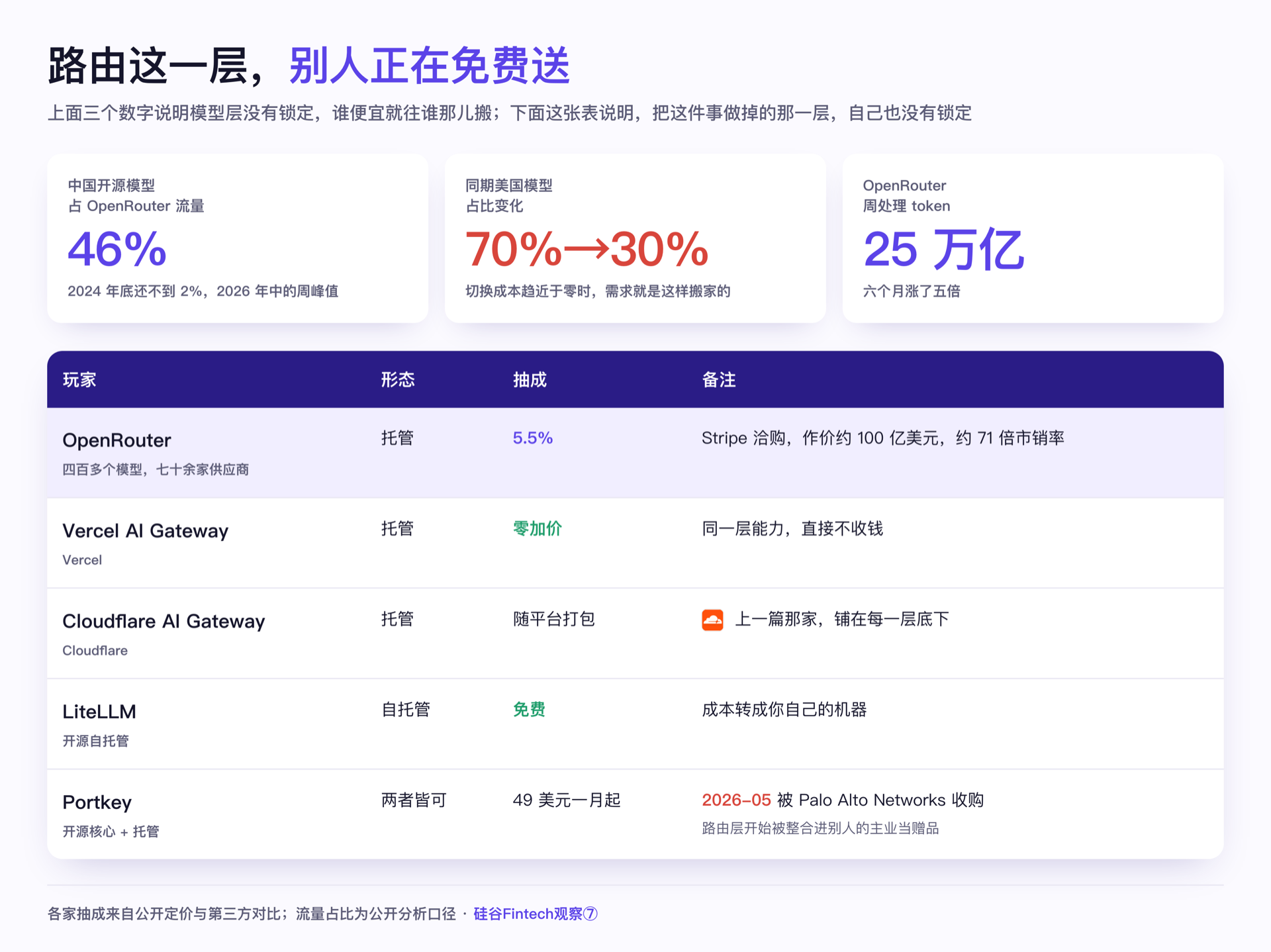
Vercel 收零,LiteLLM 开源免费,而 OpenRouter 收 5.5%。这不是理论上的可替代,这是货架上已经摆着的更便宜的替代品。TrueFoundry、Envoy AI Gateway 这些自托管方案也都在同一层。
更值得注意的是另一件事:同样做这层的 Portkey,2026 年 5 月被 Palo Alto Networks 收购了,一家网络安全公司。路由这层已经开始被整合进别人的主业当赠品,而不是作为独立生意存在。
所以那个尖锐的问题必须自己先问:如果这层注定被商品化,Stripe 的 70 亿是怎么算出来的?
四、Stripe 买的不是路由,是 AI 支出的收银台
我的答案是这句话:路由是免费的,账本不是。
Vercel 可以零抽成给你路由,因为它卖的是别的东西。LiteLLM 可以开源,因为它把成本转嫁给你的运维。但这两家都没有替你保管一件事:你团队的额度、预算、发票、按项目和按人的成本归属。
这就是 OpenRouter 那 5.5% 真正收的东西。它收的不是路由费,是资金托管和记账费。你往里充值,钱就存在它那里;你的团队用哪个模型花了多少、算在哪个项目头上、月底开给财务的发票长什么样,全长在它上面。
换掉路由是改一行配置,换掉账本是动整套财务对账。这跟我上一篇的结论是同一句话:搬得走的地方收不到租,搬不走的地方才收得到。
而且这不是 Stripe 临时起意,是一步棋的第二手。把它最近的收购连成线看:
2025 年它买了 Bridge(稳定币基础设施,约 11 亿美元)、Privy(加密钱包基础设施)、Orum(支付编排)。真正的转向发生在今年:
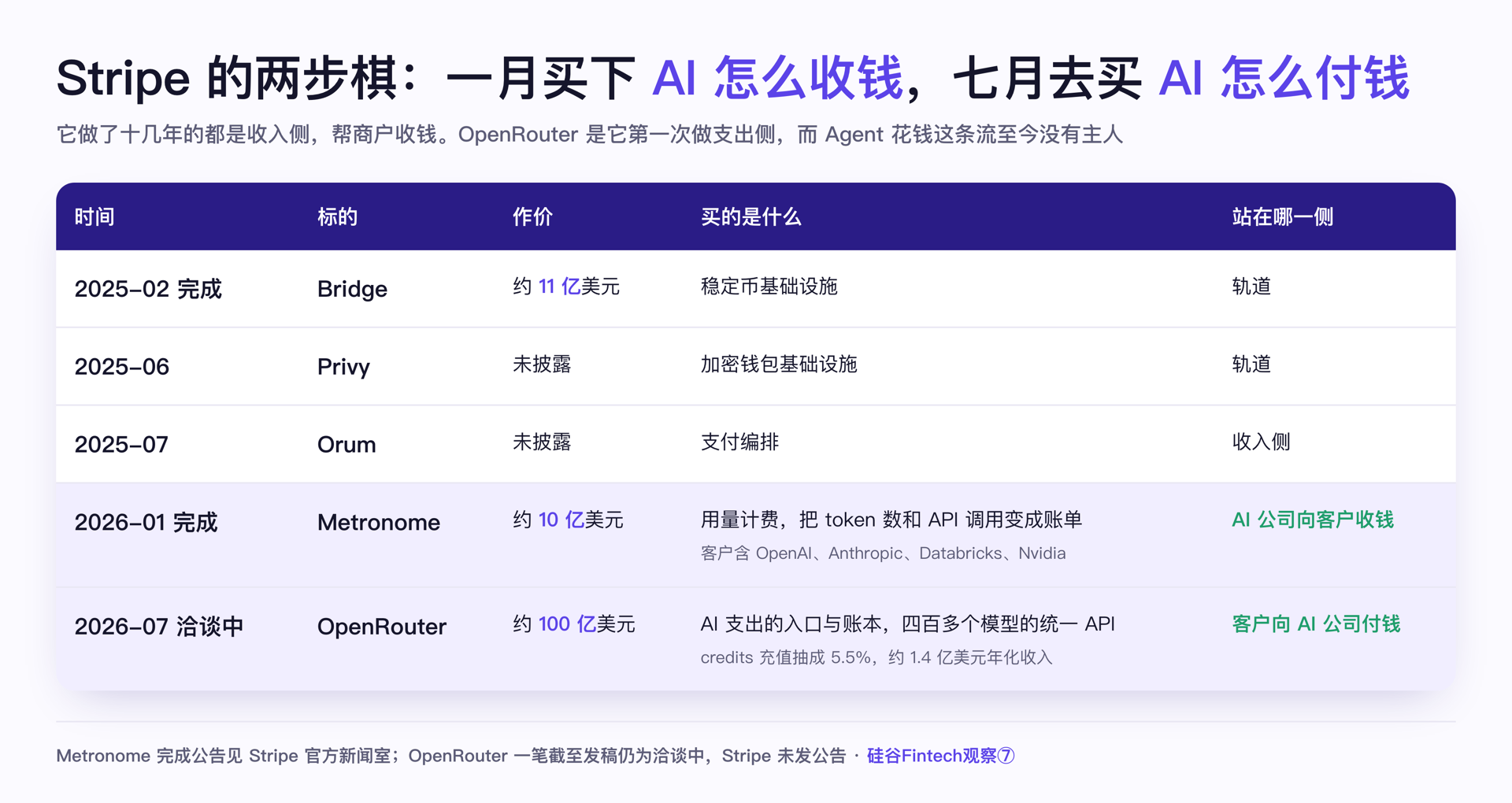
看出来了吗。1 月,Stripe 买下了 AI 公司向客户收钱的那套系统;7 月,它去买客户向 AI 公司付钱的那个入口。Metronome 干的事是把 token 数、API 调用这些用量事件变成账单,OpenRouter 干的事是把开发者的钱变成额度再花出去。一收一付,Stripe 想同时站在 AI 支出的两端。
这就是这笔交易真正买的三样东西:
第一样是支出侧的位置。Stripe 至今做的全是收入侧,帮商户收钱。这是它第一次做支出侧。Agent 经济里 Agent 既要收钱也要花钱,而花钱那一侧至今没有主人。
第二样是 MPP 的活体验证。上一篇讲过,MPP 是 Stripe 和 Tempo 共同起草的机器支付协议,核心设计就是 Agent 授权一个额度、按次流式付费给服务。而 OpenRouter 的 credits 系统,本质上就是手工版的 MPP,已经跑到近 30 亿美元年化的流量。Stripe 不是在买一个未来赌注,是在买一个已经在跑的实例。
第三样是前提本身。整个 Agent 经济的所有判断,都建立在机器会真的开始花钱这个前提上。一家公司愿意为这个前提付 70 亿美元,是它至今最贵的一次背书。
五、三个它自己造出来的风险
但这笔交易同时制造了三个原来不存在的问题,而且都很硬。
一、中立性不是它的资产,是别人给的许可。
OpenRouter 能存在,是因为 OpenAI、Anthropic、Google 这些模型厂商愿意让它转售自己的模型。这个许可随时可以收回。一旦它挂在一家有自己商业利益的母公司名下,模型厂商要重新判断一件事:我到底要把多少分发权,让给一家支付公司。中立层的中立,是被它中介的那些人授予的,不是它自己拥有的。
二、Stripe 同时是 OpenAI 和 Anthropic 的收单方。
这是最尴尬的一层。Stripe 替这两家处理支付,而 OpenRouter 的核心卖点,是帮客户把支出从贵的模型挪到便宜的模型,包括挪向 Kimi、DeepSeek 这些中国开源权重模型。同一家公司,一边帮你收钱,一边帮你的客户少给你钱。而且以体量论,OpenAI 和 Anthropic 那两笔收单关系,大概率比 OpenRouter 本身更值钱。这个冲突怎么处理,是这笔交易最需要盯的地方。
三、模型厂商自己会往下打。
大客户直签、批量折扣、自建企业车队,这些动作都在压中间层的抽成空间。当 OpenAI 和 Anthropic 愿意给大客户比 OpenRouter 更好的价格时,路由层的 5.5% 会被从两头挤。
六、拿 YouTube 那笔账做对照
有人会拿 Google 买 YouTube 来类比:当年也被骂买贵了,现在看是神来之笔。这个类比值得认真做,但做完之后的结论跟直觉相反。
2006 年 10 月,Google 花 16.5 亿美元换股买下成立才二十个月、全年收入约 1500 万美元的 YouTube。二十年后,Alphabet 在 2026 年 2 月第一次单独披露 YouTube 的账:2025 年广告收入 403 亿美元,算上订阅全年超过 600 亿。按广告口径,YouTube 现在每 15 天就能给 Alphabet 挣回一个当年的收购价。
把两笔交易摆在一起:
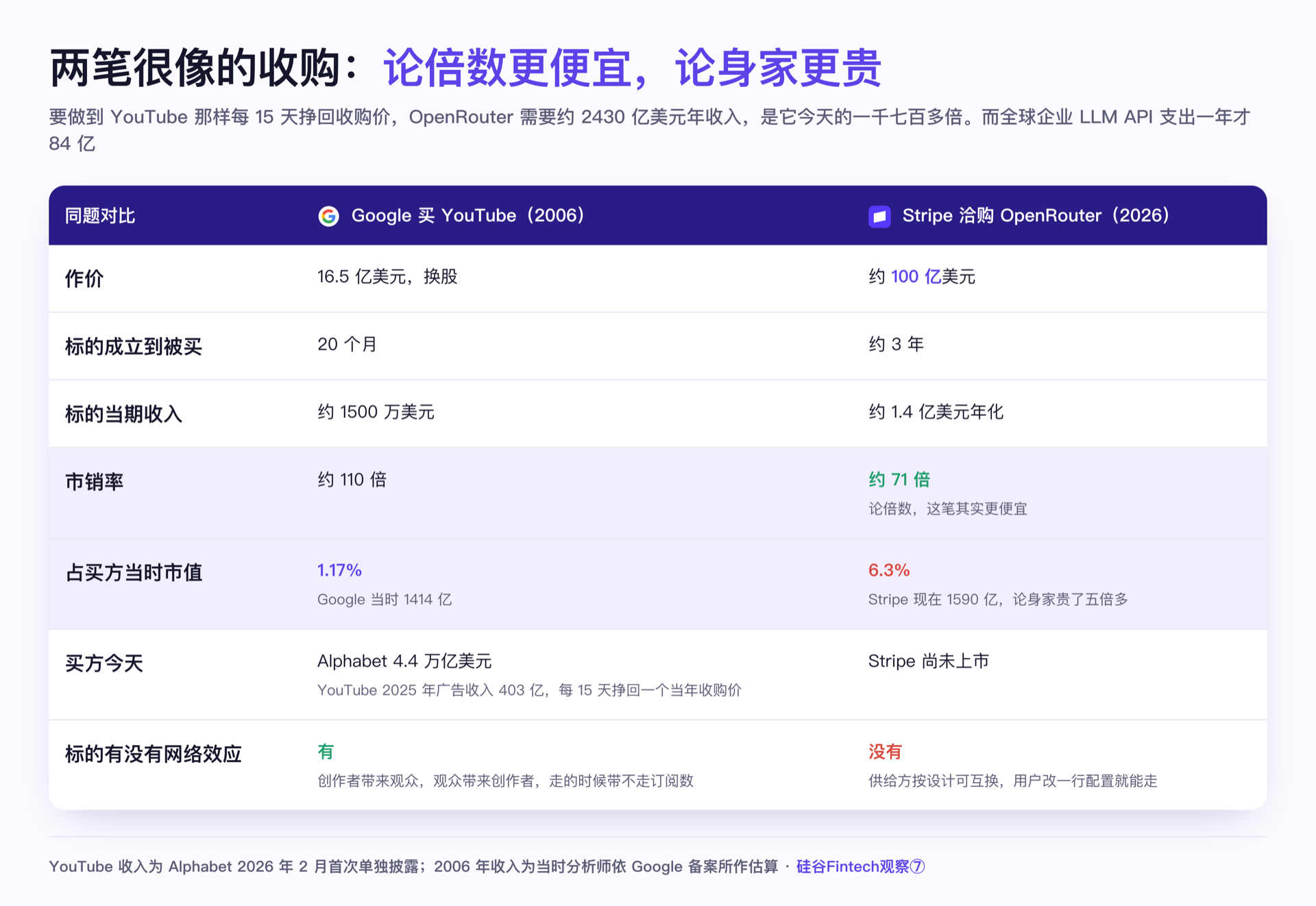
有意思的地方在这里:论市销率,Stripe 这笔其实比当年便宜;论占自己身家的比例,它贵了近四倍。Google 当年是拿家当的百分之一去赌,Stripe 是拿百分之四。
那要多大,才算复制了 YouTube?
要做到每 15 天挣回收购价,OpenRouter 需要约 1710 亿美元的年收入,是它今天的 1200 多倍。而第三方估算的 2026 年全球企业 LLM API 支出总共才 84 亿美元,Gartner 口径下把硬件服务软件全算上的企业 AI 总支出是 2.5 万亿。按今天可见的市场规模,OpenRouter 成不了 YouTube。这不是看好或看空,是算术。
更重要的是,它缺了 YouTube 最值钱的那样东西。
YouTube 能成,是三件事同时成立。一是长期趋势真的发生了,视频真的搬上了网。二是资产自带会复利的网络效应,创作者带来观众、观众带来创作者,而创作者离开时带不走自己的订阅数。三是买方有现成的变现引擎可以直接插上去,Google 把成熟的广告系统搬到视频库存上就行。
对照这三条:第三条 Stripe 有,Billing、Tax、Treasury、Radar,加上 Metronome 和 Tempo,这套东西插上去是顺的。第一条是赌,赌 Agent 会真的自己花钱,今天还没被验证。
第二条是缺的,而且缺得很彻底。OpenRouter 没有网络效应。它的供给方按设计就是可互换的,它的用户改个配置就能走。多一个用户不会让下一个用户更难离开,多一个模型也不会。
所以 Google 买 YouTube 的时候护城河已经在了,只是还没被变现;Stripe 买 OpenRouter,护城河得自己造。造法就是第四节说的:把额度、发票、成本归属长在上面,让它从一个可替换的路由,变成一个搬不走的结算地点。这件事 Stripe 大概率做得到,但那是执行,不是买来的资产。
最后,不能只讲 YouTube。同一个 Google,2011 年花 125 亿美元买下摩托罗拉移动,2014 年 29 亿美元卖给联想。同一个买家、同样是押一个未来,一个成了史上最成功的收购,一个是史上最大的减记之一。只举 YouTube 不举摩托罗拉,是幸存者偏差。
收口
把这一篇收成三句话。
第一句:模型是库存,路由是货架,账本才是生意。库存可以随时换供应商,货架有人免费送,只有账本搬起来是疼的。Stripe 花 70 亿买的是第三样,不是前两样。
第二句:这笔钱买的是位置和证明,不是收入。就算 AI API 支出未来八年按 40% 复合增长、Stripe 还能守住三成份额,这条线也就贡献十几亿美元的净收入,相对它今天六十多亿的净收入是加成,不是第二增长曲线。谁拿它去论证估值该翻几倍,那笔账算不平。
第三句:它最大的风险是自己造出来的。中立层被一个有立场的母公司买走,中立就成了需要每天证明的东西;而 Stripe 同时替 OpenAI 和 Anthropic 收单,又拥有一个劝客户少花钱在它们身上的生意。这个结怎么解,比这 70 亿贵不贵重要得多。
(本文事实口径:Stripe 收购 OpenRouter,华尔街日报 2026-07-23 前后报道洽谈作价约 100 亿美元;Bloomberg 2026-08-16 报道双方已达成协议、作价 70 亿美元以上,TechCrunch 与 Fortune 同日转述;Stripe 官方新闻室 2026-08-19 公告 agrees to acquire,未披露作价。本文 2026-09-14 更新起以 70 亿为计算基数。OpenRouter 年化收入约 1.4 亿美元、较 4 月涨约三倍来自公开报道,2026 年 3 月约 5000 万与 2024 年底约 1900 万为 Sacra 估算,均非公司披露;50 倍市销率为按 70 亿除以 1.4 亿年化口径计算。credits 充值 5.5%、BYOK 每月 2.5 万美元以内免费超出收 5%、四百余个模型与七十余家供应商、五百万开发者、每周 25 万亿 token,均来自其公开定价与公开报道。13 亿估值与 CapitalG 领投的 1.13 亿美元 B 轮为 2026 年 5 月公开报道。中国开源模型流量占比由 2024 年底不足 2% 升至 2026 年中周峰值 46%、美国模型由约 70% 降至 30%,为公开分析口径。Stripe 收购谱系:Bridge 约 11 亿美元于 2025 年 2 月完成、Privy 于 2025 年 6 月、Orum 于 2025 年 7 月、Metronome 约 10 亿美元于 2026 年 1 月完成,其中 Metronome 完成公告见 Stripe 官方新闻室;Metronome 客户名单来自公开报道。Portkey 于 2026 年 5 月被 Palo Alto Networks 收购、Vercel AI Gateway 零加价、LiteLLM 开源自托管,均来自各家公开资料与第三方对比。Stripe 1590 亿估值为 2026-02-24 员工要约口径,2025 年总交易量 1.9 万亿美元来自 Stripe 2025 年报,净收入约 69 亿为 Sacra 估算。Google 收购 YouTube 作价 16.5 亿美元换股来自 Google 2006-10-09 官方公告,YouTube 2006 年收入约 1500 万为当时分析师依 Google 备案所作估算;YouTube 2025 年广告收入 403 亿与全年总收入超 600 亿来自 Alphabet 2026 年 2 月披露;Google 2006 年底市值 1414 亿、Alphabet 2026-08-06 市值 4.42 万亿来自公开市场数据。2026 年全球企业 LLM API 支出约 84 亿与 Gartner 企业 AI 总支出 2.52 万亿来自第三方研究口径,机构之间分歧较大,仅作量级参考。摩托罗拉移动 125 亿美元收购与 29 亿美元出售为公开记录。文中关于份额与增速的假设均为本文测算前提,非预测。)
Silicon Valley Fintech Watch series · Part Seven
In brief. Stripe has agreed to acquire OpenRouter for more than $7 billion, a routing layer that fans requests out across more than four hundred large language models. The price is roughly 50 times annualized revenue, and it is the largest acquisition in Stripe's history. The strange part: at that same layer, Vercel charges a zero markup, LiteLLM is open source and free, and Portkey was bought by a security company three months ago. What exactly do you get for $7 billion when other people are giving the thing away? The last piece was about how agents pay merchants. This one follows money running the other direction: how companies pay the models.
Updated September 14, 2026. When this piece went out on August 8, Stripe and OpenRouter were still in talks and the Wall Street Journal had reported a price of about $10 billion; the title and the text were written on that number. On August 16 Bloomberg reported that the two had reached an agreement at more than $7 billion, 5.4 times the $1.3 billion valuation of the Series B three months earlier. On August 19 Stripe's newsroom published the announcement, worded as agrees to acquire, with no price disclosed. This update changes $10 billion to $7 billion in the title and throughout, the revenue multiple from 71x to about 50x, the share of Stripe's valuation from 6.3% to 4.4%, and recomputes the derived figures in the YouTube section. All three charts are re-rendered. The judgments are untouched.
Before we start
Around July 23, 2026, the Wall Street Journal reported that Stripe was in talks to acquire OpenRouter for roughly $10 billion. On August 16 Bloomberg reported the two sides had reached an agreement at more than $7 billion; on August 19 Stripe's official announcement confirmed the agreement without disclosing a price. The rest of this piece uses $7 billion.
First, the status. This is a signed deal that has not yet closed. When this piece first ran on August 8 the two sides were still talking and Stripe's newsroom carried nothing. On August 19 the announcement appeared, headlined Stripe agrees to acquire OpenRouter, with the word agrees rather than completes. Compare the January deal: when Metronome closed, the headline was Stripe completes Metronome acquisition. The gap between those two words is the gap between signing and closing, and as of this update OpenRouter is still on the first side of it. Stripe has not stated a price; more than $7 billion is Bloomberg's figure.
What is OpenRouter? In one line: it connects some seventy providers and more than four hundred models behind a single API, then routes each request to whichever one fits best on price, availability, and speed. More than five million developers use it. In May 2026 it closed a $113 million Series B led by Alphabet's CapitalG at roughly $1.3 billion. Less than three months later, the price is 5.4 times that.
The last piece was about agents paying merchants, the receivables side. Here the money runs the other way: companies paying model providers, the spending side. This is the first time Stripe has reached across to the spending side, and that flow still has no owner.
1. Get the numbers straight first
Several different revenue multiples are circulating for this deal, because OpenRouter's revenue is growing fast enough that the month you pick changes the answer by half. The timeline:
| Point in time | Annualized revenue |
|---|---|
| End of 2024 | ~$19 million |
| March 2026 | ~$50 million |
| Most recent | ~$140 million, roughly triple April |
On the most recent figure, $7 billion works out to about 50 times revenue. That is a startling number, but not the two hundred times some coverage claims. Those pieces are dividing by a revenue figure that is months old.
How does it make money? Simply: you top up your account and it takes 5.5%. Bring your own provider key and you pay nothing up to $25,000 a month of list-price inference, then 5% of what the same model would normally cost. It does not mark up the token price. It takes a cut of the money. That distinction matters shortly.
Working back from a 5% take, roughly $2.8 billion of annualized inference spend flows through it. For scale, third-party estimates put global enterprise LLM API spend in 2026 at about $8.4 billion. The two figures are not strictly comparable, since the latter counts enterprises only and excludes a large population of individual developers and small teams, so you cannot simply divide one by the other. But the order of magnitude makes the point: this is not a fringe company. It is already standing in the middle of the road where AI money moves.
One more number that says even more about position: by mid-2026 it was processing 25 trillion tokens a week, up fivefold in six months.
2. Why the model layer cannot grow a moat
To see why Stripe went after routing, you first have to see what went wrong at the model layer.
Cloud pricing power does not come from there being only three or four vendors. It comes from switching costs being enormous. Once your data, IAM permissions, CI/CD, and tooling ecosystem all grow on AWS, moving to GCP costs an astronomical amount. That is vendor lock in, and it has little to do with how many suppliers exist. Even with ten cloud vendors, as long as each one's API and ecosystem are mutually incompatible, the lock-in holds. The cloud moat equals data gravity plus integration depth plus migration friction.
This is precisely what large language models lack. At the interface layer, switching model providers costs about as much as editing one config line. And the business model of abstraction layers like OpenRouter and LiteLLM is, by design, to grind away whatever friction remains. So even if supply really does converge to six or seven labs, standardized interfaces mean those six or seven fight a pure price war, rather than the cloud pattern of locking you in and then collecting rent.
More important still: the cloud world has no open source, freely self-hostable cloud acting as a competitive baseline. The model world does. Kimi, GLM, DeepSeek, Qwen, and Llama, as open-weight models, nail a price ceiling over the whole market. As long as open weights keep tracking close to the closed frontier, any closed lab that tries to collect rent faces customers who could in principle self-host, or rent a cloud provider to run open weights for them.
That ceiling is not absolute. Self-hosting only pencils out at high utilization; at low utilization the unit cost of running your own is far above simply buying the API. But it is enough that closed pricing cannot drift wildly above the cost of self-hosting.
And this is not a thought experiment. OpenRouter's own traffic is the evidence. By public accounts, Chinese open-weight models went from under 2% of traffic on the platform at the end of 2024 to a weekly peak of 46% by mid-2026, while US models fell over the same span from around 70% to 30%.
That pair of numbers deserves a pause. A neutral layer drove switching costs to nearly zero, developers worldwide voted with their feet for two years, and the result was demand migrating at scale from the closed frontier to open weights. This is what a market without lock-in looks like: money goes wherever is cheap and good, and yesterday's lead buys you no pricing power tomorrow.
So what is actually valuable was never the model. It is the engineering assets at the layer where the model meets the business: routing decisions, prompts and post-training, eval sets, cost attribution. You can swap suppliers on the inventory at any time, but you cannot swap the supply chain system you built on top of it.
To be precise about it: switching costs at the interface layer approach zero; at the application layer they do not. Prompts are tuned to specific models, and changing models means re-running your evals. What actually stops you switching suppliers is never the API. It is what you have accumulated on top of the API.
3. But at the routing layer, other people are giving it away
The logic above amounts to this: whoever eliminates switching costs earns the money the model vendors cannot.
Which raises the obvious question: does the routing layer itself have switching costs?
Almost none, and the price war there has already started:
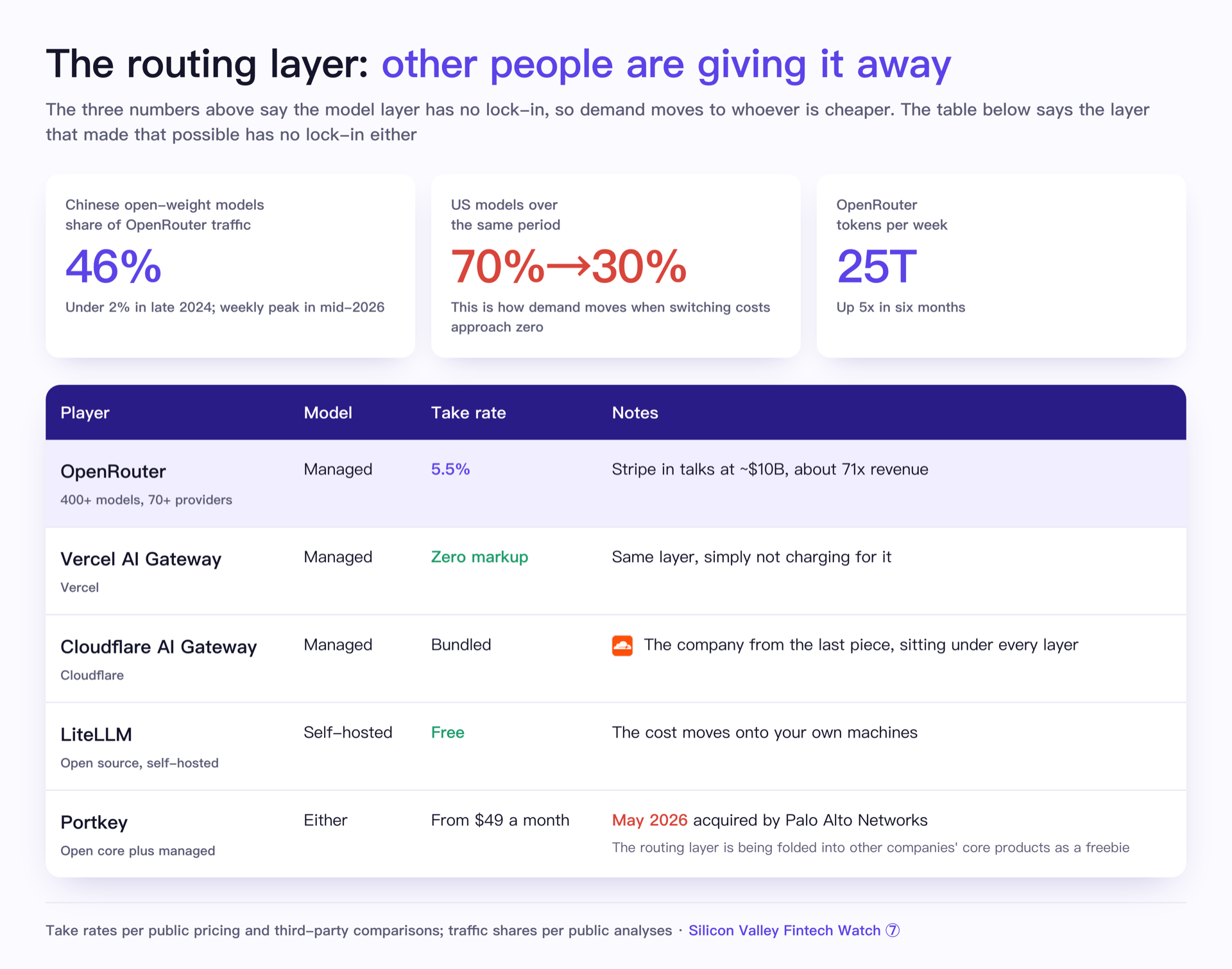
Vercel charges nothing, LiteLLM is open source and free, and OpenRouter takes 5.5%. This is not theoretical substitutability. These are cheaper substitutes already sitting on the shelf. Self-hosted options like TrueFoundry and Envoy AI Gateway occupy the same layer.
More telling still: Portkey, doing the same job, was acquired in May 2026 by Palo Alto Networks, a network security company. The routing layer is already being folded into other companies' core products as a giveaway, rather than surviving as a standalone business.
So the sharp question has to be asked first, and asked of oneself: if this layer is destined to be commoditized, how does anyone arrive at $7 billion?
4. Stripe is not buying routing. It is buying the checkout counter for AI spend
My answer fits in one line: routing is free, the ledger is not.
Vercel can hand you routing at zero take because it sells something else. LiteLLM can be open source because it pushes the cost onto your own operations team. But neither of them holds one thing for you: your team's balance, budgets, invoices, and cost attribution by project and by person.
That is what OpenRouter's 5.5% actually charges for. It is not a routing fee. It is a custody and bookkeeping fee. You top up and the money sits with it. Which model your team spent what on, which project it lands against, what the invoice you hand finance at month end looks like, all of it grows on top of that account.
Changing your router means editing one config line. Changing your ledger means redoing an entire finance reconciliation. This is the same sentence as the conclusion of my last piece: you cannot collect rent on ground that moves, only on ground that does not.
And this was not a spur-of-the-moment idea. It is the second move of a two-move plan. Line up the recent acquisitions:
In 2025 Stripe bought Bridge (stablecoin infrastructure, ~$1.1 billion), Privy (crypto wallet infrastructure), and Orum (payments orchestration). The real pivot happened this year:
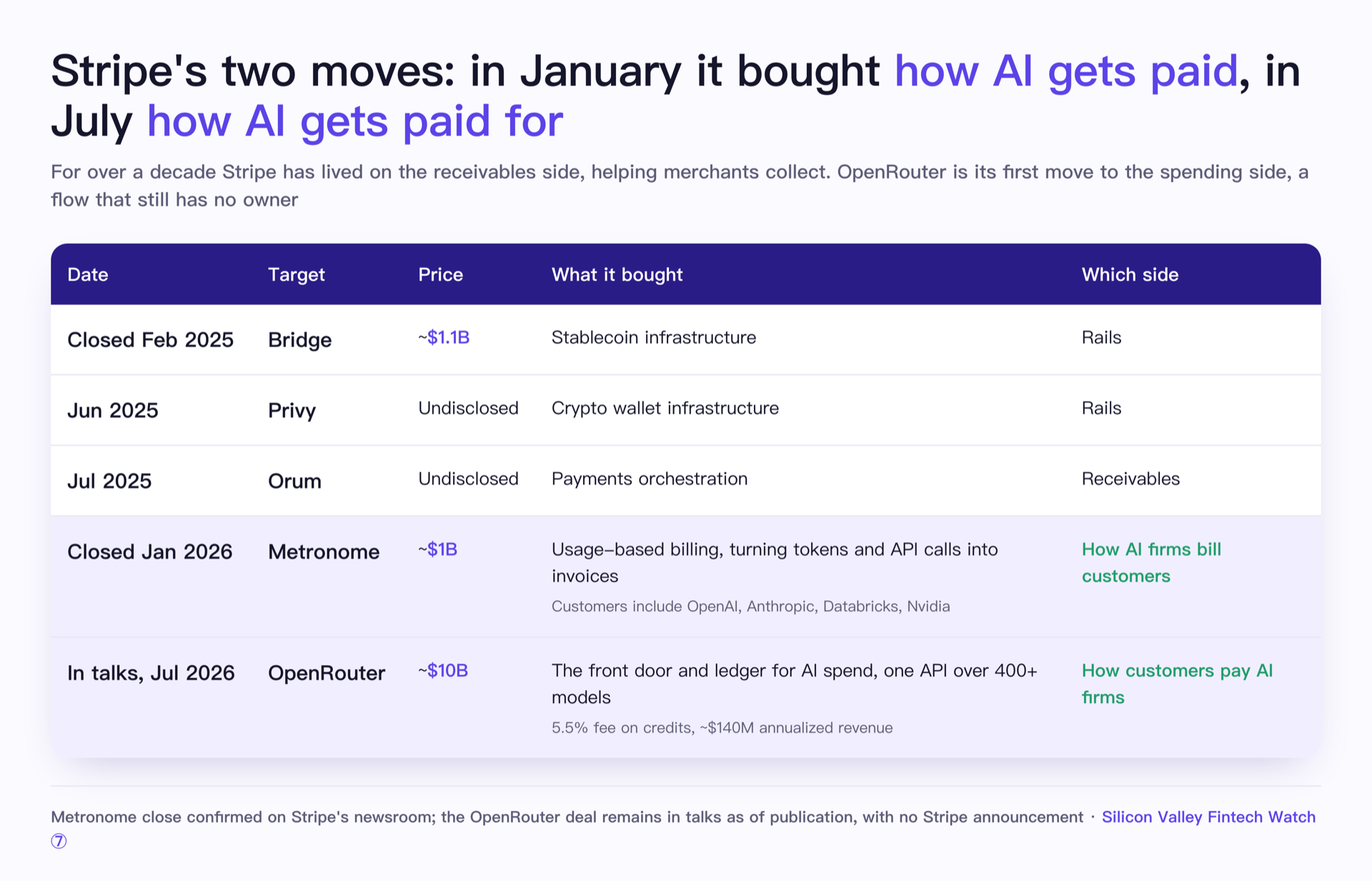
See it? In January, Stripe bought the system AI companies use to bill their customers. In July, it went after the front door customers use to pay AI companies. Metronome turns usage events like token counts and API calls into invoices. OpenRouter turns a developer's money into balance and then spends it. One collecting, one paying. Stripe wants to stand on both ends of AI spend at once.
Which is what this deal actually buys, in three parts.
First, a position on the spending side. Everything Stripe has done to date is receivables, helping merchants collect. This is its first move to the spending side. In an agent economy, agents both collect and spend, and the spending side has had no owner.
Second, a live proof of MPP. As covered last time, MPP is the machine payments protocol Stripe co-authored with Tempo, and its core design is an agent authorizing a spending limit and then streaming per-use payments to services. OpenRouter's credits system is, in substance, a hand-built version of MPP, already running close to $3 billion of annualized flow. Stripe is not buying a bet on the future. It is buying an instance already in production.
Third, the premise itself. Every judgment in the agent economy rests on the premise that machines will really start spending money. A company willing to pay $7 billion for that premise is the most expensive endorsement it has received.
5. Three risks it created for itself
But this deal also manufactures three problems that did not exist before, and all three are hard.
One. Neutrality is not its asset. It is a permission granted by others.
OpenRouter exists because OpenAI, Anthropic, Google, and the rest are willing to let it resell their models. That permission can be withdrawn at any time. Once it hangs beneath a parent with commercial interests of its own, the labs have to re-evaluate one question: how much distribution leverage do we want to hand to a payments company? A neutral layer's neutrality is granted by the very parties it sits between. It does not own it.
Two. Stripe is also the acquirer for OpenAI and Anthropic.
This is the most awkward layer of all. Stripe processes payments for both, while OpenRouter's core pitch is helping customers move spend off expensive models and onto cheaper ones, including Chinese open-weight models like Kimi and DeepSeek. One company, helping you collect on one side, helping your customers pay you less on the other. And by size, those two processing relationships are almost certainly worth more than OpenRouter itself. How that conflict gets handled is the thing to watch most closely.
Three. The model vendors will push down from above.
Direct enterprise contracts, volume discounts, in-house enterprise fleets, all of these compress the middle layer's take. When OpenAI and Anthropic are willing to quote large customers a better price than OpenRouter can, that 5.5% gets squeezed from both ends.
6. Running the YouTube comparison
Someone will reach for Google buying YouTube: everyone called it overpriced at the time, and it turned out to be a stroke of genius. The comparison is worth doing properly, and doing it properly produces a conclusion opposite to the intuition.
In October 2006, Google paid $1.65 billion in stock for a twenty-month-old company with about $15 million in annual revenue. Twenty years later, in February 2026, Alphabet broke out YouTube's numbers for the first time: $40.3 billion in 2025 advertising revenue, and more than $60 billion including subscriptions. On the advertising line alone, YouTube now earns back the entire 2006 purchase price every 15 days.
Put the two deals side by side:
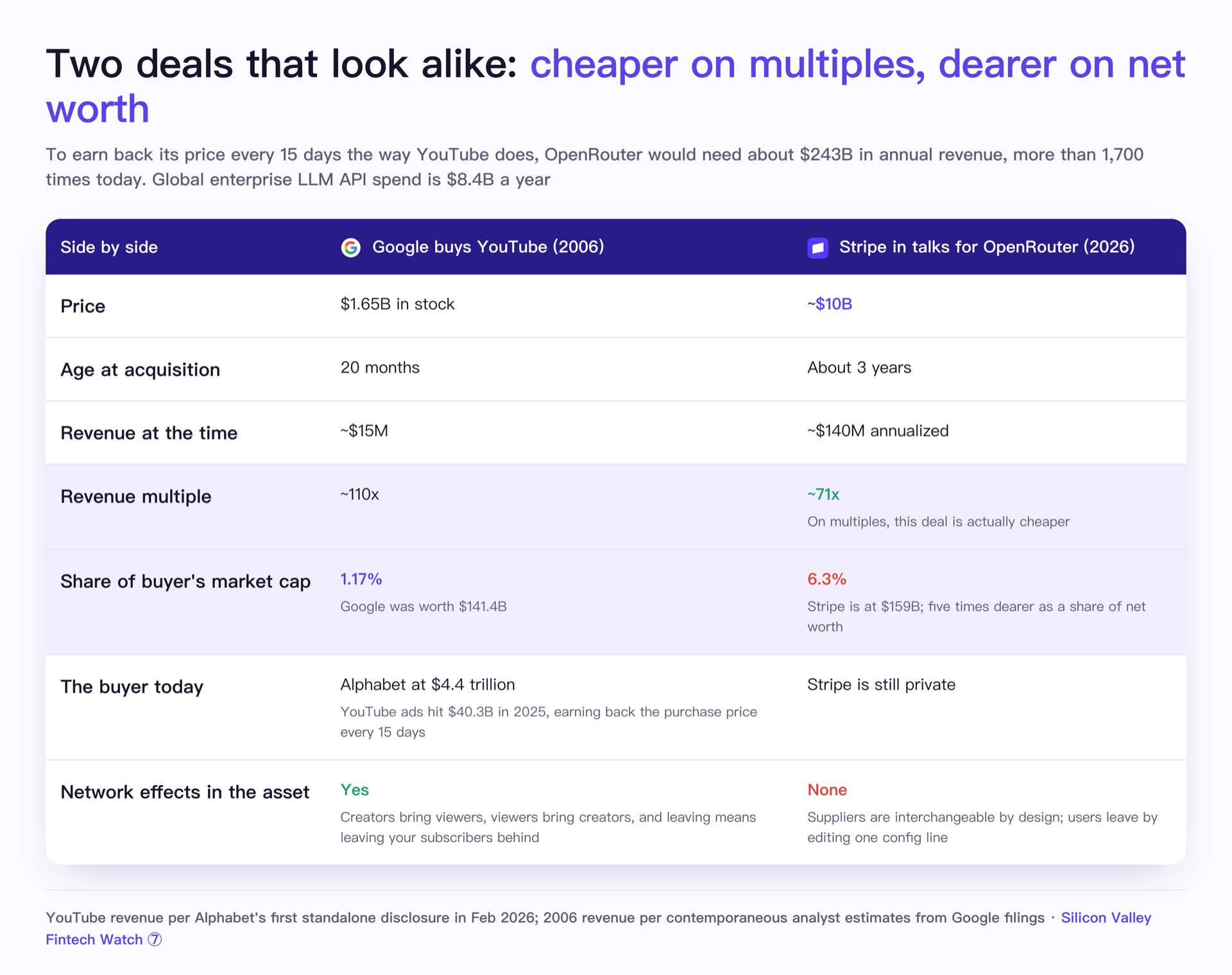
Here is the interesting part. On revenue multiples, Stripe's deal is actually cheaper than Google's. As a share of its own net worth, it is nearly four times dearer. Google was betting one percent of what it had. Stripe is betting four.
So how big would this have to get to replicate YouTube?
To earn back its price every 15 days, OpenRouter would need roughly $171 billion in annual revenue, more than 1,200 times where it is today. Third-party estimates put all global enterprise LLM API spend in 2026 at $8.4 billion, and Gartner's number for total enterprise AI spending, counting hardware and services and software, is $2.5 trillion. At any market size visible today, OpenRouter cannot become YouTube. That is not bullishness or bearishness. It is arithmetic.
More importantly, it is missing the most valuable thing YouTube had.
YouTube worked because three things were true at once. The secular shift really happened: video really did move online. The asset carried a compounding network effect: creators bring viewers, viewers bring creators, and a creator who leaves cannot take their subscribers along. And the buyer had a monetization engine ready to plug in: Google simply pointed a mature ad system at video inventory.
Against those three: Stripe has the third. Billing, Tax, Treasury, Radar, plus Metronome and Tempo, all plug in cleanly. The first is the bet, that agents will really spend on their own, and it is not yet proven.
The second is missing, and missing completely. OpenRouter has no network effect. Its suppliers are interchangeable by design and its users leave by editing a config file. One more user does not make the next user harder to lose, and neither does one more model.
So when Google bought YouTube, the moat was already there and merely unmonetized. When Stripe buys OpenRouter, it has to build the moat itself. The method is the one from section four: grow the balances, invoices, and cost attribution on top of it until it stops being a replaceable router and becomes a settlement location that cannot be moved. Stripe can probably pull that off, but that is execution, not an asset you purchased.
Finally, do not only talk about YouTube. The same Google paid $12.5 billion for Motorola Mobility in 2011 and sold it to Lenovo for $2.91 billion in 2014. Same buyer, same act of betting on a future, one the most successful acquisition in history, the other among the largest write-downs. Citing YouTube without Motorola is survivorship bias.
Closing
Three sentences for the whole piece.
One: the model is inventory, routing is the shelf, and the ledger is the business. You can change suppliers on inventory whenever you like, other people give the shelf away for free, and only the ledger hurts to move. Stripe's $7 billion buys the third thing, not the first two.
Two: this money buys position and proof, not revenue. Even if AI API spend compounds at 40% for eight years and Stripe holds a third of it, that line contributes something like a billion or two in net revenue, an add-on to today's six-plus billion rather than a second growth curve. Anyone using it to argue the valuation should multiply is running a set of books that will not balance.
Three: its biggest risk is self-inflicted. When a neutral layer is bought by a parent with a position, neutrality becomes something that must be proved daily. And Stripe simultaneously processes payments for OpenAI and Anthropic while owning a business whose pitch is spending less with both. How that knot gets untied matters far more than whether $7 billion was expensive.
(Sourcing. Stripe's acquisition of OpenRouter: the Wall Street Journal reported talks at roughly $10 billion around July 23, 2026; Bloomberg reported an agreement at more than $7 billion on August 16, 2026, carried the same day by TechCrunch and Fortune; Stripe's newsroom announced the agreement on August 19, 2026, worded agrees to acquire, with no price disclosed. From the September 14, 2026 update this piece uses $7 billion as its base. OpenRouter's ~$140 million annualized revenue and roughly threefold growth since April come from public reporting; the ~$50 million figure for March 2026 and ~$19 million for end-2024 are Sacra estimates, none of them company disclosures. The 50x multiple is $7 billion divided by the $140 million annualized figure. The 5.5% credit fee, the BYOK terms free to $25,000 a month then 5%, the 400-plus models across 70-plus providers, five million developers, and 25 trillion tokens a week all come from public pricing and public reporting. The $1.3 billion valuation and CapitalG-led $113 million Series B are from May 2026 reporting. Chinese open-weight share of traffic rising from under 2% at end-2024 to a mid-2026 weekly peak of 46%, with US models falling from around 70% to 30%, follows public analyses. Stripe's acquisition history: Bridge at ~$1.1 billion closed February 2025, Privy in June 2025, Orum in July 2025, Metronome at ~$1 billion closed January 2026, with the Metronome close confirmed on Stripe's newsroom; the Metronome customer list is from public reporting. Portkey's May 2026 acquisition by Palo Alto Networks, Vercel AI Gateway's zero markup, and LiteLLM's open-source self-hosting all come from company materials and third-party comparisons. Stripe's $159 billion valuation is the February 24, 2026 employee tender; 2025 total payment volume of $1.9 trillion is from Stripe's 2025 annual letter; net revenue of roughly $6.9 billion is a Sacra estimate. Google's $1.65 billion all-stock YouTube acquisition is from Google's October 9, 2006 announcement, and YouTube's ~$15 million 2006 revenue is a contemporaneous analyst estimate drawn from Google filings. YouTube's $40.3 billion in 2025 ad revenue and $60 billion-plus total are from Alphabet's February 2026 disclosure. Google's $141.4 billion market cap at end-2006 and Alphabet's $4.42 trillion on August 6, 2026 are from public market data. Global enterprise LLM API spend of ~$8.4 billion and Gartner's $2.52 trillion enterprise AI figure are third-party research estimates that vary widely between houses and are cited for order of magnitude only. The $12.5 billion Motorola Mobility purchase and $2.91 billion sale are public record. All share and growth assumptions in this piece are stated premises for the arithmetic, not forecasts.)
Comments留言