硅谷Fintech观察⑥|Agent 钱包大战:四个协议抢标准,Cloudflare 却在收地租Silicon Valley Fintech Watch ⑥ | The Agent Wallet Wars: Four Protocols Fight Over the Standard, While Cloudflare Collects the Ground Rent
A web original — first published here on August 4, 2026.本文 2026.08.04 首发于本站。 Last updated August 8, 2026. 最后更新 2026.08.08。
目录Contents
- Before we start
- 1. Take the wallet apart first
- 2. What the four protocols are fighting over: a map
- 3. The research desk: five majors, hand by hand
- 4. Devil's Advocate: five buckets of cold water for Cloudflare
- 5. Bay Area startups: who gets steamrolled, who picks up a weapon
- Closing
- (Appendix: two personal notes)
硅谷Fintech观察系列 · 第六篇
导读|全球大约两成的网站,背后站着同一家公司。2026 年 8 月 4 日,这家公司给每个 AI Agent 发了一个钱包,免费。与此同时,四个支付协议、九个巨头正在抢 Agent 怎么付钱的标准:Stripe 四处下注,Google 把亲儿子协议捐了,OpenAI 的购物按钮上线五个月就凉了,连 Visa 和 Mastercard 的 agent 方案,验明正身那一层踩的都是同一家的砖。我的判断是:这场仗表面在抢协议,实际在抢结算发生的地点。往下看。
更新于 2026-08-08|Stripe 正在洽谈以约 100 亿美元收购 OpenRouter,把手伸到了 Agent 花钱的那一侧。同一个道理换了一条流又演了一遍,我单写了第七篇来拆这笔账。
更新于 2026-09-14|这笔收购 8 月 19 日由 Stripe 官方公告确认,Bloomberg 口径作价 70 亿美元以上,Stripe 未披露价格。第七篇已按 70 亿重算。
写在前面
2026 年 8 月 4 日,Cloudflare 上线了一个新东西:cloudflare.pay。
你没看错,不是 .com,是 .pay。页面极简,一张橙色的卡片,一个输入框,一句话:Reserve your Cloudflare Wallet. 你输一个名字,它就把 @你的名字,连同一个 你的名字.cloudflare.pay 的地址留给你,免费,先到先得。我顺手输了一个四字母的名字,一分钟拿下。
这个钱包不是给人用的,是给 Agent 用的。Cloudflare 的说法是:以后你的 AI Agent 出门干活,用这个钱包付 API 的钱、付内容的钱、付数据的钱;你给它设好额度和白名单,它在笼子里自己花钱,你不用盯着,它也刷不爆。
一家做 CDN 和防火墙起家的公司,突然发钱包。要看懂这件事,得把镜头拉远:过去一年多,硅谷在 Agent 怎么付钱这件事上,已经打出了四个协议、拉出了九路诸侯。最近流传一张协议覆盖图,把这张牌桌摆得很清楚:横轴是四个协议(ACP、MPP、AP2、x402),纵轴是九个玩家(Stripe、Visa、Mastercard、Coinbase、Google、OpenAI、PayPal、Cloudflare、Circle),谁是协议的创建者、谁是合作方,一目了然。
图上最扎眼的两件事:Stripe 的覆盖条最长,四个协议全沾;而 Cloudflare 的覆盖条几乎最短,只在 x402 一格里当创建者。
看起来最弱?我的判断恰恰相反。这一篇讲清楚三件事:这个钱包到底是什么;四个协议、五路大玩家各自在抢什么位置;以及为什么覆盖图上那家看起来最偏科的公司,可能摸到了整场牌局里最值钱的东西。
一、先拆钱包:Cloudflare 到底发了个什么
先把产品说人话。Cloudflare Wallets 分两层:
第一层叫 Account Wallet,账户钱包。这是你作为人类持有的钱包,能充值、能提现,充的是锚定美元的稳定币。它挂在你的 Cloudflare 账号上,@名字就是它的门牌号。
第二层叫 Virtual Wallet,虚拟钱包。这是你从账户钱包里切出来、发给某个 Agent 的零花钱账户,靠 API Key 运行。你可以给它设三道锁:总额度上限、单笔交易上限、商户白名单。Agent 只能在这三道锁的笼子里花钱。
打个比方:这不是把你的银行卡绑给 Agent,而是你给实习生办了一张有额度的公司卡,还规定了只能在指定的几家店刷。实习生再能折腾,坏账也就那点额度。
钱包之外还有一层更容易被忽略的东西:身份。每个钱包背后是一个经过验证的 Cloudflare 账号,Agent 付钱的时候,可以选择性地亮明自己代表谁,收钱的一方能验证这笔请求是谁授权的;不想亮明的,也可以匿名。这一下就把 Agent 经济里两个最头疼的问题(这个机器人是谁的、它花的钱谁认账)打包答了一半。
底层协议用的是 x402。这个名字来自 HTTP 状态码 402,官方释义 Payment Required:这个状态码 1997 年就写进了 HTTP 标准,占着付费墙的坑位,但整整二十多年没人真正用过。x402 干的事,就是把这个休眠的状态码激活:服务器对一个请求回一个 402,意思是先付钱;Agent 用稳定币当场付掉,再重新请求。整个过程发生在 HTTP 请求里,不用开户、不用绑卡、不用人出面。
要泼的冷水也得先泼上:截至发稿,这个钱包只开放了留名字这一步,充值、提现、给 Agent 发虚拟钱包这些真功能,官方说法是未来几个月陆续上线。今天你抢到的只是一个门牌号。
但门牌号背后的野心,得放到那张牌桌上才看得清。
二、四个协议在抢什么:一张地图
四个协议的名字都很拗口,我先给你一个能拿走的锚:这张牌桌上真正决定局势的是三家,Stripe、Coinbase、Cloudflare,其他玩家都围着这三家的路线站队。下面按协议一个个过。
ACP,让你在聊天框里下单。全称 Agentic Commerce Protocol,由 OpenAI 和 Stripe 维护。它管的是:人在 ChatGPT 里说想买,Agent 怎么替你把单下了。商户把商品目录交给 OpenAI,支付走 Stripe,用户在聊天框里点确认。这个协议有个著名的注脚:它随 ChatGPT 的 Instant Checkout 购物功能一起亮相,结果 2026 年 3 月,OpenAI 悄悄关停了 Instant Checkout,多家行业分析的说法是,这个旗舰消费场景跑了大约五个月,成交寥寥。协议还活着,但它证明了一件事:把购物按钮塞进聊天框,不等于用户真的会在聊天框里买东西。
AP2,管谁授权的,然后 Google 把它捐了。全称 Agent Payments Protocol,Google 在 2025 年 9 月发布,拉了 60 家机构站台,Visa 和 Mastercard 都在。它管的不是钱怎么走,是责任怎么算:用户给 Agent 签一份密码学凭证(协议里叫 Mandate,可以理解为授权书),Agent 每次花钱都带着这份授权书,事后出了纠纷,能验证这笔是用户真授权的,还是 Agent 自作主张。2026 年 4 月 28 日,Google 把 AP2 整个捐给了 FIDO 联盟(就是管指纹和通行密钥标准的那个组织),60 家机构联署。FIDO 为此开了两个工作组,认证组的主席里有 CVS Health、Google、OpenAI,支付组的主席是 Mastercard 和 Visa。翻译一下:Google 主动从庄家退成了裁判,因为授权和责任这层,谁独占谁就推不动;而卡组织抢着当支付组主席,是因为出错之后谁来赔的这套规矩,过去五十年一直是它们的家底。
MPP,Stripe 给机器修的收单台。全称 Machine Payments Protocol,2026 年 3 月 18 日发布,共同作者是 Stripe 和 Tempo。它管商户侧:接一段代码,你的网站就能收 Agent 的钱,支持三条轨道,Tempo 链上的稳定币、闪电网络、以及走 Stripe 的信用卡和借记卡。Visa 给它做了第一个卡支付 SDK,Anthropic、OpenAI、Mastercard、Shopify 都宣布了集成。
x402,把付款做成 HTTP 的一部分。Coinbase 在 2025 年 5 月提出,Cloudflare 是最早的共建者,两家一起发起了 x402 基金会。它的成绩单值得细看:按 Coinbase 2026 年中的口径,协议上线第一年处理了超过 1.69 亿笔支付,覆盖 59 万个买家、10 万个卖家。注意这个结构:59 万个买家,绝大多数不是人,是机器。另一组 2026 年 3 月的行业口径:年化交易额大约 6 亿美元,协议层零抽成。6 亿美元什么概念?Visa 一年清算的量是十几万亿美元,x402 现在的体量是传统卡网络的零头的零头。但 2026 年 7 月 14 日发生的事说明谁都不敢小看它:Linux 基金会接手成立 x402 基金会,首批 40 家成员里,Google、Stripe、Visa、Mastercard、Cloudflare、Coinbase 全员到齐。
四个协议放在一起,地图就清楚了:AP2 管谁授权,ACP 和 Google 另推的 UCP 管怎么下单,MPP 和 x402 管钱走哪条轨。入口、责任、轨道,三层。轨道层的两个协议代表两种世界观:MPP 说,机器付钱应该兼容人类的老轨道,卡、银行、链全都接;x402 说,机器付钱根本不需要人类的轨道,HTTP 本身就是轨道。
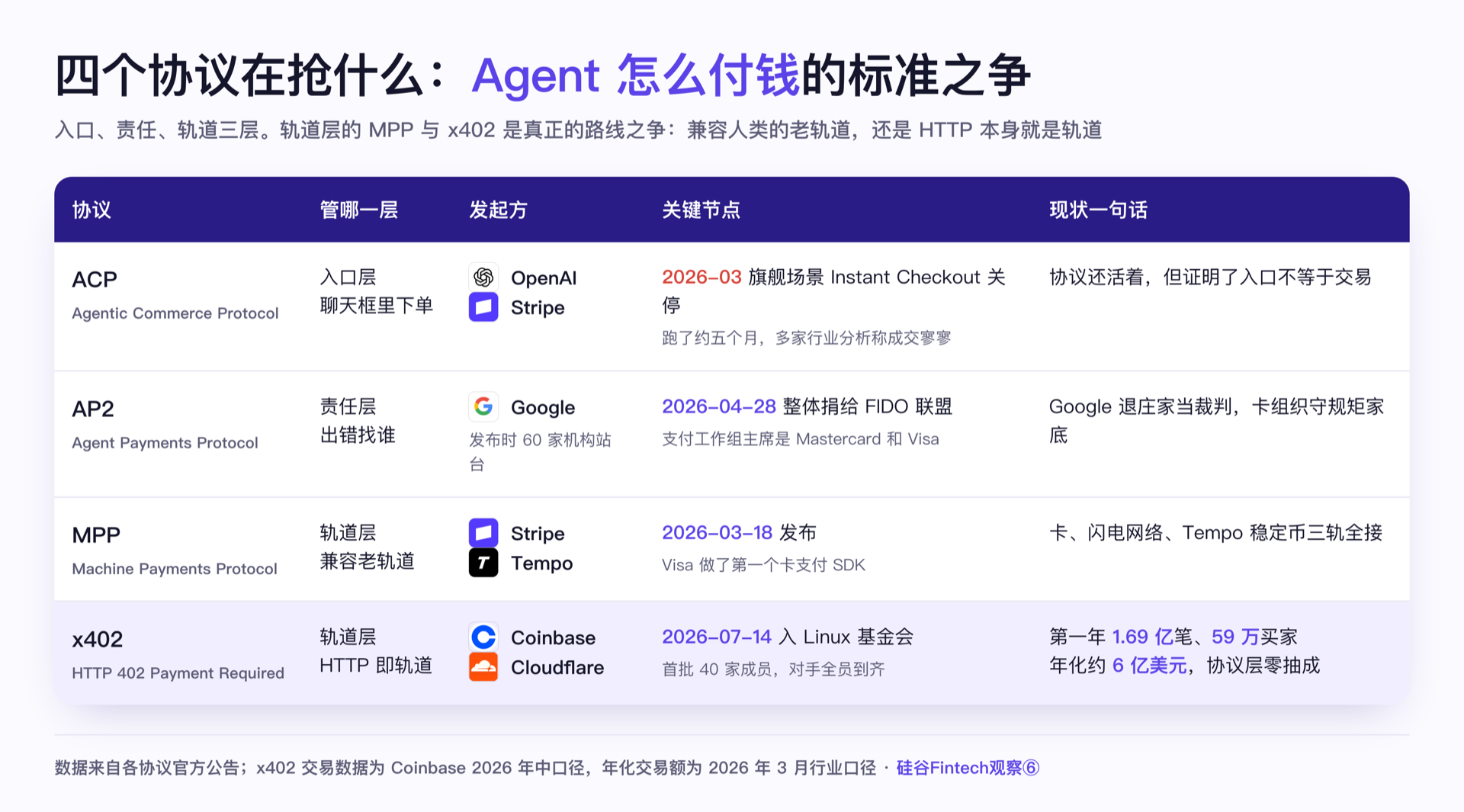
这才是真正的路线之争。其他都是站队问题。而地图上还藏着第四层,先按下不表:交易发生之前,总得有人在门口验一句,来的这个机器人是谁。这一层没画在覆盖图上,却是理解 Cloudflare 的钥匙。
三、研报层:五路大玩家,逐家过牌
光看协议还不够,这一节把五路真正的大玩家逐家过一遍:手里的牌、打法、软肋,以及各自站在哪一层。
Stripe:全家桶打法,赌无论谁赢,收银台都是它的
Stripe 是全场下注最全的玩家,而且不只是站台,是真金白银地修基建。
看它 2026 年 Sessions 大会一口气掏出来的东西:Agentic Commerce Suite,商户把商品目录传上 Stripe 后台,就能直接在 AI 入口里卖货,还宣布了和 Meta、Google 的合作,以后 Gemini 和谷歌 AI Mode 里下单,支付一层可以走 Stripe;Issuing for agents,给 Agent 程序化签发一次性虚拟卡,带实时授权和额度控制,Agent 刷完即焚;Link 的 agent 钱包,让它自家一亿多消费者的快捷支付账户也能授权给 Agent 用。入口、发卡、钱包、收单,一套全家桶。
再加上前面说的两张底牌:ACP(和 OpenAI)、MPP(和 Tempo)。Tempo 值得单独说两句,它是 Stripe 和 Paradigm 共同孵化的支付专用公链,没有原生代币,手续费直接用稳定币付,出块最终性大约 0.6 秒;2026 年初据 The Block 等媒体报道以 50 亿美元估值融了 5 亿美元,Thrive 和 Greenoaks 领投,3 月主网上线,4 月第一批外部验证节点进场,名单是 Stripe、Visa 和渣打旗下的 Zodia。
Stripe 的世界观很清楚:它不赌哪条轨赢,它赌商户永远需要一个收银台。卡轨赢,它有收单;链上赢,它有 Tempo;聊天框赢,它有 ACP;连对家 Coinbase 的 x402,它都是基金会成员。覆盖图上它的条最长,不是因为它看清了哪条路赢,恰恰是因为它也不知道,所以每条路都买了票。
软肋也在这里:全家桶的每一层,都有一个更专注的对手。它是九个玩家里树敌最多的。
而它下注最重的一笔,其实不在支付上。2026 年 7 月 23 日前后,华尔街日报报道 Stripe 正在洽谈以约 100 亿美元收购 OpenRouter,一个把请求分发给七十来家供应商、四百多个大模型的路由层;8 月 19 日 Stripe 官方公告确认收购协议,Bloomberg 口径作价 70 亿美元以上。这是它至今最大的一笔收购,也是全场唯一一个把手伸到 Agent 花钱那一侧的动作。这笔账值得单独算,我放在第七篇里拆。
卡组织:规矩派的防守反击
Visa 和 Mastercard 的打法几乎是镜像的,可以放在一起讲。
Visa 在 2025 年 4 月推了 Intelligent Commerce(把卡凭证 token 化后交给 Agent 用),10 月又推了 Trusted Agent Protocol,一个帮商户区分恶意爬虫和合法 Agent 的验证框架,计划把两者合进一个 SDK,默认兼容 AP2,还公开说在和 Coinbase 对齐 x402 的互操作。Mastercard 在 2025 年 4 月底推了 Agent Pay,核心是 Agentic Token(给 Agent 的专用支付凭证),2026 年 3 月更是干了一票大的:同意以最高 18 亿美元收购稳定币基础设施公司 BVNK。
看懂这套动作的钥匙,是认清卡组织真正的资产是什么。不是清算网络,清算网络会被新轨道绕开;是那套跑了五十年的出错找谁的规矩:拒付、争议仲裁、欺诈责任划分。所以它们的每一步都是把这套规矩往新世界里搬:把卡 token 塞进每个协议,去 FIDO 当支付工作组主席,买下稳定币公司补齐新轨道的能力。这不是进攻,是防守反击:仗可以输几场,规矩不能旁落。
软肋同样明显:Agent 经济最大的增量是机器对机器的微支付,几美分一笔的 API 调用,卡轨道的成本结构天然吃不住。这也是为什么两家嘴上说着卡,手上都在买链上能力。
还有一个细节,是我整篇文章里最想让你记住的细节之一:Visa 的 Trusted Agent Protocol 和 Mastercard 的 Agent Pay,在验证来访 Agent 是谁这一层,用的都是同一个东西,Web Bot Auth。这个验证标准是谁牵头的?Cloudflare 的工程师起草、拿到互联网标准组织 IETF 去讨论的,Cloudflare 官方博客写得明明白白:我们在和 Visa、Mastercard 合作,帮 Agent 安全地完成交易。
两大卡组织的 agent 方案,进门验身那块砖,是 Cloudflare 铺的。
Google:入口自己吃,规则送出去
Google 的打法是两头做。
入口那头,它下重注自己吃:2026 年 1 月在零售业大会上和 Shopify 一起推出 UCP(通用商务协议),管商品发现、购物车和下单,兼容 A2A、AP2 和 MCP;同月开始在美国灰度上线 AI Mode 和 Gemini 里的直接结账,买东西不离开谷歌的界面,但商户保留 merchant of record 身份(收款方还是商户自己),谷歌收编的是过程,不是账。
规则那头,它反手送人:把亲儿子 AP2 捐给 FIDO,自己退居工作组之一。
这一进一退,暴露了 Google 真正的处境:它最怕的不是错过支付,是 Agent 购物动了它的广告税基。搜索广告的商业模式建立在人自己逛上,人逛得越久、点得越多,广告越值钱;Agent 替人逛,一句话直达结果,广告位就悬了。所以入口它必须亲自守住,把结账留在自己的界面里;而责任层这种谁独占谁就推不动的东西,捐出去换个裁判席,反而划算。
Coinbase:链上半场的 Stripe,而且它的钱包发得比 Cloudflare 早
Coinbase 是链上半场的全栈玩家,而且动作比多数人以为的快得多。
协议层,x402 是它提出的。钱包层,注意这个时间点:2026 年 2 月 11 日,Coinbase 就发布了 Agentic Wallets,给 Agent 配的 MPC 钱包(私钥分片托管),带会话额度、单笔限额、Base 链上免 gas 结算、原生支持 x402。比 Cloudflare 的钱包早了将近半年。收单层,它的开发者平台有个三行代码接入的 SDK,任何 API 或 MCP 服务都能开始收 Agent 的钱;2026 年 7 月 23 日起,Coinbase Business 商业账户直接支持收 Agent 付来的 USDC。清算层,x402 的交易大约 85% 跑在它自家的 Base 链上。
协议、钱包、收单、清算,四层全栈,这就是为什么我说它是链上半场的 Stripe。两个 Stripe 的区别在世界观:Stripe 从卡轨半场向链上扩,Coinbase 从链上半场向商户扩,两边在中间地带必有一战。
至于它和 Cloudflare:现在是蜜月期盟友,x402 是两家共同的孩子。但钱包、结算这两层的重叠已经摆在桌面上了。区别暂时在人群:Coinbase 的钱包是给链上开发者的,钥匙是私钥和 gas;Cloudflare 的钱包是给普通开发者和站长的,钥匙是一个账号名。谁能把不懂链的人圈进来,谁赢下半场。
顺带把卖水人 Circle 也说了:USDC 是几乎所有协议的默认结算货币,按 DeFiLlama 2026 年 4 月底的口径,USDC 流通量约 773 亿美元,和 USDT 加起来占了约 3180 亿美元稳定币总盘子的八成多。协议打得越凶,水卖得越多,Circle 是这场仗最稳的受益者。但注意,Cloudflare 自家的 NET Dollar 上线之日,就是这对伙伴变对手之时。
Cloudflare:不抢任何一层,铺在每一层底下
现在把镜头收回 Cloudflare,把它过去一年多的动作连成线:
2025 年 5 月,牵头 Web Bot Auth,Agent 验身标准,后来 Visa、Mastercard 都踩了这块砖。2025 年 7 月,Pay Per Crawl,默认拦截 AI 爬虫,站长可以放行、拒绝或收费,供给侧第一道闸机;它手里的数据说明了为什么非做不可:到 2026 年 6 月,它网络里 52% 的爬虫请求是为 AI 训练来的,一年前还是 22%,而且超过一半的 AI 爬虫流量在反复抓根本没更新过的页面。2025 年 9 月,宣布要发自己的美元稳定币 NET Dollar,一比一美元抵押(注意,至今连部署在哪条链都没公布)。2026 年 7 月 1 日,Monetization Gateway,闸机升级,任何躲在 Cloudflare 后面的资源,API、数据集、MCP 工具调用,都可以按次收费,Agent 用稳定币经 x402 当场结清。2026 年 8 月 4 日,Wallets,给付钱的那一方发钱包。
验身的标准、供给侧的闸机、需求侧的钱包、结算的货币、走账的规则(x402),五件套。再压上它的底牌:全球大约两成的网站流量从它的网络里过。
为什么场地这么值钱?因为机器经济里,付钱和交货第一次长在了同一个动作里。人类网购,付钱在 Stripe,交货靠快递,两件事是分离的,支付层是随时可以换掉的乙方;机器买 API、买内容,货本身就是那个 HTTP 请求的返回,付钱和交货发生在同一道门、同一个来回里。协议可以随便换,换协议只是换一段代码;但你的 API 部署在哪、被谁的网络护着,这道门搬不走。能被轻易替换的东西收不到租,搬不走的东西才收得到。
这就是为什么我说协议覆盖图会骗人。数格子,Stripe 四格、Cloudflare 一格;数资产,Stripe 的四格是四张彩票,Cloudflare 的一格底下压着两成的互联网。别人在吵收费标准该用谁家的 POS 机,它把收费站修在了自己家的高速上,顺便把进站验身的国标也定了。
而且它连商业模式都是现成的。Cloudflare 历史上最出名的打法,就是把别人的收费产品做成自己的免费功能:2014 年它推 Universal SSL,把 HTTPS 证书免费送,一夜之间把卖证书这门生意打成了历史。免费送钱包,太符合它的肌肉记忆了:钱包不是用来赚钱的,是用来把两成的网站流量变成两成的支付流量的。
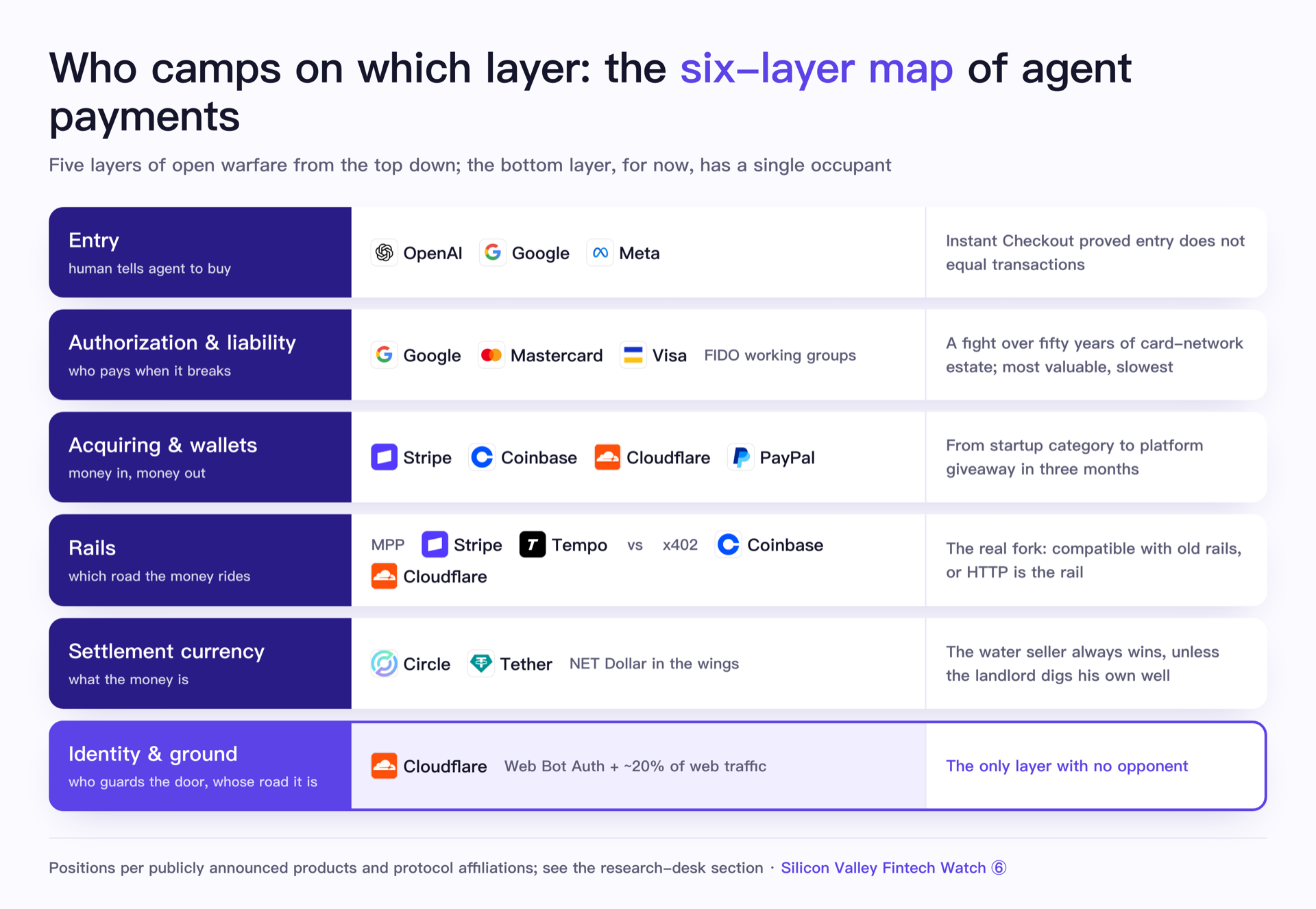
宏观站位:一张表看全场
| 层 | 在这层扎营的玩家 | 一句话 |
|---|---|---|
| 入口(人对 Agent 说想买) | OpenAI、Google、Meta | Instant Checkout 已证明:有入口不等于有交易 |
| 授权与责任(出错找谁) | FIDO 里的 Google、卡组织、CVS 们 | 五十年卡组织家底的争夺战,最值钱也最慢 |
| 收单与钱包(钱怎么进出) | Stripe、Coinbase、Cloudflare、PayPal | 三个月内从创业赛道沦为平台赠品 |
| 轨道(钱走哪条路) | MPP(Stripe/Tempo)对 x402(Coinbase/Cloudflare) | 真正的路线之争:兼容老轨道,还是 HTTP 即轨道 |
| 结算货币 | Circle(USDC)、Tether,候场的 NET Dollar | 卖水人稳赢,除非地主自己开井 |
| 验身与场地(谁在门口,路归谁) | Cloudflare(Web Bot Auth + 两成流量) | 唯一没有对手的一层 |
看出来了吗?从上往下五层,层层有血战;只有最底下那层,暂时只有一个玩家。Stripe 和 Coinbase 是两个半场的全栈派,卡组织是规矩派,Google 是入口派兼裁判,Cloudflare 是场地派。全栈派要赢要打赢每一层;场地派什么层都不用赢,只要机器经济真的发生,它就在现场。
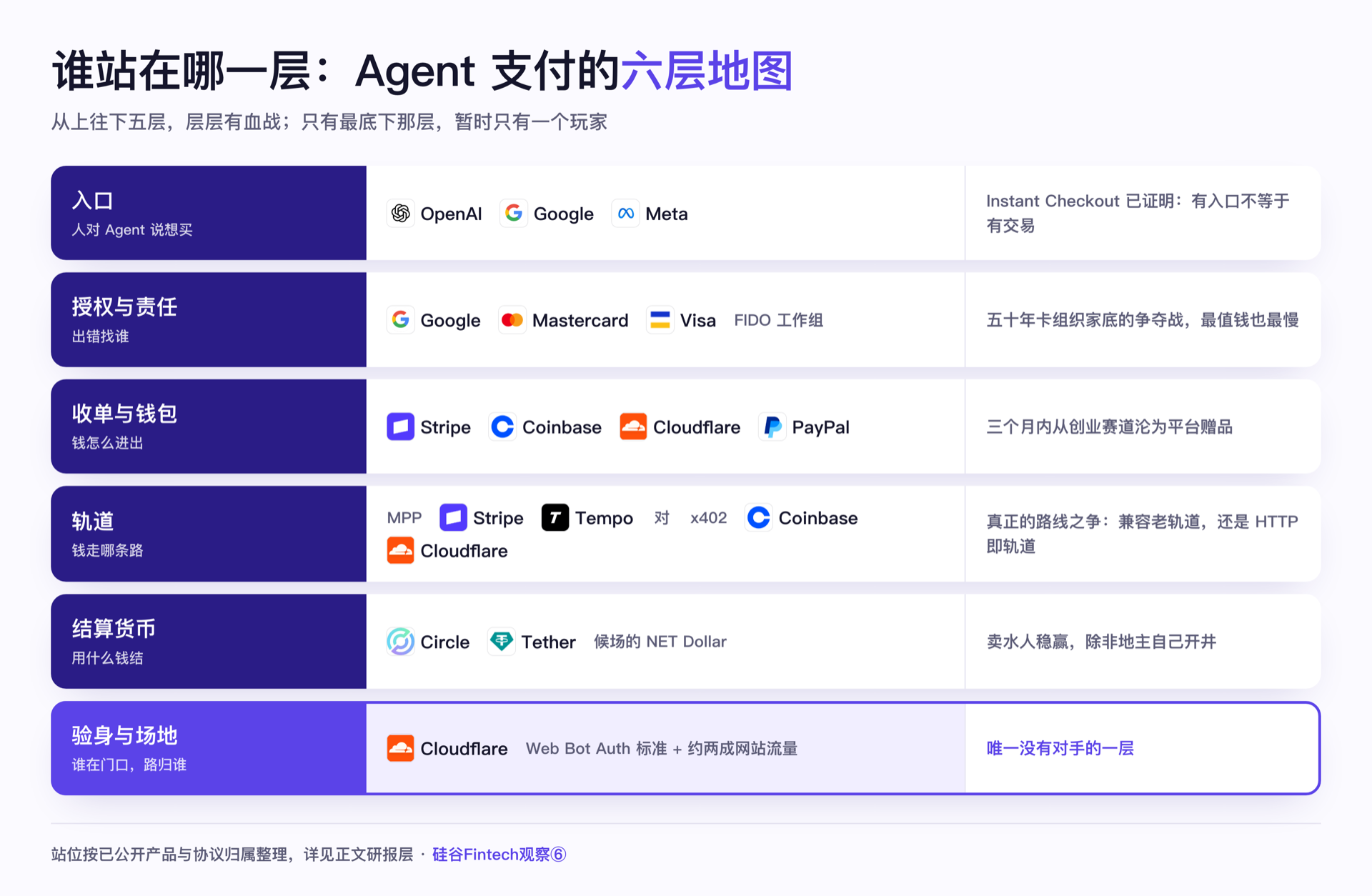
四、Devil's Advocate:给 Cloudflare 泼五盆冷水
按惯例,先把唱反调的理由说满,再回到判断。
第一盆:Agent 付费的需求,到今天并没有被证明。最响亮的证据就是 Instant Checkout 之死:背靠全球最大的 C 端 AI 入口,五个月就凉。x402 那 1.69 亿笔支付听着热闹,年化 6 亿美元的盘子,平均每笔几美元甚至几美分,全是机器之间的小额碎账。说这是下一个 Visa,为时太早。
第二盆:它不是第一个,甚至不是准备最充分的一个。Coinbase 的 Agent 钱包早发了半年,功能真上线了,MPC 托管、免 gas、原生 x402 一应俱全;Stripe 的一次性虚拟卡有整个发卡体系和风控托底。Cloudflare 的钱包今天只是一个能留名字的页面,充值提现都要等几个月。先发的门牌号,对上先发的产品,鹿死谁手未定。
第三盆:管道公司做金融,历史胜率很难看。电信运营商守着几十亿用户的管道做支付做了二十年,除了肯尼亚 M-Pesa 这种特例,基本全军覆没。管道有流量,金融要的是牌照、风控、合规和信任,这些 Cloudflare 一样都没证明过。NET Dollar 宣布快一年连链都没公布,这不是自信的节奏。
第四盆:它的钱包锁在自己的账号体系里。Cloudflare 账号是开发者和站长的世界,普通消费者根本没有。它能覆盖机器对机器的场景,但人类购物那半场,Agent 替你买机票、下单日用品,入口在 Apple、Google、OpenAI 手里,卡在 Visa、Mastercard 手里,跟它没什么关系。
第五盆:监管还没开始认真看这件事。美国的稳定币法案 2025 年生效后,发稳定币是持牌生意;而 Agent 拿稳定币自主消费,出了欺诈算谁的,全世界还没有一个监管机构给过答案。第一单大额 Agent 欺诈案出来的那天,整个行业都要陪着上课。
回到判断,并且主动把结论收窄:
Cloudflare 不需要赢下钱包大战,它甚至不需要 NET Dollar 成功。它真正押的是一件事:机器对机器的付费(API、内容、数据、算力)会成为一个真实存在的市场,而这些流量本来就从它的网络过。钱包输给 Coinbase 也好,货币做不成也罢,只要机器付费这件事成立,验身用它的标准、流量走它的网络、闸机开在它的边缘节点,它都在收费现场。
所以我的结论收窄成一句:在人类购物的那半场,Cloudflare 是个配角;但在机器付费的这半场,它是唯一同时握着场地和闸机的玩家。想象空间不在下一个支付巨头,在机器经济的地租。
五、对湾区创业公司:谁被碾过去,谁捡到枪
最后说说这一夜对创业公司意味着什么。
过去两年,湾区在 Agent 支付和身份这一层攒出了一小批创业公司:做 Agent 支付抽象层的 Skyfire,融了 950 万美元,投资方里有 a16z 的加密孵化器和 Coinbase Ventures;做 Agent 身份验证的 Nekuda,2025 年 5 月刚融了 500 万美元种子轮,Amex 和 Visa 的风投跟投;做支付凭证保管的 Basis Theory,2025 年 10 月融了 3300 万美元 B 轮。有行业统计把这一层的已披露融资加起来,大约 5000 万美元出头。
然后你看这三个月发生了什么:2 月 Coinbase 发 Agent 钱包,5 月 Stripe 发一次性虚拟卡和 Link agent 钱包,8 月 Cloudflare 发免费钱包。5000 万美元攒出来的一层生意,三家平台排着队免费送。
这就是我说灭顶级的原因。平台免费化有一条铁律:凡是能被做成账号的一个属性的东西,最后都会被做成账号的一个属性。钱包是账号的属性,身份是账号的属性,额度控制还是账号的属性。SSL 证书行业已经用命演示过一遍了。
创业公司还有哪几条活路?我看得到四条:
一是往合规和牌照钻。三家平台短期都不会去碰 KYC、货币转移牌照、大额清算这些脏活重活,这层越监管越值钱。
二是做责任和争议处理。x402 的世界没有拒付,链上稳定币付出去就是付出去了。谁能给 Agent 交易做出出错能追、能赔、能仲裁的一层,谁就是 Agent 时代的卡组织雏形。卡组织自己在 FIDO 占了主席位、又花 18 亿买稳定币公司,说明这层的入场费已经涨到了创业公司够不着的高度,但垂直场景里还有缝。
三是做跨协议的调度。四个协议短期内谁也吞不掉谁,商户和 Agent 两头都需要一个自动选最便宜最合适那条轨的路由层。协议越乱,路由越值钱。但这条得加一句提醒:它已经被定价了,而且价格高到创业公司够不着,第七篇会把这笔账算给你看。
四是干脆换个位置:别做基建,用基建。付费基建被平台打成免费,对做 Agent 应用的公司是纯利好,成本项趋零;对内容方和 API 供给方,则是凭空多出一条按次卖给机器的收入线。地主收租的时代,最好的位置未必是当地主的邻居,可能是在地主的地上开店。
收口
把整篇收成三句话。
第一句:协议会有很多个,标准也会有很多个;但结算发生的地点搬不走,谁握着地点,谁收租。
第二句:钱包会被免费化,身份会被免费化,最后剩下真正值钱的两样东西,一样叫流量必经之地,一样叫出错找谁。
第三句:Agent 经济今天的全部交易量,还不够传统卡网络的一个零头。所有判断都建立在机器会真的开始花钱这个前提上。这个前提什么时候被证真或证伪,比上面所有分析都重要。
(附:两句私货)
第一句,关于抢注。我写这篇稿子的当天,顺手在 cloudflare.pay 上把自己名字的四字母 handle 留了下来,全程一分钟,免费。
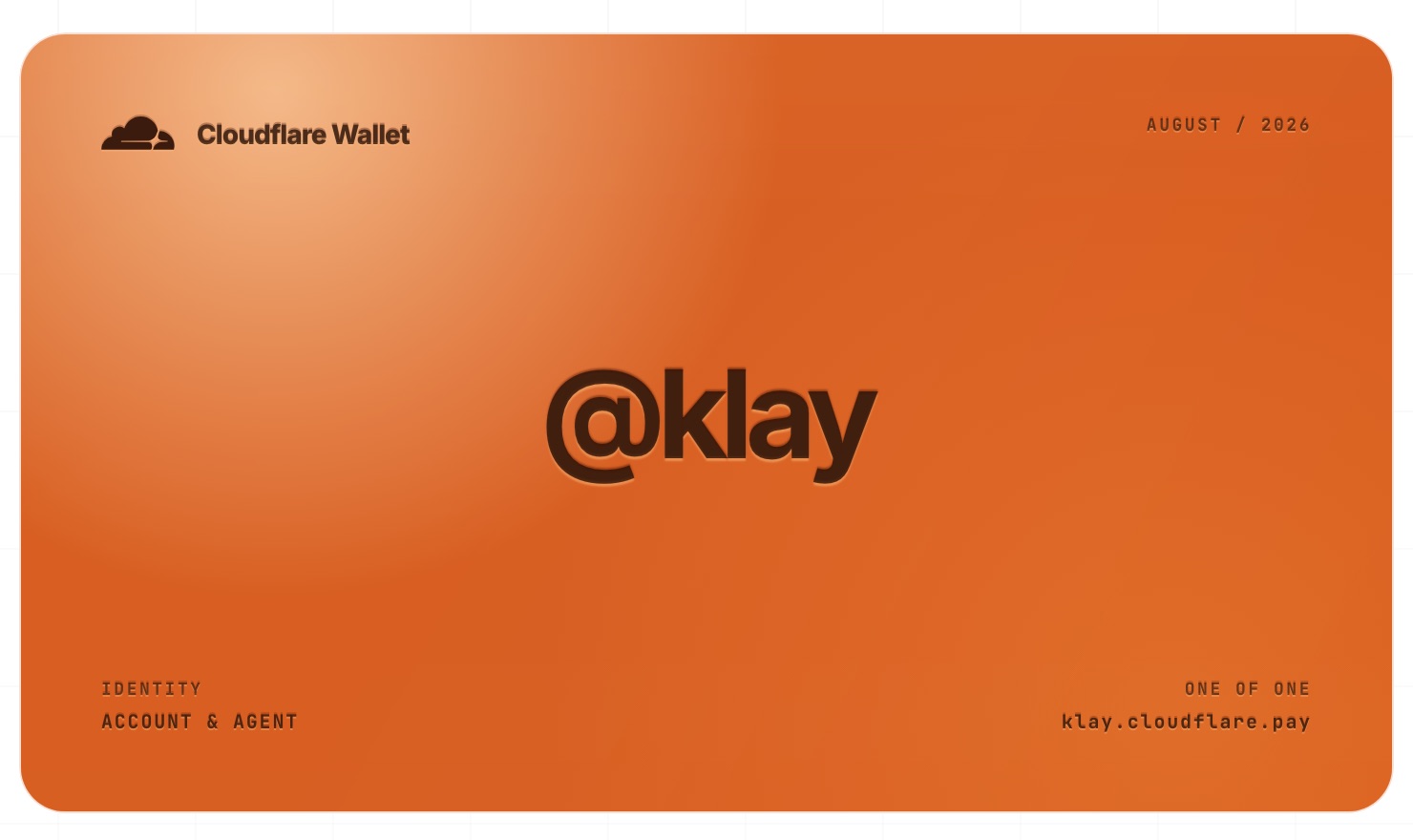
我的习惯是:新平台的名字,只要免费、只要一分钟,就先占住,这是成本最低的期权。占了不用,损失是零;没占而它成了,你的名字就在别人手里。顺带提醒一句:.pay 这个域名后缀本身是另一家公司(Amazon 的注册局)在运营,要到 2027 年初才对公众开放注册,到时候又是一轮抢注,别把这两件事搞混了。
第二句,关于位置。这篇写的虽然是 Agent 和协议,底下的道理跟我之前那个系列说的是同一件事:淘金热里最稳的生意从来不是淘金,是卖铲子,是收过路费。Agent 经济今天还在到底有没有金子的阶段,但修路的、造闸机的、发钱包的、定规矩的已经全部就位,连吵架都吵完两轮了。普通人不一定要去创业,但至少要看清一件事:下一波钱从哪里过。钱从哪里过,机会就沉在哪条路边上。
(本文事实口径:Cloudflare Wallets 与 cloudflare.pay 发布、Account/Virtual Wallet 机制、支出上限与商户白名单等,来自 Cloudflare 官方博客 2026-08-04 公告及 Fortune 等当日报道;Web Bot Auth 与 Visa/Mastercard 合作来自 Cloudflare 官方博客 Securing agentic commerce 一文;Pay Per Crawl(2025-07)、Monetization Gateway(2026-07-01)、爬虫流量占比(52% 对 22%)来自 Cloudflare 官方博客与公开报道;NET Dollar 为 2025 年 9 月宣布、截至发稿未上线、部署链未公布。Visa Intelligent Commerce(2025-04)、Trusted Agent Protocol(2025-10、与 Cloudflare 和 Akamai 合作、拟统一 SDK 并兼容 AP2)来自 Visa 官方公告;Mastercard Agent Pay(2025-04)与收购 BVNK(2026-03、最高 18 亿美元)来自公开报道。Stripe Sessions 2026 各项(Agentic Commerce Suite、Issuing for agents、Link agent 钱包、与 Meta 和 Google 合作)来自 Stripe 官方博客;Tempo 融资(5 亿美元、50 亿估值)来自 The Block 等媒体报道。AP2 发布(2025-09、60 家机构)与捐赠 FIDO(2026-04-28)来自 Google 与 FIDO 官方公告;UCP(2026-01)与 AI Mode/Gemini 结账灰度来自 Google 官方博客与商户帮助文档。x402 数据(第一年 1.69 亿笔、59 万买家、10 万卖家、约 85% 在 Base)为 Coinbase 2026 年中口径,年化约 6 亿美元为 2026 年 3 月行业口径;Coinbase Agentic Wallets(2026-02-11)、Business 收 USDC(2026-07-23)来自 Coinbase 公告与公开报道;USDC 约 773 亿美元流通量为 DeFiLlama 2026-04-29 口径。Instant Checkout 关停时间与成交寥寥的说法来自多家行业分析,非 OpenAI 官方口径;Skyfire、Nekuda、Basis Theory 融资额来自 Tracxn 与公开报道;市场规模预测类数字因口径分歧大,本文正文未采用;文中协议覆盖图的个别创建者/合作方标注与各家官方口径存在出入(如 PayPal 在 AP2 中官方口径为合作方),本文以各协议官方公告为准。配图为 cloudflare.pay 页面自身渲染的钱包卡片。
Stripe 收购 OpenRouter,华尔街日报 2026-07-23 前后报道洽谈作价约 100 亿美元,Bloomberg 2026-08-16 报道达成协议作价 70 亿美元以上,Stripe 官方新闻室 2026-08-19 公告 agrees to acquire 未披露作价,详细拆解见第七篇。)
Silicon Valley Fintech Watch series · Part Six
In brief. Roughly one in five websites on earth sits behind the same company. On August 4, 2026, that company handed every AI agent a wallet, for free. Meanwhile four payment protocols and nine giants are fighting over the standard for how agents pay: Stripe is betting on everything, Google donated its own protocol, OpenAI's shopping button died five months after launch, and even the agent programs at Visa and Mastercard stand on identity bricks laid by that same company. My read: this war looks like a fight over protocols. It is actually a fight over where settlement happens. Read on.
Updated August 8, 2026. Stripe is in talks to acquire OpenRouter for about $10 billion, reaching over to the side where agents spend. The same logic, replayed on another flow. I unpack that deal in Part Seven.
Updated September 14, 2026. Stripe confirmed the acquisition in an official announcement on August 19; Bloomberg puts the price at more than $7 billion, and Stripe has not disclosed one. Part Seven has been recomputed on $7 billion.
Before we start
On August 4, 2026, Cloudflare launched something new: cloudflare.pay.
You read that right. Not .com. Dot pay. The page is minimal: an orange card, one input box, one line: Reserve your Cloudflare Wallet. You type a name, and it holds @yourname, plus an address at yourname.cloudflare.pay, for you. Free, first come first served. I typed a four-letter name and had it in under a minute.
This wallet is not for people. It is for agents. Cloudflare's pitch: when your AI agent goes out to work, it pays for APIs, content, and data out of this wallet. You set the allowance and the whitelist, it spends inside the cage, you don't have to watch it, and it can't max out your card.
A company that grew up selling CDN and firewalls is suddenly issuing wallets. To understand this, zoom out. Over the past year and a half, Silicon Valley has produced four protocols and nine contenders around one question: how do agents pay? A coverage chart has been making the rounds that lays the table out neatly. Four protocols across the top (ACP, MPP, AP2, x402), nine players down the side (Stripe, Visa, Mastercard, Coinbase, Google, OpenAI, PayPal, Cloudflare, Circle), with each cell marked creator or partner.
Two things jump out of that chart. Stripe's coverage bar is the longest: it touches all four protocols. Cloudflare's is nearly the shortest: one cell, as creator of x402.
Weakest hand at the table? My read is the opposite. This piece walks through three things: what this wallet actually is; what the four protocols and five major players are each fighting for; and why the most lopsided player on the chart may be holding the most valuable thing in the game.
1. Take the wallet apart first
Plain language. Cloudflare Wallets has two layers.
The first is the Account Wallet. This is the wallet you hold as a human. You can fund it and withdraw from it, in dollar-pegged stablecoins. It hangs off your Cloudflare account, and the @name is its street address.
The second is the Virtual Wallet: an allowance account you carve out of your Account Wallet and hand to a specific agent, operated through an API key. You can put three locks on it: a total balance cap, a per-transaction cap, and a merchant whitelist. The agent can only spend inside those three locks.
An analogy: this is not binding your bank card to an agent. This is giving your intern a corporate card with a limit, valid only at a set list of stores. However much the intern screws up, the damage is capped at the allowance.
There is a quieter layer under the wallet: identity. Every wallet sits on a verified Cloudflare account. When an agent pays, it can optionally disclose who it represents, and the receiving side can verify who authorized the request. It can also stay anonymous. In one move this half-answers the two most painful questions in the agent economy: whose bot is this, and who stands behind its spending?
The underlying protocol is x402. The name comes from HTTP status code 402, officially Payment Required. That code was written into the HTTP standard back in 1997 to hold the slot for paywalls, and then sat unused for more than two decades. What x402 does is wake the dormant code up: a server answers a request with a 402, meaning pay first; the agent pays on the spot in stablecoins and retries. The whole exchange happens inside HTTP. No account opening, no card on file, no human in the loop.
Cold water first, though: as of this writing, the wallet only lets you reserve a name. Funding, withdrawals, issuing virtual wallets to agents: all of that is, officially, coming in the next few months. What you grabbed today is a street address.
But the ambition behind the street address only makes sense at the card table.
2. What the four protocols are fighting over: a map
The names are a mouthful, so here is an anchor you can keep: the three players who actually decide this game are Stripe, Coinbase, and Cloudflare. Everyone else is picking sides among their routes. Protocol by protocol:
ACP: buy inside the chat box. Agentic Commerce Protocol, maintained by OpenAI and Stripe. It covers the flow where a person says "I want this" in ChatGPT and the agent places the order: merchants hand their catalog to OpenAI, payments run through Stripe, the user taps confirm in chat. The protocol carries a famous footnote. It debuted alongside ChatGPT's Instant Checkout, and in March 2026 OpenAI quietly shut Instant Checkout down. Multiple industry analyses say the flagship consumer surface ran about five months with next to no sales. The protocol survives, but it proved something: putting a buy button inside a chat box does not mean people buy inside a chat box.
AP2: who authorized this, and then Google gave it away. Agent Payments Protocol, launched by Google in September 2025 with sixty organizations behind it, Visa and Mastercard included. It governs not how money moves but how blame is assigned: the user signs a cryptographic credential for the agent (the protocol calls it a Mandate, think of it as a power of attorney), the agent carries it on every purchase, and when a dispute comes up you can verify whether the user really authorized this or the agent went rogue. On April 28, 2026, Google donated AP2 wholesale to the FIDO Alliance (the body behind fingerprint and passkey standards), with sixty organizations co-signing. FIDO stood up two working groups: the authentication group chaired by CVS Health, Google, and OpenAI, and the payments group chaired by Mastercard and Visa. Translation: Google stepped down from dealer to referee, because at the authorization-and-liability layer, whoever monopolizes it can't get it adopted. And the card networks grabbed the payments chairs because "who pays when it goes wrong" has been their family estate for fifty years.
MPP: Stripe's checkout counter for machines. Machine Payments Protocol, released March 18, 2026, co-authored by Stripe and Tempo. It covers the merchant side: drop in a snippet of code and your site can take agent money over three rails, stablecoins on the Tempo chain, the Lightning Network, and credit or debit cards via Stripe. Visa built the first card SDK for it; Anthropic, OpenAI, Mastercard, and Shopify have all announced integrations.
x402: make payment part of HTTP itself. Proposed by Coinbase in May 2025, with Cloudflare as the earliest co-builder; the two together launched the x402 Foundation. The scoreboard deserves a close look. By Coinbase's mid-2026 count, the protocol handled more than 169 million payments in its first year, across 590,000 buyers and 100,000 sellers. Note the structure: most of those 590,000 buyers are not people. They are machines. Another industry figure from March 2026: roughly $600 million in annualized volume, with zero protocol-level fees. What is $600 million? Visa clears somewhere north of ten trillion dollars a year. x402 today is a rounding error on a rounding error. But what happened on July 14, 2026 shows nobody dares ignore it: the Linux Foundation took over the x402 Foundation, and the first forty members included Google, Stripe, Visa, Mastercard, Cloudflare, and Coinbase. Full attendance.
Put the four together and the map is clear. AP2 covers who authorized it. ACP, and Google's separate UCP, cover how the order gets placed. MPP and x402 cover which rail the money rides. Entry, liability, rails: three layers. And the two rail-layer protocols carry two different worldviews. MPP says machine payments should stay compatible with humanity's old rails: cards, banks, chains, plug them all in. x402 says machine payments don't need humanity's rails at all: HTTP is the rail.
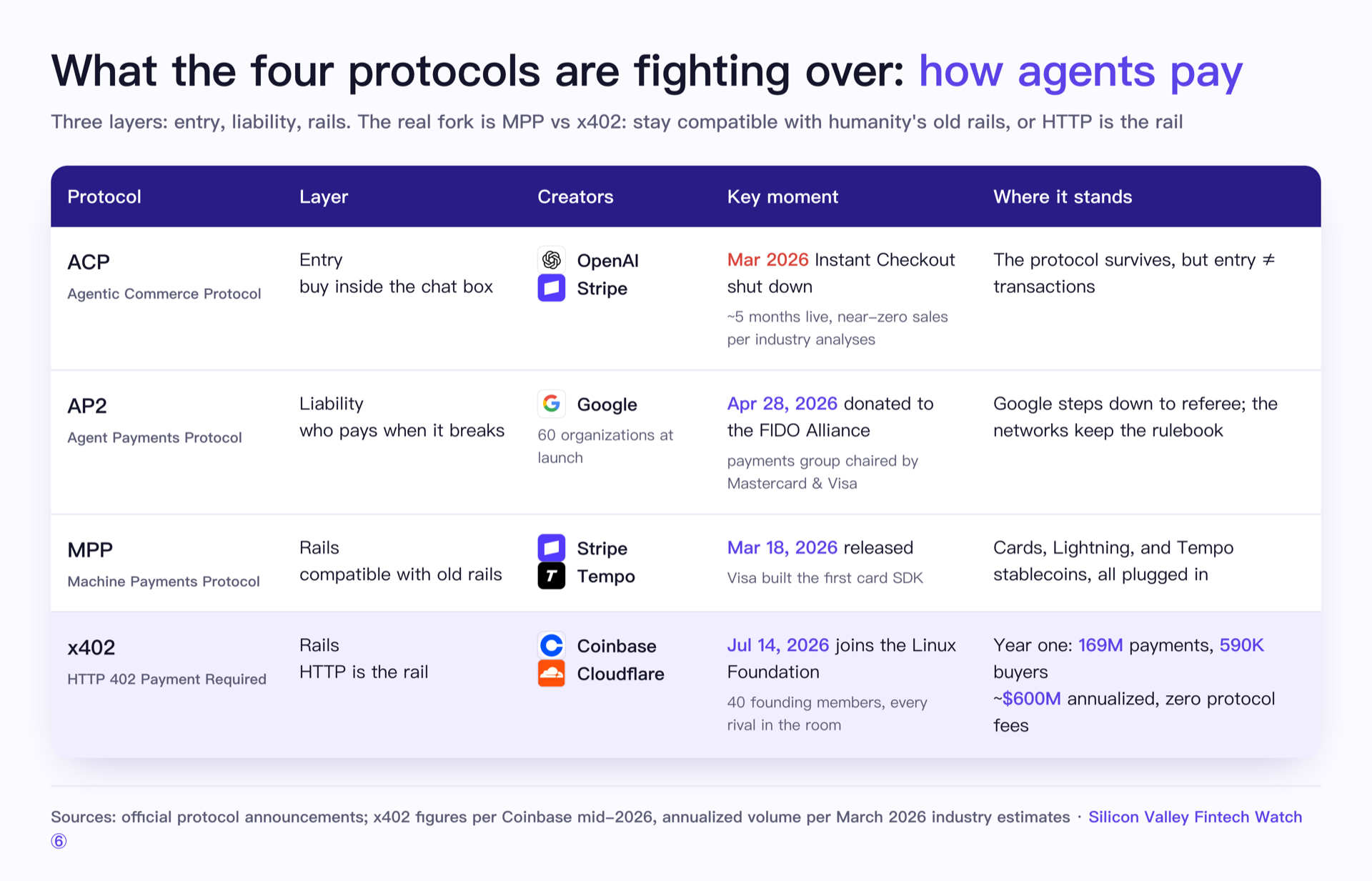
That is the real fork in the road. Everything else is seat-picking. And there is a fourth layer hiding off the chart, which we will hold for now: before any transaction, someone at the door has to ask, who is this bot? That layer isn't drawn on the coverage chart, and it is the key to Cloudflare.
3. The research desk: five majors, hand by hand
Protocols aren't enough. This section walks the five real heavyweights one by one: their cards, their play, their weak spot, and which layer they camp on.
Stripe: the full-stack combo, betting that whoever wins, the register is theirs
Stripe has the widest spread on the table, and it isn't just signing partnerships. It is pouring concrete.
Look at what it unloaded at Sessions 2026 in one go. The Agentic Commerce Suite: merchants upload a catalog to the Stripe dashboard and sell directly inside AI surfaces, plus announced partnerships with Meta and Google, so orders placed in Gemini and Google's AI Mode can settle through Stripe. Issuing for agents: programmatically issue single-use virtual cards with real-time authorization and spend controls; the agent swipes once and the card burns. And Link's agent wallet, which lets its consumer fast-checkout accounts, more than a hundred million of them, be delegated to agents. Entry, issuing, wallet, acquiring: the whole combo meal.
Add the two aces already on the table: ACP (with OpenAI) and MPP (with Tempo). Tempo deserves its own sentence. It is a payments-only Layer 1 incubated by Stripe and Paradigm: no native token, fees paid directly in stablecoins, roughly 0.6-second finality. In early 2026, per The Block and others, it raised $500 million at a $5 billion valuation, led by Thrive and Greenoaks; mainnet went live in March, and the first outside validators arrived in April: Stripe, Visa, and Standard Chartered's Zodia.
Stripe's worldview is plain: don't bet on a rail, bet that merchants will always need a register. If cards win, it has acquiring. If chains win, it has Tempo. If chat boxes win, it has ACP. It even holds a seat in rival Coinbase's x402 foundation. Its bar on the coverage chart is longest not because it knows which road wins, but precisely because it doesn't, so it bought a ticket for every road.
That is also the weak spot: at every layer of the combo, there is a more focused opponent. It has more enemies than anyone else at the table.
And its heaviest bet is not in payments at all. Around July 23, 2026, the Wall Street Journal reported that Stripe was in talks to acquire OpenRouter, a routing layer that fans requests across some seventy providers and four hundred-plus models, for roughly $10 billion; on August 19 Stripe's official announcement confirmed the agreement, at more than $7 billion by Bloomberg's account. It is the largest acquisition Stripe has ever made, and the only move at this table that reaches over to the side where agents spend. That deal gets its own piece: Part Seven.
The card networks: the rulekeepers' counterattack
Visa and Mastercard are near mirror images, so take them together.
Visa launched Intelligent Commerce in April 2025 (tokenized card credentials handed to agents), then the Trusted Agent Protocol in October, a verification framework that helps merchants tell malicious bots from legitimate agents. It plans to merge the two into one SDK, AP2-compatible by default, and has said publicly it is aligning x402 interoperability with Coinbase. Mastercard launched Agent Pay in late April 2025, built on Agentic Tokens, dedicated payment credentials for agents. Then in March 2026 it swung big: agreeing to acquire stablecoin infrastructure firm BVNK for up to $1.8 billion.
The key to reading all this is knowing what the card networks' real asset is. It is not the clearing network; new rails can route around clearing. It is the rulebook that has run for fifty years: chargebacks, dispute arbitration, fraud liability. Every move above is about carrying that rulebook into the new world: push card tokens into every protocol, chair the FIDO payments group, buy a stablecoin firm to cover the new rail. This is not offense. It is a counterattack in defense: you can lose battles, but you cannot lose the rulebook.
The weak spot is just as obvious: the biggest increment in the agent economy is machine-to-machine micropayments, API calls at a few cents each, and card economics simply don't clear at that size. Which is why both firms talk cards and buy chains.
And one detail I most want you to keep from this entire piece: Visa's Trusted Agent Protocol and Mastercard's Agent Pay, at the layer that verifies which agent is knocking, both use the same thing: Web Bot Auth. Who drove that standard? It was drafted by Cloudflare engineers and taken to the IETF, and Cloudflare's own blog spells it out: we are working with Visa and Mastercard to help agents transact safely.
The identity brick at the front door of both card networks' agent programs was laid by Cloudflare.
Google: eat the entrance, give away the rules
Google plays both ends.
At the entrance, it bets heavy and keeps the meal: in January 2026, at the retail industry's big annual show, it launched UCP (Universal Commerce Protocol) with Shopify, covering product discovery, carts, and checkout, compatible with A2A, AP2, and MCP. The same month it began rolling out direct checkout inside AI Mode and Gemini with selected US merchants. You buy without leaving Google's surface, but the merchant remains the merchant of record. Google absorbs the journey, not the ledger.
At the rules end, it gives the family silver away: AP2 donated to FIDO, Google reduced to one seat among many.
That push-and-pull exposes Google's real position. Its fear is not missing payments. It is agents gutting the ad tax base. Search advertising is built on humans browsing: the longer you wander and the more you click, the more the ads are worth. An agent browses for you and goes straight to the answer, and the ad slots hang in the air. So the entrance must be defended in person, checkout kept inside its own walls, while the liability layer, which no single owner could ever get adopted anyway, is donated in exchange for a referee's chair.
Coinbase: the Stripe of the on-chain half, and its wallet shipped first
Coinbase is the full-stack player of the on-chain half, and it moves faster than most people register.
Protocol layer: x402 is its proposal. Wallet layer, note the date: on February 11, 2026, Coinbase shipped Agentic Wallets, MPC wallets for agents (key shards held in custody), with session caps, per-transaction limits, gasless settlement on Base, and native x402 support. Nearly half a year ahead of Cloudflare's wallet. Acquiring layer: its developer platform has an SDK that adds agent payments to any API or MCP service in three lines of code, and since July 23, 2026, Coinbase Business accounts accept USDC paid directly by agents. Clearing layer: roughly 85% of x402 transactions run on its own Base chain.
Protocol, wallet, acquiring, clearing: four layers deep. That is why I call it the Stripe of the on-chain half. The difference between the two Stripes is worldview: Stripe expands from the card half toward chains, Coinbase expands from the chain half toward merchants, and they will meet in the middle with swords out.
As for Coinbase and Cloudflare: honeymoon allies for now; x402 is their shared child. But the overlap at the wallet and settlement layers is already sitting on the table. The difference, for the moment, is audience. Coinbase's wallet is for on-chain developers; the keys are private keys and gas. Cloudflare's wallet is for ordinary developers and site owners; the key is an account name. Whoever captures the people who don't understand chains wins the second half.
While we're here, the water seller: Circle. USDC is the default settlement currency of nearly every protocol. Per DeFiLlama as of late April 2026, USDC's circulation is about $77.3 billion, and together with USDT they make up over eighty percent of a roughly $318 billion stablecoin float. The harder the protocols fight, the more water gets sold. Circle is the steadiest winner in this war. With one caveat: the day Cloudflare's own NET Dollar goes live is the day this partner becomes an opponent.
Cloudflare: fighting for no layer, laid underneath every layer
Now pull the camera back to Cloudflare and connect the moves of the past year and a half.
May 2025: it drives Web Bot Auth, the agent identity standard that Visa and Mastercard would later stand on. July 2025: Pay Per Crawl, blocking AI crawlers by default and letting site owners allow, refuse, or charge. The first tollgate on the supply side. Its own data shows why it had no choice: by June 2026, 52% of crawler requests on its network were for AI training, up from 22% a year earlier, and more than half of AI crawler traffic was re-fetching pages that hadn't changed. September 2025: it announces its own dollar stablecoin, NET Dollar, fully dollar-collateralized (note: to this day it hasn't even named the chain). July 1, 2026: the Monetization Gateway. The tollgate upgraded: any resource behind Cloudflare, APIs, datasets, MCP tool calls, can now charge per use, settled on the spot in stablecoins over x402. August 4, 2026: Wallets. The paying side gets its purse.
The identity standard, the supply-side tollgate, the demand-side wallet, the settlement currency, the accounting rules (x402). Five pieces. And under them, the hole card: roughly a fifth of the world's website traffic passes through its network.
Why is the ground worth so much? Because in the machine economy, for the first time, payment and delivery live inside the same act. When a human shops online, payment happens at Stripe and delivery happens on a truck. The two are separate, so the payment layer is a vendor you can swap at will. When a machine buys an API or a piece of content, the goods are the HTTP response itself. Payment and delivery happen at the same door, in the same round trip. Protocols can be swapped freely; swapping a protocol is swapping a snippet of code. But where your API is deployed, and whose network shields it, that door does not move. What can be easily replaced collects no rent. What cannot move, does.
That is why the coverage chart lies. Count cells and Stripe has four to Cloudflare's one. Count assets and Stripe's four cells are four lottery tickets, while Cloudflare's one cell has a fifth of the internet underneath it. While everyone argues over whose POS terminal the toll plaza should use, Cloudflare built the toll plaza on its own highway, and wrote the national standard for the ID check at the gate while it was at it.
Even the business model is off the shelf. Cloudflare's most famous move in history is turning other people's paid products into its own free features: in 2014 it launched Universal SSL and gave HTTPS certificates away, flattening the certificate business overnight. Giving wallets away for free is pure muscle memory. The wallet is not there to make money. It is there to turn a fifth of web traffic into a fifth of payment traffic.
The macro seating chart
| Layer | Who camps here | One line |
|---|---|---|
| Entry (human tells agent to buy) | OpenAI, Google, Meta | Instant Checkout proved entry ≠ transactions |
| Authorization and liability (who pays when it breaks) | Google-in-FIDO, the card networks, the CVSes | A fight over fifty years of card-network estate; most valuable, slowest |
| Acquiring and wallets (money in, money out) | Stripe, Coinbase, Cloudflare, PayPal | Went from startup category to platform giveaway in three months |
| Rails (which road the money rides) | MPP (Stripe/Tempo) vs x402 (Coinbase/Cloudflare) | The real fork: compatible with old rails, or HTTP is the rail |
| Settlement currency | Circle (USDC), Tether, NET Dollar waiting in the wings | The water seller always wins, unless the landlord digs his own well |
| Identity and ground (who guards the door, whose road is it) | Cloudflare (Web Bot Auth + a fifth of traffic) | The only layer with no opponent |
See it? Five layers from the top down, and every one is a bloodbath, except the bottom one, which for now has a single occupant. Stripe and Coinbase are the full-stack schools of their respective halves. The card networks are the rulekeepers. Google is the entrance-keeper doubling as referee. Cloudflare is the landlord. The full-stack schools have to win every layer. The landlord doesn't need to win any. If the machine economy happens at all, it is standing at the till.
4. Devil's Advocate: five buckets of cold water for Cloudflare
As always, make the opposing case at full strength first, then come back to the judgment.
Bucket one: demand for agent payments has not been proven. The loudest evidence is the death of Instant Checkout: backed by the biggest consumer AI entrance on earth, gone in five months. x402's 169 million payments sound loud, but a $600 million annualized pot at a few dollars or cents a ticket is machine pocket change. Calling this the next Visa is premature.
Bucket two: Cloudflare is not first, and maybe not best prepared. Coinbase's agent wallet shipped half a year earlier and actually works: MPC custody, gasless, native x402. Stripe's single-use virtual cards sit on a full issuing stack and risk engine. Cloudflare's wallet today is a page that holds your name; funding and withdrawal are months out. A first-mover street address versus first-mover products: unsettled.
Bucket three: pipe companies have a terrible record in finance. Telecom carriers sat on billions of users and spent twenty years trying payments. Outside of special cases like Kenya's M-Pesa, they mostly failed. Pipes have traffic; finance takes licenses, risk management, compliance, and trust, and Cloudflare has proven none of them. NET Dollar was announced almost a year ago and still hasn't named a chain. That is not the tempo of confidence.
Bucket four: the wallet is locked inside its own account system. Cloudflare accounts belong to developers and site owners. Ordinary consumers don't have one. It can cover machine-to-machine, but the human shopping half, agents booking your flights and ordering your groceries, runs through Apple, Google, and OpenAI at the entrance and Visa and Mastercard on the rails. None of that is Cloudflare's.
Bucket five: the regulators haven't really looked yet. Since the US stablecoin law took effect in 2025, issuing a stablecoin is a licensed business. And nobody's regulator anywhere has answered who eats the fraud when an agent spends stablecoins autonomously. The day the first big agent-fraud case lands, the whole industry goes back to school.
Now back to the judgment, narrowed on purpose:
Cloudflare doesn't need to win the wallet war. It doesn't even need NET Dollar to work. Its real bet is one sentence: machine-to-machine payment, for APIs, content, data, compute, becomes a real market, and that traffic already flows through its network. Lose the wallet to Coinbase, fail the currency, fine. As long as machines start paying, identity runs on its standard, traffic runs on its network, and the tollgate sits on its edge nodes. It is at the till either way.
So the narrowed conclusion: in the human shopping half, Cloudflare is a supporting actor. In the machine payment half, it is the only player holding both the ground and the gate. The upside is not "the next payments giant." The upside is ground rent on the machine economy.
5. Bay Area startups: who gets steamrolled, who picks up a weapon
Finally, what this night means for startups.
Over the past two years the Bay Area assembled a small cohort at the agent payments-and-identity layer: Skyfire, building agent payment abstraction, raised $9.5 million from backers including a16z's crypto accelerator and Coinbase Ventures; Nekuda, agent identity verification, raised a $5 million seed in May 2025 with Amex Ventures and Visa Ventures participating; Basis Theory, payment credential vaulting, raised a $33 million Series B in October 2025. One industry tally puts the layer's total disclosed funding at just over $50 million.
Now watch the last three months: February, Coinbase ships an agent wallet. May, Stripe ships single-use virtual cards and the Link agent wallet. August, Cloudflare ships a free wallet. A layer of business built on $50 million of venture money, and three platforms lined up to give it away.
That is why I called it extinction-grade. Platform free-ization has one iron law: anything that can be turned into an attribute of an account will end up as an attribute of an account. A wallet is an account attribute. Identity is an account attribute. Spending limits are an account attribute. The SSL certificate industry already demonstrated this with its life.
What paths remain? I can see four.
One: burrow into compliance and licensing. None of the three platforms will touch KYC, money transmitter licenses, or large-value clearing any time soon, and that layer gets more valuable the more regulated it becomes.
Two: build liability and dispute resolution. The x402 world has no chargebacks; a stablecoin paid on-chain is paid. Whoever builds the layer where agent transactions can be traced, refunded, and arbitrated becomes the embryo of the card network of the agent era. The incumbents chairing FIDO and writing $1.8 billion checks for stablecoin firms tells you the entry fee at the center is out of startup range, but the vertical niches still have cracks.
Three: cross-protocol routing. None of the four protocols will swallow the others soon, and both merchants and agents will need a layer that automatically picks the cheapest, best-fit rail. The messier the protocols, the more the router is worth. One caveat, though: this path has already been priced, and the price is far beyond any startup's reach. Part Seven runs that arithmetic.
Four: change seats entirely. Don't build infrastructure; use it. Payment infrastructure being bulldozed to free is pure upside for companies building agents, a cost line going to zero. For content and API owners it conjures a new revenue line: selling to machines by the call. In the age of the rent-collecting landlord, the best position may not be next to the landlord. It may be running a shop on the landlord's land.
Closing
Three sentences for the whole piece.
One: there will be many protocols and many standards, but the place where settlement happens does not move, and whoever holds the place collects the rent.
Two: wallets will be free, identity will be free, and the two things left worth owning are the chokepoint traffic must pass and the answer to "who pays when it breaks."
Three: the entire agent economy today wouldn't round the corner of a card network's ledger. Every judgment above rests on one premise: that machines will truly start spending. When that premise gets proven true or false matters more than everything else in this piece.
(Appendix: two personal notes)
First, on name-grabbing. The day I wrote this piece, I reserved my own four-letter handle on cloudflare.pay. One minute, free.
My habit: on any new platform, if the name is free and takes a minute, claim it first. It is the cheapest option money can't buy. If you never use it, you lose nothing; if the platform takes off and you didn't, your name belongs to someone else. One reminder while we're here: the .pay domain suffix itself is run by a different company (Amazon's registry) and doesn't open to public registration until early 2027. That will be another land rush. Don't confuse the two.
Second, on position. This piece is about agents and protocols, but the logic underneath is the same thing my earlier series kept saying: in a gold rush, the steadiest business was never panning for gold. It is selling shovels and collecting tolls. The agent economy is still at the "is there even gold" stage, but the road builders, gate builders, wallet issuers, and rulemakers are all in position, and they've already had two rounds of public arguments. You don't have to start a company. But you should see one thing clearly: where the next wave of money will flow. Wherever the money flows, the opportunities settle along that road.
(Fact notes: Cloudflare Wallets and cloudflare.pay launch details, the Account/Virtual Wallet mechanics, spending caps and merchant whitelists are from Cloudflare's official blog announcement of August 4, 2026 and same-day coverage including Fortune. The Web Bot Auth collaboration with Visa/Mastercard is from Cloudflare's "Securing agentic commerce" blog post. Pay Per Crawl (July 2025), the Monetization Gateway (July 1, 2026), and crawler statistics (52% vs 22%) are from Cloudflare's blog and public reporting. NET Dollar was announced in September 2025 and remains unlaunched with no chain disclosed as of this writing. Visa Intelligent Commerce (April 2025) and the Trusted Agent Protocol (October 2025, built with Cloudflare and Akamai, to be unified in one SDK with default AP2 compatibility) are from Visa's official announcements; Mastercard Agent Pay (April 2025) and the BVNK acquisition (March 2026, up to $1.8 billion) are from public reporting. Stripe Sessions 2026 items (Agentic Commerce Suite, Issuing for agents, Link agent wallet, Meta and Google partnerships) are from Stripe's official blog; Tempo's raise ($500 million at a $5 billion valuation) is per The Block and others. AP2's launch (September 2025, 60 organizations) and FIDO donation (April 28, 2026) are from Google and FIDO announcements; UCP (January 2026) and the AI Mode/Gemini checkout rollout are from Google's blog and merchant documentation. x402 figures (169 million payments, 590,000 buyers, 100,000 sellers in year one, ~85% on Base) are Coinbase's mid-2026 count; the ~$600 million annualized volume is a March 2026 industry figure. Coinbase Agentic Wallets (February 11, 2026) and Coinbase Business USDC acceptance (July 23, 2026) are from Coinbase announcements. USDC circulation of ~$77.3 billion is per DeFiLlama as of April 29, 2026. The Instant Checkout shutdown timing and "near-zero sales" characterization come from multiple industry analyses, not OpenAI. Skyfire, Nekuda, and Basis Theory funding figures are from Tracxn and public reporting. Market-size forecasts were deliberately excluded due to divergent methodologies. Where the circulating coverage chart's creator/partner labels differ from official accounts (e.g., PayPal is officially an AP2 partner), this piece follows the official protocol announcements. The image is the wallet card as rendered by the cloudflare.pay page itself.)
Comments留言