硅谷Fintech观察⑤|美国银行 vs Visa:网络这东西,攥在手里就活不了Silicon Valley Fintech Watch ⑤ | Bank of America vs Visa: A Network Dies in a Closed Fist
A web original — first published here on August 1, 2026.本文 2026.08.01 首发于本站。
目录Contents
- 1. 1904—1906: the only startup capital was trust
- 2. 1930—1958: build the network first, then drop the cards
- 3. 1970—1976: handing your own son to your enemies
- 4. 1998: the name stayed in San Francisco, the company moved to Charlotte
- 5. 2011: the deal that came out of a bathtub
- 6. Two report cards, 2026
- 7. Devil's advocate: was letting Visa go actually a catastrophe?
- 8. The same play, running for the third time in 2026
- 9. Closing: three sentences, and something personal
「硅谷Fintech观察」系列 · 第五篇(「巨头起家史」开篇)
导读|你钱包里那张 Visa,是一家银行发明的。1958 年它在加州一座小城一口气撒出去六万张卡,收卡的人没一个申请过,第一年坏账率 22%、亏掉近两千万美元;十二年后,它把这门已经赚钱的生意整个交了出去,交给了一群银行,里面全是自己的竞争对手。这家银行叫 Bank of America。它为什么要这么干?这个问题的答案,正在 2026 年的华尔街被重新翻出来演一遍。
先摆两个数字。
2026 年 7 月 28 日,美国银行(Bank of America)市值约 4465 亿美元。2026 年 7 月,Visa 市值约 7057 亿美元。
儿子比爹大了将近六成。
对,Visa 是美国银行生的。这家全球最大的支付网络,出生时的名字叫 BankAmericard,1958 年由美国银行发明、1970 年由美国银行主动交出控制权、1976 年才改叫 Visa。今天美国银行每发出一张卡、每收一笔刷卡的钱,还要给 Visa 交网络费。
我是最近才把这条线捋清楚的。说实话有点惭愧。做 fintech 观察这么久,居然没认真看过这条产业里最重要的一条家谱。而当我把 1904 年到 2026 年这一百二十年铺开看,发现它根本不是一段公司史,是一条规律被反复验证了三次:
网络这东西,攥在手里就活不了。
这篇我们把这一百二十年老老实实走一遍,从 1904 年走到 2027 年。是的,还有一段在未来。前四篇聊的都是今天正在发生的事,这一篇往回走,看看今天这套东西到底是怎么长出来的。
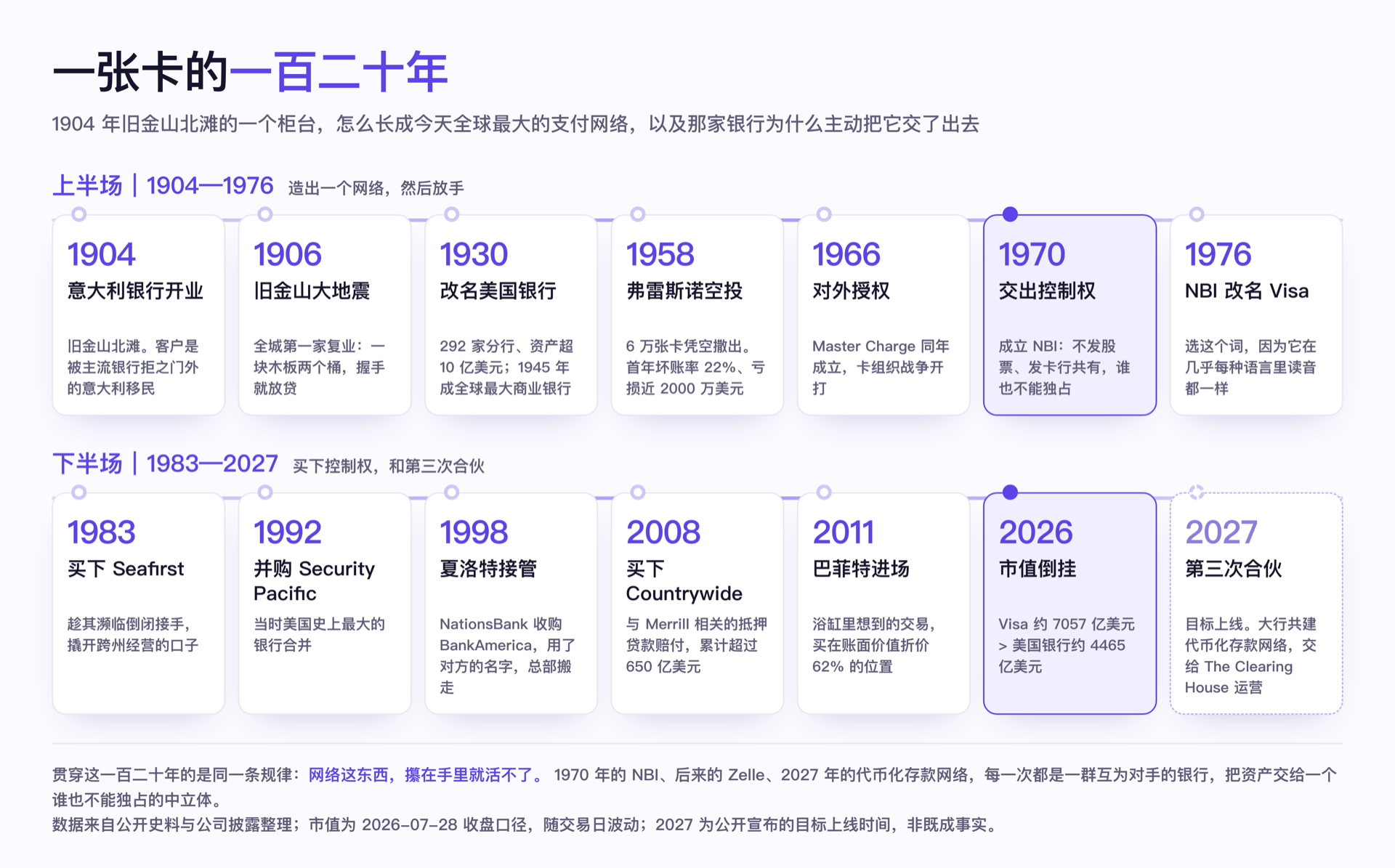
一、1904—1906:唯一的启动资本是信任
故事从一个被主流银行看不起的人开始。
1904 年,Amadeo Peter Giannini 和五个合伙人在旧金山北滩开了一家银行,名字叫 Bank of Italy,意大利银行。名字这么起,是因为它的客户就是当时在旧金山码头扛活的意大利移民。
那个年代美国的银行是什么样?只服务商人和富人。工人阶级要借钱,去找高利贷。Giannini 干了两件在当时看来很不体面的事:他给小农和小生意人放贷,而且他主动上街拉客户。银行主动拉客户,在 1904 年是掉价的行为。
结果是这家银行的存贷款一年之内翻了大约五倍。
然后 1906 年 4 月 18 日,旧金山大地震。
这一天才是这家银行真正的起点。地震引发的大火正在往北滩烧过来,Giannini 带着连夜赶到的几个银行职员冲进金库,把黄金、现钞和所有账本全部搬空运出城。(还有一个流传很广的版本说他用一车橘子箱盖住金子做掩护,这个细节我没能在权威来源里核到,姑妄听之。)
几天之后,当全城的银行还在等金库冷却、根本不敢开门的时候,Giannini 在北滩的街上架起一块木板、下面垫两个桶,就这么开始收存款、放重建贷款。贷款凭一个握手就算数,没有抵押,没有征信。
他是旧金山第一家恢复营业的银行。全城最急需现金的那几个月,现金流几乎是他一个人接住的。
这里有一条我觉得是整篇文章的地基的东西:银行卖的从来不是钱,是信任。钱是同质的,谁家的一百块都一样;能不能在别人不敢的时候借出去、能不能让人相信你借出去了会兑现,这才是差异。1906 年 4 月那几天,Giannini 用一块木板和一个握手,把这件事演示得干干净净。
后来的一百二十年里,这家银行换过名字、换过总部、换过控股方,但每一次它赚到大钱,赚的都还是这一样东西。
二、1930—1958:先铺网络,再撒卡
Giannini 接下来干的事,是把这套东西复制到全加州。
当时美国银行业的主流是单一网点制,一家银行就一个门店。Giannini 建了全美第一个覆盖全州的分行网络。到 1930 年,292 家分行,资产超过 10 亿美元。1930 年 11 月 1 日,Bank of Italy 正式改名 Bank of America。
到 1945 年,它以 493 家加州分行、约 50 亿美元资产成为全球最大的商业银行。1949 年 Giannini 去世时,这家从北滩一个柜台起家的银行,已经有 500 多家分行、约 60 亿美元资产,按存款算是当时世界第一。
这个分行网络是理解后面所有事的关键:它是这家银行的第一个网络效应资产。你在旧金山存的钱可以在弗雷斯诺取,网点越多这件事越值钱,越值钱就有越多人来存,越多人来存就越有钱开新网点。这个飞轮,Giannini 转了四十年。
而正因为手里握着这么一张覆盖全州的网,1958 年的那件事才可能发生。
1958 年 9 月 18 日,加州弗雷斯诺。美国银行一次性向这座城市的大约六万人寄出了一张塑料卡片。收到卡的人没有一个申请过,绝大多数人根本不知道这是什么、能干嘛。这就是支付史上著名的 the Fresno Drop,弗雷斯诺空投。
先说清楚一件常见的误解:BankAmericard 不是世界上第一张信用卡。1950 年的 Diners Club 更早,但那是 charge card(记账卡),月底必须全额还清。BankAmericard 的开创性在别处:它是第一张跑通了规模的、由银行发行的、可以循环授信的卡。你这个月可以只还一部分,剩下的滚到下个月、付利息。今天全世界所有信用卡的商业模式,是从这里开始的。
那么它为什么要用“空投”这么野蛮的方式?
因为支付是典型的双边网络,它有个死结:商户不接受这张卡,是因为没有持卡人;消费者不办这张卡,是因为没有商户收。鸡生蛋蛋生鸡,两边都在等对方先动。
美国银行的解法简单粗暴到今天看都觉得离谱:不等了,直接把一边灌满。一座城市六万张卡直接砸下去,持卡人凭空出现,商户自然会跟。
代价是惨烈的。这批卡没有做任何征信审核,寄给了失业的人、已经负债的人、根本还不起的人;卡在信箱里被偷走盗刷也很常见。第一年的坏账率冲到 22%,而当时项目负责人的乐观预测是不会超过 4%。首年亏损接近 2000 万美元。
放在 1958 年,2000 万美元是一笔能让高管集体下课的钱。
但美国银行扛住了,没停。几年之后,BankAmericard 开始赚钱。
这件事的意义,比“发明了信用卡”要大得多:它是我知道的第一个被暴力解决的双边网络冷启动问题。后来所有补贴大战(网约车补贴司机、外卖补贴骑手、支付补贴商户),用的都是同一套逻辑:先亏钱把一边灌满,等网络效应自己转起来。弗雷斯诺那六万张卡,是这套打法的祖师爷。
三、1970—1976:把亲儿子交给敌人
到这里为止,故事都还是“一家聪明的银行做成了一件大事”。真正让我觉得值得写一篇的,是接下来这一段。
1966 年,美国银行开始把 BankAmericard 对外授权,让全美乃至海外的其他银行也能发这张卡。
它为什么要这么干?因为不这么干,网络长不大。加州以外的商户凭什么装它的机器?只有当本地银行也发这张卡、也把本地商户拉进来,这张网才铺得开。
授权很快见效,也很快引来了对手。同样是 1966 年 8 月,一批银行在纽约布法罗开会,成立了 Interbank Card Association,就是后来的 Master Charge,再后来的 Mastercard。它们的组织形式一开始就跟 BankAmericard 不一样:它是一群银行合伙搞的联合体,不是某一家的产品。
到 1970 年前后,BankAmericard 这套授权体系已经乱得管不动了。清算、授权、对账、纠纷,全压在美国银行一家的运营体系上;再加上法律层面的压力,摆在美国银行面前的选择变得很清楚。
1970 年,美国银行把 BankAmericard 的控制权和所有权,整个交了出去。接手的是一家新公司 National BankAmericard Inc.(NBI),领头的是 Dee Hock。
这家公司的组织形式很值得看一眼:它不发行股票,成员银行持有的是不可转让的“参与权”。换句话说,它是发卡行共有的,谁也没法把它买下来,谁也没法把它卖掉。Dee Hock 后来给这种既非等级制、又非市场制的组织造了个词,叫 chaordic,由 chaos 加 order 拼成,混沌与秩序的合体。
1976 年,NBI 改名 Visa。为什么选这个词?因为它在几乎每一种语言里的读音都一样。一家从一开始就打算做全球基础设施的公司,连名字都是按这个标准挑的。
现在回到那个问题:美国银行为什么要放走自己最值钱的发明?
我的答案是:它别无选择,而且这是它做过的最正确的决定之一。
道理其实很朴素:一个网络的价值来自受理面,受理面来自竞争对手愿意加入。而没有任何一家银行,会心甘情愿把自己的支付业务,长期做在竞争对手的品牌和系统上。
只要 BankAmericard 姓“美国银行”,其他银行就永远只是租客,永远在盘算什么时候搬走。事实上它们已经在搬了,Master Charge 就是那个新家。美国银行 1970 年真正面对的选择,不是“自己拥有 Visa 还是送走 Visa”,而是“送走 Visa 还是根本没有 Visa”。
中立性在这里不是道德姿态,是网络能不能长大的物理条件。
有人会说:那美国运通(Amex)不也一直既发卡又自己做网络吗,人家不也活得好好的?是活得好,但那是另一个物种。Amex 走的是封闭的三方模式,自己发卡、自己收单、自己清算,好处是每一分钱都留在自己家,代价是交易规模从来没有、也不可能长到 Visa 和 Mastercard 那个量级。(受理面是另一回事,运通花了十几年把它补了上来,自 2019 年底起,美国约 99% 的信用卡受理点都收运通;但规模的差距补不上,因为那不是能力问题,是结构问题。)闭环能赚钱,但闭环长不成基础设施。这个取舍,五十多年前就分岔了,到今天也没有第三条路。
我的总结是一句话:你想拥有一个网络,就必须先放弃拥有它。
四、1998:名字留在了旧金山,公司搬去了夏洛特
历史线还得往下走一段,不然今天这家美国银行到底是谁,是说不清楚的。
放走 Visa 之后,美国银行继续做它擅长的事:铺网络,只不过这次铺的是分行和资产负债表。1983 年趁着西雅图第一国民银行(Seafirst)濒临倒闭把它买了下来,撬开了跨州经营的口子;1992 年吞下 Security Pacific,当时是美国史上最大的银行合并。
然后是 1998 年,最容易被忽略、但最关键的一年。
1998 年 9 月 30 日,北卡罗来纳州夏洛特的 NationsBank 完成了对 BankAmerica 的合并。新公司叫 Bank of America Corporation,董事长兼 CEO 是 NationsBank 的 Hugh McColl,总部在夏洛特。
请注意这句话的方向:法律上是夏洛特那家银行收购了旧金山这家,然后用了被收购方的名字。
NationsBank 自己是 McColl 从北卡一家地方银行靠三十年连续并购滚出来的。所以 1998 年之后,“Bank of America”这个招牌下面装的,其实是两套完全不同的基因:旧金山留下的是零售银行的信任基因,夏洛特带来的是并购机器。而真正决定这家公司此后形态的,是后者。
这台机器 21 世纪的账单是这样的:
- 2004 年,FleetBoston Financial
- 2006 年,MBNA(信用卡)
- 2007 年,LaSalle Bank、U.S. Trust
- 2008 年 7 月,Countrywide Financial,约 41 亿美元
- 2008 年 9 月宣布、2009 年 1 月完成,Merrill Lynch,约 500 亿美元
最后两笔是危机中抄底,也是这家公司历史上最贵的一堂课。
Merrill 那笔,争议大到今天还有人吵:收购宣布后亏损集中暴露、奖金风波、监管调查、股东集体诉讼(这一项后来以 24.3 亿美元和解)。但十几年回头看,它把美国银行一夜之间变成了顶级的财富管理和投行平台,这笔账是赚的。
Countrywide 那笔,是彻头彻尾的灾难。买价约 41 亿美元。而围绕 Countrywide 与 Merrill 这两笔收购产生的抵押贷款相关和解与赔付,累计超过 650 亿美元,其中光 2014 年跟司法部的那一笔就是 166.5 亿美元。
650 亿是什么概念?超过这家公司 2025 年全年净利润的两倍。
我把这段放进来,是因为它和前面那条主线正好构成一组对照:1970 年那次,美国银行放弃了控制权,换来了一个活到今天的网络;2008 年那两次,它买下了完整的控制权,换来的是一张二十年都没付完的账单。
五、2011:浴缸里想出来的那笔交易
账单最疼的时候,有个人进场了。
2011 年 8 月,美国银行的股价被 Countrywide 的官司、罚单和拨备摁在地上,普通股的交易价格相对账面价值折价 62%。翻译成大白话:市场认为这家银行的资产,就算清算变卖,也不值它账上写的那个数,能打四折就不错了。
巴菲特是在浴缸里想到这笔交易的。这不是段子,是他自己在 CNBC 上说的:周二在浴缸里冒出这个念头,周三就给美国银行 CEO Brian Moynihan 打了电话。Moynihan 没找投行、没告诉下属,只跟董事长通了气。从想法到成交,24 小时。
交易结构值得看一眼,因为它非常“巴菲特”:伯克希尔拿出 50 亿美元买累积永续优先股,年息 6%;附赠认股权证,可以按每股约 7.14 美元买入 7 亿股普通股。
优先股那 6% 是他的地板,不管股价怎么走,每年 3 亿美元利息照收。认股权证那 7 亿股是他的天花板,不用出一分钱,白拿一个看涨期权。下有保底、上不封顶,这是他在别人最恐慌的时候一贯的开价方式。
2017 年他行权,一次性拿到约 120 亿美元的浮盈,顺手成了美国银行的第一大股东。
这笔交易在这篇文章里的意义,不在于他赚了多少,而在于他买的到底是什么。
他买的是 1906 年那个资产。不是技术,不是网络,不是牌照,而是“这家银行的存款和信任还在,只是被一张过期的账单压着”。他赌的是账单终会付完,而存款特许权不会消失。从 Giannini 在北滩那块木板上收下第一笔存款开始,这家银行值钱的东西一百多年就没变过。
而这里有一个细节,我查完之后盯着看了很久:
同样是 2011 年,伯克希尔在那一年的第一季度,已经买了 Visa 和 Mastercard。
也就是说,2011 年这一年,这条家谱的爹和儿子,同时进了同一个人的组合。而且是分开买的、按两家完全不同的公司买的。市场从来没把它们当成一回事,即便它们本是同根。
故事的结尾发生在 2026 年。
巴菲特从 2024 年 7 月 17 日到 2025 年 9 月 30 日,卖掉了约 4.65 亿股美国银行,占持仓约 45%;连同更早的减持,累计卖出约 5.16 亿股,接近峰值持仓的一半。理由并不神秘:美国银行进入 2026 年时,股价相对账面价值已经是 43% 的溢价。当年那个四折的东西,现在要溢价四成买。便宜没了,仅此而已。
2025 年底,巴菲特卸任 CEO,Greg Abel 接班。2026 年 5 月 15 日,Abel 任内第一份 13F 交了出来:Visa 清仓,Mastercard 清仓(约 399 万股,均价 525.64 美元);而美国银行留着,仍在伯克希尔的前五大持仓里。
一个持有了十五年的组合,最后留下的是爹,卖掉的是儿子。
我不打算把这个当成什么预言。13F 是季度快照,新管理层调仓的理由可以有一百种,其中大部分跟本文的论点毫无关系。但作为这一百二十年家谱的一个脚注,它确实有点意思:这条链上最值钱的那家公司,和生下它的那家公司,在同一个投资人的账户里躺了十五年,谁也没变成谁。
六、2026 年的两张成绩单
历史讲完,看现状。这一节是研报层,数字密一点,各位看官担待。
先把两家摆在一起:
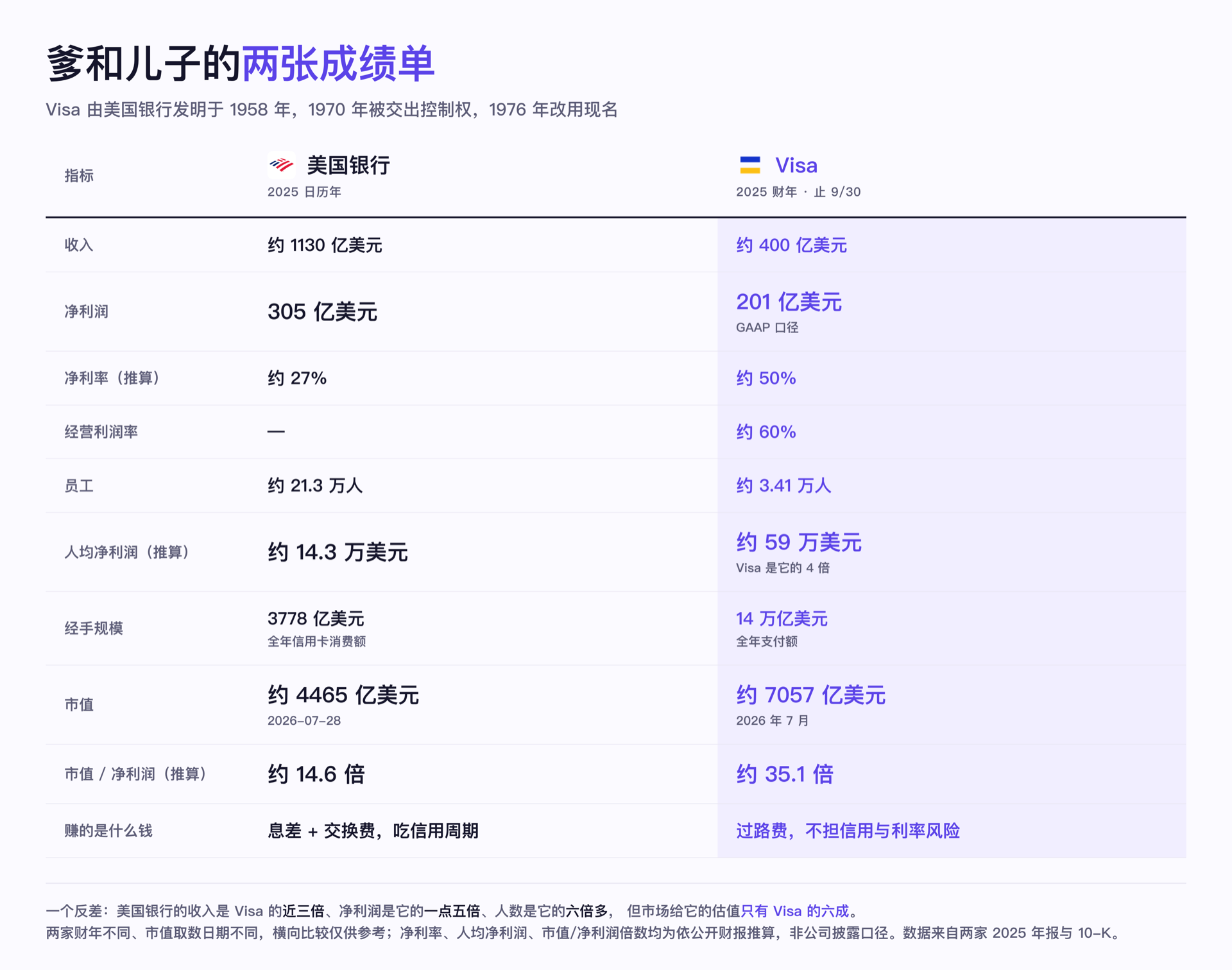
美国银行的收入是 Visa 的近三倍,净利润是 Visa 的一点五倍,人数是 Visa 的六倍多。但市场给它的估值,只有 Visa 的六成。
单看人效更刺眼:Visa 每个员工创造的净利润,是美国银行的四倍。
为什么?我们把一笔刷卡拆开看,答案就摊在桌上了。
你在商户刷一笔卡,商户被扣掉的总费用(业内叫 MDR,商户折扣率)大体分三块:
- interchange(交换费),约 1.4%—3.3%,归发卡行,也就是美国银行这类发卡的银行。这一块通常占总费用的 70%—80%,是最大的一块。
- 网络费(assessment),Visa 信用卡约 0.14%,归 Visa,这是最小的一块。
- 收单方加价,约 0.1%—1.5%,在收单行、处理商、网关这些人之间分。
看清楚了吗:这条链上拿走最大一块的是银行,Visa 拿的是最小那一块。但市场给 Visa 每一块钱利润的标价,是给美国银行的两倍半。
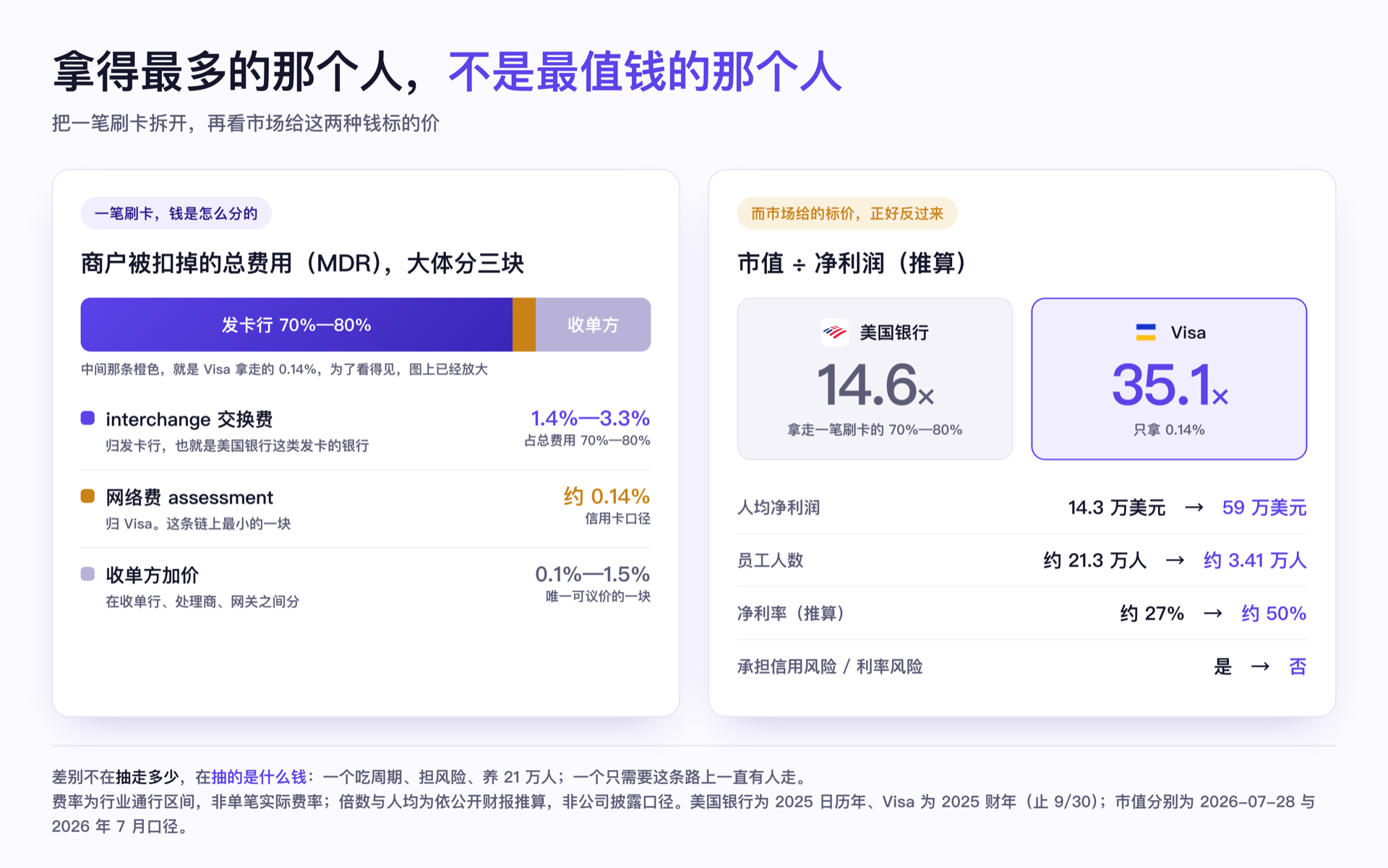
这就是这个系列反复在说的那件事:重要的不是你抽走多少,是你抽的是什么钱。
Visa 收的是过路费。它不放贷,所以不承担信用风险;它不吸存款,所以不承担挤兑风险和利率错配;它的成本几乎不随交易量线性增长,所以每多一笔交易,边际利润接近纯利。美国银行那 305 亿净利润里,藏着一整个信用周期。经济好的时候它很好看,经济一转向,坏账、拨备、监管资本会一起找上门。市场给这两种利润定的价,从来就不是一个价。
再看两个尺度:
Visa 2025 财年的支付额约 14 万亿美元,总交易额约 17 万亿美元,处理交易笔数约 2575 亿笔。用净收入除以支付额推算,Visa 的整体抽成大约是 29 个基点,每做成 1 万块交易,Visa 自己拿走约 29 块。(口径说明:这是“净收入 / 支付额”的整体推算值,不是任何一笔交易的实际费率。)
作为对照,第三篇里 Adyen 的 take rate 约 17 个基点。一家收单基建和一家全球卡组织,抽成量级居然在同一个数量级上。卖铲子的和铺铁轨的,赚的都是这么薄的一层,但都薄得极其稳定。
再看美国银行的卡业务:2025 年全年信用卡消费额约 3778 亿美元,年末信用卡余额约 1060 亿美元,全年新开卡约 353 万张。
3778 亿听着不小,但它只相当于 Visa 支付额的 2.7%。
这就是发卡行和卡组织的根本区别:发卡行赚的是自己这 3778 亿上面那一层厚厚的息差和交换费;卡组织赚的是全世界 14 万亿上面那一层薄薄的过路费。厚的那层要承担风险、要吃周期、要养 21 万人;薄的那层什么都不用管,只需要这条路一直有人走。
顺便说一句,这层过路费现在正在被人惦记。2026 年美国国会那部《信用卡竞争法案》(Credit Card Competition Act)想做的事,说白了就是把“这笔交易走哪个网络”的选择权从发卡行手里拿走、交给商户,逼 Visa 和 Mastercard 在同一张卡上竞争;特朗普公开支持了这件事,用词是“失控的敲诈”。另一条线上,Visa 和 Mastercard 在 2025 年 11 月跟商户达成的交换费和解,承诺五年内把交换费下调约 0.1 个百分点,落地在 2026 年底到 2027 年初,但沃尔玛等大零售商已经明确反对,法官还没批。
这两件事都还没有定论,但方向是清楚的:过路费这门生意太好了,好到监管和商户不可能一直看着不动。
七、Devil’s Advocate:放走 Visa,会不会其实亏大了?
按老规矩,先把反方的话说满。
Bear case,认真地说:这是美国银行历史上最亏的一笔交易。
第一,账面上就很难看。如果 1970 年它没松手,今天它手里握着的是一家 7057 亿美元市值的公司,比它自己还大将近六成。它等于亲手把一家比自己更值钱的公司送了出去。
第二,它送走的恰恰是最好的那块业务。不吃资本、不担信用风险、60% 的经营利润率、能穿越周期,这些正是银行业最稀缺的性质,全被它让给了一个包括自己竞争对手在内的共有体。
第三,最讽刺的是,它今天还得反过来给 Visa 交网络费。自己生的孩子,现在向自己收过路费。
这些说得都对。但回到判断,我的答案还是那句:它攥在手里的那个东西,根本长不到 7057 亿。
理由前面已经说过一次,这里再钉一遍:网络的价值来自受理面,受理面来自竞争对手愿意加入。只要那张卡姓“美国银行”,其他银行就只会是随时准备搬家的租客,而它们当时已经在搬了,Master Charge 1966 年就成立了。历史给了这个反事实一个现成的对照组:Amex 五十多年一直既发卡又自己做网络,规模从来没到过 Visa 那个量级。闭环能赚钱,但闭环长不成基础设施。
还有人会杠:那它完全可以既拥有 Visa、又自己发卡啊,两头都占不行吗?不行。这恰恰就是 1970 年谈判桌上其他银行绝不会答应的那一条。中立性不是姿态,是这张网能不能铺开的前提条件。
而且必须说清楚:美国银行并没有“白送”。它让出的只是这条链上最薄的那一层过路费;最厚的那层,也就是发卡行的交换费和息差,占一笔刷卡总费用的 70% 到 80%,它一直拿着,拿到了 2026 年,一年 3778 亿美元的卡消费额还在给它产生收入。
它失去的不是费池,它失去的只是费池上面那层收过路费的权利。而它用这层权利,换来了整个费池的存在。
没有 Visa,就没有今天这个万亿级的费池,它自己那 3778 亿也无处可去。
八、同一出戏,2026 年正在第三次上演
写到这我本来准备收尾了,然后发现这条规律根本没停。它今天正在华尔街被重新演一遍,而且演得几乎一模一样。
第一次就是 1970 年的 NBI,前面讲完了。
第二次是 Zelle。七家美国大行共同拥有的转账网络,2025 年跑掉了 1.2 万亿美元。组织形式跟 1970 年的 NBI 是一个模子:没有哪一家银行拥有它,所有银行都在用它。因为如果 Zelle 姓摩根大通,其他六家一天都不会接。
第三次就在眼前。2026 年 6 月 5 日,摩根大通、花旗、美国银行、富国,加上 BMO、纽约梅隆、汇丰、PNC、Truist、道明等一批银行,共同宣布要建一个共享的代币化存款网络:把商业银行存款变成链上的代币,实现 7×24 小时的行间转账,先服务跨国企业客户,目标 2027 年上半年上线。运营方是 The Clearing House,这些银行本来就共同拥有的那家清算公司。
它们为什么突然要合伙?因为稳定币打到家门口了。流通中的稳定币规模约 2630 亿美元,2025 年光 B2B 稳定币支付就有约 2260 亿美元。而按美国银行自己的测算,可能被稳定币抽走的银行存款高达 6 万亿美元。
Forbes 对这件事的评价直白得可爱:这些银行是在翻出当年做 Zelle 的那本旧剧本。
而我想补一句:Zelle 那本剧本,本身就是 1970 年 NBI 那本。同一家银行(美国银行),五十六年前是这个剧本的作者,今天是它的联署人之一。
那这一次能成吗?可以用历史给的两个条件卡一下。
反面教材一大把:贸易金融联盟 we.trade 2022 年破产、Marco Polo 2023 年破产、Contour 2023 年关停、银行稳定币联盟 USDF 从 2024 年起休眠。这些失败有个共同点被总结得很好:当各方的痛感不一样、而运营方又是个新面孔的时候,联盟必散。
1970 年那次为什么成了?两个条件都满足:所有发卡行都面临同一个生存威胁(Master Charge 已经成立,不合伙就等着被吃掉);而且有一个所有人都能接受的中立运营方(NBI,谁都拥有一点、谁都不能独占)。
2026 年这次,两个条件也都在:共同的生存威胁是稳定币在抽存款;现成的中立运营方是 The Clearing House,不是新面孔,是这些银行已经共用了很多年的老基础设施。
所以我对这次的判断偏乐观。不是因为技术,是因为它复刻的这套组织结构,五十六年前就跑通过一次,而且跑出来的那个东西今天值 7057 亿美元。
不过必须补一句边界:这次要做的是代币化存款(tokenized deposit),不是稳定币。区别在于,代币化存款是银行存款的链上凭证,还在银行体系里;稳定币是把美元搬到银行体系外面去。银行们选择做前者而不是后者,本身就是态度:它们要的不是加入新世界,是把新世界搬进自己的地盘。这个仗打得成打不成,我们两年后再对账。
九、收口:三句话,和一点私货
第一,这一百二十年的主线不是“一家银行做大了”,是同一条规律被验证了三次。1970 年的 NBI、后来的 Zelle、2026 年的代币化存款网络,每一次都是一群互为对手的银行发现自己单独干不成,于是把资产交给一个谁也不能独占的中立体。网络这东西,攥在手里就活不了。
第二,链条上抽走最多的那个人,不一定是最值钱的那个人。发卡行拿走一笔刷卡里 70%—80% 的费用,Visa 只拿 0.14%;但市场给 Visa 每一块钱利润的标价是 35.1 倍,给美国银行是 14.6 倍。差别不在抽多少,在抽的是什么钱:一个吃周期、担风险、养 21 万人,一个只需要这条路上一直有人走。
第三,控制权和网络效应,是一个跷跷板。1970 年美国银行放掉控制权,换来了一个活到今天的网络;2008 年它花 41 亿买下 Countrywide 的完整控制权,换来的是超过 650 亿的账单。这两笔交易的方向正好相反,结果也正好相反。
最后说点私货。
Giannini 1949 年去世的时候,遗产是 48.9 万美元,在当时也就是一个体面中产的水平,而他手里那家银行是全世界最大的。1926 年董事会决定按净利润的 5% 给他发报酬、保底 10 万美元,他拒绝了,让董事会把钱捐掉,1928 年 1 月那 150 万美元去了加州大学。他自己有一句话流传下来:“我这辈子最难的工作,是让自己别变成百万富翁。”
我一开始觉得这只是一个企业家的道德轶事,跟正文那条产业规律没什么关系。后来越想越觉得,这两件事说的其实是同一件:
一个创办人不肯把公司的钱攥成自己的财富,一家银行不肯把网络攥成自己的产权。前者让这家银行活过了 1906 年,后者让 Visa 活到了今天。
有些东西,只有松开手,才长得大。
这条规律不止在支付里成立。你手上那点东西,一个流程、一份数据、一个不肯交出去的接口,攥得越紧,它能长到的天花板就越低。这个道理讲起来谁都懂,真到了要松手的那一刻,一百年里也没几个人做得出来。
回到中国。第四篇我们聊过,中国长不出 Stripe 那样的中立基建,因为缺土壤。这一篇的历史给了这个判断一个更具体的注脚:Visa 不是长出来的,是一家银行被逼着放手放出来的。它需要有一群体量相当、互相谁也吃不掉谁的商业银行,需要它们同时面对一个共同的威胁,还需要有一个大家都肯认的中立运营方。中国有银联,但银联是国家队,不是银行共有体:它是被指定的中立,不是被谈判出来的中立。这两种中立,长出来的东西不一样。
哪一种更好,这篇不下结论。但至少,1970 年那张谈判桌上发生的事,值得每一个做基础设施生意的人认真看一遍。
下一篇聊什么,各位有什么想看的,评论区告诉我。
(本文数据口径:美国银行 1904—1998 年史实综合自 OCC、大英百科、Giannini 基金会与美国银行家协会等公开资料;1998 年 NationsBank 合并日期据 SEC 8-K 与公开报道;BankAmericard 弗雷斯诺空投的 6 万张卡、22% 首年坏账率、近 2000 万美元首年亏损,以及 1966 年对外授权、1970 年成立 NBI、1976 年更名 Visa,均据公开史料。美国银行 2025 日历年收入约 1130 亿美元、净利润 305 亿美元、年末员工约 21.3 万人、信用卡消费额 3778 亿美元、卡余额 1060 亿美元、新开卡约 353 万张,据其 2025 年报与 10-K;市值约 4465 亿美元为 2026-07-28 收盘口径。Visa 2025 财年(止 9 月 30 日)净收入约 400 亿美元、GAAP 净利润 201 亿美元、支付额约 14 万亿美元、总交易额约 17 万亿美元、处理笔数约 2575 亿笔、员工约 3.41 万人,据其财报与 10-K;市值约 7057 亿美元为 2026-07-28 收盘口径。净利率、人均净利润、市值/净利润倍数、29 个基点抽成率均为作者依上述公开数据推算,非公司披露口径;两家财年不同、市值取数日期不同,横向比较仅供参考。刷卡费用三段拆解(交换费 1.4%—3.3%、Visa 网络费约 0.14%、收单加价 0.1%—1.5%)为行业通行区间,非单笔实际费率。Countrywide 与 Merrill 相关抵押贷款和解赔付累计超过 650 亿美元、2014 年司法部和解 166.5 亿美元、Merrill 股东集体诉讼和解 24.3 亿美元,据公开报道。伯克希尔 2011 年 8 月 50 亿美元优先股(年息 6%)与 7 亿股、行权价约 7.14 美元的认股权证,据美国银行同期 8-K 与当时报道;浴缸构思与 24 小时成交据巴菲特本人受访及公开报道;2017 年行权浮盈约 120 亿美元、2011 年买入时相对账面价值折价 62%、2026 年初溢价 43%、2024-07-17 至 2025-09-30 减持约 4.65 亿股(约 45%)、累计约 5.16 亿股,以及伯克希尔 2011 年第一季度首次买入 Visa 与 Mastercard、2026 年 5 月 15 日提交的一季度 13F 中两者清仓(Mastercard 约 399 万股、均价 525.64 美元)而美国银行仍在前五大持仓,据 13F 与公开报道汇总;13F 为季度快照,不代表实时持仓。2026 年 6 月 5 日代币化存款网络、2027 年上半年目标上线、The Clearing House 运营方,以及稳定币流通规模约 2630 亿美元、2025 年 B2B 稳定币支付约 2260 亿美元、Zelle 2025 年 1.2 万亿美元、6 万亿美元存款风险敞口,以及 we.trade、Marco Polo、Contour、USDF 等银行联盟的失败案例,据 2026 年 6—7 月公开报道。上市公司市值随交易日波动。)
Silicon Valley Fintech Watch series · Part Five (opening the "How the Giants Began" arc)
In brief. That Visa in your wallet was invented by a bank. In 1958 it dropped sixty thousand cards on one small California city in a single go. Not one recipient had applied for one. First-year delinquency hit 22% and the loss came close to twenty million dollars. Twelve years later, with the business finally making money, that bank handed the whole thing over to a group of other banks, its own competitors among them. The bank was Bank of America. Why would anyone do that? The answer to that question is being acted out on Wall Street all over again in 2026.
Two numbers first.
On 28 July 2026, Bank of America was worth about $446.5 billion. In July 2026, Visa was worth about $705.7 billion.
The son is nearly 60% bigger than the father.
Yes, Bank of America gave birth to Visa. The largest payment network on earth was christened BankAmericard, invented by Bank of America in 1958, surrendered by Bank of America in 1970, and renamed Visa only in 1976. Today, every card Bank of America issues and every swipe it collects on still pays Visa a network fee.
I only recently traced this line properly, and I am a little embarrassed about it. All this time watching fintech and I had never sat down with the most important family tree in the industry. When I laid out the hundred and twenty years from 1904 to 2026, it turned out not to be a company history at all. It is one rule, proven three separate times:
A network you hold in a closed fist cannot live.
So this piece walks those hundred and twenty years honestly, from 1904 all the way to 2027. Yes, part of it is still in the future. The first four pieces were about things happening right now. This one goes backwards, to see how the machinery we live inside actually grew.
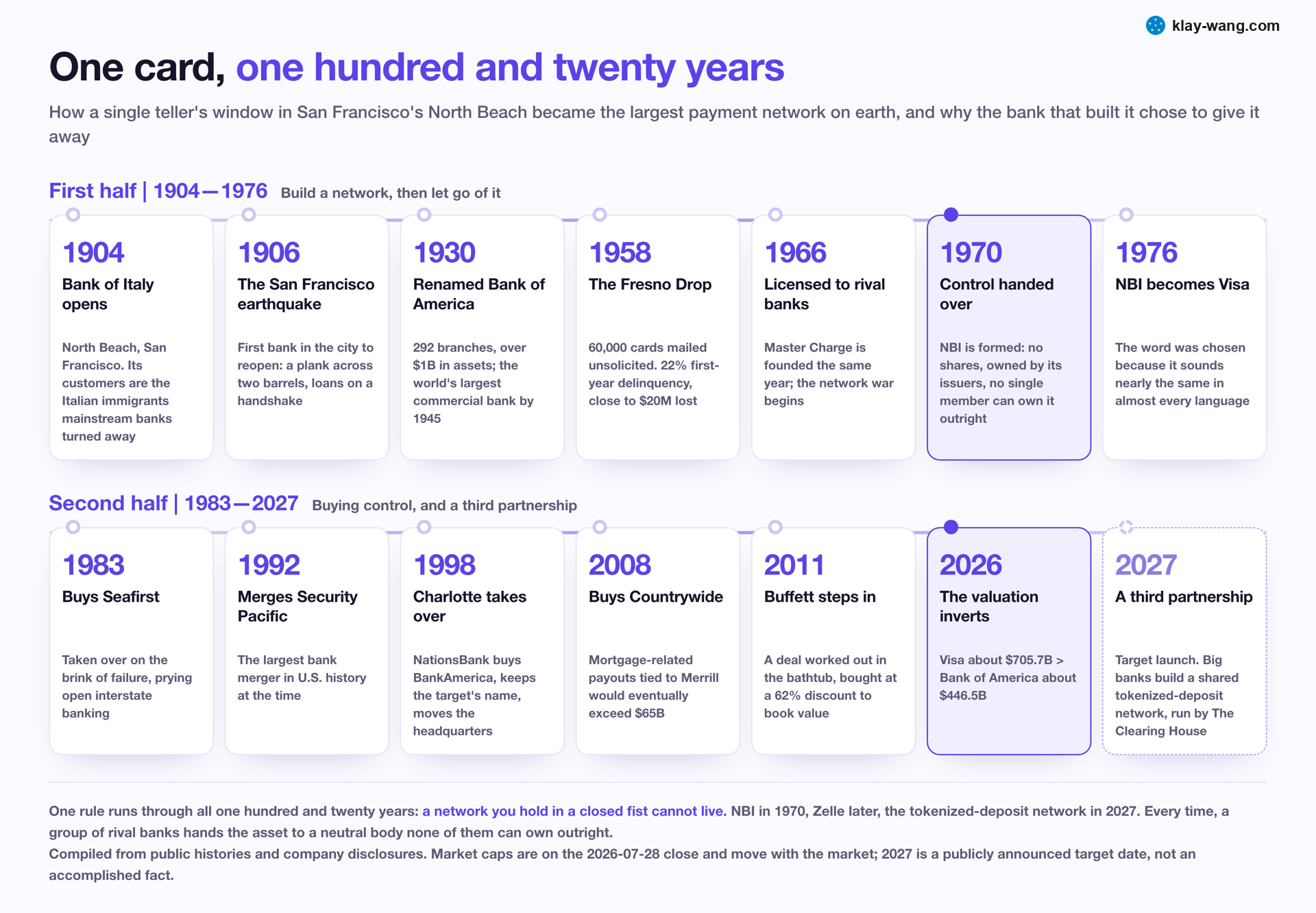
1. 1904—1906: the only startup capital was trust
The story starts with a man the respectable banks looked down on.
In 1904, Amadeo Peter Giannini and five partners opened a bank in San Francisco's North Beach and called it Bank of Italy. The name was literal: its customers were the Italian immigrants working the city's docks.
What did an American bank look like then? It served merchants and the wealthy. Working people who needed to borrow went to loan sharks. Giannini did two things that were considered undignified at the time: he lent to small farmers and small businesses, and he went out into the street to find customers. A bank soliciting customers, in 1904, was beneath the profession.
Deposits and loans grew roughly fivefold inside a year.
Then came 18 April 1906, and the San Francisco earthquake.
That day is the bank's real beginning. With the fires closing in on North Beach, Giannini and a handful of staff who had rushed in overnight emptied the vault, hauling the gold, the cash and every ledger out of the city. (There is a much-repeated version in which he hid the gold under a wagonload of orange crates. I could not verify that detail in any authoritative source, so take it as folklore.)
Days later, while every other bank in the city was still waiting for its vault to cool and would not dare open, Giannini set a plank across two barrels on a North Beach street and started taking deposits and making rebuilding loans. A loan closed on a handshake. No collateral, no credit check.
He was the first bank in San Francisco to reopen. For the months when the city needed cash most, one man was very nearly the whole cash flow.
There is something here that I think is the foundation of this entire piece: a bank has never sold money, it sells trust. Money is fungible; a hundred dollars is a hundred dollars wherever it comes from. Whether you will lend when nobody else dares, and whether people believe you will honour what you lent, is the only difference there is. For a few days in April 1906, a plank and a handshake demonstrated that cleanly.
Over the hundred and twenty years since, this bank has changed its name, its headquarters and its owners. But every time it has made serious money, that is still the thing it was selling.
2. 1930—1958: build the network first, then drop the cards
What Giannini did next was copy the model across California.
American banking at the time ran on unit banking: one bank, one office. Giannini built the first statewide branch network in the country. By 1930 he had 292 branches and more than $1 billion in assets. On 1 November 1930, Bank of Italy formally became Bank of America.
By 1945, with 493 branches in California and about $5 billion in assets, it was the largest commercial bank in the world. When Giannini died in 1949, the bank that started from a single counter in North Beach had more than 500 branches and about $6 billion in assets, first in the world by deposits.
That branch network is the key to everything that follows: it was the bank's first network-effect asset. Money you deposited in San Francisco could be withdrawn in Fresno; the more branches there were, the more that was worth; the more it was worth, the more people deposited; the more people deposited, the more branches you could afford. Giannini turned that flywheel for forty years.
And it is precisely because it held a statewide net that what happened in 1958 was possible at all.
18 September 1958, Fresno, California. Bank of America mailed a plastic card to roughly sixty thousand people in that city, all at once. Not one recipient had applied. Most had no idea what it was or what it was for. This is the famous Fresno Drop.
One common misunderstanding to clear up first: BankAmericard was not the world's first credit card. Diners Club came earlier, in 1950, but that was a charge card, settled in full at the end of every month. BankAmericard's originality lies elsewhere: it was the first bank-issued revolving-credit card that ever worked at scale. You could pay part of the balance this month and roll the rest into the next, with interest. The business model of every credit card on earth today starts here.
So why choose a method as brutal as an airdrop?
Because payments are a textbook two-sided network, with a textbook deadlock: merchants will not accept the card because there are no cardholders, and consumers will not carry the card because no merchant accepts it. Chicken and egg, both sides waiting for the other to move.
Bank of America's answer was crude enough to look absurd even now: stop waiting, and simply flood one side. Sixty thousand cards into a single city, cardholders conjured out of nothing, and merchants will follow.
The cost was severe. None of these cards had been underwritten. They went to the unemployed, the already indebted, people who plainly could not repay; cards were stolen out of mailboxes and used fraudulently all the time. First-year delinquency hit 22%, against the project lead's optimistic forecast of no more than 4%. The first-year loss came close to $20 million.
In 1958, $20 million was the kind of number that gets an entire management team fired.
Bank of America absorbed it and did not stop. A few years later, BankAmericard started making money.
The significance of this is far larger than "they invented the credit card": it is the first brute-force solution to a two-sided cold-start problem that I know of. Every subsidy war since (ride-hailing paying drivers, delivery apps paying couriers, payment firms paying merchants) has run the same play: lose money flooding one side, then let the network effect take over. Those sixty thousand cards in Fresno are the ancestor of all of it.
3. 1970—1976: handing your own son to your enemies
Up to this point the story is still just "a clever bank pulled off something big." What made me want to write a whole piece is what comes next.
In 1966, Bank of America began licensing BankAmericard to other banks across the country and eventually abroad.
Why do that? Because without it the network could not grow. Why would a merchant outside California install its terminal? Only when the local bank also issued the card, and brought local merchants in with it, could the net actually spread.
Licensing worked quickly, and it drew rivals just as quickly. In August 1966, a group of banks met in Buffalo, New York and formed the Interbank Card Association, which became Master Charge and later Mastercard. Its structure was different from BankAmericard's from day one: it was a consortium a group of banks built together, not one company's product.
By around 1970, the BankAmericard licensing system had become unmanageable. Clearing, authorisation, reconciliation and disputes all landed on Bank of America's own operations, and with legal pressure on top of it, the choice in front of the bank became very clear.
In 1970, Bank of America handed over control and ownership of BankAmericard in its entirety. It went to a new company, National BankAmericard Inc. (NBI), led by Dee Hock.
The structure of that company is worth a look: it issued no stock, and member banks held non-transferable "participation rights." In other words it was owned in common by its issuers. Nobody could buy it and nobody could sell it. Hock later coined a word for this kind of organisation, neither hierarchy nor market: chaordic, from chaos and order.
In 1976, NBI became Visa. Why that word? Because it sounds nearly identical in almost every language. A company that intended from the outset to be global infrastructure picked even its name against that standard.
Now back to the question: why would Bank of America let go of its most valuable invention?
My answer: it had no choice, and it was one of the best decisions it ever made.
The logic is plain enough. A network's value comes from acceptance, and acceptance comes from competitors being willing to join. And no bank will willingly run its own payments business, long term, on a competitor's brand and a competitor's system.
As long as BankAmericard carried the Bank of America name, every other bank was only ever a tenant, always calculating when to move out. They were already moving, in fact, and Master Charge was the new address. The choice Bank of America actually faced in 1970 was not "own Visa or give Visa away." It was "give Visa away or have no Visa at all."
Neutrality here is not a moral posture. It is the physical precondition for the network growing at all.
Someone will object: hasn't American Express issued cards and run its own network the whole time, and isn't it doing fine? It is doing fine, but it is a different species. Amex runs a closed three-party model, issuing, acquiring and clearing for itself. The upside is that every cent stays home; the cost is that its transaction scale has never reached, and cannot reach, the order of magnitude of Visa and Mastercard. (Acceptance is a separate matter. Amex spent more than a decade closing that gap, and since the end of 2019 roughly 99% of U.S. locations that take credit cards take Amex. But the scale gap cannot be closed, because it is not a question of capability, it is a question of structure.) A closed loop can make money, but a closed loop never becomes infrastructure. That fork in the road happened more than fifty years ago, and there is still no third path.
My summary is one sentence: if you want to own a network, you first have to give up owning it.
4. 1998: the name stayed in San Francisco, the company moved to Charlotte
The timeline has to run on a bit further, or it is impossible to say who this Bank of America actually is today.
After letting Visa go, Bank of America kept doing what it was good at: laying networks, only this time made of branches and balance sheet. In 1983 it picked up Seattle-First National Bank (Seafirst) as it teetered on failure, prying open interstate banking; in 1992 it swallowed Security Pacific, then the largest bank merger in American history.
Then came 1998, the year most easily overlooked and the most consequential.
On 30 September 1998, NationsBank of Charlotte, North Carolina completed its merger with BankAmerica. The new company was called Bank of America Corporation, its chairman and CEO was NationsBank's Hugh McColl, and its headquarters was in Charlotte.
Note the direction of that sentence: legally, the Charlotte bank bought the San Francisco one, and then took the name of the bank it had bought.
NationsBank was itself the product of thirty years of continuous acquisitions by McColl, rolled up out of a North Carolina local bank. So after 1998, what sits under the Bank of America sign is really two entirely different sets of genes: San Francisco left behind the retail bank's instinct for trust, and Charlotte brought an acquisition machine. It was the second one that determined the shape of the company from then on.
The machine's twenty-first-century bill reads like this:
- 2004, FleetBoston Financial
- 2006, MBNA (credit cards)
- 2007, LaSalle Bank and U.S. Trust
- July 2008, Countrywide Financial, about $4.1 billion
- announced September 2008 and completed January 2009, Merrill Lynch, about $50 billion
The last two were bottom-fishing in the crisis, and the most expensive lesson in the company's history.
Merrill is still argued about today: losses surfacing in bulk right after the deal was announced, the bonus scandal, regulatory investigations, the shareholder class action (settled later for $2.43 billion). But with a dozen years of hindsight it turned Bank of America overnight into a top-tier wealth management and investment banking platform. That one nets out positive.
Countrywide was an unmitigated disaster. The purchase price was about $4.1 billion. Mortgage-related settlements and payouts arising from Countrywide and Merrill together came to more than $65 billion, including $16.65 billion in the 2014 settlement with the Department of Justice alone.
What does $65 billion mean here? More than twice the company's entire net income for 2025.
I include this stretch because it sets up an exact contrast with the main thread: in 1970 Bank of America gave up control and received a network that is still alive today; in 2008 it bought complete control twice and received a bill it spent twenty years paying off.
5. 2011: the deal that came out of a bathtub
At the point where the bill hurt most, somebody walked in.
In August 2011, with Bank of America's share price pinned to the floor by Countrywide's litigation, fines and provisions, the common stock traded at a 62% discount to book value. In plain English: the market believed that even if you liquidated this bank's assets, they were not worth what the books said, and forty cents on the dollar would be doing well.
Buffett thought of the deal in the bathtub. That is not a joke, it is what he told CNBC: the idea surfaced in the tub on a Tuesday, and on Wednesday he phoned Bank of America's CEO Brian Moynihan. Moynihan did not call a bank, did not tell his staff, and spoke only to his chairman. From idea to done: twenty-four hours.
The structure is worth looking at, because it is so very Buffett. Berkshire put up $5 billion for cumulative perpetual preferred stock paying 6% a year, and got, thrown in, warrants to buy 700 million common shares at about $7.14 each.
The 6% preferred was his floor: whatever the stock did, $300 million of interest arrived every year. The 700 million warrant shares were his ceiling: a free call option, not a cent down. Protected below, uncapped above. That is how he has always priced his help at the moment everyone else is panicking.
He exercised in 2017, took roughly $12 billion of paper gain in one go, and became Bank of America's largest shareholder along the way.
What matters about this deal in this piece is not how much he made. It is what he was actually buying.
He was buying the 1906 asset. Not technology, not a network, not a licence, but "this bank's deposits and this bank's trust are still intact, they are just sitting under an overdue bill." He was betting the bill would eventually be paid and the deposit franchise would not disappear. From the first deposit Giannini took across that plank in North Beach, the valuable thing inside this bank has not changed in more than a century.
And there is a detail here that I stared at for a long time after I found it:
In the first quarter of that same year, 2011, Berkshire had already bought Visa and Mastercard.
Which means that in 2011 the father and the son of this family tree entered the same investor's portfolio at the same time. Bought separately, and bought as two completely different companies. The market has never treated them as one thing, even though they share a root.
The end of the story happens in 2026.
Between 17 July 2024 and 30 September 2025 Buffett sold about 465 million Bank of America shares, roughly 45% of the position; together with earlier trims, about 516 million shares in all, close to half the peak holding. The reason is not mysterious: going into 2026, Bank of America's shares carried a 43% premium to book value. The thing that once went for forty cents on the dollar now costs a forty per cent premium. The cheapness was gone, and that is all.
At the end of 2025 Buffett stepped down as CEO and Greg Abel took over. On 15 May 2026 the first 13F of Abel's tenure landed: Visa cleared out, Mastercard cleared out (about 3.99 million shares at an average price of $525.64). Bank of America stayed, still among Berkshire's five largest holdings.
A portfolio held for fifteen years, and what survives is the father while the son is sold.
I am not going to treat that as a prophecy. A 13F is a quarterly snapshot, and a new management team can have a hundred reasons to reposition, most of which have nothing to do with the argument in this piece. But as a footnote to a hundred and twenty years of family history it is genuinely interesting: the most valuable company on this chain and the company that gave birth to it sat in the same investor's account for fifteen years, and neither ever became the other.
6. Two report cards, 2026
History done, now the present. This section is the research layer, so the numbers get dense. Bear with me.
The two side by side:
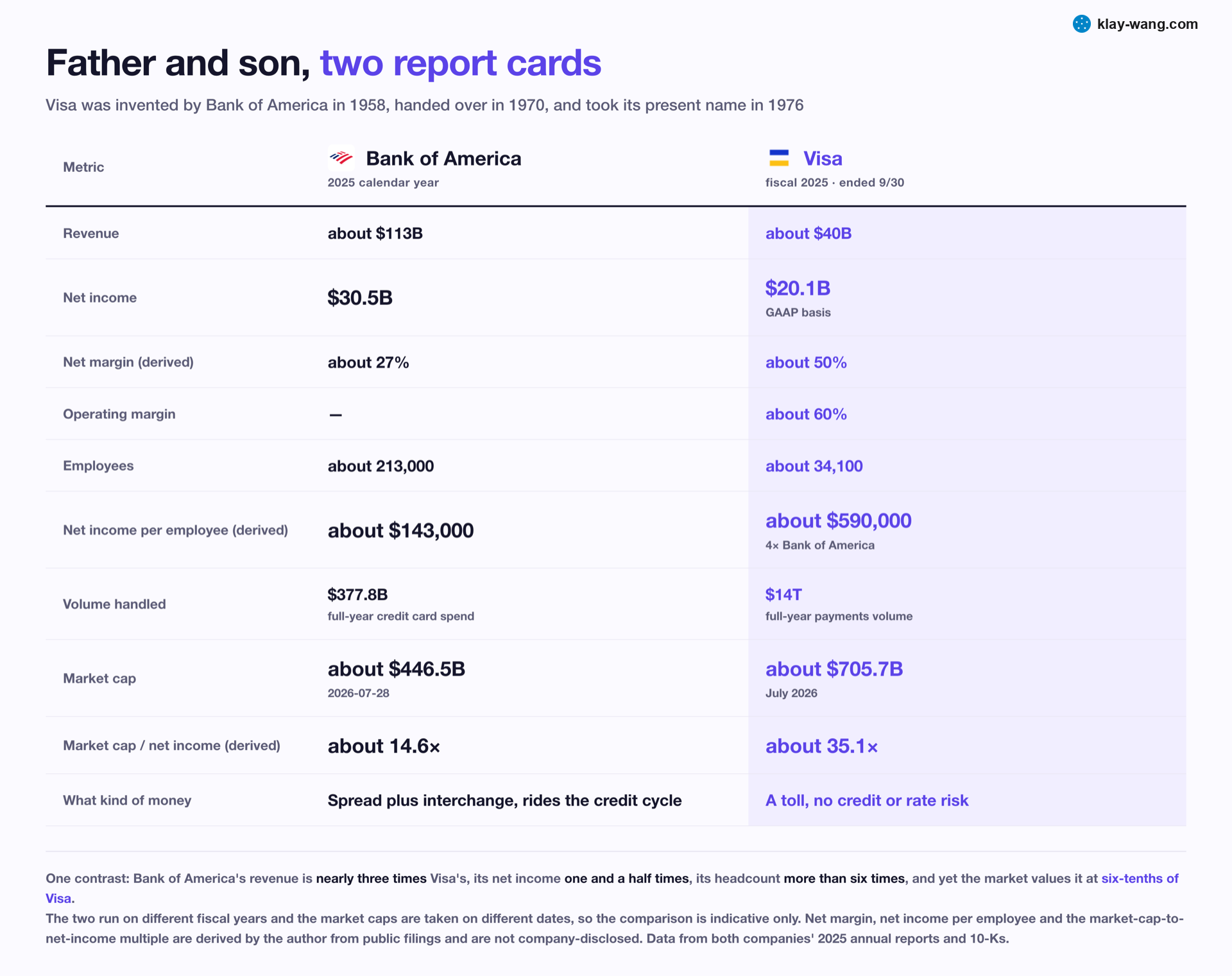
Bank of America's revenue is nearly three times Visa's, its net income one and a half times, its headcount more than six times. And the market values it at six-tenths of Visa.
Per head it is starker still: each Visa employee generates four times the net income of a Bank of America employee.
Why? Pull one card swipe apart and the answer is sitting there on the table.
When you swipe at a merchant, the total fee the merchant gives up (the industry calls it MDR, the merchant discount rate) breaks broadly into three pieces:
- Interchange, roughly 1.4%—3.3%, goes to the issuing bank, meaning banks like Bank of America. This piece is usually 70%—80% of the total, by far the largest.
- The network assessment, about 0.14% on a Visa credit card, goes to Visa, the smallest piece of all.
- The acquirer markup, roughly 0.1%—1.5%, split among the acquiring bank, the processor and the gateway.
See it? The largest slice on this chain goes to the bank, and Visa takes the smallest one. And yet the market pays two and a half times as much for a dollar of Visa's profit as it does for a dollar of Bank of America's.
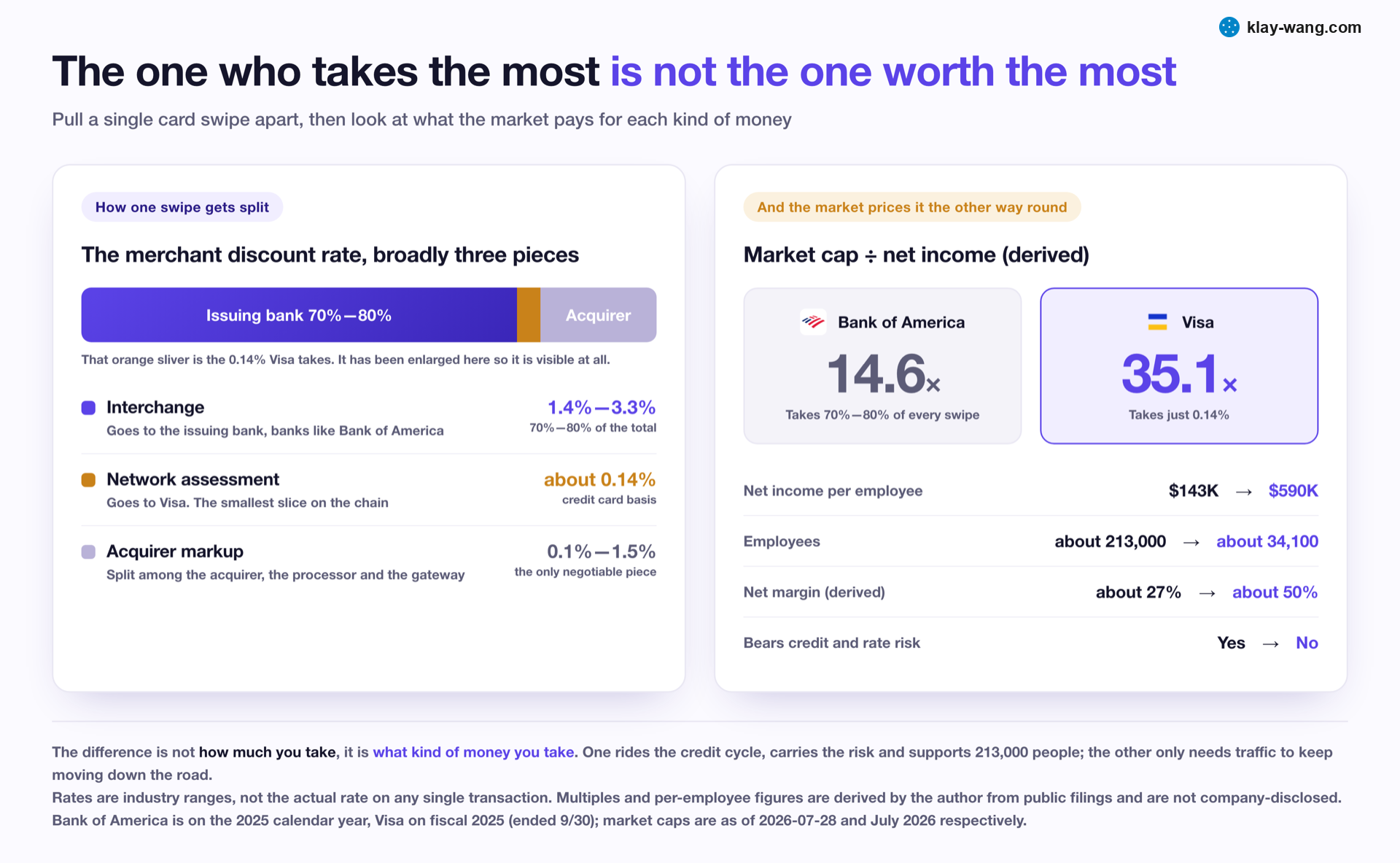
Which is the thing this series keeps coming back to: what matters is not how much you take, it is what kind of money you take.
Visa collects a toll. It does not lend, so it carries no credit risk; it does not take deposits, so it carries no run risk and no rate mismatch; its costs barely scale with volume, so every extra transaction is close to pure margin. Inside Bank of America's $30.5 billion of net income sits an entire credit cycle. It looks wonderful when the economy is good, and the moment the economy turns, charge-offs, provisions and regulatory capital all arrive together. The market has never priced those two kinds of profit the same way.
Two more yardsticks.
Visa's fiscal 2025 payments volume was about $14 trillion, total volume about $17 trillion, across roughly 257.5 billion transactions. Dividing net revenue by payments volume puts Visa's overall take at about 29 basis points: for every $10,000 of transactions it clears, Visa keeps around $29. (A note on basis: this is an aggregate derived from net revenue over payments volume, not the actual rate on any single transaction.)
For comparison, Adyen's take rate in Part Three was about 17 basis points. An acquiring infrastructure company and a global card network, taking cuts of the same order of magnitude. The shovel seller and the rail layer both earn a layer this thin, and both earn it with extraordinary stability.
Now Bank of America's card business: 2025 credit card spend of about $377.8 billion, year-end card balances of about $106 billion, about 3.53 million new accounts opened in the year.
$377.8 billion sounds large, but it is 2.7% of Visa's payments volume.
This is the fundamental difference between an issuer and a network: the issuer earns a thick layer of spread and interchange on its own $377.8 billion; the network earns a thin layer of toll on the whole world's $14 trillion. The thick layer carries risk, eats the cycle and supports 213,000 people. The thin layer has to manage none of it, and only needs the road to stay busy.
Worth mentioning: that toll is now being eyed. The Credit Card Competition Act in the U.S. Congress in 2026 essentially wants to take the choice of which network a transaction routes over away from the issuer and hand it to the merchant, forcing Visa and Mastercard to compete on the same card; Trump publicly backed it, calling the status quo extortion run wild. On a separate track, the interchange settlement Visa and Mastercard reached with merchants in November 2025 commits to cutting interchange by about 0.1 percentage points over five years, landing between the end of 2026 and early 2027, though large retailers including Walmart have objected outright and a judge has yet to approve it.
Neither is settled, but the direction is clear: the toll business is too good for regulators and merchants to keep watching it forever.
7. Devil's advocate: was letting Visa go actually a catastrophe?
As usual, let the other side speak in full first.
The bear case, stated seriously: this was the worst trade in Bank of America's history.
First, it simply looks terrible on paper. Had it not let go in 1970, it would today be holding a company worth $705.7 billion, nearly 60% larger than itself. It handed away a company more valuable than it is.
Second, what it handed away was the best business of the lot. No capital consumption, no credit risk, a 60% operating margin, able to ride through cycles. Those are precisely the scarcest properties in banking, and all of them went to a consortium that included its own competitors.
Third, and most ironic of all, it now pays Visa a network fee. Its own child charges it a toll.
All of that is correct. But back to the judgment, and my answer is the same one: the thing it would have been holding could never have grown to $705.7 billion.
The reason has already been said once, so let me nail it down again. A network's value comes from acceptance, and acceptance comes from competitors being willing to join. As long as that card carried the Bank of America name, other banks were only ever tenants packed and ready to move, and they were already moving, since Master Charge had been founded in 1966. History even supplies a ready-made control group for the counterfactual: Amex has issued cards and run its own network for more than fifty years, and has never reached Visa's order of magnitude. A closed loop can make money, but a closed loop never becomes infrastructure.
Somebody will push further: couldn't it have owned Visa and issued cards, taking both ends? No. That is exactly the one thing the other banks at the 1970 table would never have agreed to. Neutrality is not a posture, it is the precondition for the net spreading at all.
And this has to be said clearly: Bank of America did not give it away for nothing. What it surrendered was only the thinnest layer on the chain, the toll. The thickest layer, the issuer's interchange and spread, 70% to 80% of a swipe's total fee, it kept, and has kept all the way to 2026, where $377.8 billion of annual card spend is still generating revenue for it.
What it lost was not the fee pool. It lost only the right to charge a toll on top of the fee pool. And with that right it bought the existence of the fee pool itself.
Without Visa there is no trillion-dollar fee pool today, and its own $377.8 billion would have nowhere to go.
8. The same play, running for the third time in 2026
I was ready to wrap up here, and then found that the rule has not stopped. It is being staged on Wall Street right now, and staged almost identically.
The first time was NBI in 1970, covered above.
The second time is Zelle. A transfer network owned jointly by seven large American banks, which moved $1.2 trillion in 2025. Structurally it is cast from the same mould as NBI in 1970: no single bank owns it, and every bank uses it. Because if Zelle carried the JPMorgan name, the other six would not accept it for a day.
The third time is right in front of us. On 5 June 2026, JPMorgan, Citi, Bank of America and Wells Fargo, together with BMO, BNY, HSBC, PNC, Truist, TD and others, jointly announced a shared tokenized-deposit network: turning commercial bank deposits into on-chain tokens for round-the-clock interbank transfers, serving multinational corporate clients first, targeting launch in the first half of 2027. The operator is The Clearing House, the clearing company these banks already owned together.
Why the sudden partnership? Because stablecoins arrived at the door. Stablecoins in circulation are around $263 billion, and B2B stablecoin payments alone came to about $226 billion in 2025. By Bank of America's own estimate, as much as $6 trillion of bank deposits could be pulled away by stablecoins.
Forbes put it with charming bluntness: these banks are dusting off the old Zelle playbook.
To which I would add: the Zelle playbook was itself the NBI playbook from 1970. The same bank, Bank of America, wrote that script fifty-six years ago and is a co-signer of it today.
Will it work this time? We can test it against the two conditions history supplies.
There is no shortage of cautionary tales: the trade finance consortium we.trade went bankrupt in 2022, Marco Polo in 2023, Contour shut down in 2023, and the bank stablecoin alliance USDF has been dormant since 2024. Their common failure has been summarised well: when the parties do not feel the same pain, and the operator is an unfamiliar face, the alliance falls apart.
Why did 1970 work? Both conditions were met. Every issuer faced the same existential threat (Master Charge existed, and not partnering meant being eaten). And there was a neutral operator everyone could accept (NBI, which everyone owned a piece of and nobody could own outright).
In 2026 both conditions are present again. The shared existential threat is stablecoins draining deposits. The ready-made neutral operator is The Clearing House, not an unfamiliar face but old infrastructure these banks have shared for years.
So I lean optimistic on this one. Not because of the technology, but because the organisational structure it is copying was proven once fifty-six years ago, and the thing that came out of it is worth $705.7 billion today.
One boundary has to be added, though. What is being built is a tokenized deposit, not a stablecoin. The difference: a tokenized deposit is an on-chain claim on a bank deposit and stays inside the banking system, whereas a stablecoin moves dollars outside it. That the banks chose the former and not the latter is itself a statement of intent: they do not want to join the new world, they want to move the new world onto their own turf. Whether they pull it off is something we can reconcile in two years.
9. Closing: three sentences, and something personal
First, the through-line of these hundred and twenty years is not "a bank got big," it is one rule proven three times. NBI in 1970, Zelle later, the tokenized-deposit network in 2026. Every time, a group of mutually hostile banks discovered they could not do it alone, and handed the asset to a neutral body none of them could own outright. A network you hold in a closed fist cannot live.
Second, the one who takes the most on a chain is not necessarily the one worth the most. The issuer takes 70%—80% of a swipe's fees and Visa takes 0.14%; and the market pays 35.1 times for a dollar of Visa's profit against 14.6 times for Bank of America's. The difference is not how much you take, it is what kind of money you take: one rides the cycle, carries the risk and supports 213,000 people; the other only needs the road to stay busy.
Third, control and network effects sit on a seesaw. In 1970 Bank of America let go of control and got a network that is still alive; in 2008 it paid $4.1 billion for complete control of Countrywide and got a bill north of $65 billion. Those two trades ran in opposite directions, and they ended in opposite places.
Now the personal part.
When Giannini died in 1949, his estate was $489,000, about the level of a comfortable middle-class household at the time, while the bank in his hands was the largest in the world. In 1926 the board voted to pay him 5% of net profits with a $100,000 floor. He refused, and told the board to give the money away. In January 1928, $1.5 million of it went to the University of California. A line of his has survived: "The hardest job I ever had was keeping myself from becoming a millionaire."
At first I took that for a moral anecdote about a businessman, unrelated to the industrial rule running through the piece. The longer I sat with it, the more they looked like the same thing:
A founder who refused to clench the company's money into his own fortune, and a bank that refused to clench a network into its own property. The first is why the bank survived 1906. The second is why Visa is alive today.
Some things only grow if you open your hand.
That rule is not confined to payments. Whatever it is you are holding, a process, a dataset, an interface you will not hand over, the tighter you grip it the lower the ceiling it can reach. Everybody understands this when it is explained. Very few people in a hundred years manage it at the moment letting go is actually required.
Back to China. In Part Four we discussed why China cannot grow neutral infrastructure of the Stripe kind: the soil is missing. The history in this piece adds a more concrete footnote to that judgment. Visa was not grown, it was forced out of a bank's open hand. It needed a group of commercial banks of comparable size, none able to swallow the others; it needed them to face a common threat at the same moment; and it needed a neutral operator all of them would accept. China has UnionPay, but UnionPay is a state team, not a bank-owned consortium: it is designated neutrality, not negotiated neutrality. Those two kinds of neutrality grow different things.
Which is better is not something this piece will rule on. But at the very least, what happened at that negotiating table in 1970 deserves a careful look from anyone in the infrastructure business.
Tell me in the comments what you would like the next one to be about.
(Sources and basis. Bank of America's history from 1904 to 1998 is compiled from public materials including the OCC, Encyclopaedia Britannica, the Giannini Foundation and the American Bankers Association; the 1998 NationsBank merger date is per the SEC 8-K and contemporaneous reporting. The 60,000 cards of the BankAmericard Fresno Drop, the 22% first-year delinquency rate, the first-year loss of close to $20 million, the 1966 licensing, the founding of NBI in 1970 and the renaming to Visa in 1976 are all per public histories. Bank of America's 2025 calendar-year revenue of about $113 billion, net income of $30.5 billion, year-end headcount of about 213,000, credit card spend of $377.8 billion, card balances of $106 billion and about 3.53 million new accounts are per its 2025 annual report and 10-K; the market capitalisation of about $446.5 billion is on the 2026-07-28 close. Visa's fiscal 2025 (ended 30 September) net revenue of about $40 billion, GAAP net income of $20.1 billion, payments volume of about $14 trillion, total volume of about $17 trillion, about 257.5 billion transactions processed and headcount of about 34,100 are per its filings and 10-K; the market capitalisation of about $705.7 billion is on the 2026-07-28 close. Net margin, net income per employee, the market-cap-to-net-income multiple and the 29 basis point take rate are all derived by the author from the public data above and are not company-disclosed; the two run on different fiscal years and the market caps are taken on different dates, so cross-comparison is indicative only. The three-part swipe breakdown (interchange 1.4%—3.3%, Visa network fee about 0.14%, acquirer markup 0.1%—1.5%) reflects prevailing industry ranges, not the actual rate on any single transaction. Mortgage-related settlements and payouts tied to Countrywide and Merrill exceeding $65 billion in total, the $16.65 billion Department of Justice settlement in 2014 and the $2.43 billion Merrill shareholder class action settlement are per public reporting. Berkshire's August 2011 $5 billion preferred stock (6% annual dividend) and warrants for 700 million shares at about $7.14 are per Bank of America's 8-K of the period and contemporaneous reporting; the bathtub origin and the twenty-four-hour close are per Buffett's own interviews and public reporting. The roughly $12 billion paper gain on exercise in 2017, the 62% discount to book value at purchase in 2011, the 43% premium in early 2026, the sale of about 465 million shares (roughly 45%) between 2024-07-17 and 2025-09-30 and about 516 million cumulatively, together with Berkshire's first purchases of Visa and Mastercard in the first quarter of 2011 and the exits from both in the first-quarter 13F filed 15 May 2026 (Mastercard about 3.99 million shares at an average price of $525.64) while Bank of America remained a top-five holding, are compiled from 13F filings and public reporting; a 13F is a quarterly snapshot and does not represent real-time positions. The tokenized-deposit network of 5 June 2026, the first-half 2027 target launch, The Clearing House as operator, stablecoins in circulation of about $263 billion, B2B stablecoin payments of about $226 billion in 2025, Zelle's $1.2 trillion in 2025, the $6 trillion deposit exposure figure, and the failures of we.trade, Marco Polo, Contour and USDF are per public reporting from June and July 2026. Listed company market capitalisations move with the market.)
Comments留言