大厂、哈佛和斯坦福,都在被重新定价Big Tech, Harvard, and Stanford Are All Being Repriced
A web original — first published here on October 4, 2026.本文 2026.10.04 首发于本站。
目录Contents
- 01 What the market is betting on
- 02 Execution gets repriced first
- 03 Skills you can write down
- 04 All three live somewhere specific
- 05 Already concentrated, or getting more concentrated?
- 06 Measure only software, and you misread a set of schools
- 07 What alumni can do for you
- 08 What it means for you
- 09 Final thoughts
当知识和执行越来越便宜,一张名校文凭凭什么还值三四十万美元?
干活,执行变便宜之后,企业这边买的东西变了:以前买的是把活干完,但现在把活干完不够了,还需要行业的判断、对工作流的了解,以及出了事有人负责。
这三样有个共同的麻烦:都需要做时间的朋友,用时间攒,没办法在课堂上教会,而且只长在具体的公司和具体的城市里。
所以 AI 缩小了会不会干活的差距,放大了你身在哪座城市、哪家公司的差距。
上篇写学校(供给端)怎么教,这篇写市场(需求端)要什么。
01 市场在看好什么?
最近听了一期 YC 在 2026 年 9 月 17 日发的播客,叫 The State of Startups in 2026。坐在麦克风前的是 YC 的 President & CEO Garry Tan、两位 Managing Partner Diana Hu 和 Jared Friedman,加上 Harj Taggar。
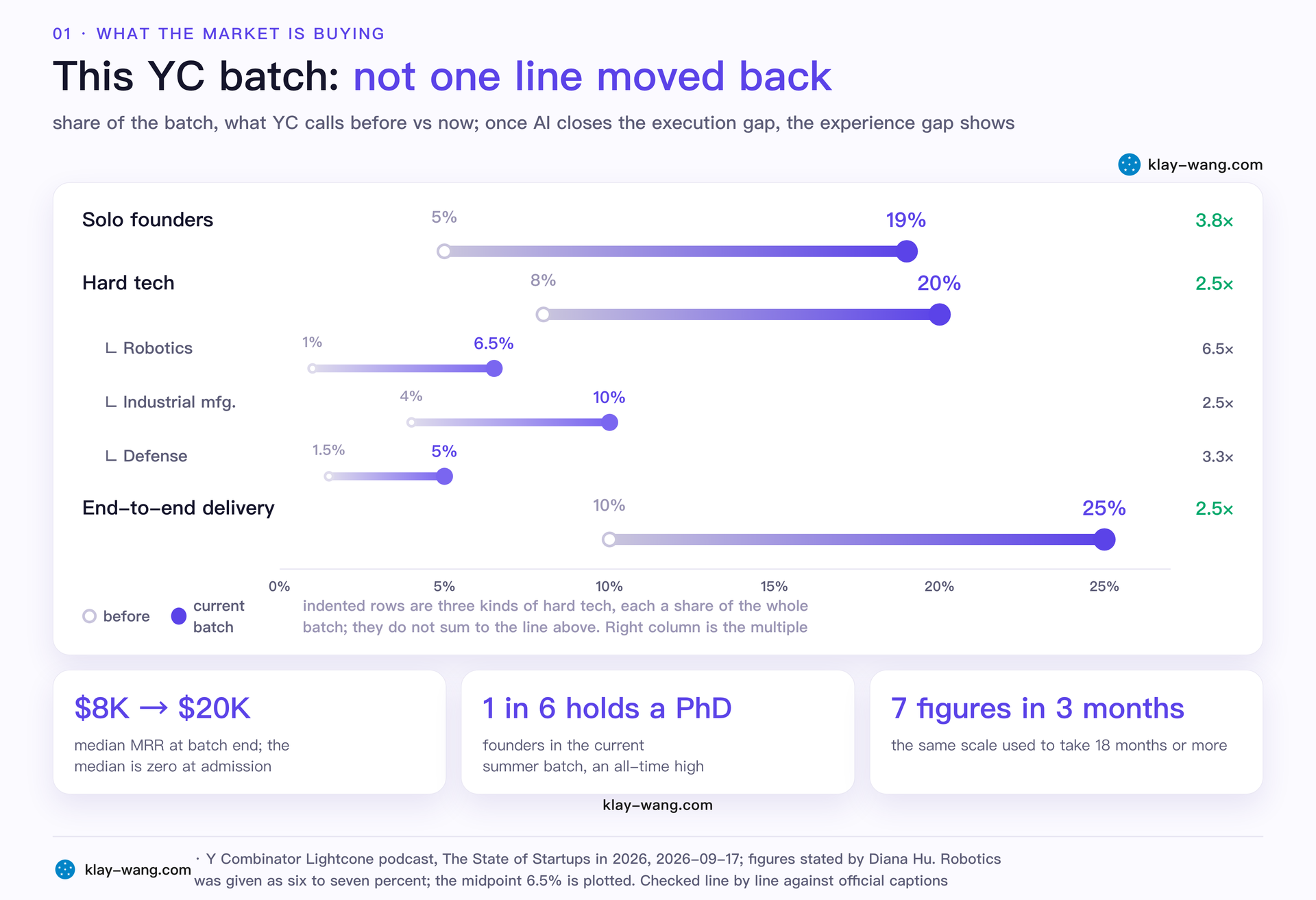
Diana Hu 在播客里说:他们过去录取的公司里大约 5% 是单人创始人,现在是 18% 到 19%。Garry Tan 接着说:接近这一批的五分之一。过去二十家里一家,现在五家里一家。这个数是 YC 自己这边的数据,但它背后是每年几千个申请里筛出来、真金白银投了钱的公司。
Diana Hu 说完还加了半句:这是我们见过的最大一次跳升。对照基准是她说的过去,按这个基准,涨了将近四倍。
Diana还说了三个数:硬科技公司的占比从 8% 涨到 20%。播客给了三个细分,机器人从 1% 涨到6%-7%,工业制造从 4% 涨到 10%,国防从 1.5% 涨到 5%。
Jared Friedman 后面补了一句:本期夏季批次里每六个创始人就有一个博士,比历史上任何时候都多。收入长得更快,公司被录取时中位收入是零,过去到 batch结束时中位月收入大约 8000 美元,现在是 2 万,还有公司在三个月里从零做到七位数。卖的东西也换了,做全栈端到端工作或者直接完成一项任务的公司比例,从 10% 涨到超过 25%。
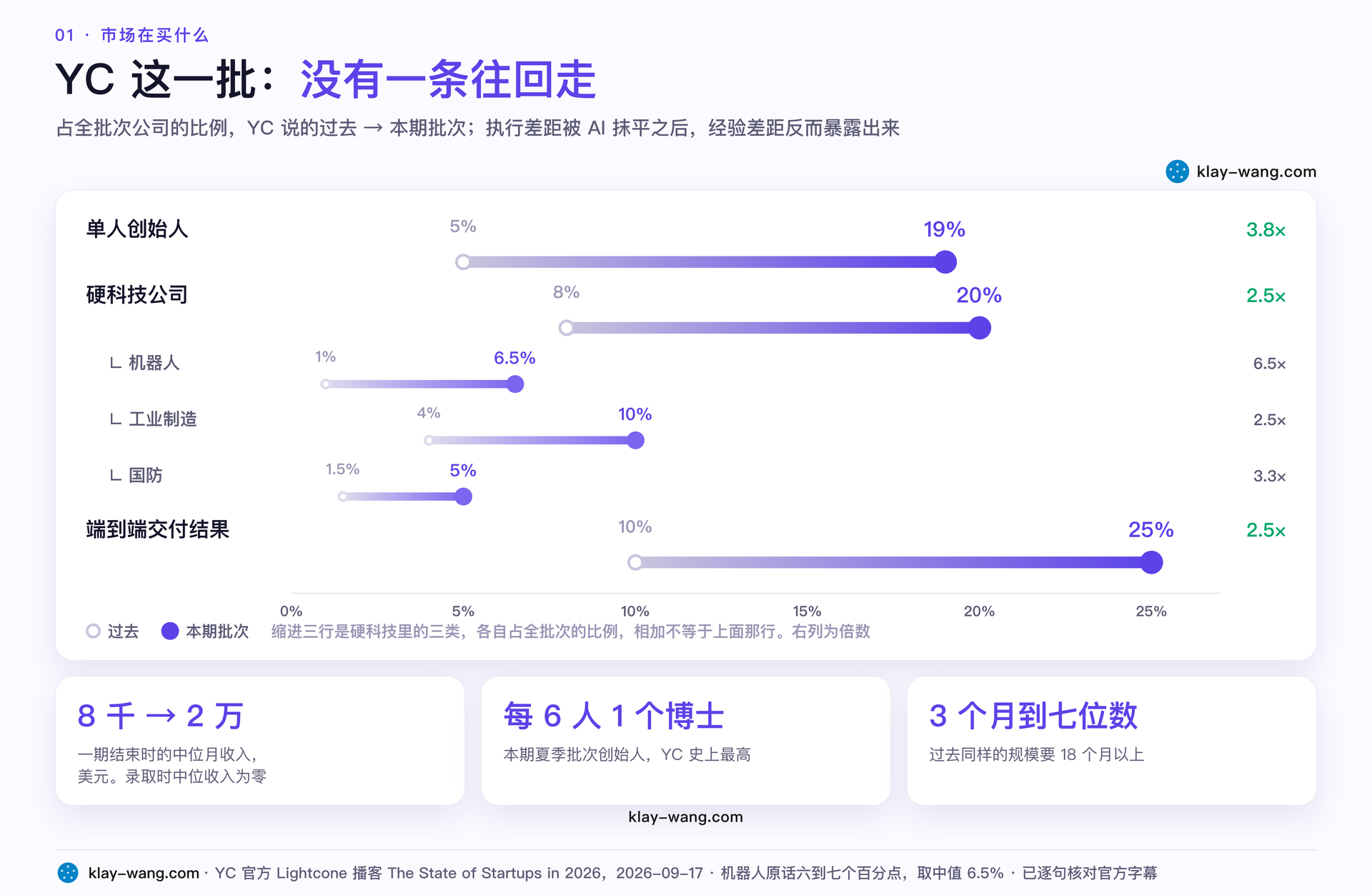
单人创始人为什么能起来?联创的作用,在过去是能力的互补,尤其是把东西造出来。写代码、做原型、改产品、查 bug、测试部署,过去需要好几个人配合,需要组织,现在一个个体,调几个编程 agent ,确实也能跑起来。
但是这不等于以后不需要团队,YC 也明说很多成功的单人创始人后面还是会加人。变的是时点。过去得先把人凑齐才能开始,现在是先跑起来再找人。
但如果只是这样,结论会是 AI 时代更属于年轻人,年轻人学工具明显更快。但YC 看到的恰好相反。
他们给这期播客写的官方简介里有一句:knowing what to build is becoming more important than simply knowing how to build it,知道该造什么,正在变得比知道怎么造更重要。同一份简介的章节列表里另有一节,标题就叫:为什么经验型创始人在回潮。
一个20年的行业老兵。他特别懂客户,知道哪里最痛,也知道过去十年大家试过什么、失败过什么。但他不会写代码,招一个完整技术团队又太贵,所以这些经验一直变不成产品。现在 AI 来了,把他缺的那块补上了,十几年攒的东西,完全没丢,而且短板自己学一下就能补上。
AI 把会不会干活的差距抹小之后,有没有经验的差距,反而凸显出来了。
年轻人的优势,是体力,是学新工具快,能快速,以及愿意拥抱变化;但学新工具,正好就是 AI 也在替你做的那件事。经历过一轮完整行业周期的人,优势就是知道什么根本不值得做,这件事模型替不了,尤其涉及真正的商业判断的时候。not-to-do list,比 to do list,重要一万倍。
经验值钱的地方,不是你干了二十年本身,而在于这二十年,你自己踩过的坑,替你划掉了多少错误选项和答案。
硬科技那边,也是差不多的情况,也很反直觉。很多人以为 AI 来了,创业会越来越轻,都去做软件,做 agent。但做机器人的、做芯片的、建数据中心,背后压着软件、算法、仿真和工程团队,AI 正在一层层削掉这些成本,以前只有大公司做得起的事,小团队开始有机会。软件变便宜之后,资本的流向是往还没变便宜的地方走:物理世界、专业知识、真实数据,还有行业判断。
YC 现在对外讲的,是把经验放到更前面。但这几个数衡量的是单人创始比例、硬科技占比、收入和博士比例,没有一个直接衡量创始人的工作年限,所以严格说,它反映的是 YC 的偏好变了。
02 先被压价的是执行
9 月 18 日,Databricks 的联合创始人兼 CEO Ali Ghodsi 上了 a16z 的播客,对谈的是合伙人 Martin Casado 和 Sarah Wang。他也是 Apache Spark 最早那批作者之一,这些年一直在替大企业把 AI 往生产线上装。
他讲的是企业本体(enterprise ontology,把一家公司到底怎么运转变成一张 AI 能理解的关系地图),举的例子很小。两个人能力差不多,一个今天刚入职,一个在公司干了五年,为什么后者做事快得多。他的原话是:干了五年的那个人有一张这家组织如何运转的本体图,知道人都是谁,知道事情该怎么推动。
这张图,组织架构图里没有,数据库里也没有。什么事该找谁,谁名义上负责但实际上推不动,哪些流程写的是一套跑起来是另一套,哪些项目为什么被砍,老板真正关心什么。数据告诉 AI 发生了什么,这张图告诉 AI 这些事之间是什么关系。
于是,今天的企业用 AI ,会撞上一个很荒谬的状态:AI 理论上拥有全世界的知识,但没有你公司的常识,或者叫工作流。
他后面讲到了组织。一家公司是一棵树,信息顺着树往上走、往下走。你拍不了板,就往上交给老板;老板得先弄清楚出了什么事,把来龙去脉补齐,才能拍板;拍完了,决定再顺着树一层层传下去。他说,有了那张本体图,这里面很大一部分现在能交给 AI。
落到具体的人身上就是:员工报经理,经理补上背景再报总监,总监再压一遍,最后到 VP、到 CEO。很多管理岗位一天里干的,就是把下面的事收上来、压成一页、递上去。公司里的不少层级,本来就是一套用人搭出来的信息中转站。
过去只能这么干,因为任何一个人能装下的东西都有限。但如果 AI 知道整个公司的会议、项目、人员、数字和历史,那么知道发生了什么这件事本身会迅速贬值。
过去职位越高,往往意味着你知道得更多。当上下文变成谁都能查的东西,靠信息差维持的地位,就开始被挑战了。带来的变化就是:谁可以在信息不全的时候拍板,敢砍掉一个已经投了钱的方向,出了事敢把责任接住。
按这个逻辑,先被压缩的可能是只负责收集、压缩和转递信息的管理工作。这一步 Ghodsi 本人没具体说,现有数据也只看得见 junior 招聘,中层是不是在变少,暂时验证不了。
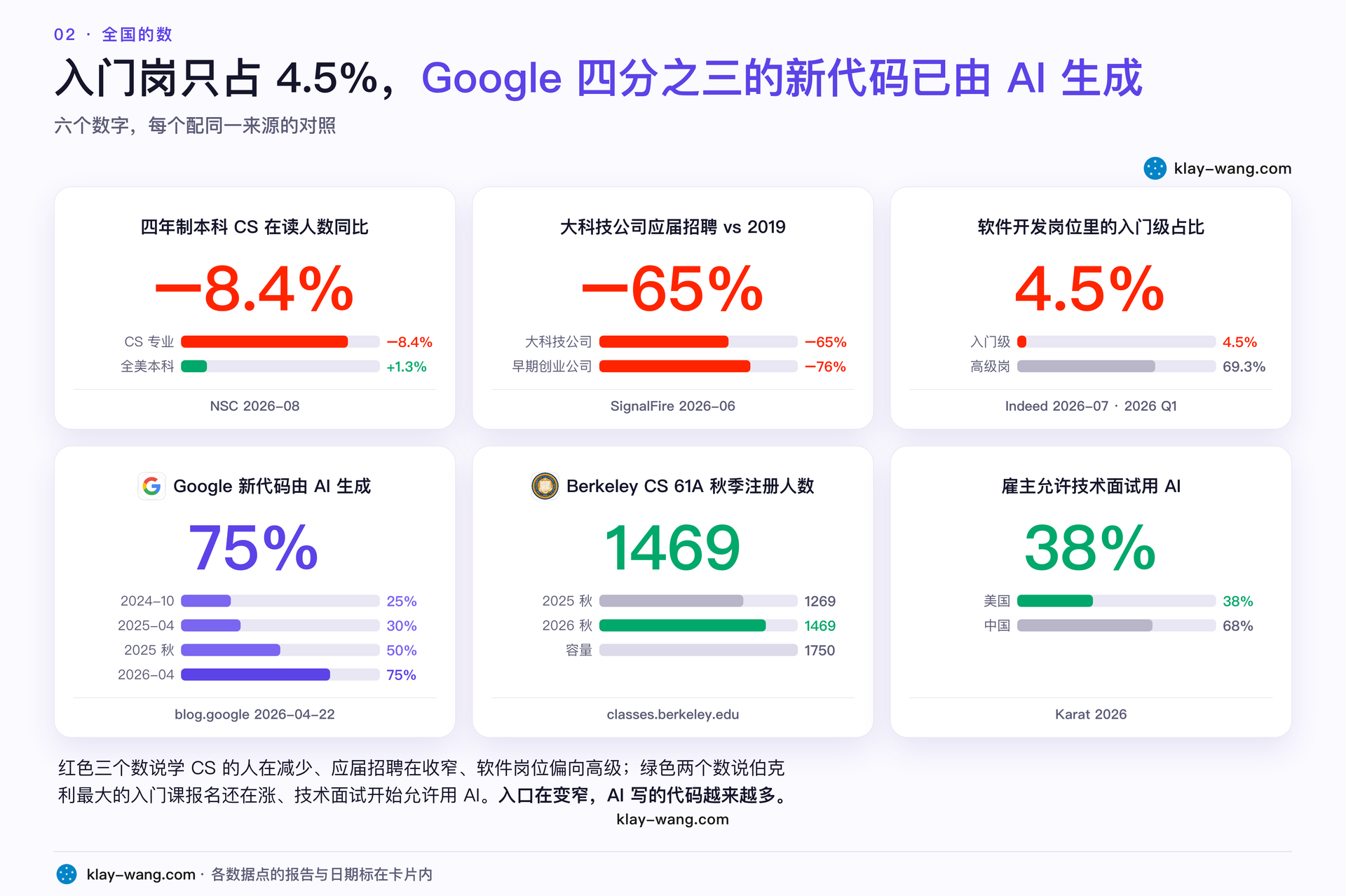
有一些能看见的数据,是 junior 阶段的:Indeed 招聘实验室 2026 年 7 月的数据,2026 年一季度软件开发岗位里入门级只占 4.5%,高级岗占 69.3%。SignalFire 2026 年 6 月的报告,大科技公司应届招聘比 2019 年少了大约 65%,早期创业公司少了 76%。斯坦福数字经济实验室 2026 年 8 月更新的论文,22 到 25 岁在 AI 高暴露职业里的就业,比按同龄人节奏推算的水平低 19%,主要原因是少招,不是裁员。
只看数据,先被压价的是执行的活。
但,如果入门级只占 4.5%,那十年后的高级工程师从哪儿来。今天 69.3% 的高级岗位上坐着的人,是十年前那批junior 一步步熬上来的。入门工作里那些看起来最没效率的部分,改别人的 bug、读没人愿意读的旧系统、跟客户来回吵需求,恰恰是一个人慢慢懂一个行业的来源。
现在 AI 可能正在收窄这条通道,公司省下的是眼前的培养成本,欠下的是十年后的人。而且这里,有一个我自己亲身经历过不同组织的差异:专业服务 firm 和大规模 corporate 消化这件事的方式不会一样。
BCG 这类 firm 的层级一点也不少。前段时间在见一个好朋友,我第一次听说 partner 上面还有不同级别的 partner,听完不禁觉得头大。但它的生产线本来就是 apprenticeship:新人跟着项目做,越来越靠近客户,判断和信任在一次次交付里长出来。AI 吃掉底层分析的同时,也可能把这条培养链一起吃薄。
但是 corporate 不一样,大厂动辄几万人甚至十几万人,你把基层都砍掉,中层高层如何升职呢?不能都空降吧?理论上可以,但是 corporate 的组织,本质上是个信任问题,不仅仅是能力问题,你可以全部空降或者外包,但是担责任,信任还是需要人的在场,需要有人接住跨部门协作和责任。基层岗位大幅减少以后,十年后缺的可能不止高级工程师,还会缺一批组织愿意把决定交给他的人。外部空降可以补人数,很难立刻补上一个人在这家公司里多年积累的信用。
公司的问题,很多时候是组织问题,而组织,就是人本身。
代码谁在写,这个数倒是清楚。Google 2026 年 4 月 22 日的官方博客说,今天 Google 75% 的新代码由 AI 生成并经工程师审核,2025 年秋季是 50%,2024 年 10 月 Pichai 的原话是超过四分之一。Ghodsi 说得更直接,Databricks 九成多的软件由 AI 写。
Ghodsi 还有一个判断跟这篇的方向相反:他不认为这条路通向超级智能,原话是我看不到任何证据表明我们正在朝超级智能前进,他的观察是训练变得更久、更脆弱、要更多人。这话从一个卖 AI 平台的人嘴里说出来,分量比安全研究员说重。
03 能被写清楚的能力
Garry Tan 7 月 17 日在 AI Engineer World's Fair 有一场演讲,题目叫:Every company should have a Brain。
2013 年他还在 YC 当工程师写内部社交网络,按他自己的统计,一天下来真正留在项目里的大概只有 14 行可用的逻辑代码。今天他几乎不全职写代码了,产出按他的说法涨了约 400 倍。他是这么说的:做到两倍的人和做到一百倍的人,用的是完全一样的 Claude,同样的权重,同样的上下文窗口,同样的 API。所以差别不在模型里,在你怎么把工作接起来。他用的动词是 wire,接线。
然后他把 agent 系统的部件挨个对上了公司的部件,一个不剩。一个 skill 文件就是一名员工,它有一项能力、一份工作,写得足够清楚到别人能照着执行。resolver 表是组织架构图,任务进来由它决定谁来干。filing rules 是内部流程。trigger evals 是绩效考核。
这话反过来同样成立:一个员工的工作里,凡是能被写清楚到别人照着执行的部分,都可以变成 skill 文件。人留下来的价值,集中在处理例外、更新规则和承担后果。
他提到 Winter 25 那一批里,四分之一的公司代码库是 95% 由 AI 生成的,那一批成了 YC 史上增长最快、最赚钱的一批。
但他没有停在把组织写成文件这一步,他接着问了一个更难的问题。AI 的上下文窗口再大,也装不下一整家公司。他说:你的公司是一座图书馆,不是摊在桌上的三本书。决定你的 agent 是天才还是金鱼的,是此时此刻谁在挑那三本书放到它桌上,模型聪不聪明反而排在后面。
company brain ,不是搭个企业知识库那么简单。检索这件事正变得越来越不值钱,难的是什么值得写进去,什么该被淘汰,两个事实冲突的时候以哪个为准。
这对很多公司扎心的地方在于,你天天研究模型怎么选、向量数据库怎么搭,但你公司最值钱的那部分知识,可能从来没进过系统,它还躺在老板脑子里、销售冠军的脑子里、十年老员工的脑子里。员工一离职,公司可能就失忆了。这种失忆每家公司都在发生,只是没人把它记成损失。
一个干了八年的人走了,公司算的是招聘成本和交接周期,那张只存在他脑子里的图值多少钱,很难量化。
他给的建议很具体:永远不要做一次性的工作。今天你让 AI 写一个方案,第一次不好你改,第二次不好继续改,终于满意了,大部分人到这里就结束。他说错了,最后还有一步,把刚才成功完成任务的方法变成一个可以反复调用的 skill。如果同一件事你还需要第二次重新教 AI,第一次就算失败了,因为你只完成了任务,没有留下能力。
英文原话是:Model quality is rented, but if you build your brain, you own that brain.
YC、Ghodsi、Garry Tan 讲的几件事放在一起,市场现在要的是三样:知道该做什么/不该做什么的判断,公司内部才知道的门道,出了事能担责的人。
这三样全部都需要用时间攒,学校能教判断框架和案例,却无法帮助个体,在真实公司里反复拍板、犯错,再把后果收回来。
既然这样,学校凭什么收你30多万美元,甚至 40 万?
04 三样东西都有迹可循
学校给不了这三样东西本身,不过学校能影响或者决定了你每天跟谁在一起、毕业以后能走进哪些公司的门
城市给学生的是,碰到机会的密度,机会能不能变成经验,要看公司如何组织工作。学校把你送进一家公司,进去以后有没有人带、能不能碰到客户、什么时候拿到决策权,决定了一张学位最后值多少。
Ghodsi 说:干了五年的人有一张这家公司怎么运转的图。那张图从每天碰见的人,听见的事,踩过的坑里来。而你能碰见谁、听见什么,取决于你在哪,每天跟谁在一个楼里,毕业以后能走进哪几家公司的门。
所以衡量一座城市对一个学生值多少,看四样:隔壁/或者附近,有没有一群能把东西做对的人(人),有没有资金(资本),有没有一个真实的产业(产业),有多少岗位(工作)。完整的表在文末附录。
PitchBook 和 NVCA 联合出的 Venture Monitor,2025 年湾区拿到 1851 亿美元、2702 笔,纽约 356 亿、1809 笔,往下是洛杉矶、波士顿、西雅图、费城、芝加哥、匹兹堡。然后就没有然后了。纽黑文、夏洛茨维尔、汉诺威、伊萨卡这四个地名,在六份 Venture Monitor 全文里一次都没出现过。
Yale 在纽黑文,Darden 在夏洛茨维尔,Tuck 在汉诺威,Cornell 本部在伊萨卡。这四所学校所在的城市,在这份季报里没有名字。季报没点名不等于当地没有投资,只说明它们进不了这份报告的点名门槛。
产业那边情况类似。纽黑文只有一家《财富》500 强,是 Amphenol,一个做连接器的元件厂,总部在沃灵福德,2026 年榜上第 198 位。夏洛茨维尔是 0 家,这个 0 经过核实,不是查不到,弗吉尼亚商业杂志 2026 年 8 月那份州内名单里夏洛茨维尔都会区一家都没有。Darden 的学生要在这座城市待满两年,学费二十多万美元,这两年他每天走在街上碰不到任何一家五百强的总部。
大学城的就业结构更说明问题。伊萨卡教育服务与医疗社服占 QCEW 覆盖岗位的 52.0%,汉诺威 43.1%,夏洛茨维尔 42.4%,纽黑文 38.8%,其中私立教育服务这一项 30176 个岗位,Yale 是里面最大的那个雇主。在伊萨卡,QCEW 数到的岗位里每两个就有一个在教育、医疗或社会服务这一档。
这个数是好是坏,看你毕业之后打算留在哪。想留下的人会发现这座城市的雇主结构高度依赖大学和医院。按劳工统计局 CES 2026 年 1 月的数,伊萨卡非农岗位约 5.05 万个,其中教育医疗岗位约 2.34 万个,剩下一半在别的行业,只是没有一个能跟大学比体量。
但要留在伊萨卡的人本来就不多,Johnson 的学生毕业多半去纽约、波士顿、芝加哥。所以这个 52% 说的是他读书那两年每天路过的是什么,不是他将来在哪上班。你在哪座城市读书,决定的是你身边有什么,不一定决定你去哪上班。
纽约的计算机类岗位 328950 个,伊萨卡 1280 个,同一个州,差 257 倍。
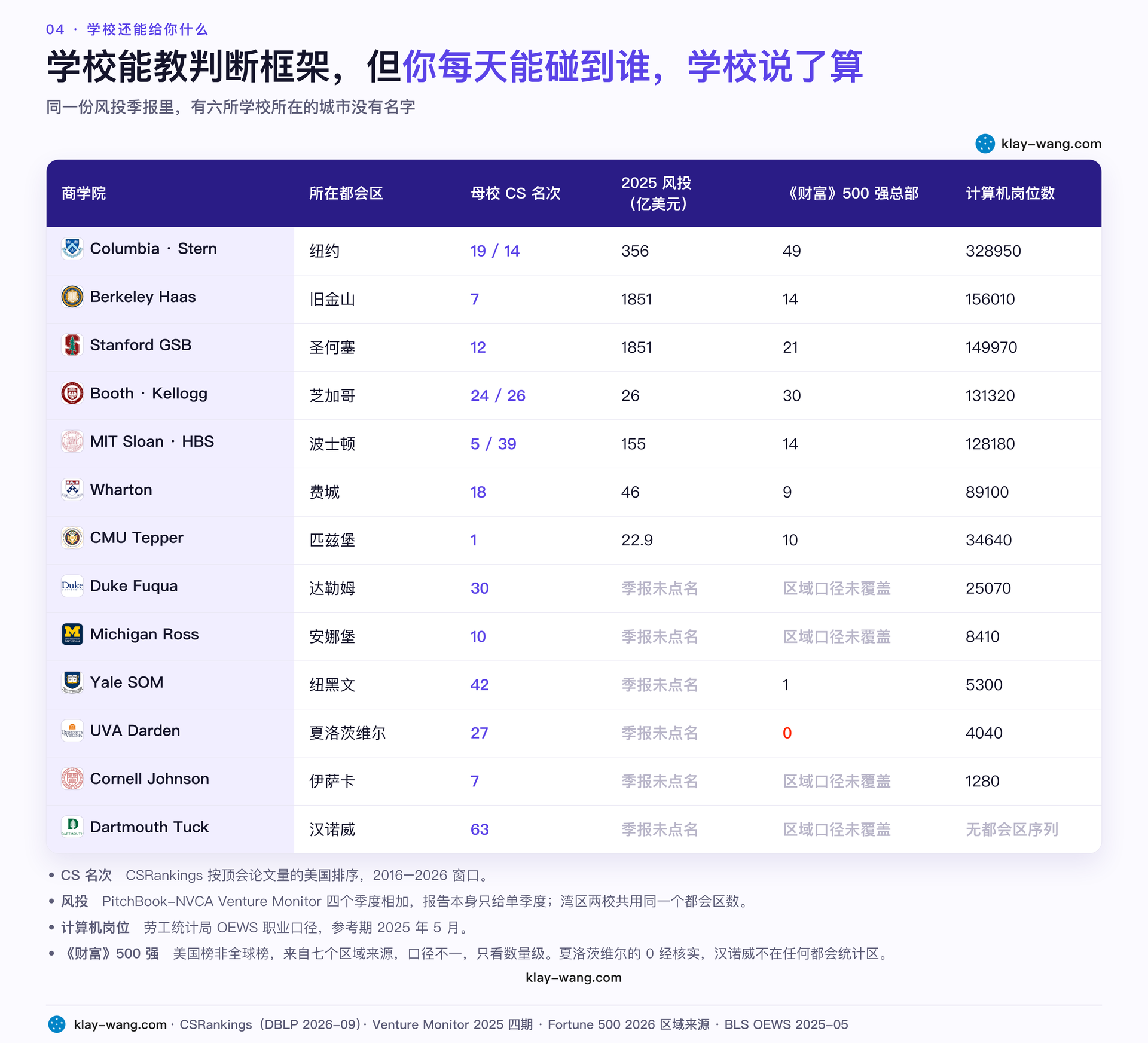
四组数里至少两处口径会误导人。
第一处是岗位。这一栏必须用职业口径,行业口径会骗你。劳工统计局的信息业是按雇主的主营业务分的,Amazon 在这套口径里算零售贸易,银行和医院里的软件工程师一个都不算进去。按行业口径,西雅图的信息业只占当地就业的 6.16%,排在旧金山的 9.18% 和圣何塞的 8.29% 后面。按职业口径,西雅图的计算机类岗位有 194970 个,反而多过旧金山的 156010 和圣何塞的 149970。
同样是西雅图,换个算法,就从三家里的最后一名变成第一名。
大学城那组数也有类似的毛病。上面那几个百分比用的是劳工统计局的 QCEW 口径。CES 把公立大学的人算进政府,QCEW 算进教育医疗,同一个夏洛茨维尔在 CES 下政府占 32.6%,在 QCEW 下教育医疗占 42.4%,选错一个结论就反过来。
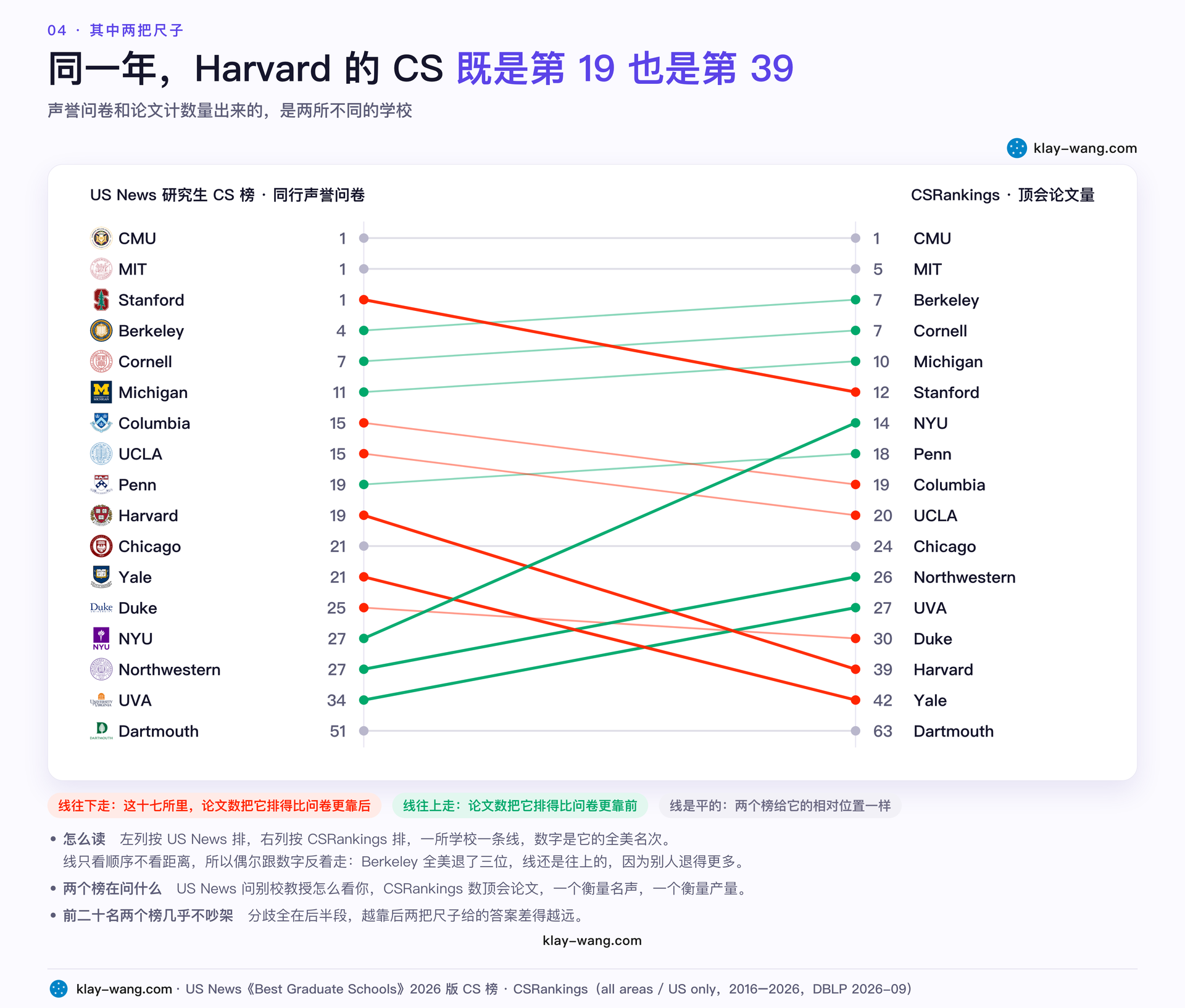
第二处是排名,而且有三套度量衡。
CSRankings 按顶会论文量算,十年窗口,CMU 第 1、MIT 第 5、Stanford 第 12、Harvard 第 39、Yale 第 42。US News 的研究生 CS 榜,是同行声誉问卷,Stanford、MIT、CMU 并列第 1,Berkeley 第 4,Harvard 第 19。而 2026 年 9 月 22 日 US News 刚发的 2027 本科榜 Best Colleges 上,MIT 是全美综合第一,首次终结了普林斯顿从 2012 版起的连续第一,同时本科工程、计算机科学、经济学三项都排第一。
同一所 MIT,三个榜给了三个位置,第 5、并列第 1、第 1。
两个榜衡量的东西不一样。US News 的名次来自问卷,衡量的是其他学校教授心里的印象;CSRankings 那个名次看的是十年里在顶会发了多少论文。一个是名声,一个是产量。产量跟人数直接相关:CSRankings 名册上 Stanford CS 是 84 人,十年里有发表的 61 人;CMU 是 274 人和 184 人,是 Stanford 的三倍。所以找导师、找同一个实验室的人,看 CSRankings;要一个拿出去有人认的 title,看 US News。
2027 新加了一个指标叫 Earnings by Major,按专业算毕业生四年后的收入,数据来自教育部的 College Scorecard,占总分 5%,替换掉的是原来的毕业生负债那一项。评价一张学位的口径,从学生欠了多少债,换成了学生挣了多少钱。
普林斯顿霸榜十几年被换掉,和榜单换尺子,是同一年的事。这项新指标在里面占了多少,没有公开的拆解。
还有一层口径是暂时没查到。十七所里只有七所在官网上公布 CS 系的在读人数和教师编制,大多是公立,Michigan 本科 2666 人、研究生 609 人、核心教师 96 人都挂在网上;最有名的那几所私立,规模查不到。所以这些榜单目前不能按人均折算。
所以区位这件事,2026 年比 2016 年重要多了。
理由不难理解。干活变便宜之后,值钱的是对一个行业的了解,而这种了解只能在具体的行业里面攒出来。Ghodsi 说的那张本体图只能在一家真实的公司里长出来,你没法在图书馆里读到它。YC 那边硬科技从 8% 涨到 20%,机器人从 1% 涨到六七个百分点,说的是同一件事:钱在往物理世界、专业知识和真实数据走,而这三样都有迹可循。
而且这个产业不一定得是科技产业。底特律的汽车、匹兹堡的机器人和医疗、北卡的制药都算。芝加哥是个好例子,风投只有 26 亿,在前十科技都会区里最少,五百强总部却有 30 家,全美第一档。一个 MBA 学生要的行业经验,它有,只不过不是科技行业。
但湾区还是湾区。在湾区,一个学生可以上午在教室里上课,下午开四十分钟车去见一个 VC或者寻找 cofounder,搭团队,晚上在某家大厂的楼里吃完饭再回学校。一天之内,合作者、资本、产业、工作机会,全部能碰一遍。
上面那四组数衡量的都是有多少,无法体现出这种便利。这十七所对应的城市里,能这么过一天的我看只有三个,旧金山(湾区)、纽约、波士顿,而且三家的优势正好是三个领域:软件、金融&媒体、生物医药和硬件。
2025 年 10 月,沃顿在旧金山金融区 555 California 长租了一栋五层楼,约八万平方英尺,比原来的落脚点翻了一倍多,这是它在旧金山的第一个独立校区。反例是:西北大学决定在 2026 年春季关掉旧金山校区,Kellogg 的楼没了,但 Kellogg 的 San Francisco Immersion 留着,学生照样在冬季学期去湾区,进 VC 或者 VC 的被投公司实习。退出的这一家,省掉的也只是房租,学生还是得人本身,去到湾区。
课表能抄,这个半径是抄不走的,这句对 CS153 的讲者名单成立,对湾区的商学院也成立。
05 已经集中,还是越来越集中
都说AI 降低了创业门槛,但实际上并没有。机会没有跟着AI一起摊开。四组互不相干的数据,都是头部拿走了大头。
2025 年全年湾区拿到 1851 亿美元,全美 3394 亿。PitchBook 2026 年的 MBA 创始人榜,Harvard、Stanford、Wharton 三所校友创办的公司累计融资 3306 亿美元,第 4 名到第 20 名十七所加起来是 3299 亿,前三所等于后十七所之和。
2025 财年的捐赠基金,哈佛 569 亿、耶鲁 441 亿、斯坦福 408 亿,三家 1418 亿,后面八所加起来 1196 亿,哈佛一家是达特茅斯的 6.3 倍。Brookings 2025 年 7 月把全美 387 个都会区分成六档,最高那档 Superstars 全美只有两个,旧金山和圣何塞,前 30 个都会区拿走了全美三分之二的 AI 职位发布。
四组都集中在头部,只是衡量的单位不同:城市、校友、学校、都会区,叠不成同一张地图。
不过,捐赠基金的集中度是几十年攒出来的,哈佛的 569 亿跟 AI 没有任何关系。风投的地理集中和校友融资的集中,在 AI 之前就长这样,但这正是AI十点所拥有的先发优势。
真正带时间维度的只有两条。一条是湾区占全美风投的比重,2025 年全年 54.5%,2026 年上半年 77.5%。另一条是 SignalFire 那个应届招聘,比 2019 年少了 65% 到 76%。
门槛降了,但没有把分布摊平,而在有时间序列的那两条上,集中度还在往上走。中间层,到底是不是正在被掏空,眼下只看到分布长这样,还需要持续观察和验证。
做小事和做大事的差别,倒是可以说说。AI 让一家三个月的新公司做到七位数年化,这是 YC 说的。AI 同时让做前沿模型变成一个需要几十亿美元算力的游戏,这也是真的。两件事都是真的,差别是,你打算做多大的事情?
风投的笔数离你要的答案近一些,湾区那 2702 笔背后是一批刚拿到钱的公司。但 PitchBook 数的是融资交易,招聘要看 SignalFire 那种数;拿到钱不等于在招人,钱可能进了算力、并购或者续命,一家公司一年也可以融两轮。
单人创始人是在变多,但不等于以后不再需要人,只是需要人的时点往后挪了。你不用等团队凑齐才能开始,但做到一半的时候,仍然要找到那个对的人。该问的是你有多大概率在一年之内能碰到他,而不是这所学校有多少个 CS 教授。
06 只衡量软件,会看错一批学校
前面那四组数据,合作者、资金、产业、岗位,衡量的全是一座城市离软件有多近。如果只用这一把尺子衡量,维度可能有点单一。
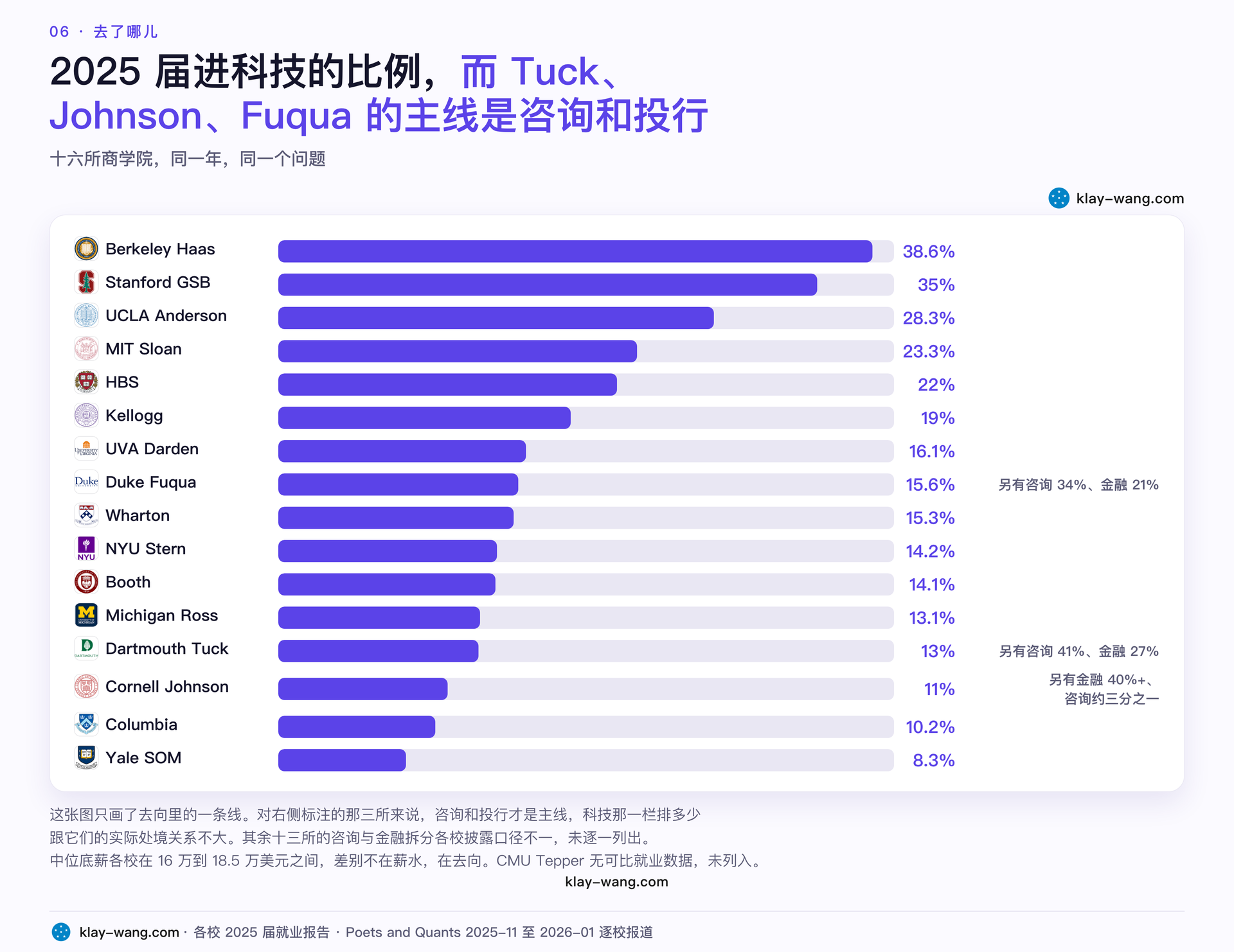
比如对于Dartmouth,按区位数据它四样都很弱:汉诺威连 OEWS 的计算机岗位序列都没有。但是它 2025 届 41% 进咨询、27% 进金融,近七成走的是一条跟本地有没有程序员毫无关系的路。
第二是 Cornell ,伊萨卡 1280 个计算机岗位是十七所里最少的,而它同样超过四成的毕业生进了金融业,康奈尔的那条路,是通向纽约的。
第三是把技术等同于 CS。
AI 改写的是任何一个有大量重复判断、又有大量数据的行业,而生物医药两条都占,蛋白结构、药物发现、临床试验设计,这几年落地最猛的就是这一块。
2025 财年的 NIH 经费,密歇根 7.24 亿美元排全美第四,宾大 7.23 亿第五,耶鲁 6.80 亿第六,斯坦福 6.44 亿第八,杜克 6.24 亿第十,哥大医学口径 5.94 亿第十一,UCLA 5.16 亿第十五。往下还有 NYU 医学院 4.38 亿第十九,西北大学芝加哥校区 4.06 亿第二十一,康奈尔威尔医学院 3.17 亿第二十九,芝加哥大学 2.74 亿第三十七,弗吉尼亚大学 2.31 亿第四十五。
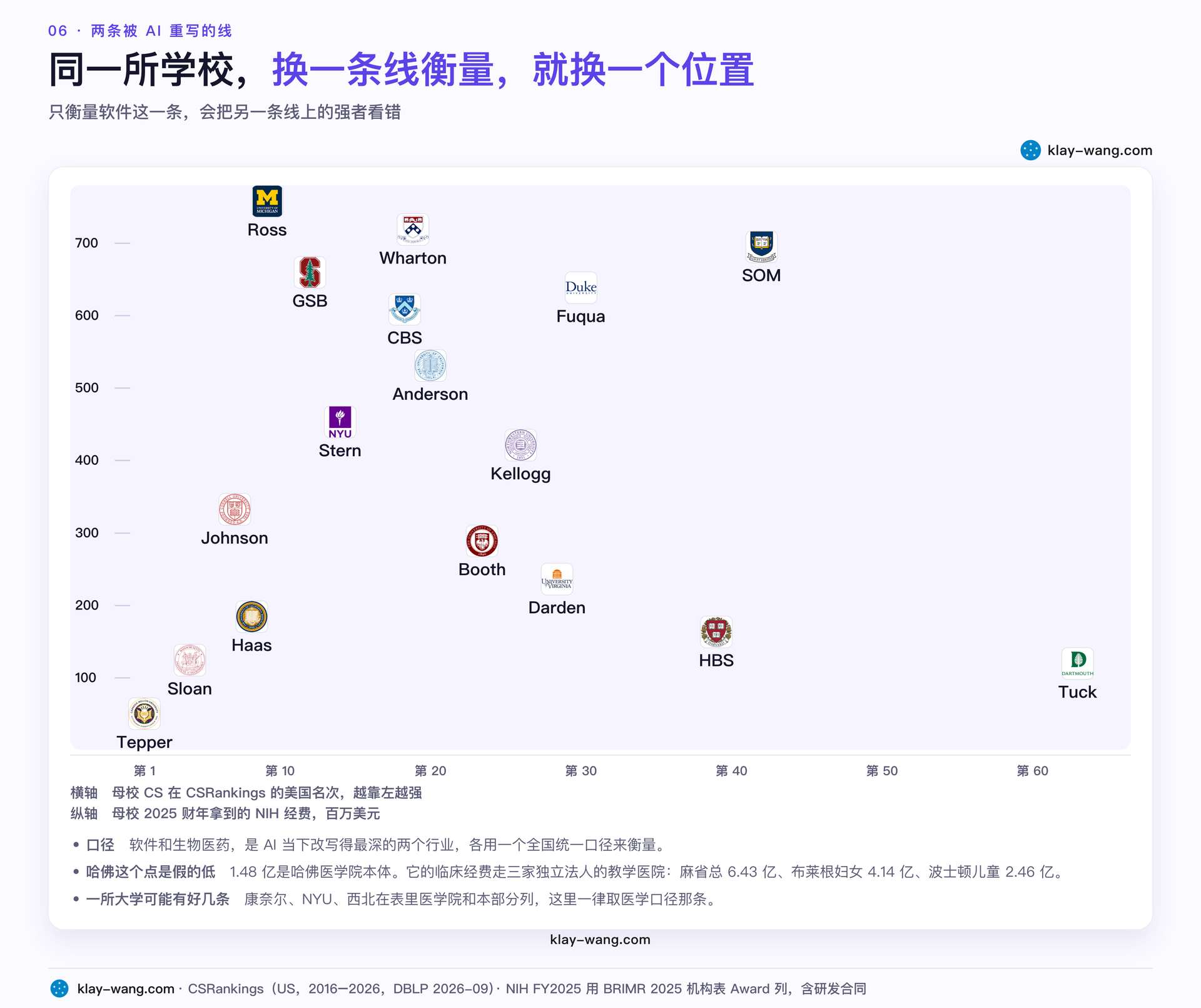
耶鲁的 CS 在 CSRankings 上排第 42,2025 届只有 8.3% 进科技,按 CS 排名它在十七所里倒数第二,只比 Dartmouth 高;按去科技的比例它是最低的。按 NIH 这个维度看,它排全美第六。两个数都是真的。
CMU、MIT、伯克利、达特茅斯都在这张表上,只是都在五十名以外,前三家的共同点是没有自己的医学院和附属医院体系。哈佛的情况是个口径陷阱。哈佛医学院本体排第六十三,1.48 亿,看着不起眼,因为哈佛的临床经费走的是附属教学医院:麻省总医院第九 6.43 亿,布莱根妇女医院第二十 4.14 亿,波士顿儿童医院第四十二 2.46 亿。不过这三家在 NIH 那里是三个独立的获奖法人,把它们相加再去跟单独一个约翰霍普金斯比,两边的机构边界不一样,这个加法不能当成排名用。
按机构一条条排,哈佛的名次很低;按波士顿那片实验室实际在做的事,它的体量被这张表切碎了。加上这一维,十七所大致分成四类。
NIH 那一维,十七所对应的大学都有数,但同一所大学在表里常常分成几个法人,康奈尔的威尔医学院在纽约、本部在伊萨卡是两条,NYU 和西北也是两条,下面统一取了医学口径,因为这一维衡量的就是临床和生物医药。
第一类,本地产业密度厚。GSB、Haas、CBS、Stern、Anderson、HBS、Sloan、Booth、Kellogg ,这九所在 CompTIA 统计的全美前十科技都会区内,另外八所在榜外。这一类的学生不用等毕业,在读期间就能碰到一手的东西。
第二类,本地机会少,但校友网能把人带出去。Tuck 和 Johnson 是最干净的样本。汉诺威连计算机岗位序列都没有,伊萨卡只有 1280 个,可这两所一个把近七成学生送进了咨询和金融,一个把四成多送进了金融。它们卖的是一条修了几十年、把学生送进咨询和金融的通道,本地机会从来不是卖点。
第三类,科技那条线弱,医学那条线强。NIH 经费反映的是大学医学体系的体量:Wharton(宾大第五)、Ross(密歇根第四)、Yale SOM(耶鲁第六)、Fuqua(杜克第十),还有 Darden(弗吉尼亚大学第四十五)。这几所都不在前十科技都会区内,但它们所在的大学在生物医药这条线上都进了全美前五十。
第四类,单一强项突出。CMU 拥有宇宙最强的 CS,Count 值 21.0,第二名连它的六成都不到。但 CMU 没有医学院也没有法学院,匹兹堡的计算机岗位只有 34640 个。
技术能在本地长出来,决定权和资本,却可能留在别处。Argo AI 就是从 CMU 的人才池里长起来的,福特和大众投了数十亿美元,巅峰估值 124 亿,2022 年两家停止投资,公司关门,两千个人里这座城市能就地接住的并不多。2026 年 9 月 30 日,Citadel 创始人肯·格里芬宣布给 CMU 一笔 30 亿美元的捐赠承诺,10 亿给 CMU 匹兹堡本校,20 亿用于筹建 CMU 迈阿密校区。迈阿密是 Citadel 2022 年迁去的全球总部所在地,CMU 的说法是那里的信息技术和金融更集中,能给师生带来不同的合作方。Tepper 商学院代理院长 Laurence Ales 说,风投看着能投到任何地方,其实地理距离起作用,这是一门靠关系的生意。
Darden 最能说明这一维改变了什么。夏洛茨维尔零家五百强、风投季报里没有名字、计算机岗位 4040 个,按前四样看,它是最弱的一所;弗吉尼亚大学的 NIH 经费却有 2.31 亿,全美第四十五。
把范围放大,十七所里有四所不是全科大学。MIT 和 CMU 没有医学院也没有法学院,伯克利没有医学院,达特茅斯没有法学院。另外十三所,斯坦福、哈佛、耶鲁、宾大、哥大、NYU、西北、芝加哥、杜克、康奈尔、密歇根、UCLA、弗吉尼亚,商、法、医、CS、工程五样齐全,只是芝加哥那个工学院 2019 年才有,Pritzker 分子工程学院,起步晚、方向也窄。
AI 不会只改写一个行业,它会一个接一个地改,学科面宽的学校每被改写一次就多一次机会。
但有个现成的反例,就是上一节那个刚出炉的 2027 本科榜。MIT 全美综合第一,而它没有医学院也没有法学院。除了那三项第一,它在生物计算、生物信息、生物技术这个合并方向上也排全美第一,与 CMU 并列。
MIT 走的是另一条路。它没把学科铺全,而是让手上这几样互相交叉。没有医学院,照样拿到了生物学里计算的那一半。所以学科少不一定吃亏,但需要靠几个学科之间交叉,去补学科不全的短处。
还有一维。Dartmouth 本科是华尔街投行的传统目标校,投行每年秋天上门宣讲,学校组织去纽约的 trek,校友网是常春藤里出了名的紧,Tuck 的 MBA 接在这张网上。这张网跟 CS 排名无关,跟本地有多少程序员无关,跟 NIH 经费也无关。它是几十年里一批人互相接电话接出来的,而一个学长愿不愿意接你的电话,取决于他觉不觉得你是自己人。
布迪厄管这个叫社会资本,需要时间,买不来,也没法一个学期抄过去。没有公开数据集在衡量它,但测不出来不等于不存在。它可能是这十七所之间差别最大的一维,也是 AI 最难动的一维。
这十七所在 AI 时代的位置,取决于它们各自押在哪个行业上,以及那个行业什么时候轮到。
07 校友能帮你做什么?
学校、城市和钱之外,还有一群人,没被算进来:校友。国家,组织,高校,公司,都是因人成事,因人废事
一所名校,尤其哈耶普斯麻和 ivy,不是孤零零站在那儿的。它身后是上百年的历史里走出去的 CEO、合伙人、创始人、教授和校董。对这些人来说,母校不只是过去式,它是一张还在流通的凭证。学校越强,他们履历里的那一行越值钱;学校要是持续衰落,这张凭证跟着折价。除了这层利害,还有身份、声誉,和想给下一代留点什么的心思。
当下他们还同时坐在两边。一方面,他们捐钱、给算力、设教席、把公司的真实项目带进课堂、进校董会告诉学校产业在发生什么。另一方面,他们又是买家,提供实习和岗位、维持校招、给学生创业当客户,在招聘标准说不清楚的时候继续信任母校的筛选。
出资人、顾问、渠道和客户,是同一批人,这是名校最难被复制的地方。公开课和 AI的家教,能抄走课程,但无法抄走这个转了上百年的飞轮:学校有声誉,就招到更好的学生;学生毕业后进到更高的位置;这批人回头给钱、给信息、给机会;学校拿这些资源培养下一届;声誉继续涨。校友互相帮衬的网络,跟 VC 之间互相拉进 club deal 是一个道理。
AI 可能掐的正是中间那一环,毕业生进入更高位置那一环。
但这里得分开看,因为这十七所是商学院,不是 CS 系。技术那边,入门级只占软件开发岗位的 4.5%,而今天坐在高位上的人是十年前那批入门级熬上来的。咨询和投行那条路上的证据是反的,Bain 涨 25%,McKinsey 涨 12%,八家投行不缩减分析师。
所以这个循环,在不同的去向上,情况不一样。学生去做技术的那边的确在变窄,去做咨询和投行的那边暂时还没有。哪边更能决定一所商学院十年后的位置,现在看不出来。
现存校友能做的,是用捐赠、招聘和产业资源把变窄的那一头暂时补上。补成了,头部学校的优势会进一步扩大。补不成,只靠老校友维持而没有长出新一代赢家,这个循环会在十年二十年之后慢慢失速。所以名校,和大厂一样,并没有因此安全,它们只是比别人多一次自救的机会,能不能做到,要看下面几件事。
首先是意愿。每一个拿了学位的人都在持有这张凭证,一个大厂 VP、一个投行 MD、一个创始人、一个校董,没有谁希望母校十年后变得不值钱。
校友能给的东西其实只有四样:钱,岗位和实习,时间和关系,声望背书。而学校现在缺的,是能考核学生的人手,和好的地理位置。
钱能换成考核学生的人手,但换得很不划算。上篇里伯克利那笔钱就是个参照,2.52 亿起头再加三笔 7500 万,三亿多美元,绝大部分变成了一栋楼,官方材料里跟这笔钱绑在一起的新教职是两个。钱确实能变成教席,只是一个永续教席要压一大笔本金进去,那笔钱从此锁死,只够养那一个位子。CMU 计算机学院 9 月拿到的 5 亿美元捐赠承诺,公告写到的方向有重新设计计算机怎么教、GPU 等算力、AI 工具和对学生的支持,各自分到多少没有写,其中多少会变成教学和考核上的人手,公告也没说。
岗位这块,难在一个很具体的地方。一个在大厂当 VP 的校友,过去能给母校最实在的帮助,是每年多要几个 headcount 给应届生。如果大科技公司应届招聘大幅减少,这类校友手里能调的坑就跟着少了。校友最想给、也最容易给的那样东西,恰好是 AI 可能正在收窄的那样东西。
以后校友能给学生最稀缺的,除了一个岗位,还有一段真正的学徒期:接触客户、处理例外、参加复盘,并对一小块结果负责。
还有一个错位:捐赠的方式跟学校缺的东西,不匹配。楼可以刻名字,一笔助教工资刻不了名字。口试时间、监考人力、当面追问,这些全是经常性支出,年年要花,月月要有,是现金流,没有剪彩仪式,而学校缺的正是这笔运营预算。楼和设备更容易被看见、被冠名、被统计,在媒体报道里也更显眼。
十七所里有十二所的名字来自某位捐赠人或他的基金会,Wharton、Booth、Kellogg、Sloan、Haas、Stern、Anderson、Ross、Tuck、Johnson、Fuqua、Tepper。冠名的价也能看出时间,J.B. Fuqua 1980 年出一千万美元,杜克商学院改叫 Fuqua;Tepper 2004 年出 5500 万;同一年 Ross 出一亿。二十四年,名字的价钱涨了十倍。冠名的钱也不是全进了楼,Ross 2017 年又给了五千万,学校公布的拆分里只有一千万进校园建设,一千六百万给教师支持,八百万做学生投资基金。
商学院的名字,是一张过去的富豪榜。
比钱更难的是,大学收到的是个人给的资源,要真正用起来,得先变成学校自己能年年做下去的事,而这一步最容易卡住。请一位 CEO 来做一场演讲很容易,把他公司的真实项目嵌进一门课、配上助教、设计考核、年年重开,是另一回事。收到一笔捐赠不是结束,把它变成教师、算力、考核和学生机会,才是开始。何况很多捐赠被限定了用途,学校未必能挪去做最该做的事。
之前Garry Tan 讲的是同一件事。他说一家组织如果不能把成功的做法沉淀成可以反复调用的东西,无论模型多好,每天早上醒来都是失忆的。大学是这条规律最老的样本。一场讲座结束,那位 CEO 带来的东西就随他走了,只有被写进课程、写进实习管道、写进招聘关系的那部分才留得下来。
上一代赢家回来帮学校守住的,可能恰恰是上一代的成功模式。一个靠二十年前那套路径做到高位的人,他的经验有多少还适用于今天,谁也说不准。校友既可能是转型的推力,也可能是旧体系最坚固的支持者。而且他们更容易关心排名、冠名和声誉,学校真正需要动的却是课程、考核和教师激励,后面这三样没有任何一样能做成剪彩仪式。
同样的好心,在不同的地方能兑现多少也不一样。湾区学校的校友就在湾区的公司里,他给的岗位、实习、一杯咖啡,在本地当场就能兑现。弱区位学校的校友,本地能兑现的那部分自然少,因为本地本来就没那么多公司,他给的岗位落在别的城市,引荐也可能发生在外地。这对学生有用,对学校所在地的产业没用。
所以校友这一项,不会让钱和机会变得没那么集中。哈佛 569 亿对达特茅斯 90 亿那个 6.3 倍,是几十年的捐赠本金和长期投资回报一起滚出来的,有钱,很多时候真的可以“为所欲为”。
校友能帮的事很多,设教席、建研究中心、出创业基金、给奖学金、把公司课程搬进来、开数据合作。跟区位有关的是两条:把产业搬过来,或者把学生送出去。其中一条一直有效,而且恰好是弱区位学校在做。
第一条很难。Argo AI 就是标本,技术长在匹兹堡,决定权和资本在其他地方,两家车企一撤资,公司就没了。但匹兹堡的机器人公司并没有跟着消失,NREC 周边那一片还在,所以 Argo 证明的是单家公司扛不住外部资本撤退,不是产业搬不过来。
第二条一直有效。Tuck 2025 届 41% 进咨询、27% 进金融,Johnson 40%多进金融,而这两所所在的汉诺威和伊萨卡,在六份风投季报里是零命中。这说明这两所建成了一条跨地区的就业通道。这条通道把人运出去,没有把产业运进来。第三条路是 CMU 迈阿密校区准备试的,学校自己去另一座城市。按当前计划,拿到监管批准后,2028 年先招研究生,本科再晚四年。这条路能不能走通,要看规划中的近 300 个教职能不能招满。
判断一所学校安不安全,知名校友的数量最容易数,也最不说明问题。我觉得核心,得看校友的心意,能不能变成学校实际做的事。那位校友 CEO 是一次性站台还是持续参与,钱进了楼还是进了教师和课程,校友给的是建议还是真实项目和岗位,学校有没有因为产业反馈改过培养和考核,以及这些最后有没有反映在毕业去向上。
这套说法有个能推翻它的条件。如果未来三年有哪所弱区位学校,靠校友把一个真实产业锚在了本地,让那座城市的风投笔数和五百强总部数真的动起来,捐一栋楼不算,那可能需要重新衡量。CMU 迈阿密校区它是异地新建,说明不了产业能不能锚在 CMU 匹兹堡本校周围。目前没见到这样的例子。
捐钱给母校的人,很少有人是在做投资决策。多半是在还一笔他认为自己欠下的债,或者想让今天的学生少走一点他当年走过的弯路。但是,学校现在缺的那样东西,靠捐款买不到。美国高校史上最大的一笔个人捐赠,出钱的人并不是 CMU 校友。格里芬读的是哈佛,2015 年起通过 Citadel 资助 CMU,CNN 把这笔捐赠写成他押注佛罗里达的一部分。他还将进入 CMU 校董会。
AI 把知识的门槛压低了,却可能把信任和关系的门槛抬高了。学校的教学价值正在被重新定价,而头部学校那张校友网可能因此更值钱。剩下的问题只有一个,这些校友资源,学校能不能真正用起来。
08 对于个体意味着什么?
在大厂的员工,不能只看公司部署了多少 AI 工具,看层级有没有动。层级没动,不等于没价值,可能它还停在组织惯性,效率、质量或者交付周期那一层。哪些岗位开始不再搬运信息,谁拿到了最终签字权,哪些团队把一次成功的做法沉淀成了能反复调用的东西,这些才更有价值。还可以自查一下:把下面的事收上来、压成一页、递上去,这类活每天占你多少时间。占得越多,可能越危险。
金融行业的从业者,更快写完备忘录护不住你,模型比你快。要看你离交易、离客户、离风险承担有多近。八家投行对路透说他们不缩减分析师,理由是 AI 生成的模型和 pitchbook 还不能直接交给 CFO,那句话的重量全压在交给两个字上。没有扣扳机的机会,再漂亮的分析,也无法成为判断。
在创业的人,先要看客户的预算表和现金流。有人已经在为这段工作花钱,你才有机会把整项任务接走,YC 那个端到端从 10% 涨到超过 25% 说的就是这个。合同里还要写清楚出了问题谁负责,这一条现在比选哪个模型重要得多。另外,硬科技从 8% 涨到 20% 这个数值得认真看一眼,如果行业经验本身长在一个有物理世界、有监管、有真实数据的地方,那,现在正是最缺人做的地方。
09 写在最后
上一篇,我们留的问题是,市场在买哪一种证明。两种它都不太买,它买的是证明之外的东西:判断、上下文,和出了事有人担责。
投资人、企业的老板、顶级孵化器,在三个位置上说的是同一件事。会不会干活的差距缩小之后,有没有经验的差距露了出来。
管理层级和入门岗位哪个先被砍,现有数据指向入门岗位。过去用来练新人的那些活,可能正在交给 AI。这对刚毕业的人是坏消息,对干了二十年的人是好消息,而这两拨人恰好都不是商学院和 CS 系招生简章上画的那个人。
未来两三年,这套判断成立与否,我觉得可以看四个数:
一是单人创始人的占比会停在20% 左右,还是继续往上。继续往上,说明创业不用先凑齐人这件事还在往前走。 二是软件开发里入门级岗位的占比会不会从 4.5% 回升。这是整篇里最要命的一个数,它不回升,十年后的高级工程师就是一笔没人认领的欠账。 三是湾区风投,占全美的比重会不会从 77.5% 回落。要连着几个融资周期都往下走,才动摇得了湾区的地理优势;单看一两个季度,回落也可能只是那几笔巨额融资的基数消失了。 四是有没有一所非湾区的学校能证明,线上接触可以拿到跟实地同等质量的机会。
还有一点很重要,这篇放不下了,下一篇专门写:当一个中层可以带十个 agent,新人过去练手的活被机器接走,公司会变小、变扁,还是把权力集中到更少的人手里?
伯克利用纸笔守住的,和 YC 花钱买的,是同一样东西:不可替代的判断,和只能用时间攒出来的信任。
这两篇数了很多表,课表、榜单、经费、岗位、都会区。但每一格数字底下都是人。一个决定把考试改回纸笔的老师,一个不肯给自己的系扩招的系主任,一个六十岁了还在给母校写支票的人,一个今年毕业才发现学长那条路已经没了的人。AI 换掉的是工具,运转这套东西的、参与的、被席卷的,从头到尾都是人。
最后留一句 Garry Tan 的话:模型的能力是租来的,你自己的大脑才是你自己的。这句话对公司成立,对人也成立;而那个大脑长在哪座城市里,比它长在哪所学校里更要命。
如果你正在这十七所里的任何一所,或者正在替谁做这个选择,我很想知道你会先看哪一样。
数据附录
2025 年风险投资(PitchBook-NVCA Venture Monitor 四个季度相加,合计为本文计算):湾区 1851 亿美元 / 2702 笔,纽约 356 亿 / 1809 笔,洛杉矶 175 亿,波士顿 155 亿,西雅图 65 亿,费城 46 亿 / 575 笔,芝加哥 26 亿 / 311 笔(Crain's 引 PitchBook-NVCA 口径),匹兹堡 22.9 亿(其中机构风投 20.6 亿 / 63 笔,来自 Innovation Works 与安永第十四届年报)。纽黑文、夏洛茨维尔、汉诺威、伊萨卡、安娜堡、底特律六份报告零命中。
《财富》500 强总部数(2026 年起官方不再发布都会区拆分,以下来自七个区域性来源、七套口径,只能看数量级):芝加哥 30,纽约 49(康州单算口径;按更大的联合统计区是 62),圣何塞 21,旧金山 14,波士顿 14,匹兹堡 10,费城 9,纽黑文 1,夏洛茨维尔 0。
计算机类岗位(BLS OEWS 职业口径,参考期 2025 年 5 月):纽约 328950,西雅图 194970,旧金山 156010,圣何塞 149970,芝加哥 131320,波士顿 128180,费城 89100,匹兹堡 34640,达勒姆 25070,安娜堡 8410,纽黑文 5300,夏洛茨维尔 4040,伊萨卡 1280。汉诺威不属于任何都会统计区,无序列,最近的可引数字是 Manchester 的 9210。
CSRankings 美国院校名次(all areas,2016 至 2026 窗口):CMU 1,MIT 5,Cornell 与 Berkeley 并列 7,Michigan 10,Stanford 12,NYU 14,Penn 18,Columbia 19,UCLA 20,Chicago 24,Northwestern 26,UVA 27,Duke 30,Harvard 39,Yale 42,Dartmouth 63。
教育服务与医疗社服占 QCEW 覆盖岗位的比例(BLS QCEW,2026 年 3 月;数的是岗位不是人,多份工作者分别计入):伊萨卡 52.0%,汉诺威 43.1%,夏洛茨维尔 42.4%,纽黑文 38.8%(其中私立教育服务 30176 个岗位)。
NIH 经费 FY2025(BRIMR 机构表 Award 列,单位亿美元,括号内为全美名次):Michigan 7.24(4)、Penn 7.23(5)、Yale 6.80(6)、Stanford 6.44(8)、Duke 6.24(10)、Columbia 医学 5.94(11)、UCLA 5.16(15)、NYU 医学院 4.38(19)、Northwestern 芝加哥校区 4.06(21)、Cornell Weill 3.17(29)、Chicago 2.74(37)、UVA 2.31(45)。哈佛医学院 1.48(63),其教学医院另计:麻省总 6.43(9)、布莱根妇女 4.14(20)、波士顿儿童 2.46(42)。Berkeley 1.46(66)、MIT 1.34(70)、Dartmouth 1.04(81)、CMU 0.35(176)。
捐赠基金 FY2025(NACUBO-Commonfund 口径):哈佛 569 亿美元,耶鲁 441 亿,斯坦福 408 亿,宾大 248 亿,密歇根 200 亿出头,哥大 159 亿,西北 152 亿,杜克 123 亿,康奈尔 118 亿,芝大 106 亿,达特茅斯 90 亿。
出处
YC:Lightcone 播客 The State of Startups in 2026,Y Combinator 官方 YouTube,2026-09-17,https://www.youtube.com/watch?v=yslXlV2BP_Y 。knowing what to build is becoming more important than simply knowing how to build it 这句,以及经验型创始人在回潮那节标题,出自该期官方简介与章节列表,不是某一位嘉宾的口述。文中引语均出自该期。Diana Hu 与 Jared Friedman 的头衔据 https://www.ycombinator.com/people 与 YC 官方博客 2026-06-11。 Ali Ghodsi:a16z 播客,对谈 Martin Casado 与 Sarah Wang,2026-09-18,https://www.youtube.com/watch?v=GzEtpAKYRvE 。该视频有两个标题在流通,以链接与日期为准。 Garry Tan:Every company should have a Brain,AI Engineer World's Fair,AI Engineer 官方频道,2026-07-17,https://www.youtube.com/watch?v=eBUyTS7SzV4 。注意他 2026-08-06 在 YC Startup School 另有一场内容重叠但措辞不同的演讲,本文所引全部出自 7 月这场。 宏观数据:Indeed Hiring Lab 2026-07-23;SignalFire State of Talent 2026-06-22;Stanford Digital Economy Lab, Canaries in the Coal Mine, 2026-08-12 修订版;FRED 序列 IHLIDXUSTPSOFTDEVE 至 2026-09-11;blog.google 2026-04-22。 匹兹堡:TechCrunch 2022-10-26 与 Smart Cities Dive(Argo AI 停运、福特与大众撤资、约两千名员工、巅峰估值 124 亿美元);The Robot Report 引 Aurora CEO Chris Urmson;CMU Tepper 2022-23 届 MBA 就业报告地理分布。 校区:Poets and Quants 2025-10-23(沃顿 555 California 新校区)与 2025-05-02(西北大学关闭旧金山校区、Kellogg SF Immersion 保留);executivemba.wharton.upenn.edu 旧金山校区页;kellogg.northwestern.edu San Francisco Winter Quarter 页。 财务:NACUBO-Commonfund 2025 年度捐赠基金研究(FY2025 市值,657 所参与机构合计 9443 亿美元);各校 FY2025 捐赠基金数据经 NACUBO 口径转引;NSF NCSES《Higher Education Research and Development Survey》FY2024(全美高校研发支出 1175 亿美元,联邦占 55%,机构自筹约 25%);斯坦福 FY2025 资助研究收入与联邦占比见 facts.stanford.edu;NIH 经费 FY2025 用 Blue Ridge Institute for Medical Research(BRIMR)2025 机构表,表名原文 All Funded Institutions including R&D Contracts,含研发合同,底层为 NIH RePORT 2025 财年年终合成数据,取表中 Award 列,https://brimr.org/brimr-rankings-of-nih-funding-in-2025/ ,文件 Institution_2025.xlsx,2026-09-27 下载核对。同一所大学在表里可能分成几个法人条目,本文取医学口径那条,附属教学医院单列。 区位:CSRankings(all areas / US only,2016–2026 窗口,底层 DBLP 2026 年 9 月版,2026-09-22 浏览器实时读表);US News《Best Graduate Schools》2026 版 Best Computer Science Schools(同行声誉问卷,研究生口径);US News《Best Colleges》2027 版本科榜,2026-09-22 发布(MIT 首次全美综合第一,新增 Earnings by Major 指标占总分 5%,顶替原毕业生负债项,数据源为教育部 College Scorecard);PitchBook-NVCA Venture Monitor 2025 四期与 2026 Q1–Q2;Innovation Works 与安永第十四届匹兹堡年报 2026-03;CED《2025 NC Venture Report》2026-02-24;Fortune 500 Explorer 2026-06-03 与 Philadelphia Inquirer 2026-06-04、Pittsburgh Business Times 2026、AdvanceCT 2026-06-04、Virginia Business 2026-08-02;BLS QCEW 2026 年 3 月、CES 2026 年 8 月初值、OEWS 2025 年 5 月;CompTIA State of the Tech Workforce 2026;Brookings《America's AI boom is concentrating in a few metro areas》2025-07(387 个都会区六档分类);PitchBook University Rankings 2026(官网 403,用 Poets and Quants 2026-09-08 转载并逐行核对)。 校友与冠名:Bloomberg Philanthropies 与 washingtonpost.com 2018-11-18(JHU 18 亿美元)、forbes.com 2024-07-08(10 亿美元医学院学费);news.stanford.edu 2016-02-23(Knight 4 亿美元);news.umich.edu 2013 与 Poets and Quants 2017-09-20(Ross 三笔);cmu.edu 2004-03-19 与 cmu.edu/homepage 2013(Tepper 两笔);fuqua.bulletins.duke.edu 学院史(J.B. Fuqua 一千万美元,1980 年冠名);trustees.duke.edu(Tim Cook 为杜克校董、Fuqua 1988 届,未查到其对杜克的大额捐赠)。十二所的冠名归属据各校官方校史页,本文只对上述三所给了有据可查的金额与年份。 CMU 与格里芬:30 亿美元捐赠承诺、两地分配、CMU 迈阿密校区规模与学术设计、计算机学院 5 亿美元用途与冠名、2015 年起的资助关系,见 CMU 2026-09-30 总公告 https://www.cmu.edu/news/stories/archives/2026/september/carnegie-mellon-university-announces-historic-3-billion-gift-from-ken-griffin-pioneering-a-new-model ,计算机学院公告 https://www.cmu.edu/news/stories/archives/2026/september/500m-gift-will-fuel-next-era-of-computer-science-at-carnegie-mellon ,CMU Miami 学术设计页 https://www.cmu.edu/news/stories/archives/2026/september/higher-education-gets-a-new-model-cmu-miami ,格里芬与 CMU 关系长文 https://www.cmu.edu/news/stories/archives/2026/september/griffins-landmark-gift-will-shape-the-future-of-higher-education ;迈阿密的选址理由与 Laurence Ales 的说法,见 CMU 两城专题 https://www.cmu.edu/news/stories/archives/2026/september/two-cities-one-cmu ;2028 年先招研究生、本科晚四年,见 Reuters 2026-09-30,whtc.com 转载 https://whtc.com/2026/09/30/citadels-griffin-donates-3-billion-to-carnegie-mellon-with-plans-for-miami-campus/ ;Citadel 2022 年宣布把全球总部迁到迈阿密,见格里芬致员工信,fortune.com 2022-06-23 全文刊登 https://fortune.com/2022/06/23/read-the-memo-ken-griffin-sent-to-citadels-employees-outlining-the-companys-plan-to-leave-chicago-for-miami/amp ;格里芬 1989 年哈佛本科毕业,见 https://alumni.harvard.edu/stories/legacy-for-financial-aid ;美国高校史上最大个人单笔捐赠,见 Bloomberg 2026-09-30 https://www.bloomberg.com/news/articles/2026-09-30/ken-griffin-s-3b-carnegie-mellon-donation-is-biggest-single-gift-ever ;押注佛罗里达是 CNN 2026-09-30 标题的表述 https://www.cnn.com/2026/09/30/business/ken-griffin-carnegie-mellon-donation-miami ,非 CMU 或格里芬的说法。 配图里的入学与招聘数据:National Student Clearinghouse 2026-08(四年制本科 CS 在读人数同比 −8.4%,本科总数 +1.3%);classes.berkeley.edu(CS 61A 注册人数 2025 秋 1269、2026 秋 1469,容量 1750);Karat 2026(允许技术面试用 AI 的雇主比例,美国 38%、中国 68%)。 反面论证:Poets and Quants 2025-11-25、2025-10-16、2025-09-15;cityam.com 2026-06-01;Reuters Breakingviews 2026-06-29。
When knowledge and execution keep getting cheaper, why is an elite degree still worth $300K to $400K?
Once getting the work done gets cheap, what companies pay for changes. Getting the work done used to be the product. Now it isn't enough: they also need judgment about the industry, a feel for how the work actually flows, and someone who answers for it when things go wrong.
All three share the same problem. They take time, you have to be patient with them, they can't be taught in a classroom, and they only grow inside specific companies in specific cities.
So AI shrinks the gap between people who can and can't do the work, and widens the gap between which city and which company you're in.
Part one was about how schools teach (the supply side). This one is about what the market wants (the demand side).
01 What the market is betting on
I recently listened to a YC podcast released on September 17, 2026, called The State of Startups in 2026. At the mics were YC President & CEO Garry Tan, Managing Partners Diana Hu and Jared Friedman, plus Harj Taggar.
Diana Hu said on the show that about 5% of the companies they used to accept were solo founders, and now it's 18 to 19%. Garry Tan followed up: almost one fifth of the batch. It used to be one in twenty; now it's one in five. That's YC's own data, but behind it are companies picked out of thousands of applications a year and backed with real money.
Diana Hu added that this was the highest spike they had ever seen. Her baseline is what she called the past; against that baseline, it's nearly a fourfold jump.
Diana also gave three more numbers: hard-tech companies went from 8% of the batch to 20%. The show broke that down: robotics from 1% to 6–7%, industrial and manufacturing from 4% to 10%, defense from 1.5% to 5%.
Jared Friedman added that in the current summer batch, one in six founders has a PhD, more than at any point in YC's history. Revenue is growing faster too. Median revenue at acceptance is zero; median monthly revenue by the end of the batch used to be about $8000 and is now $20K, and some companies go from zero to seven figures in three months. What they sell has changed as well: the share of companies doing full-stack, end-to-end work, or simply completing a task outright, went from 10% to more than 25%.
Why are solo founders taking off? A co-founder used to be about complementary skills, especially on the building side. Writing code, prototyping, iterating on the product, chasing bugs, testing and deploying used to take several people working together, which meant organizing them. Now one person running a few coding agents really can get it off the ground.
That doesn't mean you'll never need a team, and YC is explicit that plenty of successful solo founders add people later. What changed is the timing. You used to need the team assembled before you could start; now you start running and find people along the way.
If that were the whole story, the conclusion would be that the AI era belongs to the young, since young people clearly pick up tools faster. But YC sees the opposite.
The official description they wrote for the episode includes this line: knowing what to build is becoming more important than simply knowing how to build it. The chapter list in the same description has a section titled, simply, why experienced founders are coming back.
Picture a 20-year industry veteran. He knows the customers cold, knows where it hurts most, knows what everyone tried over the past decade and what failed. But he can't code, and hiring a full engineering team is too expensive, so all that experience never turned into a product. Now AI has arrived and fills the piece he was missing. Everything he built up over all those years is still there, and with a little learning he can patch the weak spot himself.
Once AI narrows the gap between those who can and can't do the work, the gap between those with and without experience stands out instead.
The edge young people have is energy, picking up new tools fast, the ability and willingness to embrace change; but picking up new tools is exactly the thing AI is also doing for you. People who have been through a full industry cycle know what isn't worth doing at all, and models can't do that for you, especially when real business judgment is involved. A not-to-do list matters ten thousand times more than a to-do list.
What makes experience valuable isn't the twenty years themselves. It's how many wrong options and wrong answers the potholes you hit over those twenty years have crossed off for you.
Hard tech tells a similar story, and it's just as counterintuitive. Plenty of people assumed that with AI, starting a company would get lighter and lighter, and everyone would build software and agents. But robotics, chips, and data centers all sit on top of software, algorithms, simulation, and engineering teams, and AI is stripping those costs away layer by layer. Things only big companies could afford are now within reach of small teams. Once software gets cheap, capital flows to whatever hasn't gotten cheap yet: the physical world, domain expertise, real data, and industry judgment.
YC is now publicly putting experience up front. But these numbers measure the solo-founder share, the hard-tech share, revenue, and the share of PhDs; none of them directly measures how many years founders have worked. So, strictly speaking, what they reflect is that YC's preferences have changed.
02 Execution gets repriced first
On September 18, Databricks co-founder and CEO Ali Ghodsi went on the a16z podcast with partners Martin Casado and Sarah Wang. He was also one of the original authors of Apache Spark, and he has spent years helping big companies wire AI into production.
He talked about enterprise ontology (turning how a company actually works into a map of relationships that AI can understand), and his example was small. Two people of similar ability, one who started today and one who has been at the company five years: why does the second get things done so much faster? In his words, the one who has been there five years has an ontology of how that organization works, who the people are, how you get stuff done.
That map isn't in the org chart, and it isn't in the database. Who to go to for what, who is nominally in charge but can't actually move anything, which processes say one thing on paper and run another way in practice, why certain projects got killed, what the boss really cares about. Data tells AI what happened; this map tells AI how those things relate to each other.
So companies using AI today run into an absurd situation: in theory AI has all the knowledge in the world, but none of your company's common sense, or call it your workflow.
Later he got to organizations. A company is a tree, and information travels up and down it. If you can't make a call, you pass it up to your boss; the boss has to figure out what happened and fill in the context before deciding; once the call is made, it travels back down the tree level by level. With that ontology map, he said, a big part of this can now be handed to AI.
In terms of actual people: the employee reports to the manager, the manager adds context and reports to the director, the director compresses it again, and on up to the VP and the CEO. A lot of management roles spend their day gathering what's happening below, compressing it into one page, and passing it up. Many layers in a company are, at bottom, an information relay station built out of people.
It had to work that way, because there's a limit to how much any one person can hold. But if AI knows every meeting, project, person, number, and piece of history in the company, then knowing what's going on rapidly loses its value.
It used to be that the higher your title, the more you knew. Once context is something anyone can look up, status built on information asymmetry starts getting challenged. What changes is this: who can make the call with incomplete information, who dares to kill a direction that already has money in it, who dares to take the blame when something goes wrong.
By that logic, what gets squeezed first may be management work that only gathers, compresses, and relays information. Ghodsi himself didn't spell that step out, and the data we have only shows junior hiring; whether middle management is actually shrinking can't be confirmed yet.
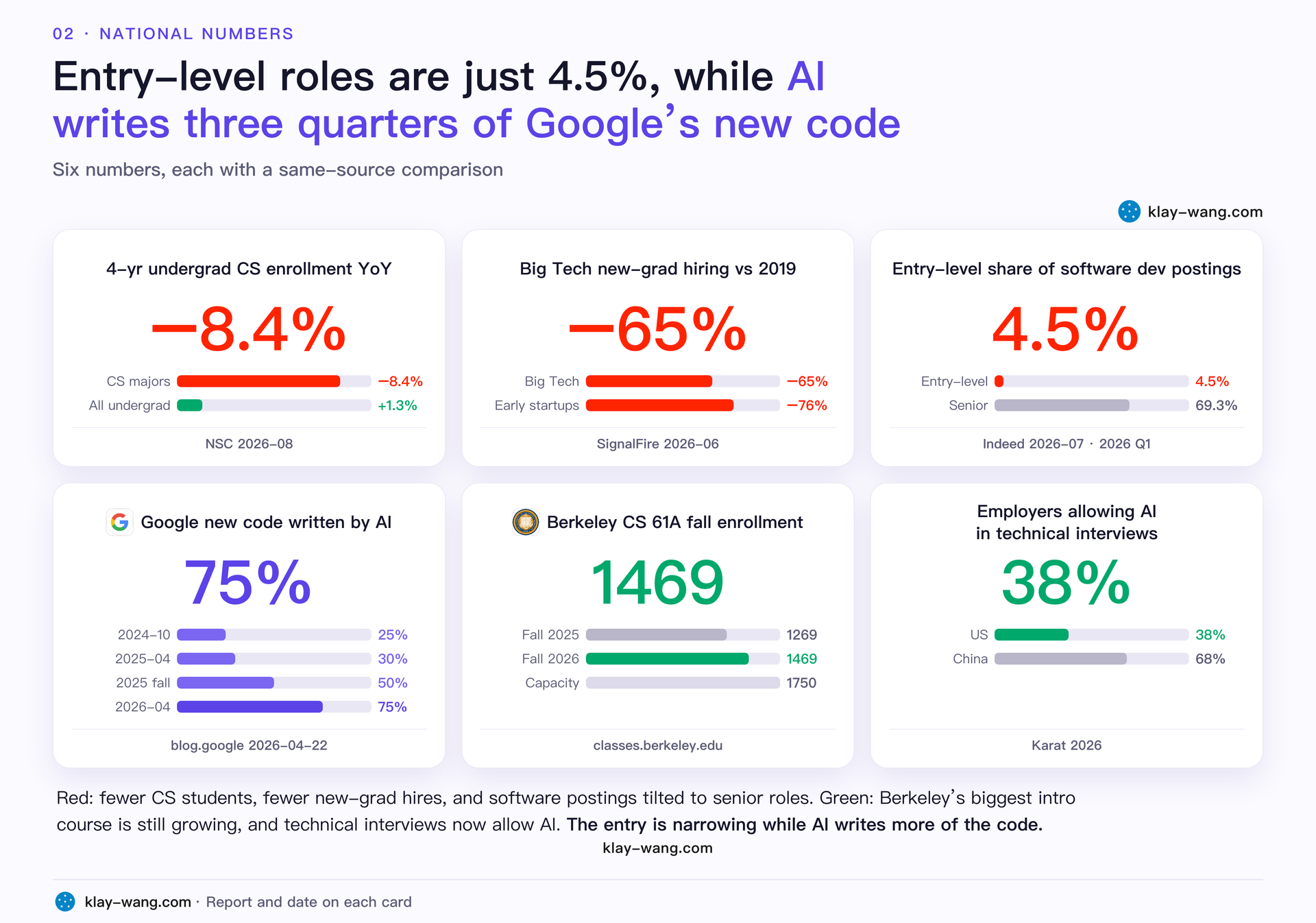
The data we can see is at the junior level. Indeed Hiring Lab data from July 2026 show that in Q1 2026, entry-level roles made up only 4.5% of software development postings, while senior roles made up 69.3%. SignalFire's June 2026 report found big tech hired about 65% fewer new grads than in 2019, and early-stage startups 76% fewer. A Stanford Digital Economy Lab paper updated in August 2026 found employment for 22- to 25-year-olds in highly AI-exposed occupations was 19% below where their peers' trajectory would predict, mainly because of fewer hires, not layoffs.
Going by the data alone, execution is what gets repriced first.
But if entry-level roles are only 4.5% of the market, where do senior engineers come from ten years from now? The people sitting in today's 69.3% of senior roles are the juniors of ten years ago who worked their way up step by step. The parts of entry-level work that look least efficient, fixing other people's bugs, reading legacy systems nobody wants to read, arguing back and forth with customers over requirements, are exactly how a person slowly comes to understand an industry.
AI may now be narrowing that path. Companies save on training costs today and owe the people ten years from now. And there's a difference here I've seen firsthand across different kinds of organizations: professional services firms and large corporates won't absorb this the same way.
Firms like BCG have plenty of levels. Not long ago I was catching up with a close friend and heard for the first time that above partner there are different grades of partner, which made my head spin. But the production line there has always been an apprenticeship: new hires work on projects, move steadily closer to clients, and build judgment and trust one engagement at a time. As AI eats the bottom layer of analysis, it may thin out that training pipeline along with it.
Corporates are different. Big companies have tens of thousands, even hundreds of thousands, of people. Cut the junior layer and how do middle and senior people get promoted? You can't parachute everyone in, can you? In theory you could, but a corporate is fundamentally a trust problem, not just a capability problem. You can parachute people in or outsource everything, but accountability and trust still have to rest with real people; someone has to hold cross-functional work and responsibility together. With far fewer junior roles, what's missing in ten years may be not just senior engineers but people the organization is willing to hand decisions to. Outside hires can fill headcount, but they can't instantly replace the credibility someone has built inside a company over years.
A company's problems are very often organizational problems, and an organization is just its people.
Who's writing the code, at least, is clear. Google's official blog said on April 22, 2026 that 75% of Google's new code is now AI-generated and reviewed by engineers, up from 50% in fall 2025; in October 2024, Pichai's words were more than a quarter. Ghodsi is blunter: more than 90% of the software at Databricks is written by AI.
Ghodsi also has a view that cuts against this piece: he doesn't think this road leads to superintelligence. He said he sees no evidence that we're heading toward superintelligence; what he observes is that training is getting longer, more brittle, and more people-intensive. Coming from someone who sells an AI platform, that carries more weight than it would from a safety researcher.
03 Skills you can write down
On July 17, Garry Tan gave a talk at the AI Engineer World's Fair titled Every company should have a Brain.
In 2013 he was an engineer at YC building an internal social network, and by his own count, only about 14 lines of usable logic per day actually stayed in the project. Today he barely writes code full-time, and by his account his output is up about 400x. Here's how he put it: the people getting 2x and the people getting 100x are using exactly the same Claude, the same weights, the same context window, the same API. So the difference isn't in the model; it's in how you connect the work. The verb he uses is wire.
Then he mapped the parts of an agent system onto the parts of a company, every last one. A skill file is an employee: it has one capability and one job, written clearly enough that someone else could follow it. The resolver table is the org chart, deciding who handles each incoming task. Filing rules are internal processes. Trigger evals are performance reviews.
It works the other way too: any part of an employee's work that can be written down clearly enough for someone else to follow can become a skill file. What people still add is concentrated in handling exceptions, updating the rules, and owning the consequences.
He mentioned that in the Winter 25 batch, a quarter of the companies had codebases that were 95% AI-generated, and that batch became the fastest-growing, most profitable batch in YC history.
But he didn't stop at writing the organization into files; he went on to a harder question. However big the context window gets, it can't hold an entire company. Your company is a library, he said, not three books spread out on a desk. What decides whether your agent is a genius or a goldfish is who is picking which three books go on its desk right now; how smart the model is comes second.
A company brain isn't as simple as setting up an internal knowledge base. Retrieval keeps getting cheaper. The hard part is what deserves to be written down, what should be thrown out, and which fact wins when two of them conflict.
What stings for a lot of companies is this: you spend your days on which model to pick and how to set up a vector database, but the most valuable knowledge your company has may never have entered any system. It's still sitting in the boss's head, the top salesperson's head, the ten-year veteran's head. When an employee leaves, the company may lose its memory. Every company has this kind of amnesia; nobody books it as a loss.
When someone with eight years at the company leaves, the company counts recruiting costs and handover time. What the map that existed only in their head was worth is hard to quantify.
His advice is concrete: never do one-off work. You ask AI to write a plan; the first draft isn't good so you fix it, the second isn't good so you fix it again, finally you're happy, and most people stop there. He says that's wrong. There's one more step: turn the method that just worked into a skill you can call again and again. If you have to teach AI the same thing a second time, the first time was a failure, because you finished the task without keeping the capability.
His words: Model quality is rented, but if you build your brain, you own that brain.
Put what YC, Ghodsi, and Garry Tan said side by side, and the market now wants three things: judgment about what to do and what not to do, the know-how that only exists inside a company, and people who will answer for it when things go wrong.
All three take time to build. A school can teach frameworks and cases for judgment, but it can't help an individual make real calls inside a real company again and again, get some of them wrong, and live with the consequences.
So why should a school charge you $300K-plus, even $400K?
04 All three live somewhere specific
A school can't give you those three things directly, but it can shape or even decide who you spend your days with and which companies' doors you can walk through after you graduate.
A city offers a density of chances to run into opportunity; whether those chances turn into experience depends on how a company organizes its work. A school can get you into a company, but whether anyone mentors you once you're in, whether you get near customers, and when you're handed real decisions determine what a degree is finally worth.
Ghodsi says the person with five years at a company has a map of how it works. That map comes from the people you run into every day, the things you overhear, the potholes you hit. And who you run into and what you overhear depends on where you are, who's in the same building with you every day, and which companies' doors you can walk through after graduation.
So to judge what a city is worth to a student, look at four things: whether there's a group of people next door or nearby who can build things right (people), whether there's funding (capital), whether there's a real industry (industry), and how many jobs there are (jobs). The full table is in the appendix at the end.
According to the Venture Monitor from PitchBook and NVCA, in 2025 the Bay Area took $185.1 billion across 2702 deals, New York $35.6 billion across 1809, followed by Los Angeles, Boston, Seattle, Philadelphia, Chicago, and Pittsburgh. And then nothing. New Haven, Charlottesville, Hanover, and Ithaca don't appear once in the full text of all six Venture Monitor reports.
Yale is in New Haven, Darden in Charlottesville, Tuck in Hanover, and Cornell's main campus in Ithaca. The cities these four schools sit in have no name in the report. Not being named doesn't mean there's no investment locally; it means they don't clear the report's threshold for being named.
Industry looks similar. New Haven has exactly one Fortune 500 company, Amphenol, a connector manufacturer headquartered in Wallingford, ranked 198th on the 2026 list. Charlottesville has zero, and that zero is verified, not a gap in the search: Virginia Business magazine's August 2026 list of in-state companies has none in the Charlottesville metro. A Darden student spends two years in this city and pays $200K-plus in tuition, and in those two years never walks past a single Fortune 500 headquarters.
The employment mix of college towns tells you even more. In Ithaca, educational services plus health care and social assistance make up 52.0% of QCEW-covered jobs; Hanover 43.1%, Charlottesville 42.4%, New Haven 38.8%, with private educational services alone accounting for 30176 jobs there, Yale being the biggest employer among them. In Ithaca, one of every two jobs QCEW counts is in education, health care, or social assistance.
Whether that number is good or bad depends on where you plan to stay after graduating. Those who want to stay will find the city's employer base leans heavily on the university and the hospital. By the BLS CES count for January 2026, Ithaca has about 50500 nonfarm jobs, about 23400 of them in education and health; the other half are in other industries, just none that comes close to the university in size.
But few people stay in Ithaca anyway; Johnson graduates mostly head to New York, Boston, and Chicago. So that 52% describes what a student walks past every day for two years, not where they'll work. The city you study in decides what's around you, not necessarily where you'll work.
New York has 328950 computer jobs; Ithaca has 1280. Same state, a 257-fold difference.
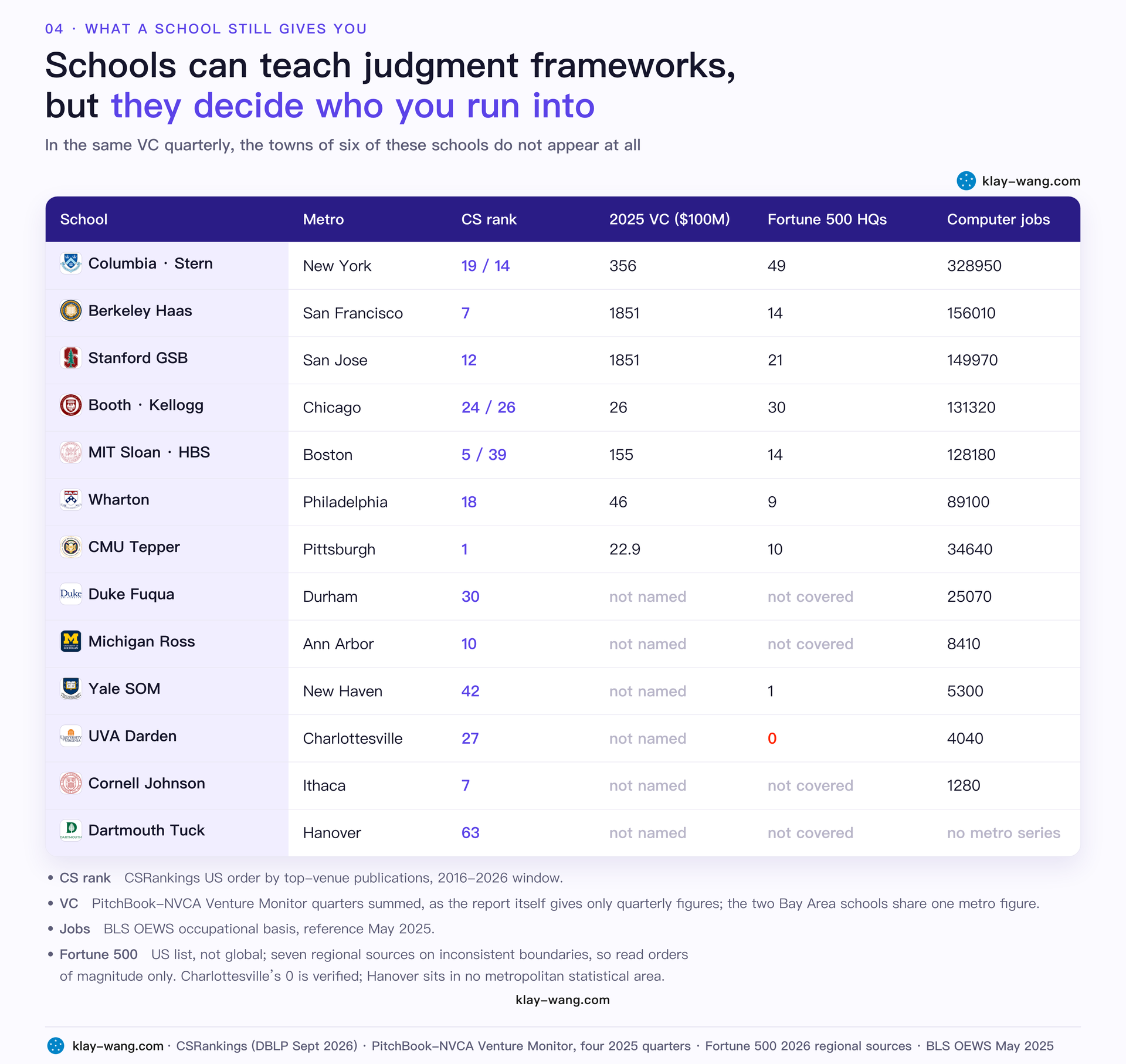
At least two of these four data sets will mislead you depending on how you measure.
The first is jobs. This column has to be measured by occupation; measuring by industry will fool you. The BLS information sector classifies employers by their main line of business, so Amazon counts as retail, and software engineers at banks and hospitals don't count at all. By industry, Seattle's information sector is only 6.16% of local employment, behind San Francisco's 9.18% and San Jose's 8.29%. By occupation, Seattle has 194970 computer jobs, more than San Francisco's 156010 and San Jose's 149970.
Same Seattle, different method, and it goes from last of the three to first.
The college-town numbers have a similar problem. The percentages above use the BLS QCEW basis. CES counts public university staff as government, while QCEW counts them as education and health. The same Charlottesville is 32.6% government under CES and 42.4% education and health under QCEW; pick the wrong one and the conclusion flips.
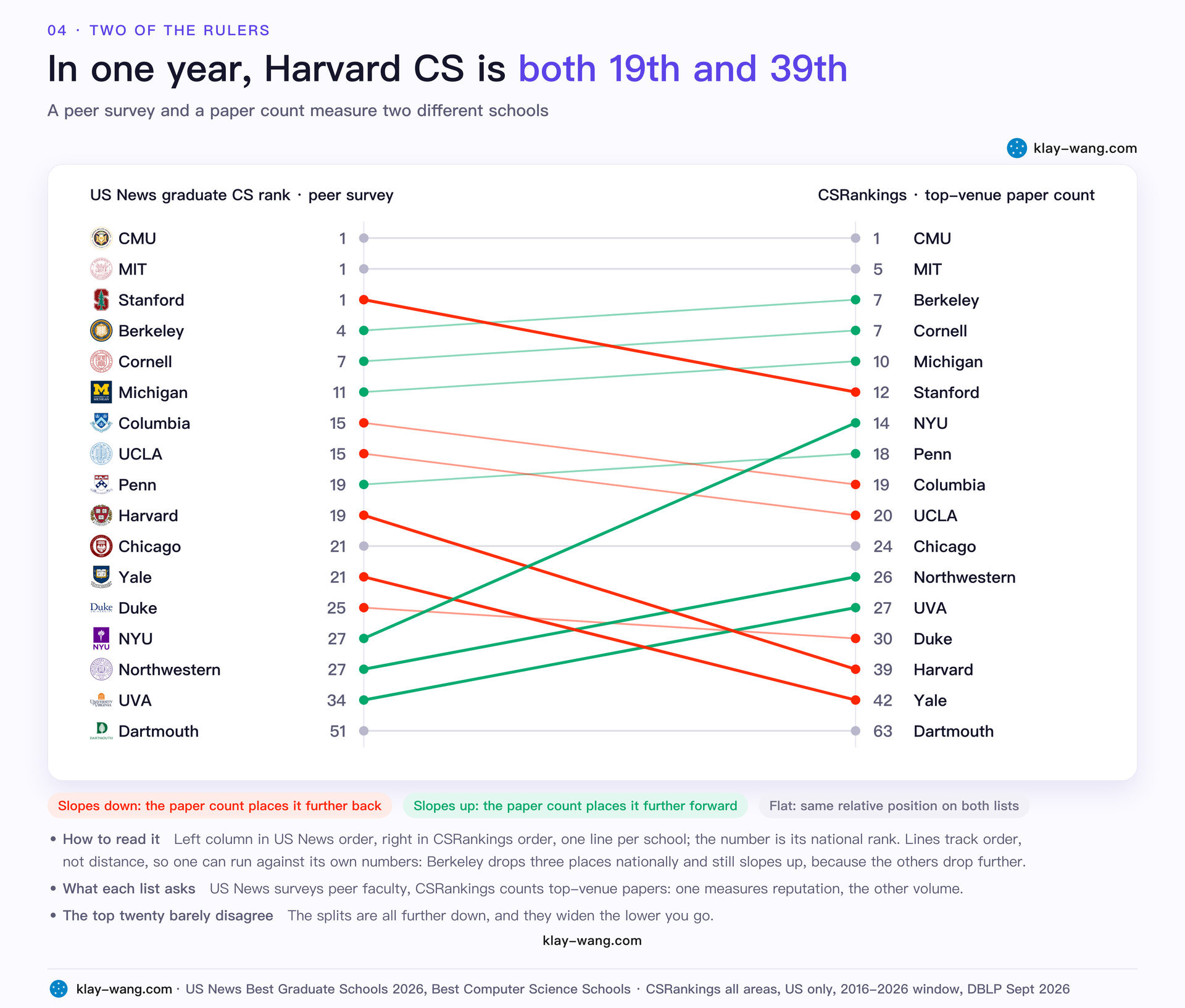
The second is rankings, and there are three different yardsticks.
CSRankings counts papers at top conferences over a ten-year window: CMU 1st, MIT 5th, Stanford 12th, Harvard 39th, Yale 42nd. The US News graduate CS ranking is a peer-reputation survey: Stanford, MIT, and CMU tied for 1st, Berkeley 4th, Harvard 19th. And in the 2027 Best Colleges undergraduate ranking US News released on September 22, 2026, MIT is No. 1 overall for the first time, ending Princeton's run at the top that began with the 2012 edition, while also ranking first in undergraduate engineering, computer science, and economics.
The same MIT gets three different spots on three lists: 5th, tied for 1st, and 1st.
The two rankings measure different things. The US News rank comes from a survey and measures the impression faculty at other schools have; the CSRankings rank looks at how many papers were published at top conferences over ten years. One is reputation, the other is output. And output tracks headcount: on the CSRankings roster, Stanford CS has 84 people, 61 of whom published in those ten years; CMU has 274 and 184, three times Stanford. So if you're looking for an advisor or people in the same lab, look at CSRankings; if you want a title that people will recognize, look at US News.
The 2027 edition added a metric called Earnings by Major, which measures graduates' earnings four years out by major, using the Department of Education's College Scorecard data. It's worth 5% of the total score and replaced the old graduate debt metric. The yardstick for a degree went from how much students owe to how much they earn.
Princeton losing a top spot it held for more than a decade and the ranking switching yardsticks happened in the same year. How much the new metric contributed hasn't been broken out publicly.
There's another layer we haven't been able to find yet. Of the seventeen schools, only seven publish their CS department's enrollment and faculty headcount online, mostly public universities; Michigan lists 2666 undergraduates, 609 graduate students, and 96 core faculty. For the best-known private schools, the size can't be found. So for now these rankings can't be adjusted per capita.
So location matters a lot more in 2026 than it did in 2016.
The reason isn't hard to see. Once getting the work done gets cheap, what's valuable is understanding an industry, and that understanding can only be built inside a specific industry. The ontology map Ghodsi described can only grow inside a real company; you can't read it in a library. YC's hard tech going from 8% to 20% and robotics from 1% to six or seven percent point to the same thing: money is moving toward the physical world, domain expertise, and real data, and all three live somewhere specific.
And the industry doesn't have to be tech. Detroit's autos, Pittsburgh's robotics and health care, North Carolina's pharma all count. Chicago is a good example: only $2.6 billion in venture capital, the least among the top ten tech metros, yet 30 Fortune 500 headquarters, in the top tier nationally. The industry experience an MBA student wants, Chicago has, just not in tech.
But the Bay Area is still the Bay Area. In the Bay Area, a student can sit in class in the morning, drive forty minutes in the afternoon to meet a VC or look for a co-founder and build a team, then have dinner in some big tech company's building before heading back to campus. In one day they touch collaborators, capital, industry, and job opportunities.
The four data sets above all measure how much there is; they can't capture that kind of convenience. Among the cities these seventeen schools are in, I count only three where you can live a day like that: San Francisco (the Bay Area), New York, and Boston, and their strengths happen to be three different fields: software, finance and media, and biomedicine and hardware.
In October 2025, Wharton signed a long-term lease on a five-story building at 555 California in San Francisco's Financial District, about 80000 square feet, more than double its previous footprint, its first standalone campus in San Francisco. The counterexample: Northwestern decided to close its San Francisco campus in spring 2026. Kellogg's building is gone, but Kellogg's San Francisco Immersion remains; students still go to the Bay Area for the winter quarter and intern at VCs or VC-backed companies. Even the school that pulled out only saved on rent; the students themselves still have to physically go to the Bay Area.
A course catalog can be copied; this radius can't. That holds for CS153's speaker list, and it holds for Bay Area business schools too.
05 Already concentrated, or getting more concentrated?
Everyone says AI lowered the bar for starting a company, but in reality it hasn't. Opportunity hasn't spread out along with AI. Four unrelated data sets all show the top taking the lion's share.
In 2025 the Bay Area took $185.1 billion of a national $339.4 billion. On PitchBook's 2026 ranking of MBA founders, companies founded by alumni of Harvard, Stanford, and Wharton have raised $330.6 billion in total, while the seventeen schools ranked 4th through 20th add up to $329.9 billion: the top three equal the next seventeen combined.
Endowments in fiscal 2025: Harvard $56.9 billion, Yale $44.1 billion, Stanford $40.8 billion, $141.8 billion for the three, versus $119.6 billion for the next eight combined; Harvard alone is 6.3 times Dartmouth. In July 2025, Brookings sorted 387 US metro areas into six tiers. The top tier, Superstars, has just two, San Francisco and San Jose, and the top 30 metros account for two-thirds of AI job postings nationally.
All four are concentrated at the top, just measured in different units, cities, alumni, schools, metros, which don't stack into a single map.
That said, endowment concentration was built over decades, and Harvard's $56.9 billion has nothing to do with AI. The geographic concentration of venture capital and of funding raised by alumni-founded companies looked like this before AI, too, and that is exactly the head start these schools carry into the AI era.
Only two of these have a time dimension. One is the Bay Area's share of US venture capital: 54.5% for all of 2025, 77.5% for the first half of 2026. The other is SignalFire's new-grad hiring, 65% to 76% below 2019.
The bar came down, but it didn't flatten the distribution, and on the two measures that have a time series, concentration is still rising. Whether the middle is being hollowed out, all we can see so far is the shape of the distribution; it needs more watching and checking.
The difference between doing small things and big things is worth a word. AI lets a three-month-old company reach seven figures in annualized revenue; that's YC talking. AI has also turned frontier models into a game that takes billions of dollars of compute; that's true too. Both are true. The difference is: how big a thing are you planning to do?
The number of venture deals gets closer to what you actually want to know; behind the Bay Area's 2702 deals is a crop of companies that just raised money. But PitchBook counts financing transactions, and hiring needs numbers like SignalFire's. Raising money doesn't mean hiring; the money may go to compute, acquisitions, or just staying alive, and one company can raise twice in a year.
Solo founders are on the rise, but that doesn't mean you'll never need people; the point where you need them has just moved later. You don't have to wait for the team before you start, but halfway through, you still have to find the right person. The question is how likely you are to run into them within a year, not how many CS professors the school has.
06 Measure only software, and you misread a set of schools
The four data sets above, collaborators, capital, industry, and jobs, all measure how close a city is to software. Using only that one yardstick may be a little one-dimensional.
Take Dartmouth. By the location data, it's weak on all four: Hanover doesn't even have an OEWS computer-jobs series. Yet 41% of its class of 2025 went into consulting and 27% into finance; nearly 70% took a path that has nothing to do with whether there are programmers nearby.
Second is Cornell. Ithaca's 1280 computer jobs are the fewest of all seventeen, yet likewise more than 40% of its graduates went into finance. Cornell's path leads to New York.
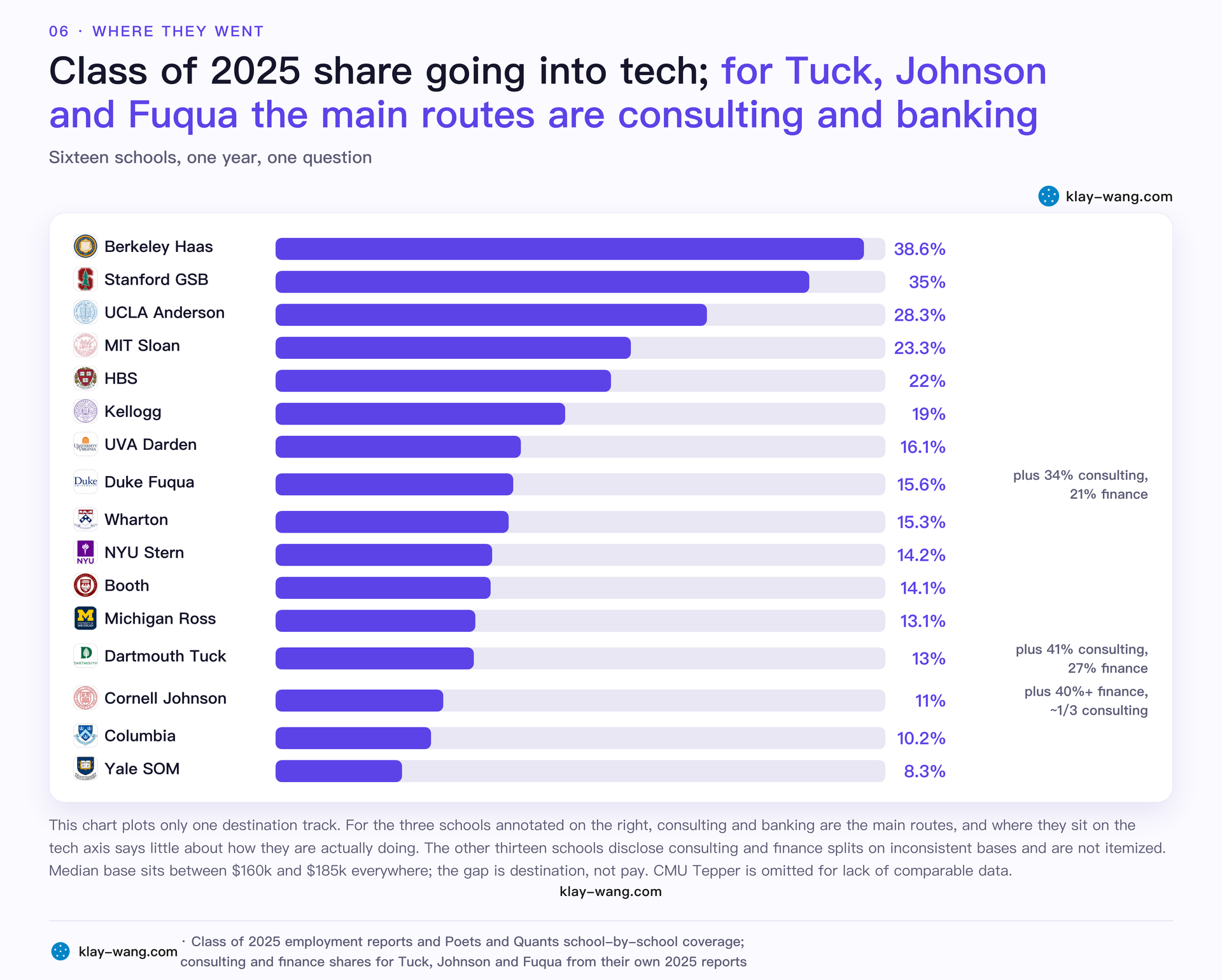
Third is treating tech as the same thing as CS.
AI rewrites any industry with lots of repetitive judgment and lots of data, and biomedicine has both: protein structure, drug discovery, clinical trial design. That's where AI has landed hardest these past few years.
NIH funding in fiscal 2025: Michigan $724 million, 4th nationally; Penn $723 million, 5th; Yale $680 million, 6th; Stanford $644 million, 8th; Duke $624 million, 10th; Columbia (medical) $594 million, 11th; UCLA $516 million, 15th. Further down: NYU School of Medicine $438 million, 19th; Northwestern's Chicago campus $406 million, 21st; Weill Cornell Medicine $317 million, 29th; the University of Chicago $274 million, 37th; the University of Virginia $231 million, 45th.
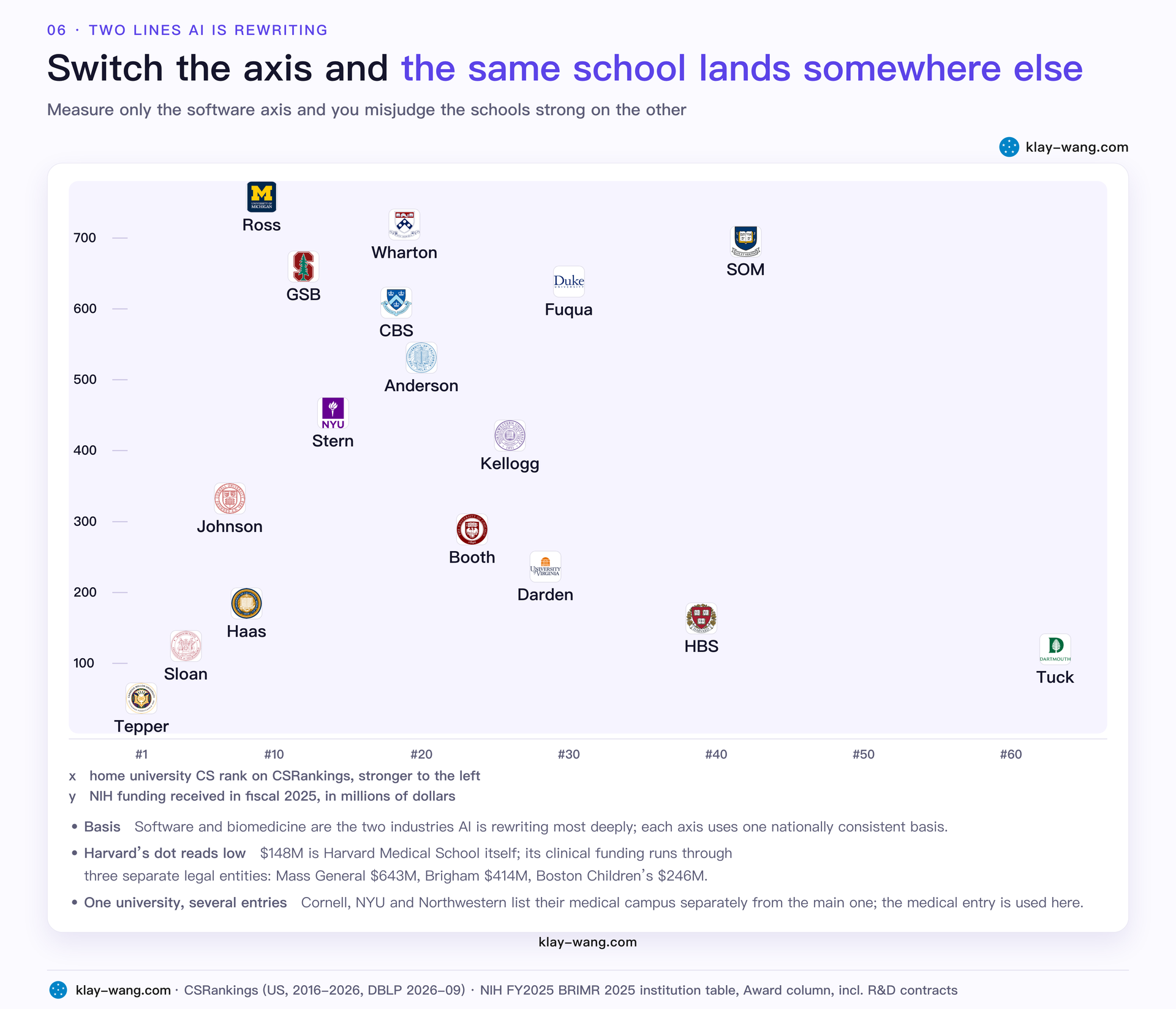
Yale's CS ranks 42nd on CSRankings, and only 8.3% of its class of 2025 went into tech. By CS rank it's second to last among the seventeen, ahead only of Dartmouth; by share going into tech it's last. On the NIH dimension, it's 6th in the country. Both numbers are true.
CMU, MIT, Berkeley, and Dartmouth are all on that list too, just outside the top fifty; the first three have in common that they lack their own medical school and affiliated hospital system. Harvard is a measurement trap. Harvard Medical School itself ranks 63rd with $148 million, which looks unimpressive, because Harvard's clinical funding flows through its affiliated teaching hospitals: Massachusetts General Hospital 9th at $643 million, Brigham and Women's 20th at $414 million, Boston Children's 42nd at $246 million. But NIH treats those three as separate award recipients, so adding them up and comparing the total to Johns Hopkins alone mixes different institutional boundaries; that sum can't be used as a ranking.
Ranked institution by institution, Harvard sits low; measured by what the labs around Boston are actually doing, its scale gets chopped up by this list. Add this dimension and the seventeen schools fall roughly into four groups.
On the NIH dimension, every university behind the seventeen schools has a number, but the same university often appears as several separate entities: Weill Cornell in New York and the main campus in Ithaca are two entries, and so are NYU and Northwestern. Below, I consistently use the medical entry, because this dimension measures clinical and biomedical work.
Group one: dense local industry. GSB, Haas, CBS, Stern, Anderson, HBS, Sloan, Booth, and Kellogg are in CompTIA's top ten US tech metros; the other eight are outside it. Students in this group don't have to wait until graduation; they get firsthand exposure while still in school.
Group two: thin local opportunity, but an alumni network that carries people out. Tuck and Johnson are the cleanest examples. Hanover doesn't even have a computer-jobs series and Ithaca has only 1280 jobs, yet one sends nearly 70% of its students into consulting and finance and the other sends more than 40% into finance. What they sell is a pipeline built over decades that sends students into consulting and finance; local opportunity was never the selling point.
Group three: weak on tech, strong on medicine. NIH funding reflects the size of a university's medical system: Wharton (Penn, 5th), Ross (Michigan, 4th), Yale SOM (Yale, 6th), Fuqua (Duke, 10th), plus Darden (UVA, 45th). None of them are in the top ten tech metros, but their universities are all in the national top fifty on biomedicine.
Group four: one standout strength. CMU has the best CS in the universe, with a CSRankings count of 21.0; the runner-up doesn't reach 60% of that. But CMU has no medical school and no law school, and Pittsburgh has only 34640 computer jobs.
Technology can grow locally while decision-making power and capital stay somewhere else. Argo AI grew out of CMU's talent pool; Ford and Volkswagen put in billions of dollars, it peaked at a $12.4 billion valuation, and in 2022 both stopped investing and the company shut down. Of its two thousand people, the city couldn't absorb many locally. On September 30, 2026, Citadel founder Ken Griffin announced a $3 billion gift commitment to CMU: $1 billion for CMU's Pittsburgh campus and $2 billion to build a new CMU Miami campus. Miami is where Citadel moved its global headquarters in 2022, and CMU's explanation is that information technology and finance are more concentrated there, which can bring faculty and students different partners. Laurence Ales, interim dean of the Tepper School of Business, said you would think a venture capitalist can invest anywhere, but geographic distance plays a role; it's a relationship business.
Darden shows best what this dimension changes. Charlottesville has zero Fortune 500 companies, no name in the venture reports, and 4040 computer jobs; by the first four measures it's the weakest of the seventeen. Yet UVA's NIH funding is $231 million, 45th in the country.
Zoom out, and four of the seventeen aren't full universities. MIT and CMU have no medical school and no law school, Berkeley has no medical school, Dartmouth has no law school. The other thirteen, Stanford, Harvard, Yale, Penn, Columbia, NYU, Northwestern, Chicago, Duke, Cornell, Michigan, UCLA, and Virginia, have all five, business, law, medicine, CS, and engineering, though Chicago's engineering school, the Pritzker School of Molecular Engineering, only arrived in 2019, starting late and narrow.
AI won't rewrite just one industry; it will rewrite them one after another, and a school with broad coverage gets another opening each time.
But there's a ready counterexample: the 2027 undergraduate ranking mentioned in the previous section. MIT is No. 1 overall, and it has no medical school and no law school. Beyond those three firsts, it also ranks first in the combined category of biological computing, bioinformatics, and biotechnology, tied with CMU.
MIT took a different road. It didn't spread itself across every field; it made the few it has cross over with each other. With no medical school, it still claimed the computational half of biology. So having fewer fields isn't necessarily a disadvantage, but it takes cross-disciplinary work between them to make up for the gaps.
There's one more dimension. Dartmouth's undergraduate college is a traditional Wall Street target school: banks come to recruit on campus every fall, the school runs treks to New York, and its alumni network is famously tight even by Ivy League standards. Tuck's MBA plugs into that network. It has nothing to do with CS rankings, nothing to do with how many programmers are nearby, nothing to do with NIH funding. It was built over decades by people picking up each other's calls, and whether an alum picks up your call depends on whether they see you as one of their own.
Bourdieu called this social capital. It takes time, can't be bought, and can't be copied in a semester. No public data set measures it, but not being measurable doesn't mean it doesn't exist. It may be the dimension where these seventeen schools differ most, and the one AI will find hardest to move.
Where these seventeen schools land in the AI era depends on which industry each one has bet on, and when that industry's turn comes.
07 What alumni can do for you
Beyond schools, cities, and money, there's one group that hasn't been counted: alumni. Countries, organizations, universities, companies: all of them rise and fall on people.
A top school, especially HYPSM (Harvard, Yale, Princeton, Stanford, MIT) and the Ivies, doesn't stand alone. Behind it are the CEOs, partners, founders, professors, and trustees who walked out of a history more than a century long. For them, their alma mater isn't just the past tense; it's a credential still in circulation. The stronger the school, the more that line on their résumé is worth; if the school keeps declining, that credential gets marked down with it. Beyond that self-interest, there's identity, reputation, and the wish to leave something for the next generation.
Right now they sit on both sides of the table. On one side, they donate, provide compute, endow chairs, bring their companies' real projects into the classroom, and sit on boards telling the school what's happening in industry. On the other side, they're buyers: they offer internships and jobs, keep campus recruiting going, become customers for student startups, and keep trusting their alma mater's screening when hiring standards get murky.
Funders, advisers, channels, and customers are the same group of people, and that's the hardest thing to copy about a top school. Open courses and AI tutors can copy the curriculum, but they can't copy this flywheel that has been turning for more than a century: the school has a reputation, so it attracts better students; graduates rise to higher positions; those people send back money, information, and opportunities; the school uses those resources to train the next class; the reputation keeps growing. Alumni helping each other works the same way VCs pull each other into club deals.
What AI may be choking off is the middle link: graduates rising to higher positions.
But you have to separate things here, because these seventeen are business schools, not CS departments. On the tech path, entry-level roles are only 4.5% of software development jobs, and the people in senior roles today worked their way up from the entry-level cohort of ten years ago. On the consulting and banking path, the evidence points the other way: Bain is up 25%, McKinsey up 12%, and eight investment banks aren't cutting analysts.
So the loop looks different depending on where graduates go. The end that sends students into tech is narrowing; the end that sends them into consulting and banking isn't, for now. Which end matters more for where a business school stands in ten years, we can't tell yet.
What today's alumni can do is use donations, hiring, and industry resources to temporarily patch the narrowing end. If it works, the top schools' advantage grows further. If it doesn't, if the school relies only on older alumni without producing a new generation of winners, the loop will slowly lose speed over ten or twenty years. So top schools, like big companies, aren't safe because of this; they just have one more chance than others to save themselves. Whether they can depends on the following.
First, willingness. Everyone with a degree holds that credential, a big tech VP, an investment bank MD, a founder, a trustee, and none of them want their alma mater's degree to be worth less ten years from now.
Alumni really only have four things to give: money, jobs and internships, time and connections, and the endorsement of their reputation. And what schools are short on right now is people who can assess students, and a good location.
Money can be turned into people who assess students, but at a bad exchange rate. The Berkeley money from part one is a reference point: $252 million to start, plus three more gifts totaling $75 million, over $300 million in all, most of which became a building, with two new faculty positions tied to it in the official materials. Money can endow chairs, but a permanently endowed chair locks up a large principal that can only ever fund that one seat. The $500 million gift commitment CMU's School of Computer Science received in September lists directions including redesigning how computing is taught, GPUs and other compute, AI tools, and support for students. How much goes to each isn't specified, and how much of it will become teaching and assessment staff isn't said either.
Jobs are difficult in a very specific way. An alum who is a VP at a big tech company used to help their alma mater most concretely by pushing for a few more new-grad headcount each year. If big tech sharply cuts new-grad hiring, the slots that alum can steer shrink with it. The thing alumni most want to give, and can most easily give, is exactly the thing AI may be squeezing.
Going forward, the scarcest thing alumni can give students, beyond a job, is a real apprenticeship: time with customers, handling exceptions, sitting in on post-mortems, and owning a small piece of the outcome.
There's another mismatch: the way people give doesn't match what schools are short of. A building can carry a name; a TA's salary can't. Oral exam time, proctoring staff, in-person questioning: all of it is recurring spending, every year, every month, cash flow with no ribbon-cutting, and that operating budget is exactly what schools lack. Buildings and equipment are easier to see, name, and count, and they stand out more in press coverage.
Twelve of the seventeen schools are named after a single donor or their foundation: Wharton, Booth, Kellogg, Sloan, Haas, Stern, Anderson, Ross, Tuck, Johnson, Fuqua, Tepper. The price of a name also tells you something about time: J.B. Fuqua gave $10 million in 1980 and Duke's business school became Fuqua; Tepper gave $55 million in 2004; that same year Ross gave $100 million. In twenty-four years, the price of a name went up tenfold. The naming money didn't all go into buildings, either: Ross gave another $50 million in 2017, and the school's published breakdown put only $10 million into campus construction, $16 million into faculty support, and $8 million into a student investment fund.
The names of business schools are a rich list from the past.
What's harder than money is that a university receives resources from individuals, and to really use them, they have to become something the school can keep doing year after year, and that's the step that most often gets stuck. Inviting a CEO to give a talk is easy; embedding their company's real project into a course, staffing it with TAs, designing the assessment, and rerunning it every year is another matter. Receiving a gift isn't the end; turning it into faculty, compute, assessment, and opportunities for students is the beginning. And many gifts come with restrictions, so the school may not be able to redirect them to what most needs doing.
Garry Tan said the same thing earlier. An organization that can't turn what worked into something it can call on again and again wakes up every morning with amnesia, no matter how good the model is. Universities are the oldest example of that rule. When a lecture ends, whatever that CEO brought leaves with them; only the part written into courses, internship pipelines, and recruiting relationships stays.
The last generation's winners, coming back to help, may end up preserving exactly the last generation's model of success. How much of the experience of someone who rose on a twenty-year-old path still applies today, nobody can say. Alumni can push a school to change, or be the old system's most solid supporters. And they tend to care more about rankings, naming, and reputation, while what schools really need to change is curriculum, assessment, and faculty incentives, none of which come with a ribbon-cutting.
The same goodwill pays out differently in different places. Alumni of Bay Area schools work at Bay Area companies, so the job, internship, or coffee they offer pays off locally on the spot. Alumni of schools in weaker locations naturally have less to offer locally, because there just aren't as many companies there; the jobs they offer are in other cities, and introductions may happen elsewhere too. That helps students; it does nothing for the local industry.
So alumni won't make money and opportunity any less concentrated. The 6.3x gap between Harvard's $56.9 billion and Dartmouth's $9 billion was compounded over decades from donated principal and long-term investment returns. With enough money, you really can do a lot of what you want.
There's a lot alumni can do: endow chairs, build research centers, fund startup funds, give scholarships, bring company courses in, set up data partnerships. Two of those relate to location: bring industry here, or send students out. One of them has always worked, and it happens to be what schools in weaker locations do.
The first is hard. Argo AI is the textbook case: the technology grew in Pittsburgh, the decision-making power and capital were somewhere else, and once the two automakers pulled their money, the company was gone. But Pittsburgh's robotics companies didn't vanish with it; the cluster around NREC is still there. So what Argo proves is that a single company can't survive outside capital pulling out, not that an industry can't be brought in.
The second has always worked. Tuck's class of 2025 sent 41% into consulting and 27% into finance, and Johnson sent more than 40% into finance, while Hanover and Ithaca turn up zero times in the six venture reports. That shows these two schools have built a cross-regional employment pipeline. The pipeline moves people out; it doesn't move industry in. A third path is the one CMU's Miami campus is about to try: the school itself goes to another city. Under the current plan, pending regulatory approval, it will admit graduate students first in 2028 and undergraduates four years later. Whether that path works will depend on whether it can fill the nearly 300 faculty positions it has planned.
When judging whether a school is safe, the number of famous alumni is the easiest thing to count and the least informative. I think the key is whether alumni goodwill turns into things the school actually does. Is that alum CEO showing up once or staying involved? Did the money go into a building or into faculty and courses? Are alumni giving advice, or real projects and jobs? Has the school changed how it trains and assesses students in response to industry feedback, and does any of that show up in where graduates end up?
This argument has a condition that would overturn it. If in the next three years some school in a weaker location uses its alumni to anchor a real industry locally, enough to actually move that city's venture deal count and Fortune 500 headquarters count (a donated building doesn't count), then this may need to be reassessed. The CMU Miami campus can't test this, since it's a new campus somewhere else; it says nothing about whether industry can be anchored around CMU's Pittsburgh campus. No such example has appeared yet.
People who give to their alma mater are rarely making an investment decision. Mostly they're paying back what they feel they owe, or trying to spare today's students some of the detours they took. But what schools need right now can't be bought with donations. The largest single gift by an individual in the history of American higher education came from someone who isn't a CMU alum. Griffin went to Harvard, has funded CMU through Citadel since 2015, and CNN described the gift as part of his bet on Florida. He will also join CMU's board of trustees.
AI has lowered the barrier to knowledge, but it may raise the barrier of trust and relationships. The teaching value of a school is being repriced, and the alumni networks of the top schools may be worth more because of it. Only one question remains: whether schools can actually put these alumni resources to work.
08 What it means for you
If you work at a big company, don't just look at how many AI tools your company has deployed; look at whether the layers have moved. Layers not moving doesn't mean nothing is happening; it may still be stuck at organizational inertia, at the level of efficiency, quality, or delivery time. Which roles have stopped shuttling information, who holds final sign-off, which teams have turned something that worked once into something they can call on again and again: these are what matter more. You can also check yourself: how much of your day goes to gathering what's happening below, compressing it into one page, and passing it up? The more it is, the more at risk you may be.
If you're in finance: writing memos faster won't protect you; the model is faster than you. What matters is how close you are to the trades, the clients, and the risk-taking. The eight investment banks told Reuters they aren't cutting analysts because AI-generated models and pitchbooks can't yet be handed directly to a CFO; the whole weight of that sentence rests on the word handed. Without a chance to pull the trigger, even the most elegant analysis can't become judgment.
If you're building a company, look first at the customer's budget and cash flow. Only when someone is already paying for that piece of work do you have a chance to take over the whole task; YC's end-to-end share going from 10% to more than 25% is about exactly this. Your contract also has to spell out who's responsible when something breaks, which now matters far more than which model you pick. And the hard-tech number going from 8% to 20% deserves a serious look: if your industry experience grew somewhere with a physical world, regulation, and real data, that's exactly where people are most needed right now.
09 Final thoughts
The question we left open in part one was which kind of proof the market is buying. It doesn't really buy either. It buys what sits outside the proof: judgment, context, and someone who takes responsibility when things go wrong.
Investors, company leaders, and a top accelerator, from three different positions, are saying the same thing. Once the gap in who can do the work shrinks, the gap in who has experience shows.
As for whether management layers or entry-level roles get cut first, the data we have points to entry-level roles. The work that used to train new people may be going to AI. That's bad news for new grads and good news for people with twenty years in, and neither group happens to be the person pictured in business school and CS department brochures.
Over the next two or three years, I think four numbers will tell whether this argument holds:
First, whether the solo-founder share levels off around 20% or keeps climbing. If it keeps climbing, the idea that you don't need a full team to start is still advancing. Second, whether entry-level roles' share of software development jobs recovers from 4.5%. This is the most consequential number in the whole piece; if it doesn't recover, the senior engineers of ten years from now become a debt nobody claims. Third, whether the Bay Area's share of US venture capital falls back from 77.5%. It has to keep falling across several funding cycles to shake the Bay Area's geographic advantage; over just a quarter or two, a drop may only mean those few mega-rounds dropped out of the base. Fourth, whether a school outside the Bay Area can show that online access delivers opportunities of the same quality as being there in person.
One more thing matters a lot, and there's no room for it here, so the next piece is about it: when one middle manager can run ten agents, and the work new hires used to learn on goes to machines, will companies get smaller and flatter, or will power just concentrate in fewer hands?
What Berkeley protects with pen and paper and what YC pays for are the same thing: judgment that can't be replaced, and trust that can only be built over time.
These two pieces counted a lot of tables: course catalogs, rankings, funding, jobs, metro areas. But under every cell is a person. A teacher who decided to put exams back on paper, a department chair who wouldn't expand their department, a sixty-year-old still writing checks to their alma mater, a new grad who just found out the path their seniors took is gone. AI replaces the tools; the ones running this system, taking part in it, and getting swept up by it are, from start to finish, people.
One last line from Garry Tan: the model's ability is rented; your own brain is yours. That holds for companies, and it holds for people; and which city that brain grows up in matters more than which school.
If you're at any of these seventeen schools, or making this choice for someone, I'd love to know which of these you'd look at first.
Data appendix
Venture capital in 2025 (sum of four quarterly PitchBook-NVCA Venture Monitor reports; totals are my calculation): Bay Area $185.1 billion / 2702 deals, New York $35.6 billion / 1809 deals, Los Angeles $17.5 billion, Boston $15.5 billion, Seattle $6.5 billion, Philadelphia $4.6 billion / 575 deals, Chicago $2.6 billion / 311 deals (Crain's citing the PitchBook-NVCA basis), Pittsburgh $2.29 billion (of which institutional venture capital was $2.06 billion / 63 deals, from the fourteenth annual Innovation Works and EY report). New Haven, Charlottesville, Hanover, Ithaca, Ann Arbor, and Detroit appear zero times across the six reports.
Fortune 500 headquarters (the official metro breakdown was discontinued in 2026; the figures below come from seven regional sources with seven different methodologies, so read them only for order of magnitude): Chicago 30, New York 49 (counting Connecticut separately; 62 for the larger combined statistical area), San Jose 21, San Francisco 14, Boston 14, Pittsburgh 10, Philadelphia 9, New Haven 1, Charlottesville 0.
Computer jobs (BLS OEWS, occupation basis, reference period May 2025): New York 328950, Seattle 194970, San Francisco 156010, San Jose 149970, Chicago 131320, Boston 128180, Philadelphia 89100, Pittsburgh 34640, Durham 25070, Ann Arbor 8410, New Haven 5300, Charlottesville 4040, Ithaca 1280. Hanover isn't in any metropolitan statistical area and has no series; the nearest available figure is Manchester's 9210.
CSRankings US institution ranks (all areas, 2016 to 2026 window): CMU 1, MIT 5, Cornell and Berkeley tied 7, Michigan 10, Stanford 12, NYU 14, Penn 18, Columbia 19, UCLA 20, Chicago 24, Northwestern 26, UVA 27, Duke 30, Harvard 39, Yale 42, Dartmouth 63.
Educational services plus health care and social assistance as a share of QCEW-covered jobs (BLS QCEW, March 2026; counts jobs, not people, so multiple jobholders are counted for each job): Ithaca 52.0%, Hanover 43.1%, Charlottesville 42.4%, New Haven 38.8% (including 30176 jobs in private educational services).
NIH funding FY2025 (BRIMR institution table, Award column, in hundreds of millions of dollars, national rank in parentheses): Michigan 7.24 (4), Penn 7.23 (5), Yale 6.80 (6), Stanford 6.44 (8), Duke 6.24 (10), Columbia medical 5.94 (11), UCLA 5.16 (15), NYU School of Medicine 4.38 (19), Northwestern Chicago campus 4.06 (21), Weill Cornell 3.17 (29), Chicago 2.74 (37), UVA 2.31 (45). Harvard Medical School 1.48 (63), with its teaching hospitals counted separately: Massachusetts General 6.43 (9), Brigham and Women's 4.14 (20), Boston Children's 2.46 (42). Berkeley 1.46 (66), MIT 1.34 (70), Dartmouth 1.04 (81), CMU 0.35 (176).
Endowments FY2025 (NACUBO-Commonfund basis): Harvard $56.9 billion, Yale $44.1 billion, Stanford $40.8 billion, Penn $24.8 billion, Michigan just over $20 billion, Columbia $15.9 billion, Northwestern $15.2 billion, Duke $12.3 billion, Cornell $11.8 billion, Chicago $10.6 billion, Dartmouth $9 billion.
Sources
YC: Lightcone podcast, The State of Startups in 2026, Y Combinator official YouTube, 2026-09-17, https://www.youtube.com/watch?v=yslXlV2BP_Y . The line knowing what to build is becoming more important than simply knowing how to build it, and the section title about experienced founders coming back, come from the episode's official description and chapter list, not from any one guest speaking. All other quotes come from the episode. Titles for Diana Hu and Jared Friedman per https://www.ycombinator.com/people and the YC blog, 2026-06-11. Ali Ghodsi: a16z podcast with Martin Casado and Sarah Wang, 2026-09-18, https://www.youtube.com/watch?v=GzEtpAKYRvE . The video circulates under two titles; go by the link and date. Garry Tan: Every company should have a Brain, AI Engineer World's Fair, AI Engineer official channel, 2026-07-17, https://www.youtube.com/watch?v=eBUyTS7SzV4 . Note that his 2026-08-06 talk at YC Startup School overlaps in content but differs in wording; everything quoted here is from the July talk. Macro data: Indeed Hiring Lab 2026-07-23; SignalFire State of Talent 2026-06-22; Stanford Digital Economy Lab, Canaries in the Coal Mine, revised 2026-08-12; FRED series IHLIDXUSTPSOFTDEVE through 2026-09-11; blog.google 2026-04-22. Pittsburgh: TechCrunch 2022-10-26 and Smart Cities Dive (Argo AI's shutdown, Ford and Volkswagen pulling investment, about two thousand employees, $12.4 billion peak valuation); The Robot Report citing Aurora CEO Chris Urmson; CMU Tepper 2022-23 MBA employment report, geographic breakdown. Campuses: Poets and Quants 2025-10-23 (Wharton's new campus at 555 California) and 2025-05-02 (Northwestern closing its San Francisco campus, Kellogg SF Immersion continuing); executivemba.wharton.upenn.edu San Francisco campus page; kellogg.northwestern.edu San Francisco Winter Quarter page. Finances: NACUBO-Commonfund Study of Endowments FY2025 (FY2025 market value, $944.3 billion across 657 participating institutions); individual FY2025 endowments via the NACUBO basis; NSF NCSES Higher Education Research and Development Survey FY2024 (US higher education R&D spending of $117.5 billion, 55% federal, about 25% institutional); Stanford FY2025 sponsored research revenue and federal share from facts.stanford.edu; NIH funding FY2025 from the Blue Ridge Institute for Medical Research (BRIMR) 2025 institution table, titled All Funded Institutions including R&D Contracts, which includes R&D contracts and is built on NIH RePORT FY2025 year-end data, Award column, https://brimr.org/brimr-rankings-of-nih-funding-in-2025/ , file Institution_2025.xlsx, downloaded and checked 2026-09-27. The same university can appear as several entities in the table; this piece uses the medical entry and lists affiliated teaching hospitals separately. Location: CSRankings (all areas / US only, 2016–2026 window, DBLP September 2026 data, read live in a browser 2026-09-22); US News Best Graduate Schools 2026, Best Computer Science Schools (peer-reputation survey, graduate level); US News Best Colleges 2027 undergraduate ranking, released 2026-09-22 (MIT No. 1 overall for the first time; new Earnings by Major metric worth 5% of the total, replacing the graduate debt metric, sourced from the Department of Education's College Scorecard); PitchBook-NVCA Venture Monitor, four 2025 editions plus 2026 Q1–Q2; Innovation Works and EY fourteenth annual Pittsburgh report, 2026-03; CED 2025 NC Venture Report, 2026-02-24; Fortune 500 Explorer 2026-06-03 plus Philadelphia Inquirer 2026-06-04, Pittsburgh Business Times 2026, AdvanceCT 2026-06-04, Virginia Business 2026-08-02; BLS QCEW March 2026, CES August 2026 preliminary, OEWS May 2025; CompTIA State of the Tech Workforce 2026; Brookings, America's AI boom is concentrating in a few metro areas, 2025-07 (six-tier classification of 387 metros); PitchBook University Rankings 2026 (official site returned 403; used the Poets and Quants 2026-09-08 reprint, checked line by line). Alumni and naming: Bloomberg Philanthropies and washingtonpost.com 2018-11-18 (JHU $1.8 billion), forbes.com 2024-07-08 ($1 billion for medical school tuition); news.stanford.edu 2016-02-23 (Knight $400 million); news.umich.edu 2013 and Poets and Quants 2017-09-20 (the three Ross gifts); cmu.edu 2004-03-19 and cmu.edu/homepage 2013 (the two Tepper gifts); fuqua.bulletins.duke.edu school history (J.B. Fuqua $10 million, named 1980); trustees.duke.edu (Tim Cook is a Duke trustee and Fuqua class of 1988; no major gift from him to Duke was found). Naming for all twelve schools per each school's official history page; this piece gives documented amounts and years only for the three above. CMU and Griffin: the $3 billion gift commitment, the split between two cities, the size and academic design of CMU Miami, the uses and naming of the School of Computer Science's $500 million, and the funding relationship since 2015, from CMU's 2026-09-30 announcement https://www.cmu.edu/news/stories/archives/2026/september/carnegie-mellon-university-announces-historic-3-billion-gift-from-ken-griffin-pioneering-a-new-model , the School of Computer Science announcement https://www.cmu.edu/news/stories/archives/2026/september/500m-gift-will-fuel-next-era-of-computer-science-at-carnegie-mellon , the CMU Miami academic design page https://www.cmu.edu/news/stories/archives/2026/september/higher-education-gets-a-new-model-cmu-miami , and the feature on Griffin and CMU https://www.cmu.edu/news/stories/archives/2026/september/griffins-landmark-gift-will-shape-the-future-of-higher-education ; the reasons for choosing Miami and Laurence Ales's remarks from CMU's two-cities feature https://www.cmu.edu/news/stories/archives/2026/september/two-cities-one-cmu ; graduate students first in 2028 and undergraduates four years later from Reuters 2026-09-30, reprinted by whtc.com https://whtc.com/2026/09/30/citadels-griffin-donates-3-billion-to-carnegie-mellon-with-plans-for-miami-campus/ ; Citadel's 2022 decision to move its global headquarters to Miami from Griffin's memo to employees, printed in full by fortune.com 2022-06-23 https://fortune.com/2022/06/23/read-the-memo-ken-griffin-sent-to-citadels-employees-outlining-the-companys-plan-to-leave-chicago-for-miami/amp ; Griffin's 1989 Harvard undergraduate degree from https://alumni.harvard.edu/stories/legacy-for-financial-aid ; the largest single gift by an individual in US higher education from Bloomberg 2026-09-30 https://www.bloomberg.com/news/articles/2026-09-30/ken-griffin-s-3b-carnegie-mellon-donation-is-biggest-single-gift-ever ; bet on Florida is CNN's phrasing in its 2026-09-30 headline https://www.cnn.com/2026/09/30/business/ken-griffin-carnegie-mellon-donation-miami , not CMU's or Griffin's. Enrollment and hiring data in the charts: National Student Clearinghouse 2026-08 (undergraduate CS enrollment at four-year schools down 8.4% year over year, total undergraduate enrollment up 1.3%); classes.berkeley.edu (CS 61A enrollment 1269 in fall 2025, 1469 in fall 2026, capacity 1750); Karat 2026 (share of employers allowing AI in technical interviews: 38% in the US, 68% in China). The case against: Poets and Quants 2025-11-25, 2025-10-16, 2025-09-15; cityam.com 2026-06-01; Reuters Breakingviews 2026-06-29.
Comments留言